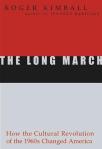
In
The Long March, Roger Kimball, the author of
Tenured Radicals, shows how the “cultural revolution” of the 1960s and ’70s took hold in America, lodging in our hearts and minds, and affecting our innermost assumptions about what counts as the good life. Kimball believes that the counterculture transformed high culture as well as our everyday life in terms of attitudes toward self and country, sex and drugs, and manners and morality. Believing that this dramatic change “cannot be understood apart from the seductive personalities who articulated its goals,” he intersperses his argument with incisive portraits of the life and thought of Allen Ginsberg, Norman Mailer, Timothy Leary, Susan Sontag, Eldridge Cleaver and other “cultural revolutionaries” who made their mark. For all that has been written about the counterculture, until now there has not been a chronicle of how this revolutionary movement succeeded and how its ideas helped provoke today’s “culture wars.”
The Long March fills this gap with a compelling and well-informed narrative that is sure to provoke discussion and debate.
Front and Back Flaps:
“The Age of Aquarius did not end when the last electric guitar was unplugged at Woodstock”, Roger Kimball writes in this controversial look at America’s cultural revolution. “The 1960s continue to reverberate in our national life today. This decade transformed high culture as well as everyday life in terms of our attitudes toward self and country, sex and drugs, and manners and morality.”
Others may think of the 1960s as The Last Good Time, but Kimball – author of Tenured Radicals, a brilliant and acerbic study of the radicalization of American universities – has no patience with such nostalgia. He sees this decade as a seedbed of excess and moral breakdown. He argues that the radical assaults on “the System” that took place then still define the way we live now – with intellectually debased schools and colleges, morally chaotic sexual relations and family life, and a degraded media and popular culture. “This inheritance has addled our hearts and minds”, Kimball writes, “and perverted our dreams while also preventing us from attaining them.”
How did we get from there to here? In the late 1960s and early 1970s, after fantasies of immediate political revolution faded, many student radicals urged their followers to begin “the long march through the institutions”. Radical philosopher Herbert Marcuse characterized this approach as working in the institutions of American life while also working against them. Kimball says that to see how well this strategy succeeded, “you need look no further than your local museum, your children’s school, your church (if you still go to church) and your workplace.”
The Long March is organized around incisive portraits of the architects of America’s cultural revolution – among them, Beat figures like Allen Ginsberg and Jack Kerouac, and celebrated or once celebrated gurus like Norman Mailer, Timothy Leary, Susan Sontag, Eldridge Cleaver and Charles Reich. In examining the lives and works of those who spoke for the 1960s, Kimball finds a series of cautionary tales, an annotated guidebook of wrong turns, dead ends, and blind alleys that, tragically, became the roadmap to the present.
For all that has been written about America’s counterculture, until now there has been no chronicle of how this revolutionary movement succeeded and how its ideas helped to provoke today’s “culture wars”. The Long March fills this gap with a witty and intelligent narrative that transforms the subject from what it was before Roger Kimball discovered it.
Amazon.com Review:
The 1960s, writes Roger Kimball, “has become less the name of a decade than a provocation.” This incisive critique of that turbulent time won’t calm the debate. The Long March will enthrall conservatives who think of themselves as culture warriors and infuriate liberals who still celebrate “the purple decade.” Kimball, managing editor of the New Criterion and author of Tenured Radicals, is one of the Right’s most articulate writers. He argues forcefully that the pernicious influence of the 1960s can still be felt: “The success of America’s recent cultural revolution can be measured not in toppled governments but in shattered values. If we often forget what great changes this revolution brought in its wake, that, too, is a sign of its success: having changed ourselves, we no longer perceive the extent of our transformation.”The Long March proceeds as a series of stimulating essays on important cultural figures and movements, beginning with the Beats. Norman Mailer comes in for an eloquent trashing (“From the late 1940s until the 1980s, he showed himself to be extraordinarily deft at persuading credulous intellectuals to collaborate in his megalomania”), as do any number of counterculture icons. I.F. Stone’s articles, writes Kimball, “read like neo-Stalinist equivalents of those multipart articles on staple crops with which The New Yorker used to anesthetize its readers.” And of The New York Review of Books, that bastion of elite liberal opinion, Kimball says: “Quite apart from the irresponsibility of the politics, there was an intellectual irresponsibility at work here, a preening, ineradicable frivolousness toward the cultural values that the journal was supposedly created to nurture.” There’s a distinctly conservative crankiness to Kimball’s writing; the jazz of Miles Davis is inevitably “drug-inspired” and rock music “was not only an aesthetic disaster of gigantic proportions: it was also a moral disaster whose effects are nearly impossible to calculate precisely because they are so pervasive.” Yet this inclination can lead to fascinating, if arguable, insights about modern American culture: “Everywhere one looks one sees the elevation of youth – that is to say, of immaturity – over experience. It may seem like a small thing that nearly everyone of whatever age dresses in blue jeans now; but the universalization of that sartorial badge of the counterculture speaks volumes.” Kimball’s writing is at once highbrow and accessible. Fans of Robert Bork’s Slouching Towards Gomorrah and Allan Bloom’s The Closing of the American Mind – or readers who have never quite believed all the English professors proclaiming Allen Ginsberg a poetic genius – will find The Long March engrossing and indispensable.
John J. Miller
Booklist Review:
Despite naming his book after Mao’s protracted war against Chiang Kai-shek, Kimball spends less time demonstrating that ’60s radicalism won its long march and became turn-of-the-millennium orthodoxy than he does denouncing the usual suspects. His targets – the Beats, Norman Mailer, Susan Sontag, liberal university presidents, the Berrigan brothers, Norman O. Brown, Timothy Leary, Eldridge Cleaver, the New York Review of Books, etc. – are relatively easy, for they were often contradictory and illogical. Recalling just how outrageous they were is a sobering corrective to ’60s nostalgia. But Kimball also scores his betes noires for sexual misbehavior, which for him means anything except conjugal rights. This obsession leads him to rope the bisexual Paul Goodman into his rogues’ gallery, even though Goodman disagreed with nearly all the others. Goodman did, however, place sex at the center of his social and psychological thought. That Kimball can’t abide, at some cost to the cogency of his rebuttal of David Allyn’s Make Love, Not War, and other wistful backward glances.
Ray Olson
Back Cover Blurbs:
“How deeply rooted are our nation’s cultural problems? What is the legacy of the 1960s? Where are America’s culture wars going? Few people take these important questions more seriously than Roger Kimball. And few write about them with such clarity and eloquence.” William J. Bennett
“I think it is terrific…We haven’t had a radical analysis like this – ever.” William F. Buckley, Jr
“Deftly and with memorable wit, Roger Kimball shows how banal and derivative, how intellectually trivial cherished Sixties icons like Susan Sontag, Norman O. Brown, Allen Ginsberg, and all the rest of the really are. Kimball is as astute as he is amusing.” John Ellis
“The extent of the cultural revolution we have lived through since the Sixties is still not clear to us, nor is its meaning. Roger Kimball has produced a searching and comprehensive study that brings it alltogether, high and low, from Herbert Marcuse to Monica Lewinsky. His well-told story is equal to the amazing event. It shows the routinization of exciting ideals, and the power and impotence of ideas.” Harvey C. Mansfield
“Roger Kimball is among our most intelligent, thoughtful, and provocative cultural critics. He also is uncommon in that he writes lucidly and persuasively.” Irving Kristol
About the Author (from the Back Flap):
Roger Kimball is managing editor of the New Criterion and an art critic for the London Spectator. He is author of Tenured Radicals: How Politics Has Corrupted Our Higher Education [and many more – JOB] and editor (with Hilton Kramer) of several books on art and politics. Mr Kimball lives with his wife and son in Norwalk, Connecticut.
JOB’s Comment:

 The Israel Lobby, by John J. Mearsheimer of the University of Chicago and Stephen M. Walt of Harvard’s John F. Kennedy School of Government, was one of the most controversial articles in recent memory. Originally published in the London Review of Books in March 2006, it provoked both howls of outrage and cheers of gratitude for challenging what had been a taboo issue in America: the impact of the Israel lobby on U.S. foreign policy.
 Mit dem Begriff Gender Mainstreaming (dt.: „durchgängige Gleichstellungsorientierung“) ist der Versuch verbunden, die Gleichstellung der Geschlechter auf allen gesellschaftlichen Ebenen durchzusetzen. Der Amsterdamer Vertrag von 1997 hat dieses Konzept auch zum offiziellen Ziel der EU-Politik erhoben. Dagegen wurde von Anfang an scharfe Kritik erhoben, die im Gender Mainstreaming-Konzept einen totalitären Kern ortet. Zu den Kritikern der GM-Politik gehört auch Barbara Rosenkranz. Die Autorin zeichnet in ihrem Buch zum einen die Entwicklung des GM nach und versucht dieses Phänomen einzuordnen. Leitend für die Untersuchung sind unter anderem folgende Fragen: Was unterscheidet Gender Mainstreaming von klassischer Frauen- und Gleichstellungspolitik? Inwieweit geht GM daran vorbei oder darüber hinaus? Wer sind die hauptsächlichen Propagandisten des GM? Wie konnte es zu der Rechtsstellung des GM kommen? Gibt es einen Zusammenhang zwischen Feminismus und Neoliberalismus? Welche konkreten Auswirkungen hat das GM auf das tägliche Leben, insbesondere in der Verwaltungspraxis und im Erziehungsbereich? Wie stark GM bereits im öffentlichen Leben verankert ist, zeigt unter anderem die Verweiblichung von Piktogrammen und Verkehrsschildern. Auch hier spürt die Autorin den Gründen für diese schleichende Veränderung im Alltagsleben nach. Die Argumente und Beobachtungen, die Rosenkranz zusammenträgt, sind alarmierend, gelingt es ihr doch, das GM-Konzept als neomarxistische Ideologie zu enttarnen, die darauf abzielt, einen neuen, geschlechtslosen Menschen zu schaffen. Grundlage ist ein behavioristisches Menschenbild, das jeglichen biologischen Unterschied zwischen den Menschen zu leugnen bestrebt ist.
 Wer die Globalisierung für ein unentrinnbares Schicksal hält, gilt als Realist, wer sie als Ergebnis zielgerichteter Politik zur Errichtung einer Neuen Weltordnung (NWO) auffaßt, als “Verschwörungstheoretiker“ – und dies ist heutzutage kein Kompliment, sondern eein Ausschlußkriterium.
 In all major regions of the world, the economic recession is deep-seated, resulting in mass unemployment, the collapse of state social programs and the impoverishment of millions of people. The meltdown of financial markets was the result of institutionalized fraud and financial manipulation. The economic crisis is accompanied by a worldwide process of militarization, a war without borders led by the U.S. and its NATO allies. This book takes the reader through the corridors of the Federal Reserve, into the plush corporate boardrooms on Wall Street where far-reaching financial transactions are routinely undertaken. Each of the authors in this timely collection digs beneath the gilded surface to reveal a complex web of deceit and media distortion which serves to conceal the workings of the global economic system and its devastating impacts on people`s lives.
 “Gender Mainstreaming” – ein Schlagwort ist in aller Munde und doch kaum fassbar. Uneingeweihte meinen, dies sei nichts anderes als die Gleichstellung von Mann und Frau. Der Journalist Volker Zastrow warnte schon 2006, dahinter verberge sich nichts anderes als eine “politische Geschlechtsumwandlung”. Worum es tatsächlich geht, will das vorliegende Buch durchleuchten und auf den Punkt bringen. In einer bisher einzigartigen Zusammenschau von Natur- und Geisteswissenschaft zerlegen der Gehirnforscher Manfred Spreng und der Religionsphilosoph Harald Seubert, das Konstrukt des Gender Mainstreaming in seine Bestandteile. Sie zeigen die geistesgeschichtlich trüben Quellen ebenso auf wie die verheerenden Folgen, denen der Mensch durch die Vergewaltigung seines natürlichen Wesens durch eine Ideologie ausgesetzt ist, die schon seine grundlegenden Anlagen im Gehirn missachtet. Was einst durch die rot-grüne Bundesregierung zur politischen “Querschnittsaufgabe” erklärt wurde, wird als nicht umsetzbar enttarnt. Jenseits ideologischer Flügelkämpfe entfernt das Buch alle Tarnkappen. Zum Vorschein kommen vor allem die Irrationalität und physiologische Unmöglichkeit des Menschen, so zu sein, wie es die Gender-Ideologie postuliert. Wer dieses Buch gelesen hat, erkennt, dass den Gender-Apologeten nicht gefolgt werden darf, wenn der Mensch nicht seiner Identität beraubt werden soll. Denn unter der Gender-Ideologie fällt seine Geschlechtsidentität wie der Kopf auf einer Guillotine.
 Wie groß ist der “kleine Unterschied” wirklich? Sind die Unterschiede zwischen Männern und Frauen natürlich gegeben oder kulturell erworben? Und zieht Ungleichheit unweigerlich Ungerechtigkeit nach sich? Aus der “Gender-Perspektive” betrachtet, ist alles eine Frage der Konstruktion. Durch “Gender-Maintreaming” soll der Misstand im Verhältnis der Geschlechter überwunden werden. “Gender Mainstreaming” das ist seit dem Amsterdamer Vertrag von 1997/1999 das offizielle Konzept und Ziel der Gleichstellungspolitik der Europäischen Union. Erklärte Maxime ist die Auflösung der Zwei-Geschlechter-Ordnung und die “Vervielfältigung der Geschlechter”. Eine lautlose Revolution stellt die Grundlagen unserer Kultur auf den Kopf. Müssen Christen ihr Bild von Mann und Frau und ihre traditionellen Ehevorstellungen über Bord werfen, wenn sie politisch korrekt bleiben wollen? Welche konstruktiven Alternativen gibt es, die Gerechtigkeit und Chancengleichheit fördern? Was befähigt Frauen und Männer zu einem versöhnten und schöpferischen Miteinander? Mit Beiträgen von Dr. Dominik Klenk, Markus Hoffmann, Konstantin Mascher, Dr. Christl Vonholdt u.a.
 Olle Bengtsson