Oxford University Press, 2022
Amazon.com
Publisher’s Description:
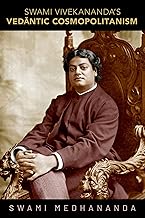
Swami Vivekananda, the nineteenth-century Hindu monk who introduced Vedanta to the West, is undoubtedly one of modern India’s most influential philosophers. Unfortunately, his philosophy has too often been interpreted through reductive hermeneutic lenses. Typically, scholars have viewed him either as a modern-day exponent of Sankara’s Advaita Vedanta or as a “Neo-Vedantin” influenced more by Western ideas than indigenous Indian traditions. In Swami Vivekananda’s Vedāntic Cosmopolitanism, Swami Medhananda rejects these prevailing approaches to offer a new interpretation of Vivekananda’s philosophy, highlighting its originality, contemporary relevance, and cross-cultural significance. Vivekananda, the book argues, is best understood as a cosmopolitan Vedantin who developed novel philosophical positions through creative dialectical engagement with both Indian and Western thinkers.
Inspired by his guru Sri Ramakrishna, Vivekananda reconceived Advaita Vedanta as a nonsectarian, life-affirming philosophy that provides an ontological basis for religious cosmopolitanism and a spiritual ethics of social service. He defended the scientific credentials of religion while criticizing the climate of scientism beginning to develop in the late nineteenth century. He was also one of the first philosophers to defend the evidential value of supersensuous perception on the basis of general epistemic principles. Finally, he adopted innovative cosmopolitan approaches to long-standing philosophical problems. Bringing him into dialogue with numerous philosophers past and present, Medhananda demonstrates the sophistication and enduring value of Vivekananda’s views on the limits of reason, the dynamics of religious faith, and the hard problem of consciousness.
Reviews:
“I conclude that Medhananda has done an excellent job presenting the thought of Vivekananda and locating it in the debates of both his Indian and British contemporaries.”
Peter Forrest, International Journal for Philosophy of Religion
“Swami Medhananda’s most recent book promises to revolutionize the study of the thought of Swami Vivekananda. In this volume, Medhananda, among other things, argues that Swami Vivekananda, like his revered guru, Sri Ramakrishna, was a highly original thinker who did not simply restate Advaita Vedānta, but put forth a radically new model of religious pluralism whose implications are not yet fully grasped or appreciated by philosophers of religion today … Swami Medhananda’s is the first which has been attentive to the chronology of Swami Vivekananda’s writings and lectures. When these materials are viewed chronologically, one can see an unfolding of Swami Vivekananda’s thought in a way that is not otherwise possible.”
Jeffery D. Long , Samvit
“In his lucid and accessible book, Swami Medhananda expounds Vivekananda’s philosophy, locating it in both the Indian and Western intellectual debates, and establishing his originality and enduring relevance … Medhananda is a meticulous scholar, engaging not merely with those in the canon, such as Kant and John Stuart Mill, but many other philosophers, such as William Hamilton and Herbert Spencer, who are not as widely read as they should be … Medhananda exhibits Vivekananda as an original epistemologist anticipating later trends … In the last section … Medhananda makes a good case that contemporary epistemologists of religion should take note of Vivekananda’s contributions … Medhananda has done an excellent job presenting the thought of Vivekananda and locating it in the debates of both his Indian and British contemporaries. Even when his philosophy is open to objection it is original and thought-provoking.”
Peter Forrest, University of New England, Australia
“Medhananda also demonstrates that Vivekananda makes vital contributions to current philosophical debates … He offers an original solution to the hard problem of consciousness.”
J. M. Fritzman, CHOICE
“Swami Medhananda’s Swami Vivekananda’s Vedantic Cosmopolitanism (Oxford University Press) is an extraordinary achievement. A brilliant, deep and searching exploration of Swami Vivekananda, this may be the best book in English on philosophical debates in modern Hinduism, and philosophy of religion more generally.”
Pratap Bhanu Mehta, Princeton University
“This is the first, and by far the best, analytical study of the original philosophy of Swami Vivekananda – who was not just a preacher, mystic, and orator, but a critical Kantian Vedāntist. Meticulously engaging with cutting-edge twenty-first century epistemological debates on testimony of spiritual experiences and with late nineteenth-century metaphysical debates about the relation between God and the world, this work establishes Vivekananda as a major modern systematic philosopher and perhaps the first ‘fusion philosopher’ of the world. Combining profound textual scholarship with lucid, argument-rich writing, it should become a must-read textbook of world philosophy.”
Arindam Chakrabarti, Stony Brook University
“In Swami Vivekananda’s Vedāntic Cosmopolitanism, Medhananda brilliantly spearheads a fresh appreciation of Vivekananda, a key member in a group of extremely insightful and innovative Indian philosophers active in the eve of Independence. Medhananda challenges the simplistic classification of these thinkers as ‘Neo-Hindu’ or ‘Neo-Vedāntic,’ demonstrating instead how Vivekananda is a pioneering voice in cosmopolitan philosophy, a creative intellectual who develops new philosophical theories inspired by both Indian and European materials.”
Jonardon Ganeri, University of Toronto
“Swami Vivekananda was not only an enormously influential religious leader; he was one of the pre-eminent Vedānta philosophers of the Indian renaissance. He offered a vision of Vedānta continuous with its classical history and in dialogue with modernity, and in doing so demonstrated how Indian philosophy could be pursued in a cosmopolitan voice. Swami Medhananda presents us with the first detailed exploration of Vivekananda’s entire philosophical program, setting it both in the context of classical Indian philosophy, and in the context of Indian renaissance thought. He shows that Vivekananda has a great deal to contribute to contemporary debates in the philosophy of religion and metaphysics. This book is erudite, clear, and compelling. It is essential reading for anyone who cares about global philosophy or religion.”
Jay Garfield, University of Melbourne
“Medhananda’s work is one of the very few that locates Vivekananda in the context of important intellectual trends of his time and examines his engagement with thinkers that include Immanuel Kant, Charles Darwin, John Stuart Mill, Herbert Spencer, and others … This is a welcome contribution to Vivekananda studies and Medhananda, immersed in both traditional and Western learning, is aptly qualified for such work…they certainly contribute to our better understanding of his Vedāntic commitments in a global intellectual context.”
Anantanand Rambachan, Philosophy East & West
“The book is well-written and valuable to the contemporary understanding of Vivekananda’s philosophy. It traverses vast scholarly literature from diverse philosophical schools, both classical Indian and modern western.”
A. Raghuramaraju, Journal of World Philosophies
“Medhananda’s Swami Vivekananda’s Vedantic Cosmopolitanism is an exceptional combination of scholarship, philosophical acumen, and cross- cultural philosophical sensitivity, which finally presents an appreciative account of Vivekananda as a representative of Hindu philosophy at its finest.”
George Adams, Nova Religio
“Swami Medhananda’s vigorous interpretations represent a new era in the academic study of Vedanta and appraisal of Vivekananda’s legacy … The insights he extracts from the persuasive examination of a wide range of topics and sources have far-reaching implications beyond the religious studies department. His rigorous and unbiased approach invites interdisciplinary dialogue across various fields and society.”
Patrick Horn, Reading Religion
About the Author:
Swami Medhananda (Ayon Maharaj) is a monk of the Ramakrishna Order and Senior Research Fellow in Philosophy at the Ramakrishna Institute of Moral and Spiritual Education in Mysore, India. He is the author of Infinite Paths to Infinite Reality: Sri Ramakrishna and Cross-Cultural Philosophy of Religion (Oxford University Press, 2018) and The Dialectics of Aesthetic Agency: Revaluating German Aesthetics from Kant to Adorno (Bloomsbury, 2013). He is also the editor of The Bloomsbury Research Handbook of Vedanta (2020). He received his PhD from the University of California at Berkeley and studied at Oxford University and Humboldt University in Berlin.