A Survival Manual for the Aristocrats of the Soul
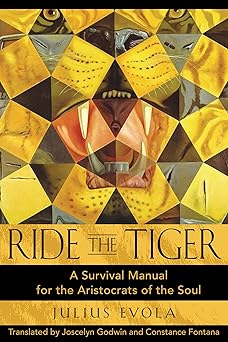
Inner Traditions, 2003
Back cover:
“A dazzling and interesting, but very dangerous author…”
Hermann Hesse, author of Siddhartha
“One of the most difficult and ambiguous figures in modern esotericism.”
Richard Smoley, in Parabola
“Evola looks beyond man-made systems to the eternal principles in creation and human society. The truth, as he sees it, is so totally at odds with the present way of thinking that it shocks the modern mind.”
John Michell, author of The New View Over Atlantis
Front flap:
“It is one of Evola’s greatest merits that he combines a prodigious wealth of erudite detail with the gift of isolating from their local conditioning the ideas or disciplines that are of value to us.”
Marguerite Yourcenar, author of Memoirs of Hadrian
“Evola rises above the usual dichotomies of left and right, liberal and conservative, challenging us to reconnect our lives and our institutions to the timeless spiritual standard that guided our ancestors.”
Glenn A. Magee, author of Hegel and the Hermetic Tradition
The organizations and institutions that, in a traditional civilization and society, would have allowed an individual to realize himself completely, to defend the principal values he recognizes as his own, and to structure his life in a clear and unambiguous way, no longer exist in the contemporary world. Everything that has come to predominate in the modern world is the direct antithesis of the world of Tradition, in which a society is ruled by principles that transcend the merely human and transitory.
Ride the Tiger presents an implacable criticism of the idols, structures, theories, and illusions of our dissolute age examined in the light of the inner teachings of indestructible Tradition. Evola identifies the type of human capable of “riding the tiger,” who may transform destructive processes into inner liberation. He offers hope for those who wish to reembrace Traditionalism.

 Olle Bengtsson