Category: Arts
William McGregor Paxton: In the Studio

Nike of Samothrace

National Art Library, Victoria & Albert Museum, London

Click to enlarge
Genesis: Pacidy
BBC Nightride, 1970.
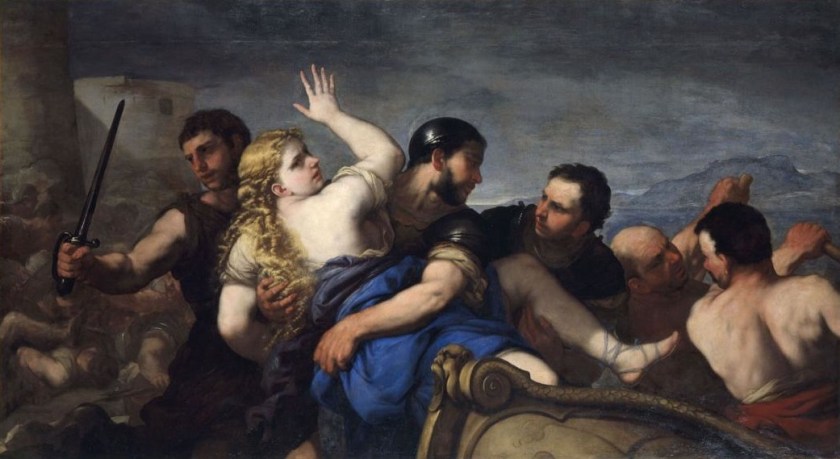
Luca Giordano: Rapimento di Elena
Roger Kimball: Experiments Against Reality
The Fate of Culture in the Postmodern Age
Ivan R. Dee, 2000 Amazon.com
Blurb:
 Is everything possible and nothing true? According to Roger Kimball, this belief, with its “mixture of gullibility and cynicism”, characterizes much of our modern culture. Thus his new collection of essays, Experiments Against Reality, is “largely a chronicle of spiritual disillusionment”. No one who is seriously concerned with the fate of our culture can afford to ignore it.
In confronting the dilemmas of modernist and postmodernist thought, Mr Kimball explores the literary and philosophical underpinnings of modernity as well as the state of our culture. In the book’s title essay, he sets the stage by considering the fate of philosophical inquiry at a time when truth is widely considered to be no more than a “social construct”. “Enlightenment”, he writes, “sought to emancipate man by liberating reason and battling against superstition. But reason liberated entirely from tradition has turned out to be rancorous and hybristic- in short, something irrational.” Mr Kimball goes on to discuss the immensely influential Victorian aesthete Walter Pater, then turns to the work of T. E. Hulme, Eliot, Auden, Wallace Steves, Robert Musil, and others to chart the modernist response to the intellectual and spiritual desolations of the age.
In Part Two of Experiments Against Reality, Mr Kimball suggests how figures from Mill and Nietzsche to Bertrand Russell, Wittgenstein, Sartre, Foucault, and E. M. Cioran have addressed – and in many cases evaded – the defining moral imperatives of modernity. In Part Three he steps back to consider more generally the career of contemporary culture – the trivializing nature of the contemporary art world, the fate of the “two cultures” controversy, and the controversy over Francis Fukuyama’s famous declaration that we have reached “the end of history”. He concludes with a meditation on the imperiled place of leisure in a society that, in Eliot’s phrase, seems ever more “distracted from distraction by distraction”.
Experiments Against Reality displays the sophistication, breadth of knowledge, and clarity of argument that have made Mr Kimball one of our most important cultural critics.
About the Author:
Roger Kimball is managing editor of The New Criterion and a frequent contributor to the Wall Street Journal, the London Spectator, and other magazines. His other books include The Long March, a perspective on the 1960s, and Tenured Radicals, an investigation of the influence of politics in higher education. Mr Kimball has also edited collections of the writings of David Stove and Walter Bagehot, and with Hilton Kramer has edited Against the Grain, The Future of the European Past, and The Betrayal of Liberalism.
JOB’s Comment:
See my essay on Kimball in Humanitas: Left and Right Eclecticism: Roger Kimball’s Cultural Criticism.
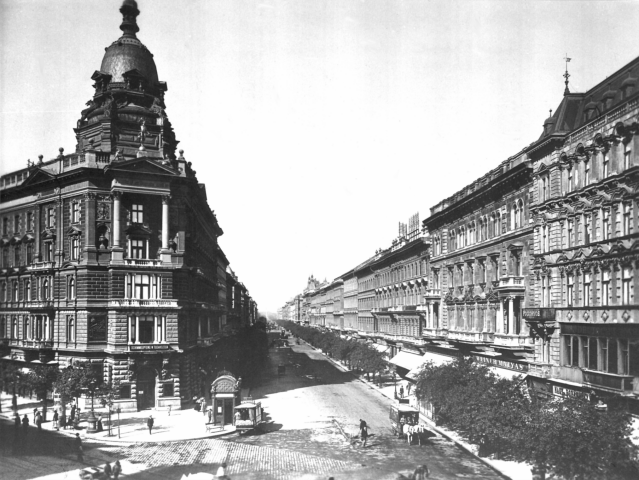
Andrássy Avenue, Budapest
Vincenzo Bellini

John M. Ellis: Literature Lost
Social Agendas and the Corruption of the Humanities
Yale University Press, 1997 Amazon.com
Book Description:
 In the span of less than a generation, university humanities departments have experienced an almost unbelievable reversal of attitudes, now attacking and undermining what had previously been considered best and most worthy in the Western tradition. John M. Ellis here scrutinizes the new regime in humanistic studies. He offers a careful, intelligent analysis that exposes the weaknesses of notions that are fashionable in humanities today. In a clear voice, with forceful logic, he speaks out against the orthodoxy that has installed race, gender, and class perspectives at the center of college humanities curricula.
Ellis begins by showing that political correctness is a recurring impulse of Western society and one that has a discouraging history. He reveals the contradictions and misconceptions that surround the new orthodoxy and demonstrates how it is most deficient just where it imagines itself to be superior. Ellis contends that humanistic education today, far from being historically aware, relies on anachronistic thinking; far from being skeptical of Western values, represents a ruthless and unskeptical Western extremism; far from being valuable in bringing political perspectives to bear, presents politics that are crude and unreal; far from being sophisticated in matters of “theory”, is largely ignorant of the range and history of critical theory; far from valuing diversity, is unable to respond to the great sweep of literature. In a concluding chapter, Ellis surveys the damage that has been done to higher education and examines the prospects for change.
About the Author:
John M. Ellis is professor emeritus of German literature at the University of California, Santa Cruz, and secretary/treasurer of the Association of Literary Scholars and Critics.
 Olle Bengtsson