Damascius
Under många år har nu Ward använt den gamla engelska termen “personal idealism” (Pringle-Pattison m.fl.) som beteckning för sin filosofisk-teologiska åskådning – här i titeln på en kort, populär sammanfattning från 2021 (en annan sådan kan höras här).
Redan på personalismkonferensen i Lund 2013 försvarade han denna position i form av en personalistisk modifikation av Bradleys typ av s.k. “absolut” idealism.
SR sände i december en trevlig intervju med professorn i nanoteknologi i Uppsala Maria Strømme (dr Wiki), där hon bl.a. diskuterar sin inom ramen för fysikens vetenskap framlagda nya teori om medvetandet.
Det finns förstås mycket att säga om detta från såväl – med min distinktion – ett filosofiskt som sofiskt perspektiv, om vad den naturvetenskapliga bevisningen är, vilken sanning filosofin därutöver kan nå, vad matematik är, vad kunskap är. Om den till allt detta hörande nödvändiga terminologin och begreppsbildningen. Om det oerhört myckna som skrivits av andra om just det som rubriken på hennes i november publicerade och mycket uppmärksammade artikel anger: ‘Universal consciousness as foundational field: A theoretical bridge between quantum physics and non-dual philosophy’. Och naturligtvis om de för teorins förståelse relevanta historiska filosofiska riktningarna – bl.a. den under hela andra hälften av 1800-talet i Sverige helt dominerande upsaliensiska idealistiska, men också den idealistiska filosofins hela historia i väst och, bortom den västerländska filosofin, de centrala sofiska traditionerna som främst har sitt ursprung i men inte längre är begränsade till österlandet.
Men Strømme är av allt att döma själv väl medveten om mycket av detta, och mer behöver inte alls omedelbart tilläggas här och nu. Mycket finns i mina kategorier Idealism (under Philosophy) och Spirituality här, för den som är intresserad. Men intervjun med Strømme måste lyssnas till som viktig och intressant i sig.
När hon talar om att vi kan få “en helt annan förståelse av det liv vi lever just nu”, att “vi springer runt på en sten som far runt i universum och fattar ingenting”, visar det att hon också äger inte bara för naturvetenskapliga forskare utan även, och ingalunda mindre, för vår tids filosofer element av genuin existentiell och sofisk insikt, relaterad till hennes nya uppfattning om medvetandet; element av egentlig visdom. Och hon berättar att hon även lever i enlighet med sin förståelse, bl.a. utövar yoga i någon form och är starkt medveten om dietens betydelse.
M.a.o. tycks hennes vetenskapliga teoribildning, eller vad som är avsett att hålla sig inom ramen för sådan även om hon är medveten om de med den nödvändigt sammanhängande filosofiska frågorna och relevansen av det komparativa studiet av “religioner”, ha fört henne i stor närhet till den egentliga, traditionellt-universella esoandliga vägens anträdande – verklighetsvägen, sanningsvägen, varovägen; “Självförverkligandets” och Gudsmedvetandets väg, den högsta och ytterst den enda.
Så här beskriver SR intervjun:
“Maria Strömme är professor i nanoteknologi vid Uppsala universitet, och ledamot av bland annat Kungliga Vetenskapsakademien. Hon forskar om det allra minsta, om material som kan förändra världen vi lever i.
Nu har Maria Strömme också tagit ett stort språng till ett annat fält, från det minsta till det största, och hävdar att vi står inför ett stort paradigmskifte. Hon har publicerat en vetenskaplig artikel, i tidskriften AIP Advances, med en teori och en hypotes om att medvetandet existerar som ett fält, bortanför tid och rum. Vilket skulle innebära att våra medvetanden fortsätter existera, efter den kroppsliga döden, precis som många stora religioner hävdar.
Hur ser Maria Strömme på kritiken att hon blandar ihop vetenskap och filosofi?
I den här intervjun berättar hon också om årets Nobelpris i kemi, hur hon lever efter longevity-trenden (försök att öka den friska livslängden) och om hur uppväxten under Lofotens stjärnhimmel påverkat henne.
Och så om förhoppningen att med hjälp av nanoteknologi kunna hjälpa förlamade att gå och kraftigt minska utsläppen inom exempelvis cementindustrin.”
Här även en kort intervju på Uppsala universitets sida.
Följande välformulerade abstract föregår artikeln i AIP Advances:
“The nature of consciousness and its relationship to physical reality remain among the most profound scientific and philosophical challenges. This paper presents a novel framework that integrates consciousness with fundamental physics, proposing that consciousness is not an emergent property of neural processes but a foundational aspect of reality. Building upon insights from quantum field theory and non-dual philosophy, a model based on the three principles of universal mind, universal consciousness, and universal thought is introduced. These principles describe an underlying, formless intelligence (mind), the capacity for awareness (consciousness), and the dynamic mechanism through which experience and differentiation arise (thought). Within this framework, the emergence of space–time and individual awareness is modeled mathematically by treating universal consciousness as a fundamental field. Differentiation into individual experience occurs via mechanisms such as symmetry breaking, quantum fluctuations, and discrete state selection – paralleling established concepts in physics, including Bohm’s implicate order, Heisenberg’s potentia, and Wheeler’s participatory universe. This model suggests that the apparent separateness of individual consciousness is an illusion, with all experience ultimately arising from a unified, formless substrate. The framework aligns with emerging theories in quantum gravity, information theory, and cosmology that posit classical space–time as emergent from a deeper pre-spatiotemporal order. It offers a non-reductionist alternative in neuroscience, suggesting that consciousness interacts with physical processes as a fundamental field. By drawing from insights from physics, metaphysics, and philosophy, this conceptual framework proposes new directions for interdisciplinary inquiry into the nature of consciousness and the origins of structure and experience.”
Läs även, förslagsvis, de på punkt efter punkt helt centralt väsentlighetsorienterade delarna 1 (Introduction), 3 (Discussion) och 4 (Conclusion) i deras helheter; endast den längre del 2 (The Mathematical Framework) kräver specialisering i fysik och matematik.

Blurben från “fulandlige” Chopra, även om invändningsfri i sig, kanske inte hjälpte seriöse Kastrup att vinna den nödvändiga typen av uppmärksamhet för denna första upplaga (2014). Men det var i så fall bara ett tillfälligt hinder.
En ny högviktig i Nederländerna baserad organisation som befrämjar den konsekventa filosofiska idealismen under beaktande av såväl traditionella andliga som samtida vetenskapliga perspektiv, och med medverkan av på denna nätplats flera gånger figurerande Bernardo Kastrup (länkar här), bildades härom året: Essentia Foundation.
Så här inleder den beskrivningen av sig själv, under rubriken “The Challenge”:
“We live under a materialist metaphysics: all that supposedly exists is matter, an abstract entity conceptually defined as being outside and independent of consciousness. This metaphysics is often conflated with science itself, even though the scientific method only allows us to determine how nature behaves, not what nature is in and of itself.
The mainstream cultural endorsement of metaphysical materialism became firmly established in the second half of the nineteenth century. Since then, however, its strength has been derived mainly from intellectual habit and inherited assumptions, not from clear reasoning, evidence or explanatory power. As a matter of fact, over the past few decades evidence has been accumulating in foundations of physics, neuroscience and analytic philosophy that materialism is false.
Nonetheless, the cultural prevalence of metaphysical materialism has myriad – and arguably dysfunctional – implications at both individual and social levels: it impacts our sense of meaning and purpose, our value systems, our understanding of health, disease and death, as well as the way we relate to others, the planet and even ourselves.”
Mot detta uppställer Essentia Foundation följande målsättningar, under rubriken “The Goal”:
“Essentia Foundation aims at communicating, in an accurate yet accessible way, the latest analytic and scientific indications that metaphysical materialism is fundamentally flawed. Indeed, clear reasoning and the evidence at hand indicate that metaphysical idealism or nondualism – the notion that nature is essentially mental – is the best explanatory model we currently have. This is known in specialist communities, but hasn’t yet been openly communicated, in an accessible manner, to the culture at large. Essentia Foundation hopes to help close this communication gap.
Although we acknowledge that analytic or scientific understanding, in and of itself, isn’t life- or behavior-changing – only felt experience or knowledge by direct acquaintance is – in modern culture the intellect is the bouncer of the heart. Therefore, we aim to create intellectual space and legitimacy for the notion that, at its most fundamental level, all reality unfolds in an extended field of mentation.”
Detta ligger helt i linje med de allmänna idealistiska positioner jag här, i många inlägg i kategorierna Idealism (under Philosophy) och Spirituality försökt försvara och lyft fram tänkare och andliga lärare som företräder. Flera av formuleringarna låter ana Kastrups intellektuella ledarskap. Termerna “mental” och “mentation” behöver från mitt perspektiv på visst problematiserande sätt diskuteras i termer av å ena sidan medvetandet i sig och å den andra de olika nivåerna av fenomenellt medvetandeinnehåll, men de överensstämmer med exempelvis Bruntons terminologi.
Hur ska man då uppnå dessa mål? Avsnittet “Way of Working” beskriver det:
“Essentia Foundation questions metaphysical materialism and argues for the plausibility of idealism by leveraging the exact same epistemic values our culture reifies today: coherence, internal logical consistency, conceptual parsimony, empirical adequacy and explanatory power. We show that, if applied objectively and consequently, these values point directly at idealism, while contradicting materialism.
Operationally, Essentia Foundation identifies and helps to promote scientific and philosophical work relevant to metaphysical idealism or nondualism. As such, we can be regarded as an information hub – strictly and thoroughly curated to weed out nonsense and pseudo-science – for the latest developments in science, analytic philosophy and other areas of scholarly work with a bearing on our culture’s metaphysical views. Our community of authors lists a growing number of academics, scholars, philosophers, scientists and authors whose works are opening the way for a new, more functional and true understanding of ourselves and reality at large.”
Detta kunde knappast formuleras på ett mer föredömligt sätt. Presentationen under About us-fliken avslutas med en förklaring av vad de kallar sitt “Editorial Commitment”:
“Essentia Foundation is not philosophically neutral: we were created precisely to address an imbalance in how the metaphysical implications of results from science and philosophy are communicated by the media.
That said, you can expect from us editorial rigor, accuracy and careful selection of the material we choose to publish. Strict curation – erring rather on the side of caution in cases of high uncertainty – is what characterizes our approach. To put it simply, we only publish credible work. And although we do try to communicate in an accessible manner – dispensing with jargon and academic obscurantism as much as possible – we are committed to not allowing these simplifications to misrepresent the original material.
Again, Essentia Foundation shall never promote nonsense, pseudo-science or gullible, unsubstantiated claims of the kind often associated with mind-first ontologies in the popular culture. This is our firm commitment to you. Whatever you see in our material may be polemical – in the spirit that every major scientific or philosophical advancement has originally been polemical – but shall never be unsubstantiated, irrational or deceiving. In cases where the solidity or credibility of a relevant result isn’t clear, we consult our Academic Advisory Board before publishing it.”
“Our team” består av Fred Matser (Founder and Honorary Chairman), Prof. dr. Jan van der Greef (Chairman), Machtelt Groothuis (Non-Executive Director), Steven Schuurman (Non-Executive Director), Bernardo Kastrup, PhD, PhD (Executive Director), och deras Academic Advisory Board av Prof. Jeffrey J. Kripal, PhD, Prof. Hyman M. Schipper, MD, PhD, FRCPC, Prof. Edward F. Kelly, PhD, Prof. Donald D. Hoffman, PhD, Prof. dr. Jan van der Greef, Prof. dr. Sarah Durston, Prof. Mikhail Ilyin, PhD, PhD, Dr. Iain McGilchrist, Claus Metzner, PhD, och Prof. Bernard Carr, PhD.
Följ dem på den ovan länkade hemsidan och på YouTube, Twitter och Facebook.
Diskussion mellan Rupert Spira och Bernardo Kastrup från 2022 (tack till viktige zen-buddhisten och politiske idédebattören Emil Eldebrink för tips):
Så här kan, inte minst med avseende på fenomenvärldens natur (inklusive det mänskliga psykofysiska komplexet, dess sinnen, själva hjärnan), i sak den konsekventa, i boströmsk mening absoluta och “rena” typen av idealism försvaras idag.
Spira är ickedualistisk andlig lärare i Oxford; Kastrup har från en vetenskaplig bakgrund utvecklats till filosof (se tidigare inlägg i idealismkategorin med diskussion om honom och rekommendationer av några av hans böcker, se länkar nedan).
Beskrivningen från Spiras YouTube-kanal:
Is everything in the world made of matter or consciousness? What exactly are matter and consciousness? Rupert Spira joins Bernardo Kastrup, scientist and author, in a deep exploration of science and spirituality and how they inevitably meet on the same path to truth.
The conversation proves that anyone, from any background, can come to the same universal understanding that non-duality teaches; that peace and happiness is who we truly are.
Rupert came to this understanding through 40 years of spiritual practice in the vedantic and tantric traditions, while Bernardo studied the professional fields of computer science and engineering.
Moderated by Simon Mundie, the discussion covers various topics as Rupert and Bernardo dissect solipsism, idealism and materialism. Through it all, they both came to the same recognition which is that peace and love surpasses all understanding, and is the very nature of everyone and everything.
Timestamps:
00:00 How Rupert and Bernardo Met 02:33 Spiritual and Scientific Backgrounds Meet 08:04 Physics, Metaphysics, Perennial and Non-Dual Understandings 11:00 What is Reality? 14:49 Sense Perceptions and Experiencing 24:30 Solipsism, Idealism, and Materialism 27:48 Everything is in Consciousness 34:50 What is Consciousness? 40:00 What is Matter? 46:30 Qualities of Experience 50:40 Science and the Church 56:20 Learning From Suffering 1:01:00 The Peace That Passeth All Understandings 1:10:00 Non Dual Understanding and Misconceptions 1:16:20 The Purpose of Life 1:26:20 Refining Your Life Through Non Duality 1:28:00 What is Wrong With Materialism? 1:29:10 The Brain, The Mind, and Individuality 1:38:00 Individual vs The Ego 1:43:00 Who Am I? Our True Identity 1:47:00 What Is Accurate About Idealism? 1:52:21 Phenomenal Consciousness vs Meta-Consciousness 1:59:00 Dissociative Identity Disorder 2:05:00 Three Consequences of the Non-Dual Understanding 2:09:40 Death, Associations and Dreams 2:17:00 The Result of the Non Duality
–
Bernardo Kastrup: Dreamed up Reality
Bernardo Kastrup: Rationalist Spirituality
Bernardo Kastrup on Why Materialism Is Baloney
Bernardo Kastrup: Why Materialism Is Baloney
Nummer av Bradley Studies med vad jag uppfattade som i några avseenden en av mina viktigare texter om den moderna filosofiska idealismen:
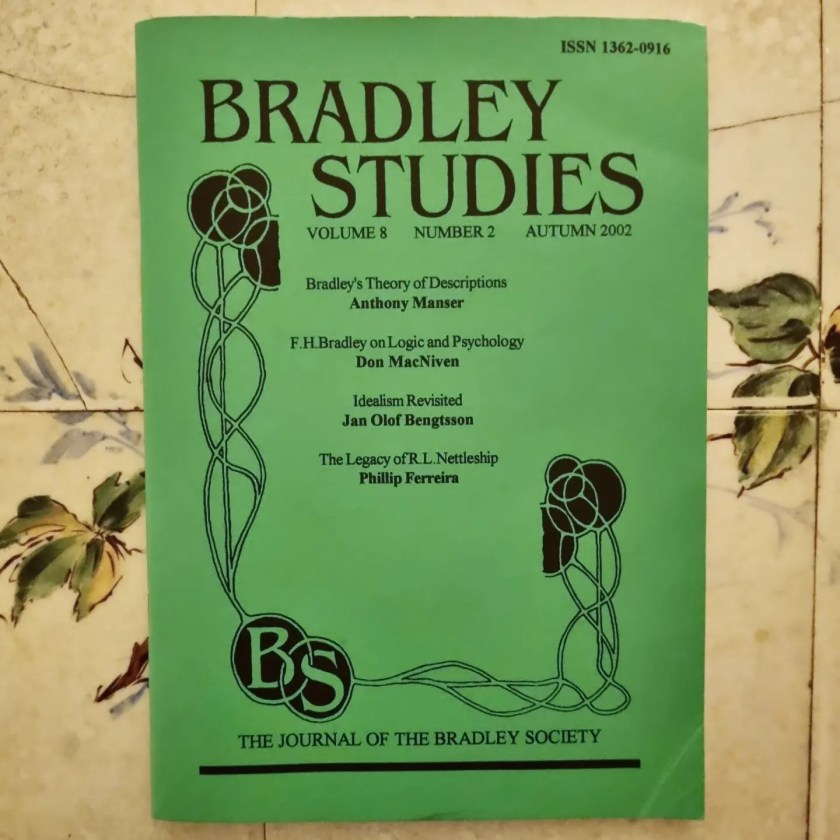
Det är en 26 sidor lång s.k. review article om en volym med papers från en konferens i Oxford 1997, i vilken jag tämligen ingående granskar bidragen från några samtida idealister och idealismforskare som Timothy Sprigge, William Sweet, James Allard, Avital Simhony och Geoffrey Thomas. Jag kommenterar också, kortare, redaktören William Manders inledning och Anthony Quintons, Phillip Ferreiras, Elizabeth Trotts, Leslie Armours, Ralph Walkers och David Holdcrofts papers. Allt handlar inte om just Bradley.
Bland de många böcker Ward utgivit sedan jag senast diskuterade honom här är jag, av naturliga skäl, inte minst benägen att nämna hans korta sammanfattning av sin åskådning förra året i den nya serien My Theology, betitlad Personal Idealism. Redan vid den 12:e International Conference on Persons i Lund 2013 försvarade han sin position i termer av personalistisk idealism, och idag behandlar han den utförligare i samma termer även i andra böcker, som Sharing in the Divine Nature: A Personalist Metaphysics, från 2020.
In Defence of the Personal Idealist Conception of the Finite Self, 1
The more basic and general difference between the personal and impersonal idealist conception of the finite self is the one regarding the interpretation of Kant’s transcendentalism.
While Pringle-Pattison accepts a minimalist version of Kant’s abstract analysis of empirical and transcendental apperception, he turns against the hypostasization of the abstract conditions of knowledge in general thus described – the categories and the unity of consciousness – into a self-existent reality, the “real Knower”, the “One Subject” in all finite minds, a hypostasization that “wipes out the selfhood and independence of the individual” and “deprive[s] both God and man of real existence”. [Notes to be added later.] Personal idealists often accept the transcendental apperception, but as in reality existing in the finite selves only, a logical presupposition, a postulated unity that is not a transpersonal self and not in itself self-conscious. As shaping the experiential awareness of the finite being and continuous with and fading off into empirical consciousness, it is not distinct from this being and does not imply the identity of one finite self with another. It can be all of these things without being in itself a self transcending finite selves; it can be understood independently of the person only as abstractly analysed. Transcendental apperception being at the most the common nature of the consciousness of unity, is not a self qua self in its self-conscious and content-accommodating core, and can therefore constitute neither an identical self of all finite beings nor an absolute self.
When Pringle-Pattison says the finite self is impervious to other selves, that in its character of self it refuses to admit another self within itself, he does not mean to say it is absolutely distinct. He is quite explicit about its sharing content with other selves and about how in this sense it transcends its own boundaries.
Given the impersonal absolutists’ conception of the finite self, what could they possibly mean if they deny that the finite self is impervious to other selves, and therefore that it is pervious? It is a little hard to see how they can claim that finite selves perviate each other. For such perviation implies agency of a kind that it is difficult to identifyi in the impersonalists’ account: there is neither anything that perviates nor even anything that can be perviated. Hence, on this account too, Pringle-Pattison’s statement must in fact be accepted as true. What they seem really to mean is simply that the hypostasization is present in all finite selves and that it is what constitutes them as in principle without boundaries.
While Pringle-Pattison accepts the finite self as the “apex of separation and differentiation”, he empathically denies any absoluteness about this. Apex means simply the highest point. He turns sharply against metaphysical pluralism. As a member of the whole, the finite self is related to and dependent on it in the way the adjectival position can indeed be interpreted as describing. But that selves belong to a common, unitary reality does not imply their merging, their reduction to identity, or the absence of their boundaries. By the finite self as “substantival”, Pringle-Pattison meant only its relative independence within this shared idealist framework.
He did not deny that the experience of one finite self may be continuous with that of another or with that of the infinite self, for selves are certainly not impervious to all the influences of experience, all the “contents of the universe”. We possess an experience more or less in common with others of what is beyond the boundaries of our own subjectivity as such. There is of course no contradiction in speaking of ourselves as impervious in our character of selves and at the same time making claims about what lies outside ourselves thus understood. The self qua self being aware of its boundaries must mean that it can go beyond them in a certain sense, since this is precisely what makes it aware of them. Such as they are, the boundaries are not abolished but confirmed. The distinctiveness is quite as real as the unifying commonality.
Pringle-Pattison accepted the absolute while rejecting the British Hegelians’ definition of it, and their distinctive way of reaching it. In accordance with his view of the finite self’s openness to what is beyond its unsuspendable limits, he conceived of the self’s continuity with God, the finite-infinite nature of man, in terms different from those of the impersonalist absolutists’ hypostasization. His position is closer to those that distinguished from the beginning what I call early personalism from the main current of German and British idealism: the special view of higher reason in Jacobi’s sense, its idea of the absolute and so forth, understood in such a way as to reinforce the arguments against pantheistic monism’s failure to distinguish between selves – as well as many other things in need of distinguishing.
But inasmuch as Pringle-Pattison would accept that the absolute is a self for which we are at least not impervious in the same sense that we are so to each other, he would have accepted that a continuity does obtain which, although beyond the logical unity of reality as a whole, and, a fortiori, beyond this logical unity as a mere postulate, could still be seen in one aspect as close to the results of the idealist development of Kant, inasmuch as the idealism of hypostasized apperception and that of reason in the early personalist sense converge with regard to continuity as such or in a general sense.
And impersonal hypostasization is not required in order to understand reality as having on all levels something of a logical structure in the dialectical and substantial sense, and to accept the process of true, systematic thought as one through which finite selves can to some extent lay it bare. Bosanquet’s account of the process of knowledge is correct in that any immediately given perceptual experience is partly abstract in the Hegelian sense. Yet Pringle-Pattison’s objection is legitimate inasmuch as even as for this reason in need of supplementation, it is and indeed must be relatively concrete. That it is not given independently of thought does not mean that it is given without any concreteness. If immediate perceptual content were not concrete at all, it would not be possible for experience to become more Concrete by its being brought by thought into relation with other such content.
Personal idealism’s “realist” or concrete element was originally provided by Jacobi, under Scottish influence, in connection with his analysis of abstraction in Spinoza. Pringle-Pattison’s interpretation of Hegel on this point is but a late restatement with renewed Scottish inspiration. In failing to understand the full Hegelian conception of concreteness, and in its onesided view of thought’s abstractive nature, it goes too far, yet Pringle-Pattison is right about the spurious excogitation in the absence of the Concrete datum, inasmuch as it loses the person as understood by the personal idealists and in this respect inadmissibly blurs the finite and the infinite. His analysis of perception and thought was part of this specific argument.
Clearly, as it progresses, the finite self’s growing experience, as grasped in its logical structure, as knowledge, ideally converges with and approximates the absolute, and the limitations and partiality of the self-enclosedness and perspectivity inseparable from its finitude is reduced. But if its perspectival experience is supported by an experience that is not that of the absolute of hypostasized apperception but of the absolute as defined by the personal idealists, the perspectival finitude itself cannot even in principle be cancelled in this process of larger experiences of the “contents of the universe”. Rather, it is precisely through the proper coordination with the whole that is the concrete universal in the widest sense that it is discovered in its determined uniqueness on this level, i.e. in its status as the apex of separation and differentiation, properly conceived. It thus finds itself as what the partly Crocean philosopher Claes Ryn describes as an intensification of unique individuality at the highest moral, aesthetic, and intellectual level.
The perspectival convergence thus also in itself implies the identification of the very boundaries. Retaining them in the manner of the alternative idealism that is personal idealism does not signify a relapse into scepticism, but is, among other things, a realistic safeguard against epistemic and indeed moral illusions. The personal idealists always insisted against Hegel the Gnostic, and more strongly and on a more consistent philosophical basis than the British impersonalists, that the constitutive differentiation within the very continuity ever precludes the finite self’s exhaustive appropriation of the absolute perspective, or, as some would perhaps prefer to see it, man’s becoming God. And this differentiation has according to them important moral, axiological and indeed existential significations that they perceive to be simply lost in the philosophy of impersonal idealism.
Under min tid som akademiker debatterade jag kontinuerligt, i paneler vid åtminstone tre konferenser såväl som i ett antal tidskriftsartiklar, förhållandet mellan den personalistiska idealismen och den s.k. absoluta idealismen med Bradley-kännaren och försvararen av Bradleys filosofi, Phillip Ferreira. Utgångspunkten var Ferreiras kritik av Pringle-Pattison, föranledd av min återgivning och diskussion av dennes ståndpunkter i The Worldview of Personalism.
Vid denna tidpunkt hade jag blivit tvungen att ikläda mig rollen av filosof, eftersom det mesta av responsen på min bok kom från filosofer – visserligen historiskt orienterade, filosofihistoriskt kvalificerade filosofer, men dock primärt filosofer. Jag hade skrivit boken som historiker (idé- eller filosofihistoriker) och primärt framfört historiska argument, presenterat en ny- och omskrivning av personalismens historia, men deras intresse för det historiska materialet var huvudsakligen rent filosofiskt. Alltsedan dess har jag därför själv föranletts att försvara den mer eller mindre idealistiska personalismen under 1800-talet i direkt filosofiska termer, i förlängningen av den allmänna sammanfattning av dess väsen och betydelse i olika avseenden som jag dock givit redan i sista kapitlet i boken. På så sätt blev min diskussion framför allt med Ferreira men även med andra idealister och idealism-historiker en partiell fortsättning av den långt tidigare debatten mellan personalistiska och absolutistiska idealister.
Men att så skedde berodde till stor del också på att jag själv också ägde ett såväl historiskt som filosofiskt intresse för 1800-talsidealismen i allmänhet, även den icke-personalistiska, och deltog i lika stor utsträckning på konferenser om den som om personalismen. Jag kunde inte godta Ferreiras förståelse av den ändliga varelsens eller personens väsen och ställning i verklighetens större ordning. Och det var framför allt detta vår diskussion gällde, i direkt förlängning av debatten mellan Pringle-Pattison och Bosanquet. För Ferreira var hans ståndpunkt i denna fråga direkt relaterad till hans allmänna bradleyanska kunskapsteori. Men jag var benägen att bestrida detta samband, och i stället, med blott ett minimum av revision av den senare, kvarhålla, bejaka och ansluta mig till Ferreiras allmänna bradleyanska redogörelse för kunskapens struktur – inklusive dess användning av det absolutas begrepp (som jag i min bok redan visat även i andra avseenden kunde, med vissa modifikationer, kvarhållas av de personalistiska idealisterna).
Ferreiras bradleyanska position i detta avseende framstår för mig som viktig, och jag vill därför här återge och kort kommentera hans egen utmärkta sammanfattning av den, sådan vi finner den i det korta avslutande kapitlet (s. 227-31) i hans bok Bradley and the Structure of Knowledge (State University of New York Press, 1999). Ferreira klargör också att han inte bara skrivit boken för att historiskt uuppvisa subtiliteten och rimligheten i Bradleys position på detta område, utan betonar också sitt syfte att med nyformuleringen och förklaringen av denna position påverka och förändra filosofin i nuet.
Bradley erbjuder nämligen enligt Ferreira ett kunskapsteoretiskt alternativ till den alltför enkla dikotomin mellan objektivism och relativism, av vilken de motsatta positionerna realism and antirealism, “foundationalism and antifoundationalism”, ofta kan ses som en underavdelning.
Bradley har visserligen tolkats både som realist och antirealist, men Ferreira argumenterar plausibelt mot dessa klassifikationer. Bradley är inte realist eftersom tanke och verklighet för honom är “aspects of the same ontological cloth”, även om de inte är reducerbara till varandra och “finite minds” inte i någon betydande utsträckning skapar sin egen verklighet. Och “[w]hatever does exist…must have been (or be) experienced by someone or something at some time or other”. Att Bradley inte är realist visas också av hans förkastande av den förenklade realistiska uppfattningen om vad som senare kallats “bivalence”, “the either-or of truth and falsity”.
Men Bradley är heller inte antirealist, eftersom han inte förnekar att det finns “facts that could make a proposition true or false irrespective of our grasp of them”. Varje omdöme har för Bradley en “real” mening som går utöver den som talaren uppfattar och erkänner, och som han även hänför till den dimension av erfarenheten som, med hans terminologi, ligger bortom vad som är åtkomligt för både tanke och förnimmelse, en meningssfär “in excess of (and forever beyond) what any finite mind can cognitively or perceptually apprehend”: verklig mening är för Bradley “nothing other than the structure of reality itself”, “that which all judgment seeks, but can only partially obtain”.
Här kan man parentetiskt inskjuta att Bradleys och Ferreiras ståndpunkt dels alltid förutsätter detta “finite mind”, men dels också systematiskt försummar att i tillräcklig utsträckning filosofiskt beskriva, uttolka och förklara dess existens’ faktum – en uppgift vars nödvändighet tvärtom den personalistiska idealismen alltifrån början förnimmer som den allra nödvändigaste och som, i det dess utförande påbörjas, i grunden formar deras idealism i en i mycket annan riktning, till en specifik och självständig idealistisk riktning.
Hursomhelst kan alltså, och, menar jag, utan några nödvändiga implikationer för förhållandet mellan dessa olika idealistiska riktningar och med samma giltighet för den personalistiska, Bradleys ståndpunkt mer allmänt formulerat i viss mening ses som ett alternativ till både objektivismen och relativismen. Man skulle kunna säga att den erbjuder en kunskapsteoretisk tredje väg förbi dessa motsatser, till vilka vår tids tänkande i så stor utsträckning förblivit bundet.
Objektivismen, normalt nära förbunden med realismen, förlitar sig på ett icke-inferentiellt erfarenhetsmässigt givet, som uppfattas som en säker grund, omöjlig att betvivla, på vilken övrig kunskap sedan kan byggas upp och kunskapsanspråk legitimeras. Denna “foundationalism” anger också en säker metod eller procedur för den fortsatta systematiska uppbyggnaden och säkra etablerandet av den fortsatta kunskapen utifrån den angivna grunden.
Bradley kan emellertid inte godta någon sådan föregiven grund. Ferreira menar sig i sin bok ha visat hur, för Bradley, “if it were the case that such certain foundations existed (at least as they are described by the foundationalists) these ‘basic truths’ could not do the work that is required of them.” Här står vi visserligen inför en av de skillnader mellan den absoluta (och mer långtgående hegelianska) idealismen å ena sidan och den personalistiska idealismen å den andra som jag debatterade med Ferreira. För exempelvis Pringle-Pattison finns utan tvekan ett icke-inferentiellt erfarenhetsmässigt givet som är av betydelse för kunskapsprocessen. Mitt förslag är att kritiken inte rimligen kan gälla detta, utan att tonvikten i stället måste ligga på att detta givna, som “basic truth”, inte endast i sig, som sådant, och, som Ferreira säger, som “isolated”, kan fylla den funktion “foundationalismen” vill tillskriva det. Ferreiras formulering “as they are described by the foundationalists” är också viktig i detta sammanhang: det är både användningen och själva förståelsen av detta givna som bör anses skilja den objektivistisk-realistisk-foundationalistiska positionen från Bradleys, eller möjligen en något modifierad bradleyansk och mer allmänt idealistisk.
Inte heller kan Bradley acceptera tilltron till en entydig metod eller procedur, “an invariable algorithm by which certainty may be achieved. In his philosophy there just are no clearly defined paths. The road to knowledge is onw which, as Bradley puts it, is ‘clearly experimental’; and any effort to rigidly prescribe this experimental approach is doomed to failure.” Här återförs vi väl också snabbt till den erfarenhetsorienterade karaktären hos Bradleys idealism. Det är s.a.s. inte den icke-inferentiella givenheten som sådan som är problematisk, utan den filosofiska förståelsen och användningen av den i det större epistemologiska sammanhanget och dess nödvändiga, dialektiskt tankemässiga utveckling.
Relativismen, å andra sidan, ofta förbunden med icke-realismen, är lika uppenbart ohållbar för Bradley. Relativismen förnekar både den givna grunden (“antifoundationalism”) och metoden, men drar också ytterst slutsatsen att “whatever knowledge we possess is utterly defeasible and completely provisional. Knowledge…is determined solely by its cultural conditions and can in no way be understood as providing any sort of universal and necessary truth.” Det är en slutsats som Bradley inte kan dela: någon pragmatismens lösning följer för honom på intet sätt som nödvändig. För “[e]ven though Bradley is the first to admit that all our knowledge is culturally and historically conditioned, he asks that we reexamine what such conditioning means. For Bradley, a correct understanding of the historical consciousness entails that we see it as supported by the whole. But this is precisely what contemporary pragmatic-relativism has missed.”
Här kommer vi nu in på Ferreiras sammanfattande formuleringar om Bradleys eget distinkta alternativ och dess betydelse i det filosofiska nuet, formuleringar som förtjänar att återges in extenso. “Mired in a subjectivism from which it cannot escape”, skriver Ferreira,
“contemporary relativism believes that the fact that we are conditioned by our historical context means that we are stuck there. It has failed to grasp the deeper conception of history that sees that truly to be ‘in the present’ entails that we simultaneously be ‘at one with our past’. Or put differently, it has not seen that any understanding of the ‘now’ constitutes an understanding of ‘then’; and that a grasp of the ‘temporal’ demands a co-originating apprehension of the ‘eternal’. Of course, from the perspective developed in these pages, if we have understood what it means to be a human being living in the twentieth century, we have at the same time grasped what is common to all human forms of life; and this because the particular can only be known relative to the universal, the part to the whole. But for the modern relativist who can conceive of history only as the brute unfolding of some mere material universe such claims must remain unmeaning.”
Exakt hur och varför enligt Bradley förståelsen av nuet involverar förståelsen av dået, varför uppfattningen av det temporala kräver uppfattningen av det eviga, och varför det partikulära kan greppas endast i relation till det universella, delen endast i relation till helheten, på sådant sätt att vi samtidigt uppfattar det universella genom det partikulära, är vad Ferreira i detalj har förklarat i bokens tidigare kapitel. Det är här lätt att den koppling som bör göras till Leanders och Ryns värdecentrerade historicism och dess partiella användning av Croces modifierade hegelianism – en riktning som i vissa avseenden också kompletterar Bradley.
Men å andra sidan kompletterar och modifierar Bradley också den värdecentrerade historicismen genom sitt kvarhållande – med inte bara den övriga absoluta idealismen i den mening denna term idag används av filosofihistorikerna, utan även med flera tongivande företrädare för den alternativa, proto-personalistiska riktningen av idealismen under 1800-talet, av det absolutas begrepp. Ferreira skriver:
“The central claim of Bradley’s philosophy can be summed up in the phrase ‘the truth is the whole’. And when this is understood so too is the claim that ‘the relative presupposes and demands the Absolute’ – even if that Absolute must remain incapable of being fully and explicitly formulated in human knowledge. But to say that we cannot grasp the Absolute fully is not to say that we cannot grasp it at all. And here the importance of Bradley’s doctrine of degrees of truth – his notion that our knowing penetration of the whole can be more or less adequate because more or less complete – shows its importance.”
Att återigen orsakerna till att det absoluta aldrig kan fullt och explicit formuleras i den mänskliga kunskapen, ja den förståelse av den mänskliga kunskapen som sådan och dess subjekt som denna korrekta uppfattning förutsätter, inte adekvat tematiseras utan är något som bara tas för givet, behöver här blott påpekas men inte närmare ingås på, eftersom mitt syfte här bara är att bejaka den tredje kunskapsteoretiska väg Ferreira beskriver som både riktig i sig och förenlig med den personalistiska idealismen. Att existensen av “finite minds”, deras väsen, och de kunskapsteoretiska och övriga konsekvenserna av deras existens och väsen aldrig adekvat behandlas är ju av mindre betydelse så länge som allt detta ändå i tillräcklig utsträckning förutsätts som självklart.
Det är, fortsätter Ferreira, bara på basis av förståelsen av den gradvisa uppfattningen av det som nödvändigt förutsatta absoluta som “either the ideas of truth and falsity or of value can arise”. Och “[n]ot only for Bradley is any truth valuable as a truth insofar as it embraces the whole, but the truest truths are those that bring to us an understanding of value”: Bradley ser
“the ‘mere fact’ as a rather low-level abstraction; and any ‘truths’ in which such facts appear (the strictly categorical judgment) are among the flimsiest and most easily falsified…our facts become much truer and more stable as they incorporate themselves into broader and more expansive systems. But with increased systematic insight come the notions of higher and lower, and better and worse. Thus we find that as our breadth of vision expands, the criteria of coherence and comprehensiveness begin to assign the various contents of our experience to their proper hierarchical space. We can then begin to say that ‘x is truer than y‘, ‘p is more beautiful than q‘, ‘and ‘a is more morally correct than b‘.”
Vad som här kallas “the mere fact” är det ovan nämnda erfarenhetsmässigt icke-inferentiellt givna, och formuleringen “a rather low-level abstraction” bekräftar återigen självklarheten att detta inte helt enkelt kan förnekas. Men den hegelianska beteckningen abstraktion här kan också lätt missförstås: vad som avses är bara den icke-medierade “isoleringen”, avskildheten, dragenheten bort från inkorporeringen i de bredare och mer expansiva systemen, som allena leder också till större konkretion. Bokens huvudtema är hur denna inkorporering, d.v.s. den större kunskapsprocessen, enligt Bradley i själva verket går till; Bradley beskriver det delvis i andra termer än Hegels dialektiska utveckling, men båda tillhandahåller, med rätt tolkning, giltiga versioner av en mer allmän idealistisk förståelse. Vad den personalistiska idealismen här insisterar på är dock alltså att den icke-inferentiella givenheten, och den faktiska om än rudimentära och s.a.s. preliminära konkretionen i denna givenhet, i princip aldrig kan förnekas, att även den självklart har och måste ha en betydelse för kunskapsprocessen. Att erfarenheten av det även som ännu-icke-införlivat i denna process sådan den förstås av Bradley alltid redan också är bestämd och betingad av andra “subjektiva” faktorer motsäger inte att den även som sådan äger den minimala men ändå betydelsefulla initiala konkretion som det här allena är fråga om. Och erkännandet av denna givna konkretion motsäger givetvis heller på intet sätt nödvändigheten av dess systematiska införlivande i den större kunskapsprocessen, oavsett om vi sedan mer exakt uppfattar detta senare på Hegels, Bradleys, Croces eller den värdecenterade historicismens sätt. Det illustrarar bara att Bradleys och Ferreiras och för den delen redan Hegels eget sätt att formulera sig om detta givna ibland är överdrivet tillspetsat, över gränsen till det missvisande och vilseledande.
Ferreira avslutar med ett längre citat från näst sista stycket i Appearance and Reality:
“The positive relation of every appearance as an adjective to Reality, and the presence of Reality among its appearances in different degrees and with diverse values – this double truth we have found to be the centre of philosophy. It is because the Absolute is no sundered abstraction but has a positive character, it is because this Absolute itself is positively present in all appearance, that appearances themselves can possess true differences of value. And, apart from this foundation, in the end we are left without a solid criterion of worth or of truth or reality. This conclusion – the necessity on one side for a standard, and the impossibility of reaching it without a positive knowledge of the Absolute – I would venture to press upon any intelligent worshipper of the Unknown.”
På detta sätt undviker Bradleys idealism relativismen, antirealismen och “antifoundationalismen” o.s.v. utan att hamna i den vanliga förhastde, realistiska och “foundationalistiska” objektivismen. Det är denna typ av idealism som under hela 1900-talet förblivit fatalt missförstådd eller helt enkelt oförstådd i de dominerande filosofiska riktningarna, och som det därför nu gäller att, med Ferreira, åter försöka lyfta fram och förklara – Ferreira tydliggör hursomhelst på utmärkt sätt varför en ny tillägnelse och ett återinförlivande av dessa den bradleyanska idealismens sanningar är så viktigt:
“Bradley’s point is, I believe, the simple one that unless we have access to reality and unless that reality that we access has a determinate structure that is capable of manifesting itself in our knowledge, then every claim we make about value – every assertion about right and wrong, the beautiful and the ugly, and truth and falsehood – is worthless. And I raise this issue because it has been the tendency of twentieth-century philosophy to reject just that point upon which Bradley is here insisting. We have been told time and time again by contemporary philosophy that either we have no access to the real or – if we do have access – we shall find no actual, no universal value there. However, the question I would like to leave with the reader is simply this: At what cost has the denial of such a universal criterion been made?”
Det enda jag här skulle vilja tillägga är att det för den önskvärda nytillägnelsen av idealismen sannolikt kan underlätta i rent pedagogiskt avseende, vid kopplingen till och dialogen med vår tids filosofi, att komplettera och modifiera den absoluta idealismen i de termer som den personalistiska idealismen tidigt uppfattade var nödvändiga, att kvarhålla men delvis omformulera de här diskuterade insikterna inom ramen för denna alternativa idealism. Att det förhåller sig så beror inte bara på rent intrinsikala överväganden rörande sanningen och hållbarheten hos dessa olika idealiska riktningars positioner som sådana, utan också på det faktum att den personalistiska idealismen är så mycket mer närstående och lättare förenlig med väsentliga sanningar i en av 1900-talets centrala strömningar, nämligen den fenomenologiska. Att även denna närhet och förenlighet i beklaglig utsträckning förblivit okänd och outforskad är också det ett förhållande som nu måste ändras.
 Olle Bengtsson