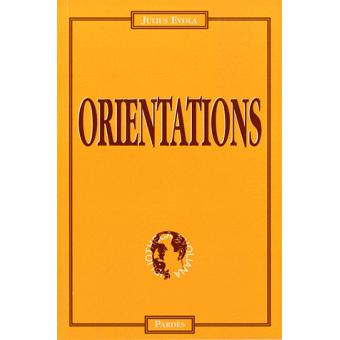
Paru initialement en 1950, puis, avec quelques variantes, en 1971, Orientations contient en germe une grande partie de l’oeuvre de Julius Evola postérieure à la Deuxième Guerre mondiale.
Écrit dans un style très dépouillé, d’une concision qui va directement à l’essentiel, ce texte n’aborde pas seulement quelques-uns des thèmes chers à Evola, comme le refus de choisir entre l’Est et l’Ouest, la dénonciation de la “démonie” de l’économie, le rejet du bonapartisme et du nationalisme, etc., mais vise aussi à susciter la formation d’une véritable élite, qui devra affirmer l’Idée “traditionnelle” sous la forme d’un “homme nouveau”, appelé a résister aux épreuves qu’entraîne la crise irréversible de la civilisation moderne.
Cette édition critique d’Orientations, présentée de façon détaillée et originale par le traducteur, comprend l’indication des variantes existant entre le texte de 1950 et celui de 1971, ainsi que des notes historiques et documentaires.
Inspired by his time spent with wise sages in Asia in the 1930s, Paul Brunton (1898-1981) wrote The Hidden Teaching Beyond Yoga (and its companion volume The Wisdom of the Overself) at the request of these remarkable teachers, who recognized that he had a significant role to play in the transmission of Hindu Vedanta and Buddhism to the West. Brunton’s books are a profound re-creation of the teachings of those two philosophical schools of thought, informed by the insights of deep meditation. Clearly written without the specialized vocabulary found in those traditions, the books speak directly to the contemporary spiritual seeker.
The Hidden Teaching Beyond Yoga is a step-by-step guide to actually experiencing the spiritual truth that reality is formed within our consciousness rather than outside us in the world of material things. Brunton’s expert analysis of perception, grounded in science, is designed to awaken us to our sacred foundation and to transform our personality into a mirror of that reality. Brunton prepares us for this journey by describing the attitudes, mental disciplines, and character traits that are beneficial for success in this quest.
This new edition has been updated to incorporate the author’s final revisions and includes an introduction by the Paul Brunton Philosophic Foundation.
Contents:
Foreword by The Paul Brunton Philosophic Foundation
1 Beyond Yoga
2 The Ultimate Path
3 The Religious and Mystic Grades
4 The Hidden Philosophy of India
5 The Philosophical Discipline
6 The Worship of Words
7 The Search After Truth
8 The Revelation of Relativity
9 From Thing to Thought
10 The Secret of Space and Time
11 The Magic of the Mind
12 The Downfall of Materialism
Epilogue: The Philosophic Life
Appendix 1: Some Misconceptions Cleared Up
Appendix 2: Additional Resources from The Notebooks of Paul Brunton, Compiled by the Paul Brunton Philosophic Foundation Editors
About the Author:
Paul Brunton (1898-1981) is one of the twentieth century’s most brilliant spiritual writers. He is generally recognized as having introduced yoga and meditation to the West. His books sold over two million copies in 17 languages. He was the most popular and authoritative source of information on Eastern philosophies, gurus, and meditation systems from the mid-’30s to the ’60s. In 1954, he withdrew from public life and continued writing the material that was posthumously published as The Notebooks of Paul Brunton – a truly East-West spiritual philosophy. Written with the passion of an authentic pioneer and the thoughtfulness of a seasoned practitioner, his work is re-emerging as a beacon for all contemporary seekers.
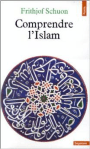
Le monde musulman – à la fois proche et méconnu – en revendiquant de nos jours un plus large rôle dans le jeu des forces humaines, attire surtout les regards sur une image très contingente de lui-même.
Cet ouvrage qui met en lumière l’aspect essentiel de la perspective islamique est d’un intérêt plus important que jamais, pour situer cette tradition dans sa véritable dimension extérieur et son expression du divin.
Pour exposer les fondements de la foi islamique, il considère quatre elements essentiels: la nature et la perspective musulmane, la doctrine koranique et la fonction du Koran, le rôle du Prophète, le Soufisme.
“Ce qui s’impose à notre époque s’éloignant de ses origines, c’est de fournir à quelques-uns des clefs renouvelées – plus différenciées et plus réflexives que les anciennes mais non meilleures – pour les aider à redécouvrir des vérités qui sont inscrites, d’une écriture éternelle, dans la substance même de l’esprit.” Frithjof Schuon
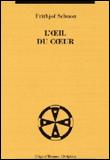
Ce livre est la réédition d’un classique de la pensée traditionelle dont Frithjof Schuon est, avec René Guénon et Titus Burckhardt, l’un des plus éminents représentants. C’est un recueil d’essais très variés relatifs, entre autres, à la métaphysique, à la cosmologie, aux états posthumes, à l’oraison et à la méditation, et plus généralement à la vie spirituelle. D’utiles et éclairants parallèles sont établis entre certains aspecs fondamentaux du christianisme, du bouddhisme et de l’islam. L’unité de l’ensemble réside plus dans son homogénéité doctrinale que dans la diversité des sujets abordés.
Le propos de l’auteur est de nous guider sur la vooie de la connaissance spirituelle, et partant symbolique, autrement det de nous faire prendre conscience de l’inconnu à l’aide du connu. Tous les phénomènes de la nature sont, comme l’attestent les Ecritures sacrées, des preuves de Dieu, et il en est ainsi pour l’homme simple comme pour le sage, mais non point nécessairement pour le philosophe qui peut n’avoir ni les yeux de la Foi ni ceux de la Connaissance, et qui, dans ce cas, se débat vainement dans les antilogies d’un conceptualisme stérile.
La Verité veut être “vue” et non simplement “pensée”, aussi l’objet de cet ouvrage est-il avant tout de contribuer, autant que faire se peut, à l’assimilation de la “vision intellectuelle” et à l’élimination des obstacles mentaux qui s’opposent à celle-ci ou, en d’autres termes, qui voilent “l’Oeil du Coeur”.



 Le monde musulman – à la fois proche et méconnu – en revendiquant de nos jours un plus large rôle dans le jeu des forces humaines, attire surtout les regards sur une image très contingente de lui-même.
 Olle Bengtsson