
The Fourth Political Theory and Structural Anthropology
I ended my post Renaming the New Right? by noting that the new term introduced by Alexander Dugin in the title of the first of his books published in English translation, The Fourth Political Theory (2012), in combination with certain formulations signaling a new kind of “openness” in comparison with the positions of the New Right, made a rapprochement seem possible between Dugin and Alain de Benoist, collaborating in the development of the Fourth Political Theory, on the one hand, and on the other the kinds of positions and traditions I have tried to point to as necessary to uphold and defend, in their political application tentatively under the name of a European post-paleoconservatism.
That, I suggested, would mark a decisive, historic shift. For, as I said, “[w]e certainly need a fourth political theory, but we also need this theory to go beyond the New Right. The new name should signal a new philosophy, or a philosophy in some important respects different from that of the New Right. I will come back to the question of the extent to which Dugin’s book bears out as reasonable the hopes for such a development.”
Now returning to Dugin’s book, I would like to begin, before proceeding to discuss that which I would like to support as the positive and valuable contributions of the Fourth Political Theory as this far formulated, by simply pointing out briefly what I still find problematic and untenable in the new project under the new name. I mentioned in the earlier post that Dugin described the theory as a collaborative project, a kind of open work-in-progress, and that he invited us to a dialogue about it and its further development. This was a nice and attractive way of presenting and introducing the new theory, and the most direct expression of what I discerned as the new openness. The criticism I will here set forth – in broadest outline only, since I can refer to several of my other publications for analyses of the kind that may be needed for a fuller understanding of it – is intended as a contribution to that dialogue. It is intended as constructive criticism that can hopefully be taken into account by the other participants in the dialogue.
From my perspective, the most obvious weakness in the Fourth Political Theory as it presently exists, i.e., as tentatively formulated in Dugin’s book, is the wholesale affirmation of structural or structuralist anthropology, implying a total relativism with regard to human civilizations and therefore also of values. “As one of its essential features”, Dugin writes,
“the Fourth Political Theory rejects all forms and varieties of…the normative hierarchisation of societies based on ethnic, religious, social, technological, economic, or cultural grounds. Societies can be compared, but we cannot state that any of them is objectively better than the others. Such an assessment is always subjective…This type of an attempt is unscientific and inhumane. The differences between societies in any sense can, in no shape or form, imply the superiority of one over the other. This is a central axiom of the Fourth Political Theory.” (p. 46; cf. 44-5, 62-4, 90-1, 100, 108-9, 120, 195.)
To reject this position in no way implies that the question of the comparison and evaluation of different cultures or civilizations is a simple one. Nor is the rejection made from any simplistic assumption that Western civilization (or in this context I should perhaps say Western European and American) civilization, not even as extended beyond and before modernity and its material achievements and claims of progress (what Dugin calls the “monotonic processes”), is obviously superior to all others. Nor is it even a matter of insisting on the need for a “normative hierarchisation” in definite practical, political respects in cases where one society might in fact come to be accepted as “objectively better” in some respects.
Quite the contrary. There are of course many criteria that need to be applied, and to many areas and dimensions of society and culture. The outcome will vary between the different fields enumerated by Dugin, and most obviously if we include spiritual life, practice, and achievement under the categories of culture and religion (and in the traditionalist sense with which Dugin is thoroughly familiar). These areas also need to be weighed against each other, and seen in a broad, historical perspective, in order for a general evaluation of the respective cultures or societies to be possible. “Normative hierarchisation” has certainly often been unscientific and inhumane, and not just when undertaken by members of Western societies.
The whole complex issue cannot even be safely approached without a solid grounding in an adequate philosophy of values and a philosophy capable of understanding the process of the kind of “totalizing” thought, in a certain sense, that can gradually and dialectically reach a perspective from which judgements about this kind of thing can reasonably be made, even though the position reached cannot be absolute. I claim the philosophy of value-centered historicism, as both being in some respects supplemented and modified by and in other respects itself supplementing and modifying idealism and personalism as I have suggested they be understood, at least begins to provide such a philosophy, the theoretical resources needed for doing justice to the plurality and particularities of cultures, traditions, and values, while at the same time transcending relativism and indeed precisely because of this appreciation of the manifold of human culture and experience being able to begin to affirm a true objectivity, a real universality concretely and more deeply apprehended.
It is certainly historically and, as it were, psychologically understandable that de Benoist and Dugin react against the not just premature but mistaken rationalist and ideological pseudo-universalist claims of Western modernity, liberalism, radicalism, globalism in its dominant form, etc. This reaction is what, from the beginning, explained the New Right’s partial endorsement also of the broader currents of poststructuralism and what came somewhat sweepingly to be summarized as postmodernism.
Yet this endorsement went much too far. The New Right came to join the impossible project of deconstructing not only the modern forms – and excesses – of rationalism, but reason as such, including the higher reason of pre-modernity as well as idealism broadly conceived and of course as affirmed in the proper context of will and imagination as alone making possible a true understanding of human nature. Along with this, what is deconstructed is of course also the moral law, natural law in the sense I have suggested it must be upheld and defended. The relativism of structural anthropology and subsequent theoretical developments is quite as untenable as the rationalism and ideological abstractions against which the New Right and the Fourth Political Theory mobilize them.
The absence of analysis and criticism of the whole modern current of thought and cultural sensibility in which Lévi-Strauss is firmly established, indeed of what in some respects at least must clearly have been his intentions, reveals as clearly as ever that the New Right, and now the Fourth Political Theory, belong squarely in this current too. The abstract theorizing of structuralism cannot disguise its irrationalist nature and purposes in Lévi-Strauss’s case and many others’ too. Assimilating structural anthropology, the Fourth Political Theory risks in this respect, and in combination with other elements similar in substance, to be dismissed as just another lower romantic, Dionysiac intellectual extravaganza, utterly incongruous not least with the Guénonian traditionalist elements which Dugin in particular seems to wish to retain.
That “[t]he differences between societies in any sense can, in no shape or form, imply the superiority of one over the other” is a truly extreme, and extremely untrue, position. As this far developed, the Fourth Political Theory unfortunately still builds on – and indeed elevates, as further exaggerated, to a “central axiom” – the weakest teaching of the New Right. A viable Fourth Political Theory must, I submit, stand on firmer philosophical ground than that.
Trotsky

(This photo replaces the original content of this post.)
E. Michael Jones: Degenerate Moderns
Modernity as Rationalized Sexual Misbehavior
Ignatius Press, 1993 Amazon.com
Back Cover:
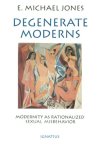 In this groundbreaking new book, Jones shows how some of the major determining leaders in modern thought and culture have rationalized their own immoral behavior and projected it onto a universal canvas. The main thesis of the book is that, in the intellectual life, there are only two ultimate alternatives: either the thinker conforms desire to truth or he conforms truth to desire.
In the last one hundred years, the western cultural elite embarked upon a project which entailed the reversal of the values of the intellectual life so that truth would be subjected to desire as the final criterion of intellectual value. In looking at recent biographies of such major moderns as Freud, Kinsey, Keynes, Margaret Mead, Picasso, and others, there is a remarkable similarity between their lives and thought. After becoming involved in sexual license early on, they invariably chose an ideology or art form which subordinated reality to the exigencies of their sexual misbehavior.
“Degenerate Moderns is a marvelous tour de force. Jones provides the reader not only with an overview of the sources of modern culture but also with a way of understanding what otherwise might seem simply surprising…at the root of many of the most influential books and theories lies the sexual problems of their authors. Sophisticated, informative and learned as this book is, it can be read as a high level corroboration of what your mother always told you. Jones is one of the most readable writers I know.” Ralph McInerny, University of Notre Dame
“In the Ethics, Aristotle pointed out that ‘Men start revolutionary changes for reasons connected with their private lives.’ This is also Michael Jones’ thesis in his profound new book. It is extraordinary how much of the modern landscape is illuminated by this perspective, as Jones dissects the moral lives of the progenitors of modernity and shows the intellectual consequences. His treatment of Mead, Kinsey, Freud and Jung is devastating. This is not an ad hominem attack, but a brilliant illustration of the inescapable relationship between the order of the soul and the order of everything external to it.” Robert Reilly, ‘Voice of America’
“A fascinating blend of biography, intellectual history, and investigative reporting. This book takes up where Paul Johnson’s Intellectuals leaves off. It should be required reading for anyone who wishes to understand the intellectual fashions of the Twentieth century.” William K. Kilpatrick, Author, Psychological Seduction
About the Author:
E. Michael Jones is a writer, former professor, media commentator and the current editor of Culture Wars magazine (formerly Fidelity magazine).
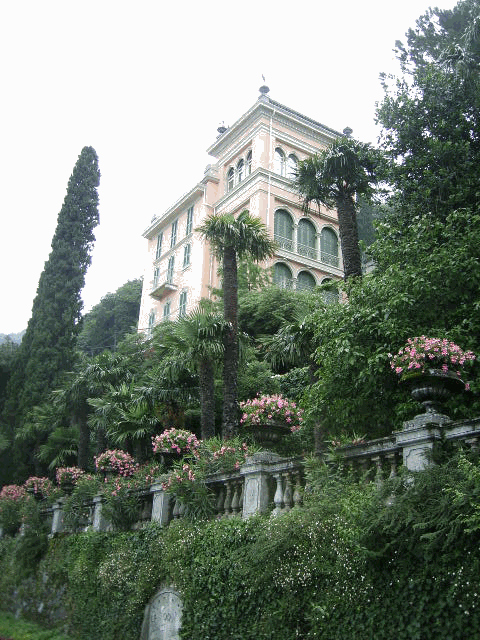
Villa in Varenna, by Lago di Como
Den vetenskapliga rationaliteten
Trots att Babbitt själv anammade och tillämpade föreställningen om den skapande och moraliska fantasin var han p.g.a. sin romantikkritik oförmögen att fullt uppfatta dess filosofiska ursprung och förankring i den idealistiska filosofin. Detta är ett av de områden där Leander och Ryn anser att Croces filosofi kan komplettera Babbitts.
En annan brist hos Babbitt, och det andra område på vilket Croce utmärker sig framför Babbitt och därmed av Leander och Ryn anses kunna komplettera denne, är förståelsen av förnuftet. Babbitt presterar en samtidig kritik av de parallella, moderna sentimentalistiska och rationalistiska strömningarna, men kritiserar som vi sett även det “klassiska” förnuftets ensidighet. Han delade också den moderna uppfattningen, formulerad inte bara av pragmatismen och fiktionalismen utan också inom idealismen, att den vetenskapliga – primärt men inte uteslutande naturvetenskapliga – rationalitetens begrepp är blott pragmatiska och fiktionalistiska. De utgör artificiella utsnitt ur den helhet som vi omedelbart och intuitivt uppfattar, och blir som sådana lätt de reifierade instrumenten för den fragmentariserade metodologiska reduktionism som utmärkte upplysningstraditionen och Kant – vars kategorier i flera fall kan visas vara av just detta slag – och som den filosofiska romantikens skapande fantasi med dess helhetliga synteser sökte övervinna.
Den värdecentrerade historicismen godtar naturligtvis denna Babbitts allmänna uppfattning av den vetenskapliga rationaliteten, så långt den i hans formulering når: denna pragmatisk-fiktionalistiska rationalitet tjänar den praktiska nyttan, men dess begrepp är ytterst sett filosofiskt overkliga: “science is a structure of useful fictions”. [Will, Imagination and Reason, 67.] Och Babbitt ser klart hur, när denna rationalitet rör sig utanför sitt begränsade kompetensområde, icke endast filosofin, estetiken och moralen förvrängs, utan hur detta får konsekvenser också för samhället i form av den karaktäristiska kombinationen av abstrakt kollektivism och atomistisk individualism.
Men Leander och Ryn anknyter inte bara till Babbitt utan till flera av de mest kända företrädarna för denna moderna vetenskapssyn. Babbitt saknar fortfarande tillräcklig förståelse för den omedelbara upplevelsens natur och dess verkliga förhållande till den filosofiska reflexionen. Förutom William James åberopar de Bergson och dennes formuleringar om “more or less arbitrary découpages which cut phenomena out of their context in the ‘whole'”. [Ibid. 67. ] Människans omedelbara “perception of the flow of life” är verkligare och mer grundläggande än naturvetenskapens konstruktioner. Naturvetenskapen innefattar i själva verket “a deliberate distortion of experience for the sake of practical ends”. [Ibid. 65.]
Men dessa découpages motsvarar Hegels “abstrakta förståndsidentiteter”, och det är framför allt hegelianen Croce som på detta område blir av central betydelse genom sitt klara urskiljande av det filosofiska förnuftet och distinktionen mellan det och den typ av tänkande som frambringar naturvetenskapernas matematiska eller klassifikatoriska fiktioner. Det är, till att börja med, endast det egentligt filosofiska förnuftet som förmår uppfatta den pragmatiska rationaliteten som just sådan.
Leander och Ryn återkommer på flera ställen till den croceansk-hegelianska förståelsen av förhållandet mellan den omedelbara erfarenheten, ibland kallad “intuition”, och “perception”, vilket senare dock är identiskt med “concrete thought” och definieras som “an act in which immediate experience acquires conceptual self-awareness”; “experience acquires conceptual self-awareness in philosophical perception”. [Ibid. 119.] De godtar också som centralt Croces likställande av det konkreta tänkandet med “historical thought”, men påminner om den vida betydelse i vilken “historiskt” här förstås. [Ibid. 69.]
Den omedelbara erfarenheten och det filosofiska tänkandet ligger varandra mycket nära – det senare handlar om det förra och det förra påverkas i själva sin omedelbarhet oundvikligen av det senare. Ja, historiskt tänkande och filosofisk reflexion är för Croce så nära förbundna att “they are ultimately indistinguishable”: [Ibid.] “perception and discrimination are the same: we cannot perceive without distinguishing and categorizing. The power of perception is the reason of philosophy”; [Ibid. 84.] “experience has a conceptual ally in genuinely philosophical reason”; [Ibid. 109.] “Science gives fictions which are useful for many purposes, among them the purpose of extending historical knowledge. The function of science is to work. Its ‘truth’ is in its working, whereas knowledge of reality (a reality which includes the working of science) is strictly philosophico-historical.” [Ibid. 118.]
Endast genom den omedelbara upplevelsen av helhet och verklighetsflöde och den med denna oupplösligt förbundna filosofiska reflexionen kan vi alltså fullt förstå de pragmatiska fiktionerna som just pragmatiska fiktioner och icke som strukturer i verkligheten själv. Vi kan förstå hur och varför “the empirical concepts of natural science do not speak with precision about the universal, permanent structure of experience, as does philosophy, but are hypothetical, pragmatic constructs always subject to revision”. [Democracy and the Ethical Life, 36.] Med insikten om det filosofiska förnuftet och dess i erfarenheten alltid närvarande, konstitutiva verkan börjar vi nämligen kunna få ett första, verkligt grepp om just dessa universella, permanenta strukturer. Detta är klassiska, grundläggande insikter i den moderna erfarenhets- och kunskapsmodala idealismen.
Pragmatikerna själva tenderar emellertid att erkänna endast de empiriskt-vetenskapliga begreppen, förståndets hypotetisk-pragmatiska och klassifikatoriska aktivitet, och att likställa just detta med det filosofiska förnuftet eller inte erkänna något annat sådant. Den pragmatism som inte kompletterats med en kategorisk logik av Croces typ reduceras därmed enligt den värdecentrerade historicismen till det absurda: “It must finally become bogged down in a chaos of undefined concepts.” [Will, Imagination and Reason, 82.] Men även Babbitt delar svagheten att uppfatta den allmänt pragmatiska rationaliteten som det enda filosofiska förnuftet, även om hans sätt att använda den syftar till skapandet av filosofiska begrepp för kritik även av den mer specifikt scientistiska varianten av denna rationalitet.
Genom sin otillräckliga förståelse av det begreppsliga tänkandets verkliga natur blir Babbitt enligt Leander och Ryn oförmögen att uppskatta dess filosofihistoriska landvinningar. Tydligast blir detta i hans negativa omdömen om Kant. Babbitt kritiserar det abstrakt och rationalistiskt begreppsliga sätt på vilket Kant introducerar det syntetiska elementet i sin kritik av Humes tänkande, där ett sådant saknas. Kant förmår inte göra rättvisa åt det förhållandet att varken den avgörande moraliska viljan eller fantasin är begreppsliga. Leander och Ryn försvarar dock Kant genom att framhålla att dennes kritik av Hume gäller uppfattningen av naturvetenskapen, ett område där det syntetiska elementet är just abstrakt och rationalistiskt. Det väsentliga var att Kant överhuvud introducerade de syntetiska helheterna. Fastän dessa hos honom är konstruerade för att försvara den newtonska fysiken, och därför inte överskrider den pragmatiska fiktionens overklighet, skulle själva ansatsen, det syntetiska tänkandet som sådant, av andra inom kort utvecklas och tillämpas på verkliga, konkreta moraliska, imaginativa och filosofiska helheter. [Ibid. 69 f.]
För den värdecentrerade historicismen blir, med de positioner jag här antytt, den livsvärld vi uppfattar genom “intuition” och perception ingalunda en mindre verklig värld än de vetenskapliga begreppens och modellernas. Det är inte så att den senare utgör en djupare, sannare verklighet, och livsvärlden endast en ytlig, mer skenbar. Det förnuft som är oskiljaktigt från erfarenheten uppfattar gradvis, och i samverkan med den av den högre viljan formade och understödda moraliska fantasin, de permanenta, kategoriella strukturerna, men inte heller livsvärldens erfarenhet som mer omedelbar och dialektiskt och fantasimässigt outvecklad (jag kommer återkomma till denna utveckling) utgör egentligen i alla avseenden en mindre verklig värld än naturvetenskapens. Livsvärlden är förvisso fenomenell och rymmer moment av illusion; det finns uppenbart en djupare verklighet av annat, andligt slag, given i den – i den fulla idealistiska meningen – “förnuftiga erfarenheten”. Men livsvärlden är aldrig som de ständigt förändrade vetenskapliga begreppen och modellerna en rationell konstruktion.
Det förhållandet att naturvetenskapens begrepp utgör pragmatiska fiktioner innebär inte att de inte skulle på sitt eget sätt vara förankrade i verkligheten: “The natural scientist does interact with reality in its external aspect, and in a sense he tries to know it. He employs hypothetical constructs which are useful in handling his subject matter and which let him predict events.” Men de allmänna matematiserade hypotetiska teoriernas och modellernas stigande abstraktion innebär inte att de blir mindre pragmatiska och uppnår universalitet; de tillhandahåller alltid blott “strategies for the further experimental interaction with the outside world”. [Ibid. 75.]
Richard Gamble on Wilson
Richard M. Gamble: In Search of the City on a Hill
The Making and Unmaking of an American Myth
Bloomsbury Publications, 2012 Amazon.com
Book Description:
 In Search of the City on a Hill challenges the widespread assumption that Americans have always used this potent metaphor to define their national identity. It demonstrates that America’s ‘redeemer myth’ owes more to nineteenth- and twentieth-century reinventions of the Puritans than to the colonists’ own conceptions of divine election.
It reconstructs the complete story of ‘the city on a hill’ from its Puritan origins to the present day for the first time. From John Winthrop’s 1630 ‘Model of Christian Charity’ and the history books of the nineteenth century to the metaphor’s sudden prominence in the 1960s and Reagan’s skillful incorporation of it into his rhetoric in the 80s, ‘the city on a hill’ has had a complex history: this history reveals much about received notions of American exceptionalism, America’s identity as a Christian nation, and the impact of America’s civil religion.
The conclusion considers the current status of ‘the city on a hill’ and summarizes what this story of national myth eclipsing biblical metaphor teaches us about the evolution of America’s identity.
Reviews:
“A thought provoking analysis of how the biblical metaphor of ‘a city on a hill’ became a national myth. Gamble begins with a careful analysis of John Winthrop’s 1630 lay sermon in the context of its time and traces the ways in which the biblical image was employed by others to define American identity in the two hundred years that intervened between the time when Winthrop delivered his sermon and its recovery in the nineteenth century. The concluding chapters explore how politicians including John F. Kennedy, Ronald Reagan, Michael Dukakis, and Sarah Palin have appropriated Winthrop’s name and words to define American exceptionalism, and what this means for America as a nation and for Christians living within the nation.” Francis J. Bremer, author of John Winthrop: America’s Forgotten Founding Father (2003) and Building a New Jerusalem: John Davenport, A Puritan in Three Worlds (2012),
“In Search of the City on a Hill is the most important study of the origins and of the evolution of a national myth. For the second time Richard Gamble took it upon himself to reveal and prove the insidious and particularly American historical tendency to employ religion for political purposes – indeed, to subordinate matters of faith to populist publicity, to enhance the latter by the former. This is a lone cry in the midst of a deafening wilderness, but one enriched with a most serious scholarly amassing of historical evidence.” John Lukacs, author of Five Days in London: May 1940 and A New Republic
“’Civil religion is voracious and will gobble up anything it thinks useful’. That stark observation of Rowland Sherrill has never been more conclusively proven than by Richard M. Gamble’s In Search of the City on a Hill. His discovery of the recent and artificial provenance of a holy verse in the American Creed proves even more astounding for the evidence that doesn’t exist than for the evidence it unearths. This concise masterpiece of historical detection blew my mind. It will also blow the circuits of misguided conservatives, neoconservatives, and evangelicals who have been duped (or duped others) into an idolatrous interpretation of their nation, their history, themselves.” Walter A. McDougall, University of Pennsylvania, Pulitzer Prize-Winning Historian, author of Throes of Democracy: The American Civil War Era
“Instead of arguing over how best to frame the American mission in terms of the city on a hill, Gamble suggests we ought to ask a different question. We ought to have a debate ‘between exceptionalists of all sorts on one side and skeptics on the other, that is, between those who believe that the United States is somehow exempt from human finitude, the lust for domination, and the limits of resources and power, and those who do not.’ Richard Gamble’s book is an important first step toward that long-overdue debate.” Thomas E. Woods Jr., The American Conservative
About the Author:
Richard M. Gamble holds the Anna Margaret Ross Alexander Chair in History and Political Science at Hillsdale College, Michigan, USA. He taught at Palm Beach Atlantic University in West Palm Beach, Florida, USA from 1994 to 2006. His previous books include The War for Righteousness: Progressive Christianity, the Great War, and the Rise of the Messianic Nation and The Great Tradition: Classic Readings on What It Means to Be an Educated Human Being. He also serves as a contributing editor for The American Conservative.
Vittorio Reggianini: Young Beauty

Joseph Baldacchino
 Olle Bengtsson