Den empiriska sensualismen

För att belysa detta modernitetens nya Mänskliga Rådande över Skapelsen måste här den traditionalistiska skolan, representerad av Lindbom, mobiliseras igen.

Lockes rationella autonomi formas helt av vad Lindbom kallar den empiriska sensualismen. Enligt denna behöver vi på intet sätt vara bekymrade över kunskapens nödvändiga begränsningar, eller de specifika begränsningar som dess filosofi förkunnar; det är för oss tillräckligt att på bästa sätt söka hantera våra åsikter och handlingar. [Tage Lindbom, Agnarna och vetet, 56.] Locke förnekar icke blott en given, prerationell, medfödd bevetenhet, intellectus; han har samtidigt “stängt in människan i en subjektivism. Ty den empiriska sensualismens människa…har avsagt sig sin förmåga att objektivera i det ögonblick, då hon vägrar att använda den intellektiva kunskapen och endast anlitar sin sinnligt-mentala utrustning. Hos denna profana människa är all kunskap, all insikt subjektiv.” [Ibid. 61.]

Det punktuala självets nya objektivering misslyckas således. Men Locke syftade i alla fall till att ta sig ur den repressiva återvändsgränd Hobbes lära om den sinnliga intressemänniskans luststrävanden hade ändat i. Därför måste i den fortlöpande borgerliga revolutionen subjektivismens relativism trots de oöverstigliga epistemiska gränserna uppvägas av postulaten att Gud etablerat en objektiv moralisk ordning, att vi i all den sinnlighet vi är konstitutivt begränsade till dock förståndsmässigt kan känna den, att den lycka som står i överensstämmelse med denna ordning är och kan förstås och eftersträvas som ett gemensamt mål, och att friheten genom allt detta kan garanteras.

Det väsentliga för mina närvarande syften är hur detta Lockes försök samtidigt teoretiskt etablerar, praktiskt befrämjar, och ideologiskt avspeglar en mänsklig personlighetstyp. Den empiriska sensualismen förenas med den liberala puritanismen. Båda finner i Locke sin första stora filosof:

“De mänskliga känslorna och begären får sin fulla legitimitet, blir likvärdiga i strävan efter att nå fram till den fulla lyckan. Mot Descartes’ vetenskapliga metod i den från allt sinnligt slagg renade tankevärlden ställer Locke en mobilisering av alla mentala krafter till ett ‘självförverkligande’. Mot aristokraten Hobbes står demokraten Locke med sin tro på rationell-moralisk självkontroll. Den enskilda människan blir ett energicentrum, som lever på en gång i enskild och medborgerlig frihet.” [Lindbom, Riket är ditt, 136 f.]

Vi har sett hur den exoteriska uppfattningen av Guds person, Guds personlighet, genomgått dramatiska skiftningar från Gamla Testamentet, över Nya Testamentet, de kristna platonisterna, kyrkofädernas treenighetsspekulation, skolastiken, occamismen, och fram till den cartesianska rationalismen. Den förändras från det konkreta, viljande, kännande, handlande, till det mer abstrakta, tänkande, ja “opersonliga” – men ibland också åter tillbaka i riktning mot de förra bestämningarna. Den lockeske och deistiske Guden är förvisso lika fjärran, abstrakt och obestämd som den cartesianske. Men det förhållande till Människan inom det harmoniska system han skapat – ett förhållande till en självständig varelse med rationell autonomi – innebär i sin principiella radikalitet och nya förståelse av förnuftets natur en nyhet i relationen mellan personerna på det “Mänskliga” (även Locke har visat oss hur inexakt detta ord är i sammanhanget och varför det är det) och det gudoma planet.

I England vände sig Joseph Butler mot såväl Lockes deism som mot hans uppfattning om den personliga identiteten. Varvaro om personlig identitet förutsätter, insisterade han, en reell sådan, varvarons enhet och kontinuitet är varvaro om enheten och kontinuiteten hos en självständig, enkel substantiell verklighet. Den personliga identitet som Locke vill bygga på ett medvetande om kontinuitet frikopplat från en sådan substantialitet kan för Butler endast vara fiktiv. Samma argument hade emellertid redan tidigare anförts gentemot Locke av Leibniz.
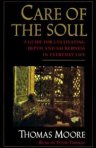
Thomas Moore: Care of the Soul

A Guide for Cultivating Depth and Sacredness in Everyday Life

Harper Collins, 1992

Amazon.com

Front Flap:

The book for our troubled times – a path-breaking lifestyle handbook that shows how to add spirituality, depth, and meaning to modern day life by nurturing the soul. Care of the Soul offers a new way of thinking about everyday life – its problems and its creative opportunities. It proposes a therapeutic way of life that is not a self-improvement project. Instead, its focus is on looking more deeply into emotional problems and sensing sacredness in ordinary things. The ancient model of “care of the soul” was rooted in religion and provided a sacred context for viewing the ordinary moments of everyday life. This new books brings “care of the soul” into the twentieth century and promises to deepen and broaden the reader’s perspective on his or her own life experiences. The author draws on his own life as a therapist practicing “care of the soul”, his studies of the world’s religions, his teaching of Jungian psychology and art therapy, and his work in music and art to create this inspirational guide that examines the connections between spirituality and the problems of individuals and society.

Back Cover Blurbs:

“From time to time I’ve been jolted by an extraordinary book which stops my world. It forces me to look at reality in a diferent way – a more expansive and meaningful way. Thomas Moore’s Care of the Soul is such a book. It has provided a missing piece for me. I soulfully recommend it without reservation.”  John Bradshaw, author of Homecoming

“This book just may help you give up the futile quest for salvation and get down to the possible task of taking care of your soul. A modest, and therefore marvelous, bokk about the life of the spirit.”  Sam Keen, author of Fire in the Belly

“Years pass; I get to read a lot of psychology but the sincerity, intelligence and style – so beautifully clean – of Tom Moore’s Care of the Soul truly moved me. The book’s got strength and class and soul, and I suspect it may last longer than psychology itself.”  James Hillman, author of Re-Visioning Psychology

“In his book, Care of the Soul, Thomas Moore reclaims the Soul for psychotherapy in a deeply moving way. He points out that our wounds offer not only a window that opens a view of our Soul, but also a door to enter its domain. Thomas Moore’s book is a brilliant, challenging and very encouraging voice in the psychotherapeutic world.”  Henri Nouwen, author of Making All Things New

Blurbs from the Harper Perennial edition, 1994:

“There is the depth and originality of Mr Moore’s observations…and a deeply consoling intelligence…that should draw many readers.”  Phyllis Theroux, New York Times Book Review

“Many thanks to Thomas Moore for these profound and timely insights…Genuinely inspirational.”  Kevin McCarthy, Bloomsbury Review

“Invigorating, demanding, and revolutionary.”  Publishers Weekly

“A wonderful book. It will do much to free the world of the medical model of psychotherapy and to help people treasure as individual poetry what they regarded as pathology.”  Polly Berrien Berend, author of Whole Child/Healthy Parent

Care of the Soul moved me deeply, in ways I only partially understand. It forced me to contemplate my own soul – its likes and dislikes, its particularity.”  Shepherd Bliss, Yoga Journal

“This is an enthralling text. One feels good just reading it…This book makes no claims to perfection: it is just a peaceful little island of good sense in a world where such a commodity is in all-too-short supply.”  Richard Poliver, Bookpage

“Thoughtful, eloquent, inspiring.”  Alix Madrigal, San Francisco Chronicle

“All too seldom one encounters a book as rich and thought-provoking as Care of the Soul…Like Shakespeare or the writings of Joseph Campbell, almost every page reveals a treasure.”  Jerry Pope, Journeymen

“Thomas Moore is an authentic example of a new kind of therapist – a doctor of the soul – which in our century has been in short supply.”  Larry Dossey, M.D., author of Meaning and Medicine and Beyond Illness

Back Flap (About the Author):

Thomas Moore is a psychotherapist and writer who lives in New England. He has published many articles in the areas of archetypal and Jungian psychology, mythology, and the arts. His books include The Planets Within, Rituals of the Imagination, and Dark Eros. He also edited A Blue Fire (HarperCollins), an anthology of the writings of James Hillman. Moore lived as a monk in a Catholic religious order for twelve years. He has a Ph.D. in religious studies from Syracuse University, an M.A. in theology from the University of Windsor, an M.A. in musicology from the University of Michigan, and a B.A. in music and philosophy from DePaul University. He is a leading lecturer and writer in North America and in Europe in the areas of archetypal psychology, mythology, and the arts.

Det punktuella självet

Taylor benämner det residuala själv som hos Locke består i det avskilda, tomma medvetandet och som icke minst, om än icke endast, genom substantialitetens bortfall innebär en tillspetsning av Descartes’ ståndpunkt, the punctual self. Detta själv saknar eget innehåll, och dess uppgift består i att genom “disengagement” objektivera inte blott yttervärlden utan även den egna kroppen och de egna tankarna, som därmed, liksom den yttre naturen, berövas den normativa giltighet som antikens kosmos ägde som del i och uttryck för det ontiska logos. Om den antika positionen var problematisk till följd av den generalistiska idéläran som ytterst låg till grund för det kosmoskonstituerande ontiska logos, i förening med det ändliga “subjektets” konstitutivt begränsade relativa, rationella perspektiv, var Lockes objektivering i likhet med Descartes’ illusorisk till följd av det senare.

Det punktuella självets uppgift är en instrumentell rekonstruktion av det empiriska materialet medels den proceduralt-metodiska rationaliteten såväl som självdisciplinen, och i enlighet med vad som uppfattas som den moraliska ordningens krav. Den senare ordningen förstås liksom hos Pufendorf i occamismens efterföljd som moralisk blott därför att den är ett uttryck för Guds vilja, men, fortfarande liksom hos Pufendorf, i motsats till occamismen dock också som begriplig genom det nya icke-kontemplativa mänskliga förnuft som uppfattar självbevarelsen som naturens lag och Guds vilja.

Detta själv som, som vi sett även Dupré framhålla i bl. a. Webers efterföljd, till skillnad från Augustinus’ själ saknar egen identitet och andligt innehåll, skapar fritt såväl en personlighet, en karaktär, som en ordnad, vetenskaplig kunskap (genom “representation”) av det empiriskt givna. Augustinus’ variant av interioritet, förstapersons-perspektiv och radikal reflexivitet är i grunden förvandlade. Taylor skriver:

“The subject who can take this kind of radical stance of disengagement to himself or herself with a view to remaking, is what I want to call the ‘punctual’ self. To take this stance is to identify oneself with the power to objectify and remake, and by this act to distance oneself from all the particular features which are objects of potential change. What we are essentially is none of the latter, but what finds itself capable of fixing them and working on them…It is assumed that something we call consciousness or self-consciousness could be clearly distinguished from its embodiment…The stance of detachment generates the picture of ourselves as pure independent consciousness, which underpins and justifies this stance and is the basis of the radical promise of self-control and -remaking it holds out.” [Sources of the Self, 171 ff.]

Här bör påminnas om att interioriteten, förstapersons-perspektivet och den radikala reflexiviteten är förändrade i lika hög grad, och i mycket t. o. m. på samma sätt, i den empiristiska och i den rationalistiska förgreningen av moderniteten. Men här handlar det inte primärt om syftet att kontrollera och förvandla den yttre naturen. Vi ser redan hur Taylor i motsats till Ayers lutar mot den “moraliska” tolkningen av Lockes personskap:

”The close connection between Locke’s subjectivist doctrine of the person and the prospect of self-making emerges in the discussion…where Locke tells us that ‘person’, which is our name for the self, ‘is a forensic term [o.s.v. enligt citatet i föregående avsnitt i denna serie]’…Locke is acknowledging…the close connection between our notion of the self and our moral self-understanding. Locke’s person is the moral agent who takes responsibility for his acts in the light of future retribution. The abstracted picture of the self faithfully reflects his ideal of responsible agency.” [Ibid. 173.]

Självet som substanslöst medvetande eller självmedvetande är alltså för Taylor i sig ett oklart “something”, och detta själv kompletteras enligt denna tolkning med “self-making” genom moralisk appropriation av empiriska egenskaper och handlingar, i linje med det renässansens projekt vi kort tittat på. Men Taylor påminner också om att med Lockes “ideal of responsible agency” även är förenat ett ideal för subjektets oberoende och, liksom hos Descartes, och med Husserls ord, “självansvar” i tänkandet och kunskapen, för frihet från traditionens, vanans och auktoritetens slaveri. Här går vi utöver det punktuella självets moraliska personlighetsskapande till dess övriga agerande, inklusive dess naturfilosofiska – vetenskapliga – kunskaps- och handlingsuppgift. Ansatsen liknar förvisso till en viss gräns en allmän kunskapsmässig aspekt av den platonska och aristoteliska, men skiljer sig genom den radikalitet som följer av bortfallet av den yttre kosmiska ordningens logosrestriktion och, framför allt, genom uppfattningen av rationalitetens nya procedurala metodiskhet.

För Platon kan vi ledas till insikt av någon som till skillnad från opinionen äger sann visdom. För Locke är förvisso målet, liksom för Descartes, alltfort insikt i sanningen om verkligheten. Men det är i tänkandets process, inte i dess innehåll, som rationaliteten ligger: “What we are called upon to do…is to think it out ourselves. As with Descartes, knowledge…isn’t genuine unless you develop it yourself…We are not just independent once we have achieved science; our whole path there must be radically independent, if the result is to be science.” [Ibid. 167 f.]

Det rationella handlandet befrämjar dock, i enlighet med puritanismens kriterium för varje giltig kallelse, samtidigt den egna självbevarelsen och det allmännas, samfundets helhets eller mänsklighetens väl. Locke lägger en grund för upplysningens och den klassiska liberalismens nya lära om möjligheten av egen- och allmänintressets harmoniska förening. I det den endast är inriktad på egen nytto- eller lyckomaximering, om än i teologiskt evighetsperspektiv, skiljer sig Lockes uppfattning om den legitima självkärleken förvisso från Augustinus’, men liksom denne räknar han dock också, trots sitt förnekande av arvsynden, med en illegitim, oförnuftig och förvrängd självkärlek. Det procedurala, lösgjorda förnuftet befriar oss från denna böjelse, samtidigt som det befriar oss till den legitima självkärleken och dess potential som i sin tur befrämjar såväl egen- som allmänintresset. [Ibid. 241 ff.]

Icke endast genom tron, lovprisandet och det tjänande arbetet i den egna kallelsen, utan i första hand genom denna förnuftets utövning fullgör vi nu Guds vilja och vår uppgift i Guds plan. Det nya förnuftet förstår Guds godhet som människans väl och självbevarelse, och evigheten, förstådd som blott en förlängning av denna existens (återigen noga taget helt i överensstämmelse med Bibeln och ortodoxin, och i motsats till platonismen), tjänar att befrämja den förnuftiga världsliga ordningen genom att med sina belöningar och straff tillhandahålla den nödvändiga motivationen för det förnuftiga och moraliska mänskliga handlande som befrämjar den individuella och kollektiva självbevarelsen. [Ibid. 244.]

Men grunddragen av en deistisk världsbild är därmed etablerade: “the universe as a vast interlocking order of beings, mutually subserving each other’s flourishing, for whose design the architect of nature deserves our praise and thanks and admiration”. [Ibid.] Uppenbarelsen kan ännu behövas – för att stödja förnuftet. Men nådens betydelse förminskas och försvinner. De varelser som ingår i den nya ordningen äger i kraft av sitt disengagerade förnuft en självständig värdighet, de är autonoma, självansvariga, fria från auktoriteters band. Därför blir det snart för deismen en central tanke att “God relates to humans as rational beings”, att “God’s purposes fully respect humans’ autonomous reason”. [Ibid. 245.] Teologin släpas med eller kan rentav sägas pietetsfullt förnyas som legitimeringsgrund för en ny, alltmer distinkt modern förståelse och gestaltning av det Mänskliga mandatet att Råda över den Goda Skapelsen.

John J. Mearsheimer & Stephen M. Walt: The Israel Lobby and U.S. Foreign Policy

Farrar, Straus and Giroux, 2007     Amazon.com
Book Description:
The Israel Lobby, by John J. Mearsheimer of the University of Chicago and Stephen M. Walt of Harvard’s John F. Kennedy School of Government, was one of the most controversial articles in recent memory. Originally published in the London Review of Books in March 2006, it provoked both howls of outrage and cheers of gratitude for challenging what had been a taboo issue in America: the impact of the Israel lobby on U.S. foreign policy.
Now in a work of major importance, Mearsheimer and Walt deepen and expand their argument and confront recent developments in Lebanon and Iran. They describe the remarkable level of material and diplomatic support that the United States provides to Israel and argues that this support cannot be fully explained on either strategic or moral grounds. This exceptional relationship is due largely to the political influence of a loose coalition of individuals and organizations that actively work to shape U.S. foreign policy in a pro-Israel direction. Mearsheimer and Walt provocatively contend that the lobby has a far-reaching impact on America’s posture throughout the Middle East – in Iraq, Iran, Lebanon, and toward the Israeli-Palestinian conflict – and the policies it has encouraged are in neither America’s national interest nor Israel’s long-term interest. The lobby’s influence also affects America’s relationship with important allies and increases dangers that all states face from global jihadist terror.
Writing in The New York Review of Books, Michael Massing declared, “Not since Foreign Affairs magazine published Samuel Huntington’s The Clash of Civilizations? in 1993 has an academic essay detonated with such force.” The publication of The Israel Lobby and U.S. Foreign Policy is certain to widen the debate and to be one of the most talked-about books of the year.
Reviews:

“Controversial.”  Terry Gross, Fresh Air, NPR

“It could not be more timely.”  David Bromwich, The Huffington Post

“The strategic questions they raise now, particularly about Israel’s privileged relationship with the United States, are worth debating.”  David Remnick. The New Yorker

“Ruthlessly realistic.”  William Grimes, The New York Times

“The argument they present is towering and clear and about time.”  Philip Weiss, Mondoweiss.com

“Mearsheimer, a political scientist at the University of Chicago, and Walt, on the faculty at Harvard, set off a political firestorm.”  Jay Solomon, The Wall Street Journal.com

“Promises controversy on a scale not seen since Samuel Huntington’s Clash of Civilizations sought to reframe a new world order.”  Stefan Halper, National Interest.com

“Deals with Middle East policymaking at a time when America’s problems in that region surpass our problems anywhere else . . . People are definitely arguing about it. It’s also the kind of book you do not have to agree with on every count (I certainly don’t) to benefit from reading.”  M.J. Rosenberg, Israel Policy Forum Newsletter

About the Authors:
John J. Mearsheimer is the R. Wendell Harrison Distinguished Service Professor of Political Science and the co-director of the Program on International Security Policy at the University of Chicago. He has published several books, including The Tragedy of Great Power Politics.
Stephen M. Walt is the Robert and Renée Belfer Professor of International Affairs at the John F. Kennedy School of Government at Harvard University, and was academic dean of the Kennedy School from 2002 to 2006. He is the author of Taming American Power: The Global Response to U.S. Primacy, among other books.

Idealism and the Renewal of Humanistic Philosophy, 4

Idealism and the Renewal of Humanistic Philosophy, 1

Idealism and the Renewal of Humanistic Philosophy, 2

Idealism and the Renewal of Humanistic Philosophy, 3

The basic idealistic insight regarding what could be called the experiential whole can be traced back to the first beginnings not only of idealism in Germany, but of the new aesthetic ideas of romanticism in a broad sense. This insight is common to the more “complete” idealism I seek to defend, which synthesizes the Platonic tradition with the partial truths of modern idealism, and the latter form of idealism in itself. It is well described by Folke Leander and Claes G. Ryn in their selective defence of idealism as part of their so-called value-centered historicism. Here as elsewhere, I will build partly on their account. But I will relate it to the work of a wider range of idealist thinkers, draw out its implications of a more complete absolute idealism, and indicate briefly the difference made by the distinct positions of personal idealism or personal absolute idealism.

The discovery of wholes, inspired by the new view of the active and synthetic imagination, was decisive for the reaction against the sensationalistic materialism of the Enlightenment and its dissolution of experience into impressions and associations, and had implications for the whole field of humanistic knowledge and thought.

The post-Kantians and the romantics, perceiving the absence in Kant of a critique of his own critical reason, moved on from his abstractly and rationalistically conceived synthetic wholes to discover, along with the properly creative imagination, the primacy of real, concrete, non-conceptual experiential wholes – moral, aesthetic, and philosophical. Coleridge’s concern was the transcendental deduction of the imagination, i. e. to show that it is a necessary part of the categorical network that constitutes the mind. This imagination orders our experiential wholes and the symbols of the infinity in which everything experienced exists and from which it is separated only by the abstractive operations of reason in the sense that the Germans, less felicitously, designated by the term Verstand and Coleridge, equally unfelicitously, the Understanding.

The insights were now fully expressed that there are no atomic “facts” related only externally to each other, that facts have whatever meaning and reality they have only because of the relations within experiential wholes, that everything is to be understood in terms of its essential relatedness, and that ultimately there is meaning only in relation to the largest whole. The idealist understanding of experience, distinct from both rationalism and empiricism, was soon fully elaborated. Everything has to start from the direct experiential awareness of the flow of life, unmediated by formulas and laws, a flow which is more fundamental and real than any of the conditional modes of experience, as Oakeshott calls them.

I should add here that the expression “flow of life”, used by Leander and Ryn, does not for me signify an endorsement of those expressions of the “philosophy of life”, from romanticism to Dilthey and beyond, which rejected idealism as mere “school philosophy” and sought something else beyond it. Indeed, I find this to be a shared error of the philosophical currents of phenomenology, existentialism and hermeneutics. Although the case is not as serious as that of the analytic philosophers, their rejection of idealism still seems to me often superficial and stereotypical, not seldom based on sheer misunderstanding and spatio-temporally parochial, incomplete assimilation. The work of the philosophers in these traditions contain important insights, but they need to be reconnected to a properly understood and reformulated idealism. The broad metaphysical horizons opened up by the renewed idealist tradition in the nineteenth century, with their great potential not least in the field of comparative studies, need to be restored.

Such an idealism includes but also transcends the insights formulated by Leander and Ryn. Supplemented or qualified by the insights of degrees of reality, truth, and value, and of the perspectival relativity and the possibility of error that follow from a clear distinction between the finite and the infinite subjects of the kind insisted on by the personal idealists, it seems to me that to assert with a more complete idealism that reality is identical with experience, that appearances are real, not illusions, and that experience is self-authenticating, not guraranteed by anything more fundamental, since there is nothing more fundamental, might be admissible. To be real is to be in experience, and every experience is part of or content of consciousness. And the full understanding of what this implies makes it clear that it is not at all a matter of a subjectivist imperialism or reduction of the being of things.

Ultimate reality, on this view, is experience as a whole, the ordered sum of appearances or of what exists, or the experience of this totality – which we can of course conceive of only imperfectly – in which all partial perspectives are overcome. This is one aspect of the absolute. The absolute, the ultimate reality, is absolute experience. Truth is this reality itself, the whole of reality or the absolute. We can in a sense understand that this is so although our own experience as finite is only partial and relative. The absolute is the ultimate standard of truth, reality, and value. Truth is in this perspective ontological rather than semantic, and not only a property of propositions or judgements. These are always distinct from the whole and partial, they are, in their own way, true as partaking of the authority of the whole.

Human thought progresses by stages or moments in its understanding of reality, although Hegel, the Hermeticist, is mistaken in his suggestion that it can actually reach a final completion of self-realization in the Idea, the point at which, in complete knowledge, it grasps its true identity with the Whole. He is right that, to the extent that and in the cases where progress takes place, each successive moment, though defective, contains a greater measure of truth than its predecessor, that each stage represents a provisional coherence until reason, exposing its inchoateness, ascends to the next platform of understanding in an evolutionary hierarchy, and that in relation to the absolute the stages differ in degree rather than kind. There are, generally speaking, degrees of abstraction and mutilation, an ascending scale of validity.