Loreen: Euphoria

Today I have been informed that we (Sweden) won the Eurovision Song Contest. I have only occasionally heard songs from this contest over the years. I remember no more than two or three good ones, although there must have been more which I would need to listen to again. I have definitely noticed – and fortunately often forgotten – a considerably greater number of truly horrible ones, in the last few decades not seldom so embarrassing as to be almost unbelievable.

Elsewhere I have discussed and formulated my views both about the various genres of popular music and about the phenomenon of rating and grading of songs of the kind with which we have to do in the ESC, and I will not repeat it here, except for the basic point that when I write about these things, I intend it to be a matter of consistent application of the same aesthetics and criteria I use in the case of other music and indeed other art forms: this area should not be neglected, the paucity of real criticism leaves it to deteriorate further into a cultural wilderness.

I have now studied this year’s winner on YouTube. I don’t know anything about those who wrote the song, ‘Euphoria’ (Thomas G:son and Peter Boström). I had never heard or even heard about the singer, Loreen. And so I was surprised and impressed by her performance in the opening and first part of the song. The presence, emotion, warmth, and soul in the first lines seemed to promise something extraordinary, almost sublime, within the parameters of the genre. “Why, why can’t this moment last forevermore? / Tonight, tonight eternity’s an open door / Noah, don’t ever stop doing the things you dooah / Don’t go, in every breath I take I’m breathing you”.

But it is unfortunate that all or most of the songs are now in English, and that also for other reasons they now seem for the most part not to express anything of the cultural distinctiveness of the participant countries (not that they always have to do so: in this case the singer has Moroccan origins and would probably be very good if she did something Moroccan). The contest is in this respect becoming a true symbolic expression of what the European Union is unfortunately about.

But for now, I have to disregard this. The romantic theme of love felt to open towards a level or dimension of the spiritual is not extraordinary, but Loreen’s opening is passable and it could certainly be developed lyrically in harmony with the mood she and the song conveys and really incarnates in this first verse. These qualities persist also when she begins the chorus – “Euphoria / Forever till the end of time” – for the first time. This was surprising; I didn’t think Eurovision performances were of this quality any longer.

The problem is that the song doesn’t go anywhere from this point. The predictable beat machines then start beating their monotonous beat. I shouldn’t be too categorical about them. I think they have sometimes “worked” in a sense in the past, in some Euro disco and Euro dance, for instance, where they could under favourable compositional and melodic conditions contribute to a certain cold beauty. But by now their use is generally much too undistinguished. It should be acknowledged that the way they here stop abruptly after the chorus and at the beginning of each verse, to be followed by what is almost a brief silence, is interesting and sets the song apart from many others. Yet they still tend to kill the potential magic of Loreen’s personal style. The lyrics, of the chorus as well as the following verses, do not develop the song’s theme on a sufficient level of quality, and their content is not matched by any further musical progression.

Loreen sings about how she and her lover, Noah, are “going up up up up up up”, that their euphoric love is “an everlasting piece of art”, that they “sail into infinity”, that they are “higher and higher and higher” and “reaching for divinity”. But the music doesn’t go higher. The “up up up up up up” part is really weak, both in terms of lyrics and melody. The whole chorus is mediocre. One cannot lyrically express euphoria by simply repeating the word. The idea of focusing the whole chorus on this feeling alone, the passionate singing of the mere word for it, is misconceived, much too simple. And again, musically there is nothing in the song beyond what was there in the first verse and chorus – and was much better there, before the commonplace, mechanical beat.

A third compositional moment with a true transcendent lift-off of the kind the opening made us expect is missing – or, if that would make the song too complex for Eurovision, at least a better chorus containing this. Instead, all that is added is the trite beat. When it stops for the second and the short third verse (it is not a problem that the verses are somewhat amorphous and asymmetrical), one hopes the song will recover, as it were, but unfortunately the performance is then suddenly weaker in another decisive respect: it is difficult to hear most of the words Loreen sings.

The performance also, like almost all Eurovision songs in recent times as I understand it, relies much too heavily on dance and movement. This is simply an empty, spectacularist substitute for quality songwriting and musical talent. But at least Loreen’s sitting down on the floor (or podium) during the second and third verse is fine, genuinely expressive, feminine, intimate, and would have been even more so if the words could be heard and were better crafted. The qualities of the beginning could have been further developed.

The choreography of the chorus tends to confirm, however, that its expressiveness is of a different kind, much too much of the common vulgar histrionics of strong passion or sublime emotion without lyrical, musical and emotional basis or credibility. This is certainly not the pits of a Whitney Houston (I am sorry to have to express myself like this about the recently departed singer). But it is also quite far from, for instance, Céline Dion’s two good songs, ‘Pour que tu m’aimes encore’ and ‘Je sais pas’.

With these weaknesses, ‘Euphoria’ cannot be said to be a particularly good song. Nonetheless, I will now try to find out more about Loreen and what she has done before. The promise of the beginning of this song may be hard to forget. For a little while, Loreen’s whole appearance seemed to point beyond the aggressive vulgarity of the event. To say “I love you Bakuuuu” after the song seemed misplaced, and detracted from the overall effect. (Perhaps all Eurovision singers do such things nowadays?) But the way she looked at the audience just before that made me think again about the beginning, and feel, despite the disappointment, that Loreen might have genuine artistic talent and could now go on to do other and greater things. There was, one hopes, more than cheap and crude entertainment in those eyes.
Idealism as Alternative Modernity, 3

Idealism as Alternative Modernity, 1

Idealism as Alternative Modernity, 2

While the continuity of its Schellingian and Hegelian versions with the esoteric tradition is today obvious, and other continuities stressed by Muirhead and others are certainly not unimportant, modern idealism in the German post-Kantian and the Anglo-American line is often, perhaps even generally, of a different kind, and introduced new and other elements. In my paper at the Idealism Today conference at Oxford in 2005, ’Idealism and the Renewal of Humanistic Philosophy’, I defended what I find to be the general truths in those lines of idealism. When I speak of idealism as alternative modernity, I have in mind primarily those truths, but I am strongly inclined to emphasize a need for a broader concept of idealism for this purpose too, an idealism reinforced, as it were, by the ”Berkeleyan”, esoteric, Platonic, and Vedantic elements that were decisive for my own early intellectual formation.

In most of those forms, idealism represents, and ever since antiquity in the case of some of them, an alternative to certain historically context-specific exoteric developments of Christian orthodoxy. Because of this, it often tended to become intrinsically and constitutively a part modernity, and both its rationalist, scientific, Enlightenment variation and its romantic one (as I have defined those terms in several publications). Scholars sometimes rightly focus on Hegelianism in the context of the question of the so-called legitimacy of modernity, but their interpretations of both Hegelianism and modernity for the most part seem, as in the case of Robert Pippin, unduly reductive. What is at stake, I suggest, is in reality much broader metaphysical and spiritual concerns.

Although it is perhaps partly because of my ”reinforced” idealism that I have never been able to see the various attempted refutations of idealism in the twentieth century as even very noteworthy, let alone convincing, I insist, as in my Oxford paper, that there are central insights of modern, specifically German idealism and its variations in the Anglo-American “empire of idealism” which are still very much valid, relevant, and indeed simply true, and not just of historical interest. The historical scholarship that dominates the presentations at these conferences help transmit that legacy even as most participants are not themselves thoroughgoing idealists, as it were.

Anglo-American idealism scholars long tended, and quite naturally, to focus on the attack of the analytical philosophers, and to a much lesser extent on the attack of phenomenologists, existentialists, and neo-Thomists. But no less important, I think, is to take a closer look at the efforts of, by now, generations of liberal political philosophers and Marxist historians of various stripes to try to isolate an admissible idealist prehistory of their own liberalism and Marxism and dismiss other important elements of idealism as exclusively part and parcel of the German so-called Sonderweg. Many of the latter elements, as characteristically analysed in works such as Fritz Ringer’s influential The Decline of the German Mandarins, entered into Anglo-American idealism too, even as the latter significantly modified them in accordance with the differences in their cultural traditions and mentalities. Much greater discernment is required for the understanding of idealism – in all its worldview ramifications, not just in philosophy but for the understanding of culture, history, politics, and religion – in Germany and in other European countries.

This is so not least in view of the factual historical course taken by modernity. Did idealism in my broader sense produce the modernity that, in time, turned against it? In my paper at the International Conference on Anglo-American Idealism in Pyrgos, Greece, in 2003, I explored this problem, and argued that, largely because of the opposition to the mentioned developments of Christian exotericism, the broader idealism (before the specific modern versions were developed) often turned into what I called a ”pantheistic revolution” which, because of its inner dynamic, generated the problematically one-sided versions of rationalism and romanticism which have come to determine the shape and substance of the main form of modernity.

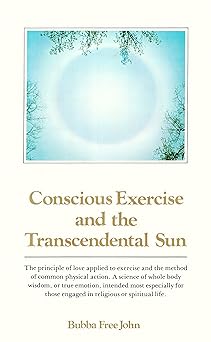
Bubba Free John: Conscious Exercise and the Transcendental Sun

The principle of love applied to exercise and the method of common physical action. A science of whole body wisdom, or true emotion, intended most especially for those engaged in religious or spiritual life.

Prepared in collaboration with Bubba Free John and based on his written and verbal instructions

The Dawn Horse Press, 1974; third edition, revised and expanded, 1977

Back Cover:

“Conscious exercise” is a “technology of love”, an approach of radiant feeling-attention, that can be applied to all systems of physical exercise, all games, all play, and all ordinary activity.

We all know, natively and bodily, what it is to look and feel and be and act completely happy. We have done so in moments when we felt we had good reasons. Conscious exercise is simply a way of practicing this whole body happiness under all conditions, without reason. It utilizes the natural laws of body, breath, and attention to realign us, consciously and instantly, with the “Transcendental Sun” – the cosmic dimension of manifest light and life-force, or the all-pervading foundation energy of the physical and super-physical universe.

The disciplines offered in this book include basic ways to stand, sit, walk, and breathe with energy and delight; brief and natual routines of calisthenics, hatha yoga, and surya namaskar; and a basic practice of pranayama, or control of life-force in breath that can be done at random throughout the day.

Bubba Free John is a living, Western-born Spiritual Master. Conscious Exercise and the Transcendental Sun is a manual for those who practice the whole spiritual Way that he teaches, the Way of Divine Ignorance, or Radical Understanding. But this balanced and immensely pleasurable approach to exercise can be learned and practiced by anyone of average health, and it can easily be taught to children as well. Conscious exercise is also particularly suited to those who are involved in a religious or spiritual view of life, and who want that view to make a practical change in their manner of living.

Descartes

För att på tydligaste sätt klargöra den av Taylor betonade men ifråga om dess fulla innebörd inte fullt belysta skillnaden mellan Descartes och Augustinus, eller snarare mellan Descartes å ena sidan och den mer allmänna och vidare klassiska platonska traditionen och den av denna tradition inspirerade tidiga kristna andligheten å den andra, såväl som för att, med denna skillnad, mer fullständigt beskriva ett avgörande moment i modernitetens huvudströmning som specifik neoterism, vill jag här föra in den s.k. “traditionalistiska skolans” perspektiv genom att tillhandahålla en liten samling citat från Tage Lindbom.

Lindbom framhäver – liksom ifråga om senare epoker ensidigt, men just därigenom tydliggörande på ett sätt som äger värde för förståelsen av vissa grunddrag i moderniteten – med eftertryck renässansen som sekularisering, materialism, mänsklig-jagisk förhävelse. De teoretiska och samhälleligt-praktiska portarna öppnas för de faktiska intressen som formar moderniteten, den blotta mänskliga makt- och luststrävan. Lindboms analys av modernitetens två vingar överensstämmer i mycket med, men går också på grund av de skilda utgångspunkterna utöver Irving Babbitts, som jag diskuterat utförligt på annat håll:

“Avstängd från den transcendenta sanningens friska källor, oförmögen att i ljuset av intellectus objektivera den värld i vilken vi lever, måste den sekulariserade människan lita till de mentala resurserna, främst förnuftet och känslan. Men dessa två lever ingalunda ett självständigt, från varandra skilt liv. Att leva uteslutande i rationalismens iskalla värld vore outhärdligt. Lika outhärdligt vore ett tillstånd, vari känslan skulle kunna fördriva varje förnuftig tanke. Förnuft och känsla blandas därför med varandra, de griper i varandra på ett sätt, som ofta gör det näranog omöjligt att avgöra vad som är det ena och vad som är det andra…Rationalismen och sentimentalismen följs åt som skuggan följer kroppen.”

Det cartesianska projektet kan därför inte förstås åtskilt från den andra sida av moderniteten vars motsats det vid en ytlig betraktelse framstår som:

”Att tänkandet vore en ‘ren’, från varje ‘slagg’ befriad vandring i rationalismens klara ljus, är en myt. I de diskursiva tankeprocesserna ingår minne, fantasi och känsla som nödvändiga beståndsdelar. Ett i cartesiansk mening förutsättningslöst, objektivt, värdefritt tänkande existerar därför icke…Människoriket [Lindboms term för den sekulariserade moderna världen] tvingas in i en subjektivism, vari de två flodfårorna, rationalismens och sentimentalismens, blandar sitt vatten.” [Agnarna och vetet (1974), 67 f.]

Avvisandet av den prerationella kunskapen innebär, skriver Lindbom, icke blott att människan skulle vara sämre utrustad än djuren – vilkas instinkter vittnar om denna kunskaps förefintlighet – utan också att “endast den enskilda människans uppfattning om vad som är sant och rätt, grundat på den sinnliga erfarenheten och den rationella prövningen, skall gälla. Därmed är subjektivismen proklamerad. Ingen högre, allmängiltig sanning skall erkännas.” [Ibid. 80.]

Den västerländska vetenskapen, “filosofiskt-metodiskt fulländad av Descartes, har frambragt ett kunskapens landskap, som för det första genomför skilsmässan himmel och jord och för det andra genomför en skilsmässa mellan tanken, det mänskliga subjektets rationella betraktande, och tingen, den sinnliga tillvaron som objektet, föremålet för detta subjektiva betraktande.” [Före solnedgången (1993), 111 f.]

Descartes “bringar till vetenskapsteoretisk fullkomning” den illusoriska uppfattningen att “människan nu nått fram till en objektivitet, hon är en iakttagande, materialsamlande, mätande och logiskt granskande varelse, och framför sig har hon en tinglig värld som sitt forskningsobjekt”. [Bortom teologin (1986), 21.] Men i verkligheten

“förhåller det sig på ett motsatt sätt. Det profana kunskapsbegreppet innebär, att människan flyttar in i en ren subjektivitet, förlitande sig på sina sinnliga organ, främst förståndet. Hon glömmer därvid att alla hennes organ är bundna till den fysiska och psykiska världen, därmed bundna till denna världs former, begränsningar, motsägelser. Våra mentala organ kan aldrig fatta och fånga i sin totalitet denna värld och än mindre dess väsen. Ty delen kan ej fatta helheten.” [Ibid.]

Och “Den kunskapsgrund, som vårt profana, jordiska vetande vilar på, förhållandet mellan en iakttagen tinglig värld, ett ‘multiversum’ av ‘fakta’, och ett iakttagande jag med dess mentala organ – detta leder förvisso till en myckenhet av mänskligt vetande. Men detta vetande vilar ej på en grund av total objektivitet, det är ett vetande, som är bundet till det relativa, till den relativa sanningen och ej till den absoluta Sanningen.” [Mystik (1990), 26.]

Descartes ser liksom Occam

“den profana vetenskapens landskap framför sig: den forskande människoanden, res cogitans, är subjektet, och dess objekt är den tingliga världen, res extensa…Men människan har också en vegetativ komponent…Människan vill lust och söker undvika plågorna, och därför måste livet bli ett kalkylerande med sinnesnjutningarna som ledstjärnor…Rationalismen och sensualismen blir de två mentala flöden, de två medvetandeformer, vari sekulariseringen flyter fram genom den västliga världen. Det mänskliga högmodet, superbia, den första och den största av de sju dödssynderna, är i växande, och det är under 1700-talet, som människan börjar umgås med den föreställningen att hon inte blott är ett jordiskt maktsubjekt utan också i sin självupphöjelse börjar ifrågasätta den mångtusenåriga visdomen, att skapelsen är en formbunden och därmed motsägelsefylld ofullkomlighet. Nu börjar människan tro att hon lever i en ‘gränslös värld’ och därför finns det inte heller några gränser för mänsklig makt. I denna växande narcissism framträder Människan och Mänskligheten som ett abstrakt tvillingpar”. [Demokratin är en myt (1991), 10 f.]

Den cartesianska revolutionen sker samtidigt som “i barocktidens monarkiska maktsträvanden den mänskliga naturen blir föremål för en psykologisk bedömning”, och den mänskliga egoismen visar sig därvid nödvändiggöra Hobbes härskarfördrag: “Den alltigenom profana mänskliga naturen har därmed fått ett maktpolitiskt uttryck: den monarkiska diktaturen.” [Före solnedgången, 87.]

Den moderna tänkandet kring subjektiviteten är emellertid mer komplext än så. Även de moderna formerna av platonism, även de moderna formerna av idealism lämnar sina bidrag till subjektivitetsförståelsen, och dessa kan inte alltid inordnas under Lindboms karaktäristik. Viktigt i Lindboms kritiska analys är hursomhelst klargörandet av hur Descartes fullbordar Occams åtskiljande av Gud och världen, och arten av den subjekt-objektrelation som kommit till uttryck i Descartes filosofi – gemensam för den nya rationalismen och den nya empirismen hos Francis Bacon – och som har till förutsättning upphöjandet av det mänskliga ratio och förnekandet av det illuminativa intellectus.

Detta senare förnekande innebär att människan inte längre äger tillgång vare sig till transcendensens eller immanensens verklighet (endast i det intellektiva ljuset vinner hon nämligen enligt Lindbom sann kunskap också om de skapade tingen), att hon nu endast kan tala om “sin uppfattning om tingen. Hon är fången i en subjektivism, en idealism, som tvingar henne, även om förtecknen är aldrig så vetenskapliga och faktasamlandet aldrig så matematiserat, till ett spekulerande, som ej står i förbindelse med en objektiv verklighet”: [Jakobs dröm (1978), 169.] “Descartes’ beskrivning av den tänkande människan och den tänkta, livlösa materian, res cogitans och res extensa, är en spekulativ dröm om det mänskliga förnuftet, ratio, som en absolut andlighet, vars fullkomnande är Gud själv.” [Mellan himmel och jord (1970), 131; Lindbom skriver också att “I denna rena andens värld kan alltså människan uppfylla ormens löfte i paradiset: att bli lik Gud.” Före solnedgången, 57.]

Men detta är en illusion, ty “människan är icke en åskådare, hon är en deltagare i livets motsatsspel, och ur detta motsatsspel kan hon icke lyfta sig upp med sina egna krafter till den upphöjda objektivitet som Descartes föreställde sig”. [Mellan himmel och jord, 131.]

Genom reduktionen av själen till den rationella tanken och genom parallellställandet av det tänkande subjektet med det tänkande objektet “öppnas de filosofiska portarna till profanvetenskapens genombrott. Världen har nu förvandlats från Guds skapade verk till en filosofisk modell.” [Tankens vägar (1982), 29.] “Subjektivism och rationalism, det är två element hos den tvivlande människan. Den sanning vi skall nå finns inte bakom oss, aprioristiskt, den finns framför oss, vi skall nå den genom att starta från tvivlets nollpunkt och på de vägar det rena, rationella tänkandet anvisar.” [Före solnedgången, 54 f.]

Genom uppdelningen i en “andlig” och en materiell värld, där “den förra, subjektet, betraktar den senare, objektet, har Descartes…skapat ett vetenskapligt landskap, som i sin slutenhet ger vetenskapen och det rationella positivistiska tänkandet ett verksamhetsfält”. [Ibid. 57.] Naturen är icke längre en skapelse, en del i och omsluten av den metakosmiska och transcendenta totalitet, som är den gudiga verkligheten, och genomlyst av den ur denna transcendens härflytande andlighetens ljus. Den är nu en rent jordisk kategori, vilket innebär att “det som står över naturen förklaras tillhöra ‘det övernaturliga’, alltså det om vilket vi intet vet”. [Ibid. 58.]

“Eftersom Descartes förvandlar naturen till en jordisk kategori”, heter det vidare,

“förnekas det skapade verkets transparens, dess sakralitet, att Gud kan ‘skådas’ i sitt verk. Därmed blir den moderna profanvetenskapen, vars filosofiska och metodologiska grundläggare är Descartes, en luciferisk revolt, och i denna revolt är det inte minst viktiga förnekelsen av tillvarons genomskinlighet. Då den skapade världen förklaras vara ‘solid’, ingenting annat än en sinnlig substans, betyder det att vår kunskap blir reflexer av fenomenvärlden. Det intellektiva ljuset, intellectus som universell kunskap, utestängs därmed. Den rationella kunskapen som en reflex av sinnevärlden måste då förankra sig i sin egen subjektivitet.” [Ibid. 61 f. En analys av Descartes återfinnes också i Riket är ditt (1981), 106-17.]

Lindboms djupare perspektiv på och större grepp om det karaktäristiska i modernitetens centrala tankeriktningar måste för den fullständigare förståelsen finnas med i den fortsatta diskussionen av den idealistiska personalismens historiska bakgrund.

Immanence, Transcendence, and the Individual

With the coming of the Hellenistic and Roman empires and with the spread of Christianity, the stage of the Greek form of collectivity was over, and the responsibility for thinking and acting in accordance with the differentiational insights came increasingly to rest on the individual.

The insights of what Voegelin calls the metaxy, as radiating from the philosophers and prophets, had long shaped the ethos of the collectivities, but the starkness of the tension in which the individual had been placed now became more evident. With the new social, cultural, and political significance of the individual, the awesomeness of the experience of transcendence, the clarity and depth with which its demands on the individual were revealed, made the latter even more aware of the imperfection both of the order of the wordly sphere, including its political structure, and of his own human nature. He stood ever more inescapably before a new chasm between the perfection of transcendence and the imperfection of immanence. And it was only he himself who perceived it; it was only in himself that their intersection was apparent. Reaching towards transcendence through his spiritual nature, the individual was yet conditioned and bound by his physical nature to the sphere of contingency, transience, sin, and evil.

But further, vast issues of how the two spheres were related had also inevitably arisen in the process of differentiation. To what extent could the experience of transcendence influence the world? What was the nature of divine immanence and its relation to divine transcendence? The experience of the metaxy did imply a duality, but could not simply be translated into a philosophy of man in relation to a new stark dualism.

Despite the adverse cultural conditions of the collapsing Roman empire and the lands beyond its borders, it was possible through the spread of the new revelation of Christianity to establish socially and institutionally much of the awareness of the metaxical human condition. The legacy of the differentiational cultural history of Israel and Greece thus shaped the emerging post-classical civilization of Europe. The new teaching of the Incarnation made the polar opposites seem to have been in a certain sense or in a certain way harmonized. In one decisive instance, the dichotomy was overcome through God’s grace. It became clear that through the instantiated grace, it was possible for the human individual successfully to live in two worlds, or between them. The difficult identity of human individuality became easier to accept, the identity which required acceptance of the tension and the responsibility of freedom.

In this space of freedom opened up by differentiation, and through the existential and moral choices exercised in it, personal individuality could thus begin to emerge. Through the translucent personal concreteness of the life of Christ, it became clear that divine transcendence stood in relation to the individual human being, not to the impersonal structures and institutions of the earthly order. It became clear that the individual had gained a new independence. He should no longer fall back into the pantheistic, cosmic unity, no longer be reduced to a mere dependent cell in its organic, impersonal whole. He was individually open to transcendence; religiosity no longer consisted in identification with the smaller or larger group; it was something that addressed his own existence, potentialities, decisions. He alone could be saved. It was seen that he was now really dependent primarily upon transcendence. It was not that divine immanence was denied. Voegelin’s discussion of this seems incomplete; divine spiritual nature was certainly still seen to permeate the created or natural world. But it was no longer simply identical with it.

Descartes och Augustinus

Filosofins och vetenskapens nya uppbyggnad företas hos Descartes utifrån det ensamma tvivlande och tänkande subjektet som enda kvarstående certum. Om subjektet som det opersonliga tänkandet delvis fortfarande har drag av den aristoteliska anima intellectiva, har det dock en annan uppgift än att vinna kunskap genom att abstrahera fram allmänbegreppen ur tingen. Med uppfattningen av jagets självmedvetna tänkandes innehåll som naturliga, medfödda idéer, genom tanken i sig, som sådan, givna sanningar, genomför Descartes också den nya tidens psykologiska och epistemologiska användning av termen idé: den börjar betyda föreställning och medvetandeinnehåll i allmänhet, och närmare bestämt det som återstår efter det metodiska tvivlet och som kan analyseras som innehåll i cogitatio.

Skillnaden mellan Augustinus och Descartes ligger främst i Descartes’ förnekande av vad Taylor kallar det “ontiska logos” som Augustinus ännu bejakar. Det ontiska logos, motsvarande den klassiska idéläran med dess “self-revealing reality”, ersätts i den nya tidens vetenskap av uppfattningen av kunskap som föreställning eller “representation”. Det är dessa föreställningar som nu benämns idéer, och de är inte blott belägna inom subjektet, utan deras ordning och sammanhang är också något som till skillnad från de klassiska idéernas, som helt enkelt återfinnes eller upptäcks av subjektet, nu också konstrueras av subjektet självt. [Sources of the Self (1989), 144-45.]

Cusanus’ lära om vis assimilativa utvecklas hos Descartes till läran om cogitatio – Taylor (som dock tyvärr förbiser Cusanus) framhåller hur redan Augustinus framlyft det etymologiska sambandet mellan cogitare och cogere (samla, sammanställa, sammanhålla). [Ibid. 539, not 4.] Vetenskaplig kunskap är kunskap om eller kunskap möjliggjord av “klart och tydligt” förnumna, och därför sanna, sådana idéer. Föreställningarnas sanning är givna med deras évidence. Bevetenhetens innehåll är för Descartes inte givet genom illumination, utan med det mänskliga tänkandet självt.

Med den klassiska idélärans förkastande förändras, framhåller Taylor, kriteriet för människans rationalitet och själens inre ordning från överensstämmelse med idéernas ytterst av det Goda bestämda ordning till evidensen hos de egna idéerna och deras metodiskt, systematiskt organiserade verklighetsrepresentation: rationaliteten “is no longer defined substantively, in terms of the order of being, but rather procedurally, in terms of the standards by which we construct orders in science and life…For Descartes rationality means thinking according to certain canons. The judgement now turns on properties of the activity of thinking rather than on the substantive beliefs which emerge from it.” [Ibid. 146 f.]

Detta är det nya fokus på la méthode. Naturligtvis menar Descartes att “his procedure will result in substantively true beliefs about the world”. Men detta är “something which has to be established…We make the link between procedure and truth with the proof that we are the creatures of a veracious God…Rationality is now an internal property of subjective thinking, rather than consisting in its vision of reality…The move from substance to procedure, from found to constructed orders, represents a big internalization.” [Ibid. 156.]

Men fokuserande på interioriteten vill Taylor ändå fortfarande lägga stor tonvikt på likheten och kontinuiteten med Augustinus: “Plainly the whole Cartesian project owes a great deal to its Augustinian roots”. [Ibid.] Men att tala om hela projektet här känns kanske litet överdrivet; skillnaderna är väl lika uppenbara.