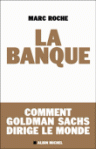
Marc Roche: La Banque

Comment Goldman Sachs dirige le monde

Albin Michel, 2010     Amazon.fr

Prix du livre d’économie 2010

Présentation de l’éditeur:

Une nouvelle puissance a surgi sur la scène mondiale. C’est celle d’une banque privée ultrasecrète.

Créé en 1869 cet établissement s’est longtemps contenté d’exercer son métier de banque d’affaires, avant de spéculer sur tous les marchés (boursiers, matières premières, or, produits dérivés…).

Depuis une dizaine d’années ses dirigeants ont pénétré les cercles les plus fermés de Washington. Et le krach de septembre 2008 est arrivé, faisant disparaître leur principal concurrent, Lehman Brothers. La “maison Goldman” est alors devenue à ce jour la banque la plus prospère de l’histoire.

Conseiller des Etats on l’a vu récemment avec la Grèce mais il y a d’autres pays concernés recruteur du staff du président des Etats-Unis Bush hier, Obama aujourd’hui , interlocuteur des grandes organisations internationales et du FMI, Goldman Sachs est au centre d’une gigantesque toile d’araignée. Aujourd’hui mise en cause pour avoir trahi ses clients, la banque reste une puissance, une pieuvre tentaculaire disent ses détracteurs.

Pour la première fois cette passionnante enquête livre un récit riche d’anecdotes sur les rapports de force entre le capitalisme et les gouvernements du monde entier et dresse le portrait de ses redoutables dirigeants, et notamment celui de son président, Lloyd Blankfein.

2ème édition, Points, 2011:

Le culte du secret : voilà ce qui fait la force de Goldman Sachs, la Banque d’affaires la plus puissante du monde. Journaliste à Londres, l’auteur met au grand jour les rouages sulfureux de cet empire financier qui peut faire basculer les gouvernements. OPA brutales, spéculation à outrance, relations secrètes avec de grandes multinationales : cette enquête très documentée livre un récit riche en anecdotes sur de redoutables pratiques.

Biographie de l’auteur:

Marc Roche, 58 ans, est correspondant du Monde à Londres depuis vingt ans [et spécialiste des investigations financières]. Il est l’auteur de plusieurs ouvrages dont le dernier paru chez Albin Michel en 2009, Un ménage à trois.

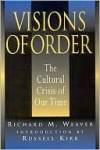
Richard M. Weaver: Visions of Order

The Cultural Crisis of Our Time

ISI Books, 1995 (1964)     Amazon.com

Book Description:

This classic work by the author of Ideas Have Consequences boldly examines the intellectual roots of our current cultural crisis.
JOB’s Comment:
The too exclusive focus on Ideas Have Consequences does not, in my view, do full justice to this conservative and classical idealist thinker. There is a significant development in his work, both with regard to his general philosophy and his view of rhetoric, and the resulting revised positions can be clearly seen in Visions of Order. In some respects, this book can be defended as containing deepened and more nuanced insight. Platonism has been supplemented and modified by an element of historicism.

Charles Taliaferro: Consciousness and the Mind of God

Cambridge University Press, 2005 (1994)     Amazon.com

Book Description:

Contemporary materialist accounts of consciousness and subjectivity challenge how we think of ourselves and of ultimate reality. This book defends a nonmaterialistic view of persons and subjectivity and the intelligibility of thinking of God as a nonphysical, spiritual reality. It endeavors to articulate in a related way the integral relationship between ourselves and our material bodies and between God and the cosmos. Different versions of materialism are assessed, as are alternative, post-dualist concepts of God.
Book Description 2:
A book which introduces readers to substantive terrain in both the philosophy of mind and the philosophy of religion in a clear, not overtly-technical, fashion. It defends with great sophistication the intelligibility of thinking about God as a non-physical and spiritual reality, and challenges popular post-dualist theology.

Front Flap of First Edition:

Consciousness and the Mind of God is especially concerned with the central metaphysical claims about the nature of persons and the implications of these claims for the philosophy of God. Charles Tagliaferro shows that in the contemporary climate there is a widespread view that the insights gained from a philosophy of human persons lead either to a total abandonment of traditional theistic claims about God or to a radical revision of theistic claims about how God relates to the world. Thus, the preponderance of physicalism has led a wide range of philosophers and theologians to reconsider the traditional conception of God as a nonphysical person or person-like reality, ideas about the afterlife, and the Christian doctrine of the incarnation. Some have taken the plausibility of physicalism to be a sufficient ground for embracing philosophical atheism, and thereby rejecting wholesale the fundamental claims of Christianity, Judaism, and Islam. Others have taken the success of a physicalist philosophy to justify treating religion along noncognitive lines. Taliaferro critically examines these oiptions, and defends a nonphysicalist understanding of the God-world relation. He maintains that, while persons are not identical with their bodies, and God is not identical with the cosmos, it remains the case that persons and bodies, God and the cosmos, “exist in a profoundly integral union”. His notions of “integrative dualism” and “integrative theism” seek to avoid some of the extremes of Cartesian and Platonic dualism.

Blurbs on Back Cover of First Edition:

“Charles Taliaferro’s comprehensive treatise, Consciousness and the Mind of God, is baseed upon a sophisticated critique of materialism, particularly in its most developed contemporary forms. That critique would be of use to students of metaphysics and of contemporary philosophy, whatever their interests in theism might be. The author’s positive views on the subject are suggestive and original, making it clear that a devastating critic may also be a highly constructive thinker. This is a significant philosophical work.” – Roderick M. Chisholm, Professor of Philosophy, Brown University

“Taliaferro’s project to examine the significance of recent philosophy of mind for philosophical theism is ‘an idea whose time has come’. His own positions, integrative dualism and integrative theism, are sensitive, intelligent, well-argued attempts to move dialectically beyond the thesis-antithesis that has characterised the debate between materialists, on the one hand, and dualists and/or theists, on the other hand, for the last half-century.” – Richard E. Creel, Professor of Philosophy and Religion, Ithaca College, New York

“Taking on one of the most liberally used and abused theological terms of contemporary theological discourse – dualism – Taliaferro argues cogently for a more precise understanding, one which can alleviate the curent disenchantment with dualism. His alternative to materialist naturalism focuses and defends what others have dismissed as ‘the blurry folk notion of ourselves’ as spirit and matter. Writing for the educated nonexpert, Taliaferro disputes contemporary arguments that a nonphysical personal God is incoherent. He developes and elucidates and ‘integrative theistic philosophy which avoids the atomism, cosmic-denigration, ad isolationism often associated with traditional theism’. This clear-headed and thoughtfully argued book goes to the heart of current issues in philosophical theology.” – Margaret R. Miles, Bussey Professor of Theology, Harvard University

Reviews:

“This work should attract wide attention. Its extensive learning and careful formulations of arguments advances a position often not taken seriously enough, plus it offers ways to save the central dogmas of Christian incarnation and supports a new way of understanding the Trinity. Highly recommended.” – The Reader’s Review

“He has lucidly and thoroughly explored the issues within the mind/body-God/world analogy. For anyone wishing to investigate the analogy and needing a strong, obvious case for it, this is an excellent book.” – Choice

“…a delight to read…clear, elegant, and compelling…this is a vitally important book.” – The Expository Times

“At present, leadership in the philosophy of mind is largely, if not exclusively, in the hands of naturalists and materialists. There is need and, I believe, also a genuine opportunity for serious, constructive work by Christian philosophers in this vital field of philosophyu. An excellent (and extremely readable) book on the subject is Charles Taliaferro’s Consciousness and the Mind of God.” – William Hasker, Books and Culture

“…an interesting and significant contribution to philosophical anthropology, philosophical theology and Christian apologetics….a first-rate piece of work. It is clearly argued, succinctly written, takes full measure of recent discussions of the topics raised and considers important counter-arguments to the positions taken…both engaging and accessible to anyone who thinks about human nature and God.” – Christian Scholar’s Review

“On balance, this is a highly suggestive book discussing some of the most challenging questions put to the Christian understanding of personhood and the doctrine of God in today’s world.” – Arthur Vogel, Anglican Theological Review

“What we have here, then, is a serious constructive project in philosophical theology. It is carried through with energy, care, and precision; it shows acquaintance with the best recent work in philosophy of mind (and its close materialist cousin, cognitive science), and in philosophical theology; and it is marked throughout by a care for and attention ro the strictly philosophical (principally ontological and metaphysical) import of traditional Christian claims about the matters with which it deals. These are considerable virtues. Taliaferro’s work provides more evidence that the most interesting work in philosophical theology today is being done by those with philosophical rather than theological training…this is a very important book that deserves close and careful reading by philosophers and theologians and that ought to provoke much discussion.” – Paul Griffiths, Journal of Religion

“…demonstrates remarkable boldness…The scope of this book is staggering….this is a well-written and engaging book. Taliaferro has a good grasp of the literature and is engaging the right opponents. He also keeps the reader interested with a brisk pace and frequent subject changes.” – Thomas D. Senor, Canadian Philosophical Review

“His goal is twofold: First, to catalogue the arguments of the various proponents of such scientific materialism…I would say that Taliaferro admirably achieves his first goal. I do not know of any similar catalogue of the various contemporary arguments of scientific materialism.” – Commonweal

About the Author (from Wikipedia):

Charles Taliaferro is an American Philosopher specializing in Theology and Philosophy of Religion. He is a Professor of Philosophy at St. Olaf College, a Senior Research Fellow at the Institute for Faithful Research. and a member of the Royal Institute of Philosophy. He is the author or co-author, editor or co-editor of fifteen books, most recently The Image in Mind: Theism, Naturalism and the Imagination (Continuum), co-authored with the American artist Jil Evans.

JOB’s Comment:

Some terminological confusion, but an important book. The author and I once planned to meet in Philadelphia but some obstacle appeared. It was an APA conference of the size and kind where it was quite possible for both to be present and yet not meet. I hope there will be some other opportunity in the future.
The Meaning of Materialism

Keith Ward on Materialism, 14     1  2  3  4  5  6  7  8  9  10  11  12  13

Having dismissed the theoretical arguments for materialism, Ward turns to what he is inclined to see as its real causes and underlying motivation, “the raw nerve and the emotional powerhouse of materialism”: What really drives much materialist philosophy is rage at the injustice and indifference of the universe. Things happen to people by chance; the innocent suffer and the evil flourish. There is too much suffering and pain in the universe for it to be designed by any half-way benevolent being. Better, then, to postulate unconscious laws operating without benevolent purpose, than to think of there being a great intelligence that has intentionally planned such pain and pointlessness.”

Theory remains, however, also when Ward focuses on the materialists argument from evil and suffering against the “great intelligence”, rather than on the question of the existence of matter as conceived by classical materialism. This is partly because materialism for Ward means primarily the rejection of the position that reality is ultimately spiritual, even though that position may also accept that there is some such a thing as matter as conceived by classical materialism. This is Ward’s broad category of idealism: any position that accepts the ultimacy of spirit is idealism, regardless of whether or not it accepts non-ultimate classical-materialist matter, i.e. their matter without their materialism (difficult as that may be).

I would prefer to define idealism more narrowly, as excluding also non-materialist, non-ultimate, classical-materialist matter. A distinction should be made between on the one hand materialism, the affirmation of classical materialist matter and the concomitant rejection of ultimate spiritual reality or even any spiritual reality, and on the other what could perhaps be called “matterism”, the mere affirmation of classical-materialist matter as such or indeed of any matter which shares at least some of the characteristics of classical-materialist matter, regardless of the position with regard to ultimate spirituality.

Of course, “matterism” is not a very felicitous term. First of all, it seems to signify precisely the same thing as “materialism”. But what I intend it to mean is simply the affirmation of the existence of matter in any form that is incompatible with the kind of idealism I think might be defended – which, I add, does not include classical idealist conceptions of matter, which are quite different from the classical materialist one. It would be better to speak of this not as an “ism”, and instead only of materialism as an “ism” that takes such affirmation so far as to assert such matter as the ultimately and perhaps exclusively real.

But it is inconvenient to have to repeat “the affirmation of the existence of matter in any form that is incompatible with the kind of idealism I think might be defended” each time this is referred to. A separate term signifying this is needed in order to avoid it, as well as avoiding the loose usage of “materialism” about any affirmation of the reality of matter regardless of the larger philosophical context. And it is impossible to take consistently the position that all “isms” are extreme exaggerations: “ism”-words must be used for all kinds of positions that are not of this kind at all. Thus matterism in itself is not an extreme and unusual position like materialism. It is compatible with Ward’s broadly defined idealism, which is not extreme either. Idealism more narrowly defined may be less common and is certainly viewed as extreme by many who have not studied it deeply yet are certainly not materialists. But positions that from some perspectives appear extreme cannot of course for that reason be rejected in philosophy. This holds for materialism too. Its extremism and unusualness in the perspective of the history of philosophy as well as contemporary philosophy which Ward has discussed is not, as Ward is of course aware, in itself a sufficient argument against it. For these reasons, “matterism” might perhaps be an admissible and useful term in discussions like this one. But other and better suggestions are welcome.

The argument against the “great intelligence”, remains, as I said, theoretical. But it is non-theoretical and based on the motives Ward is here beginning to describe and analyse inasmuch as it implies the affirmation of materialism in the sense of the position that what exists instead of that intelligence is matter. Even though the ultimate spiritual reality is rejected on the basis of experienced evil and suffering, this does not in itself imply that classical materialist matter takes it place in being made ultimate.

Thus something like classical-materialist matter is commonly brought in despite the weaknesses of the distinct arguments in favour of it as such. Perhaps the position resulting from the simultaneous rejection of ultimate spirituality and classical-materialist matter would still seem to resemble too much some other kind of idealism: the “unconscious laws” mentioned by Ward must be the laws of classical-materialist matter. But in view of the theoretical difficulties of such materialism, this affirmation cannot be accounted for except by the emotional factors involved, alongside the theoretical argument from evil, in the rejection of ultimate spirituality.

“These are entirely serious points”, Ward notes. “If the universe is morally unjust and indifferent to suffering, that counts strongly against the existence of a just and compassionate God. But perhaps part of the trouble is that we think of a cosmic mind as able and wanting to avoid all suffering, and as immediately and directly rewarding the good and punishing the wicked. For a moment, set such an overtly religious but basically naïve picture to one side, and think just of a consciousness that conceives all possibilities and generates a universe directed to evolving other intelligent information-processing intelligences.”

As we have already seen, Ward thinks in terms of Christian or Biblical creation, and we have also seen that although he certainly rejects “matterism” as the affirmation of classical-materialist matter, he accepts as congruent with his broader idealism (i.e., in his case, the affirmation of God as ultimate spirituality) some other form of matter more congruent with contemporary physics. Although it is unclear what that matter is, not least as Ward himself in fact, as I have pointed out, adduces arguments which would seem to be in favour of the rejection of any and all matterism, it is necessary to stress that matterism should be defined as including also the affirmation of modified, contemporary versions of matter which still, if this is possible, retain some of the metaphysical characteristics of classical-materialist matter that are relevant here.

Because of his acceptance of such non-ultimate and modified matter, Ward speaks of a generation and evolution of “other intelligent information-processing intelligences”, which involves and presupposes that alternative matter. This is a very different idealist position from the one I think could be defended. The broader idealism is somewhat hampered by the religious image-thinking of exoteric Biblical creation-theology, notwithstanding the expression of the latter in terms of evolution.

But what we are concerned with here is the analysis of materialism, and although the difference has to be pointed out for the sake of clarity, it is less important than the specific arguments Ward presents for the purposes of that particular analysis, arguments which are of importance for idealism in general, including the one I would try to defend. My point about materialism and matterism, or the proper meaning of materialism, is a minor one in this connection.

Ward is moving on here to the important analysis of what “really drives” materialism as the affirmation of matter, classical-materialist or modified, as ultimate or even exclusive. And this turns out to be the theoretical arguments for the rejection of spirit or God as ultimate that are not the specific theoretical arguments for materialism themselves, and that, as Ward will show and signals by his use of the words “raw nerve”, “emotional powerhouse”, and “rage”, are almost always combined with the motives that, without theory, reach for materialism as a replacement.

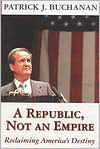
Patrick J. Buchanan: A Republic, Not an Empire

Reclaiming America’s Destiny

Regnery, 2002 (1999)     Amazon.com

Back Cover with Quotes from the New Introduction:

“‘If we continue of this course of reflexive interventions, enemies will one day answer our power with the last weapon of the weak – terror, and eventually cataclysmic terrorism on U.S. soil.’ So I predicted in these pages in 1999.”

“On September 11, 2001, ‘cataclysmic terrorism’ struck America as three Boeing 767s crashed into the World Trade Center and Pentagon, bringing down the towers and burning to death three thousand people.”

“Now let me repeat the warning: If this Prodigal Nation does not cease its mindless interventions in quarrels and wars that are not America’s concern, our lot will be endless acts of terror until, one day, a weapon of mass destruction is detonated on American soil. What is it about global empire that is worth taking this risk?”

Back Cover of the First Edition:

“Present U.S. foreign policy, which commits America to go to war for scores of nations in regions where we have never fought before, is unsustainable. As we pile commitment upon commitment in Eastern Europe, the Balkans, the Middle East, and the Persian Gulf, American power continues to contract – a sure formula for foreign policy disaster.”

“The day is coming when America’s global hegemony is going to be challenged, and our leaders will discover they lack the resources to make good on all the war guarantees they have handed out so frivolously; and the American people, awakened to what it is their statesmen have committed them to, will declare themselves unwilling to pay the price of empire.”

“A day of reckoning is approaching. It is my hope that the price in blood, treasure, and humiliation America will eventually be forced to pay for the hubris, arrogance, and folly of our reigning foreign policy elites is not, God forbid, war, defeat, and the diminution of this Republic – the fate of every other great nation or empire that set out on this same course.”

First Edition Flaps:

America is a great power now…will it be in the future, or will it collapse from imperial overstretch?

A Republic, Not an Empire is presidential candidate Pat Buchanan’s erudite and eloquent plea for a new American foreign policy. To avoid a future of endless war, he offers a new policy rooted in America’s greatest traditions.

This is the story of how American statesmen, through vision and courage, quadrupled the size of our Republic in a single century to create the most remarkable nation the world had ever seen. This is also the story of how twentieth-century presidents abandoned George Washington’s “great rule” – to avoid permanent alliances and stay out of foreign wars – and led this country into global conflagrations that changed America and the world forever, and not always for the better.

The United States has piled commitment upon commitment to nations and regions around the world – the Balkans, Eastern Europe, the Persian Gulf, the Middle East, Taiwan, Japan, and South Korea. Buchanan shows how America is reenacting the ancient folly of imperial overstretch that has led to the ruin of every other great power in history – and to the catastrophic world wars of this blood-soaked century.

He argues for a new foreign policy rooted in the wisdom of the Founding Fathers and giants fo American statesmanship – George Washington, Thomas Jefferson, Alexander Hamilton, John Adams, John Quincy Adams, Henry Clay, and Andrew Jackson – as well as modern warrior herors like Dwight Eisenhower and Doublas MacArthur.

Surveying the sweep of our nation’s history, Buchanan demonstrates how America’s liberty is best protected when the United States pursues its own vital interests, and how our liberty is most endangered when we embark on international crusades that are divorced from those interests.

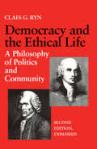
Claes G. Ryn: Democracy and the Ethical Life

A Philosophy of Politics and Community

The Catholic University of America Press, 1990 (1978)     Amazon.com

Back Cover:

RynThis study of democracy goes to the heart of ethics and politics. Strongly argued and lucidly written, the book makes a crucial distinction between two forms of democracy. The author defends constitutional democracy as potentially supportive of the ethical life, while he criticizes the plebiscitary form of democracy as undermining man’s moral nature. The book includes an extensive interpretation and refutation of the ideas of Jean-Jacques Rousseau and offers a new perspective on the American Constitution and the relationship between moral community and self-interest. This edition includes an important new section on the common good and the state of Western democracy.
“One of the more important studies in critical thought to be published in recent decades…Claes Ryn, like Alexis de Tocqueville, understands the American social edifice better than do those reared within it.” – Russell Kirk in The Review of Metaphysics

“One of the best books on the terrain where politics and morality precariously overlap, recommended vigorously to all who are concerned with the loss of political morality. Combines scholarly research with an ornery independent mind.” – Peter Viereck

Front Flap of the Cover of the First Edition (Louisiana State University Press, 1978):

RynThis lucid synthesis of classical Greek, Judaeo-Christian, and modern ideas poses a challenge to positivism and moral relativism in modern sociopolitical thought. The true science of social life, Claes Ryn contends, is based on a humanistic and philosophical grasp of the moral nature of man.

Viewing democracy in the light of such an understanding of human nature and politics – an understanding gained in part through an extensive interpretation and refutation of Rousseau’s view of man and politics – Ryn develops here the idea that constitutional democracy is potentially supportive of ethical ends, whereas plebiscitarian democracy undermines the pursuit of such ends by basing public policy on the momentary majority.

Ryn presents an interpretation of human nature, stressing the tension within man between higher and lower potentialities and explaining “ethical conscience” as a check on spontaneous responses. Constitutionalism in its highest dimensions, he argues, is the political counterpart of moral self-discipline. Constitutional provisions must be used to ally the self-interest of man with the moral ends of society.

In this defence of constitutional restraints on the majority, Democracy and the Ethical Life offers not only a subtle and penetrating theory of democracy but also a philosophy of man.

JOB’s Comment:

Readers of this blog will be familiar with Ryn from a number of posts in the category Value-Centered Historicism. Here I wish to draw the reader’s attention to the briefly formulated supplementation with regard to the definitions of and distinction between constitutionalism and plebiscitarianism in view of the case of corruption of formally constitutional government, which I provide in my Swedish post Till frågan om populismen and elsewhere in this blog. These additional considerations do not involve any rejection of Ryn’s position but only a kind of extended application.