
1 februari
Jim Powell: Wilson’s War
How Woodrow Wilson’s Great Blunder Led to Hitler, Lenin, Stalin and World War II
Crown Forum, 2005 Amazon.com
Book Description:
 President Woodrow Wilson famously rallied the United States to enter World War I by saying the nation had a duty to make “the world safe for democracy.” But as historian Jim Powell demonstrates in this shocking reappraisal, Wilson actually made a horrible blunder by committing the United States to fight. Far from making the world safe for democracy, America’s entry into the war opened the door to murderous tyrants and Communist rulers. No other president has had a hand – however unintentional – in so much destruction. That’s why, Powell declares, “Wilson surely ranks as the worst president in American history.”
Wilson’s War reveals the horrifying consequences of our twenty-eighth president’s fateful decision to enter the fray in Europe. It led to millions of additional casualties in a war that had ground to a stalemate. And even more disturbing were the long-term consequences – consequences that played out well after Wilson’s death. Powell convincingly demonstrates that America’s armed forces enabled the Allies to win a decisive victory they would not otherwise have won – thus enabling them to impose the draconian surrender terms on Germany that paved the way for Adolf Hitler’s rise to power.
Powell also shows how Wilson’s naiveté and poor strategy allowed the Bolsheviks to seize power in Russia. Given a boost by Woodrow Wilson, Lenin embarked on a reign of terror that continued under Joseph Stalin. The result of Wilson’s blunder was seventy years of Soviet Communism, during which time the Communist government murdered some sixty million people.
Just as Powell’s FDR’s Folly exploded the myths about Franklin Roosevelt and the New Deal, Wilson’s War destroys the conventional image of Woodrow Wilson as a great “progressive” who showed how the United States can do good by intervening in the affairs of other nations. Jim Powell delivers a stunning reminder that we should focus less on a president’s high-minded ideals and good intentions than on the consequences of his actions.
Reviews:
“That government intervention can have unintended consequences is nowhere more true than in foreign policy. Wilson’s War brings the lesson home in a way Americans today can ill afford to ignore. Read this absorbing and critically important book.” Thomas E. Woods Jr., author of The Politically Incorrect Guide to American History
“Jim Powell makes a persuasive case against Woodrow Wilson. But I disagree with Jim. During the latter part of his second term Wilson was nearly comatose, thereby making him the perfect progressive interventionist politician, in my opinion.” P. J. O’Rourke, author of Peace Kills and Parliament of Whores
“Wilson’s War makes a compelling case that Woodrow Wilson was America’s worst president and an unmitigated disaster for the world. In a learned exposition of the Law of Unintended Consequences, Jim Powell shows how U.S. intervention into World War I strengthened the hand of Soviet Communism and led directly to the rise of Hitler and World War II. Wilson’s War exposes how America’s court historians have misled the public for generations.” Thomas J. DiLorenzo, author of The Real Lincoln and How Capitalism Saved America
“Wilson’s War is a highly controversial interpretation of twentieth-century political history, which asserts that its worst evils – Communism and Nazism – were unintended consequences of President Wilson’s decision to enter World War I on the Allied side.” Richard Pipes, Baird Professor of History, Emeritus, Harvard University
About the Author:
Historian Jim Powell is the author of FDR’s Folly and The Triumph of Liberty. A senior fellow at the Cato Institute since 1988, he has written for the New York Times, the Wall Street Journal, American Heritage, Barron’s, Esquire, the Chicago Tribune, Money magazine, Reason, and numerous other national publications. He has lectured at Harvard, Stanford, and other universities across the United States, as well as in Europe, Asia, and South America. Powell lives in Connecticut with his family.
Carl Johan Ljungberg: En stridslysten drömmare
Gunnar Unger som journalist och opinionsbildare
Klubben Brunkeberg, 2009
Baksida:

Under mer än 30 år förargade och förnöjde Gunnar Unger sin publik. Mest känd blev han som medarbetare i Svenska Dagbladet från mitten av 1950-talet och fram till sin död 1976. Med osviklig stilkänsla, elegans och ironi gisslade han fel och brister i sin samtid.
Legendariska blev Ungers samtal med den ilskne geronten, onkel H. Ungers vassa kritik av socialdemokratin och nyvänstern publicerades på Svenska Dagbladets ledarsida under rubriken Apropå (med signaturen Sagittarius) och satte även de starka spår. Även om Ungers borgerligt, liberalkonservativt präglade inlägg ofta gällde dagsfrågor hade hans åskådning sina rötter både i Europas klassiska arv och i anglosaxisk publicistik.
Carl Johan Ljungbergs essä En stridslysten drömmare söker teckna en profil av Ungers breda insats som opinionsbildare, kritiker, kåsör och recensent. Ljungberg är journalist och stats- och litteraturvetare samt har en PhD från Catholic University of America i Washington, DC, USA.
JOBs kommentar:
Unger uppvisar vissa brister, blindheter och ytligheter som var karaktäristiska för denna tids svenska konservatism. Mest påfallande idag är detta kanske i uppfattingen av EEC och Europafrågan sådan den gestaltade sig på hans tid, men svagheterna har att göra med uppfattningen av hela nittonhundratalets politiska dynamik, dess djupare sammanhang, dess intressens spel, och dess verkliga innebörd. Även hos honom kan vi identifiera det beklagliga nya glapp i förhållande till traditionerna från före det andra världskriget och tillbaka till artonhundratalet som jag skrivit om i flera inlägg.
Dessa svagheter illustrerar också, åtminstone i förlängningen, i ljuset av deras konsekvenser, vad jag bl.a. i några formuleringar på About-sidan menar med konservatismens och borgerlighetens otillräcklighet och nödvändigheten av vad jag där kallade en europeisk post-paleokonservatism. Det räcker inte att vara en drömmare, även om man är skridslysten. Vi finner hos Unger något ytterst tidstypiskt i den alltför ofta framskymtande tendensen att självironiskt underminera allvaret i den egna kritiken. Till och med hos honom ser man i denna attityd, när stridslystnaden inte lyckas övervinna den, tydliga spår av socialdemokratins långa maktinnehav och forna resursrikedom: det känns som om det, med Stig Strömholms ord, är en fråga om att “sätta betyg på magistern”.
Inget av detta får emellertid överskugga Ungers ofta viktiga insats i övrigt. Inom de antydda tidsbetingade ramarna är han utan tvekan framstående. Unger var verksam vid tiden för inte bara ett starkt konsoliderat socialdemokratiskt maktinnehav, utan även för sextioåttavänsterns genombrott och dominans. Högern hade efter denna tid, under åttiotalet, en möjlighet att utveckla en kulturkonservativ politik och samhällssyn i linje med hans, och med möjlighet till ytterligare fördjupning. Man tog inte tillvara den. I stället lät man den globalistiska kulturradikalismen ta över, först i pseudolibertariansk form, sedan i Nya Moderaternas. Carl Johans fina och kongeniala lilla bok tydliggör därför avståndet mellan vad Unger visade att borgerligheten och högern när de var som bäst trots allt kunde vara på hans tid, och vad de är idag.
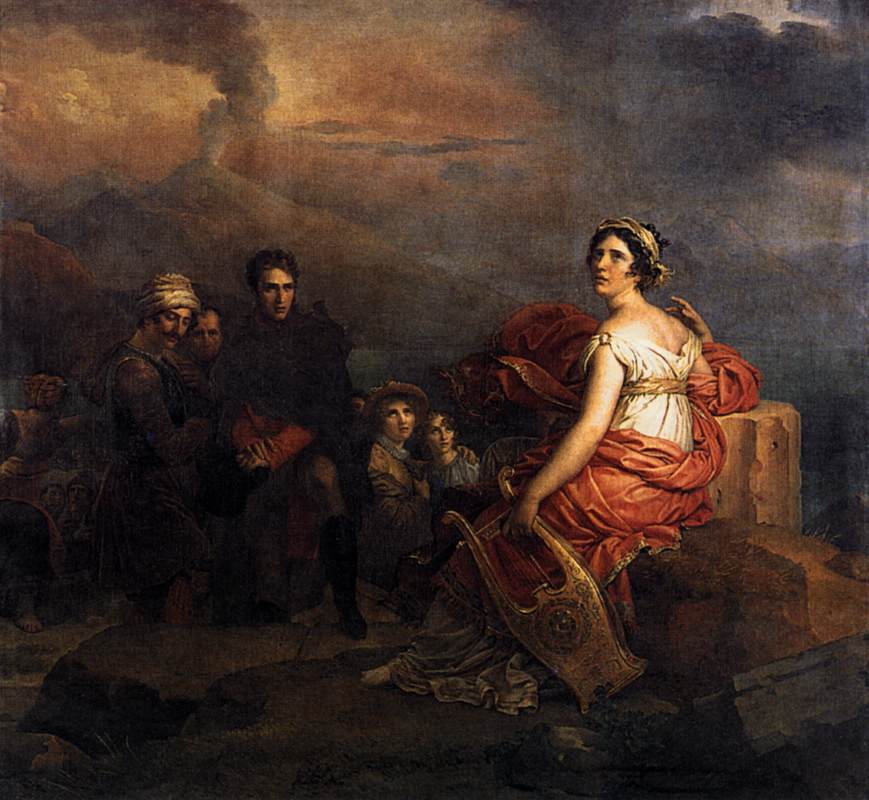
François Gérard: Corinne au Cap Misène
From Science to Philosophy
Keith Ward on Materialism, 13 1 2 3 4 5 6 7 8 9 10 11 12
“The search for specific final causes or purposes proved a dead-end in physics. It was much more fruitful to seek precise mathematical descriptions of closely observed regular behaviour patterns. But in the twentieth century a more cosmic sort of finality re-emerged. The fundamental laws of nature seemed remarkably ordered towards the emergence of consciousness and rational control of the environment. To put it bluntly, matter seems to have an inner orientation towards the emergence of mind.”
This is still the perspective of science. It is the last paragraph describing the reality dealt with from this perspective only, a perspective that could be demarcated as one level of relative and finite perception and a certain kind of speculation primarily with regard to mathematical models with reference to that level, as discussed earlier.
“It is hard to conceive of such finality unless the goal of information and control is somehow already potential in the origin of the cosmic system. It is not surprising, then, that some quantum physicists think that something mind-like or conscious must lie at the very basis of physical reality.” Here the step from science to philosophy is clearly taken. The sentence shows one way in which it can be taken.
“Eugene Wigner said that ‘study of the external world leads to the conclusion that the content of consciousness is an ultimate reality’, and von Neumann wrote that ‘all real things are contents of consciousness’.” Wigner’s statement is doubtful. I would suggest it be put like this: the study of the external world in conjunction with philosophical reflection on this study as well as on the nature of consciousness leads to the conclusion that the external world exists as content of consciousness. This is a difficult position to embrace, and not only because we first think of the world as content of the consciousness of the finite human individual only, which could be tantamount to solipsism if sufficient grounds were not provided for the existence of the plurality of finite persons, and would even then be unacceptable.
The natural philosophical position to take in this regard today is the phenomenological one of bracketing the question of idealism versus materialism. But it remains a fact that whatever else the world may be, whatever else our experience may be experience of, it remains content of our consciousness. And it must again be stressed that what idealism says is just that matter is not what materialists think it is. It does not deny the experience of matter, that there is that which we experience as matter. That which historical and dialectical materialists, for instance, experience as matter. That it is content of conscsiousness does not mean that the world is necessarily any less real than what those who believe in the common concept of matter think: there is nothing “nothing-but” about it. Idealists say that the world, being content of consciousness, is in a sense less real than the ultimate reality, the ultimate consciousness that is its ground. But this could be taken to mean only that the ultimate reality is more real. The world’s reality for us as finite experiencers of it would not, in itself, have to be in the least reduced, although the main focus of our attention would, or should, be shifted towards the ultimate reality.
This position would coherently account for and affirm the reality of all the shapes and colours and sounds and weight and massiveness of our experienced world, along with their metaphysical ground, whereas classical materialism seeks to reduce them all to a dull, ghostly abstraction. “Things” really have all the qualities we perceive in them: the so-called “secondary” ones are in reality quite as primary as what was once thought to be the “primary”. Nor would this position imply anything solipsistic or even subjectivistic. The world clearly would not exist in its entirety as content of our finite consciousness, individual or collective, and by means of a process of dialectical mediation, what we perceive would gradually attain the intelligible form of true objectivity in an emerging whole of knowledge. It follows that the statement by von Neumann is plausible, although not a conclusion of science or the study of the external world only, but of philosophy.
“For them, the collapse of the possibilities described by wave-functions into actual existents is brought about by consciousness. Their view may be a minority one, but it demonstrates the fact that quantum physics has moved so far beyond classical materialism that it is no longer clear that ‘matter’ is radically different from ‘mind’. It could be that matter is just one form the objects of consciousness take, and that consciousness is needed to give definite actuality to its objects.” It may be possible for physics alone to show that the collapse into actual existents is brought about by consciousness; I cannot judge about that. But philosophically it is true that “matter” is not radically different from “mind”. And that the difference is a difference in the manner of appearance to mind or consciousness of particular kinds of its content: “matter is just one form the objects of consciousness take”.
“It certainly seems to be the case that the existence of consciousness and purpose in human minds is an unresolved problem for philosophical materialism, since there seems little prospect of giving a complete explanation of conscious experience in purely physical terms.” Indeed. Just as the above conclusion regarding the true nature of “matter” as content of consciousness is a philosophical one, so classical materialism, with its attempt at a complete account of conscious experience in physical terms, is a philosophical position, not a scientific one.
“If we have a view of the universe as intrinsically oriented towards consciousness, it is almost inevitable that we should think of this orientation as consciously intended. In that case conscious intention, and therefore mind, will not merely be the goal of the cosmic process, but its originating cause. That would make mind a basic and foundational, rather than a peripheral and unexpected, element of ultimate reality.” Once proper philosophical reflection on consciousness is brought in, it seems not just possible but inevitable to go further than this. It would not be a matter of orientation towards consciousness from out of something else which is not consciousness, intended by an originating, basic and foundational conscious cause of both that orientation and the non-conscious something, the ultimate conscious reality. Rather, it seems it would be a matter of degrees of manifestation, on the level of finitude, of an already existing consciousness.
“And if there is just one independent and complete mind, not composed of separate parts, which generates all physical realities in order to bring into being sets of dependent and developing finite minds, that would provide an economical and elegant explanation for the existence of the physical universe.” If, as Ward has already suggested, “all physical realities” are in reality “contents of consciousness” and “just one form the objects of consciousness take”, they cannot be spoken of as something separately existing in the manner of the illusory matter of classical materialism. They cannot be conceived to be “physical realities” in that sense at all. The “existence of the physical universe” is already accounted for in the sense that its nature or ontological status is explained in a still more economical and elegant manner.
Therefore, the “one independent and complete mind” cannot have brought into being “sets of dependent and developing finite minds” by means of the prior generation of such realities. There are no such realities. There is no classical-materialist “matter” with an “inner orientation” towards the emergence of mind and consciousness. What there is, is finite minds emerging or developing, from their own perspective, from various degrees of conditioning by contents of consciousness (perceived or experienced by them as “matter”) to other such degrees. The finite minds must be considered to be always already “part” of the one independent and complete mind, although certainly not “independent” parts of which that mind is “composed”. They are indeed “dependent” on that mind, not on “physical realities”, and ultimately not even on those contents of consciousness that appear as such realities. They are “developing” in the sense that their consciousness is in various degrees conditioned and obscured by the association with that content or at least with some of it, and that it is, from their own perspective, reawakened in the temporal-phenomenal process which can perhaps be understood to be what Ward refers to as generation and development.
But the important point here is that a move is made from science to philosophy. That, and not quantum physics alone, is, I suggest, what makes the various conclusions I have briefly discussed possible.
Jean Sévillia sur Historiquement incorrect
David Frawley: Yoga and Ayurveda
Self-Healing and Self-Realization
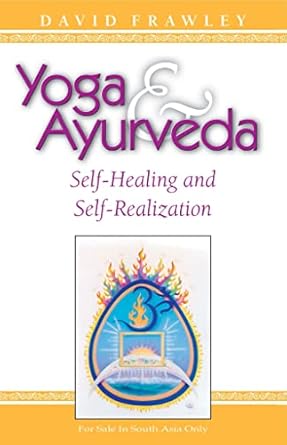
Lotus Press, 1999
From the Back cover:
Yoga and Ayurveda together form a complete approach for optimal health, vitality, and higher awareness. Yoga & Ayurveda reveals to us the secret powers of the body, breath, senses, mind, and chakras. More importantly, it unfolds transformational methods to work on them through diet, herbs, asana, pranayama, and meditation. This is the first audiobook published in the West on these two extraordinary subjects and their interface. It has the power to change the lives of those who listen to and apply it.
About the Author:
Dr. David Frawley (or Pandit Vāmadeva Śāstrī वामदेव शास्त्री) is a Vedic teacher and educator who is the author of over forty books in several Vedic and Yogic fields published worldwide over the past thirty years. He is the founder and director of the American Institute of Vedic Studies (www.vedanet.com), which offers on-line courses and publications on Ayurveda, Yoga, Vedanta, mantra and meditation, and Vedic astrology. He is involved in important research into ancient Vedic texts and is a well known modern exponent of Hinduism and Sanatana Dharma. He has a rare D.Litt in Yoga and is a recipient of the prestigious Padma Bhushan award, one of India’s highest civilian awards for “distinguished service of a higher order.” His work is highly respected in traditional circles in India, as well as influential in the West, where he is involved in many Vedic and Yogic schools, ashrams and associations.
Robert Nisbet: The Quest for Community
A Study in the Ethics of Order and Freedom
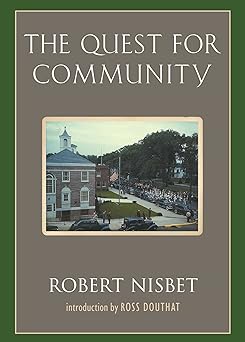
Intercollegiate Studies Institute, 2010 (1953)
Publisher’s Description:
One of the leading thinkers to emerge in the postwar conservative intellectual revival was the sociologist Robert Nisbet. His book The Quest for Community, published in 1953, stands as one of the most persuasive accounts of the dilemmas confronting modern society.
Nearly a half century before Robert Putnam documented the atomization of society in Bowling Alone, Nisbet argued that the rise of the powerful modern state had eroded the sources of community – the family, the neighborhood, the church, the guild. Alienation and loneliness inevitably resulted. But as the traditional ties that bind fell away, the human impulse toward community led people to turn even more to the government itself, allowing statism – even totalitarianism – to flourish.
ISI Books is proud to present this new edition of Nisbet’s magnum opus, featuring a brilliant introduction by New York Times columnist Ross Douthat and three critical essays. Published at a time when our communal life has only grown weaker and when many Americans display cultish enthusiasm for a charismatic president, this new edition of The Quest for Community shows that Nisbet’s insights are as relevant today as ever.
Back Cover of the Institute for Contemporary Studies edition (1990):
The Quest for Community stands among the most important social critiques ever written. The first book by the man the New York Times calls “one of our most original social thinkers”, Robert Nisbet’s study explores how individualism and statism have flourished while the primary sources of human community – the family, neighborhoods, the church, and voluntary organizations – have grown weaker. First published in 1953, this timeles work is a seminal contribution ot the understanding of the spiritual and intellectual crisis of Western society.
With a new introduction by William A. Schambra that places the book in a contemporary perspective, Quest for Community deseres to tbe reread in the light of events that have confirmed its provocative thesis.
“I have read it with much interest and substantial agreement…It should do its good work in the long run, and to me at least it is one of the more hopeful signs.” T. S. Eliot
“I have read the book with great interest and enthusiasm. I think you have stated all our problems of community with great astuteness and fairness, and have pointed to the creative answers for which we must seek.” Reinhold Niebuhr
“Masterful.” Senator Daniel Patrick Moynihan
About the Author:
Robert Nisbet was professor of socioloty at Columbia University and is the author of The Sociological Tradition, The Social Bond, The Degradation of the Academic Dogma, The Present Age: Progress and Anarchy in Modern America, Roosevelt and Stalin: The Failed Courtship, Twilight of Authority, Tradition and Revolt; The History of the Idea of Progress, Prejudices: A Philosophical Dictionary, and Conservatism: Dream and Reality.
John Lukacs: Historical Consciousness
The Remembered Past
With a new introduction by the author and a foreword by Russell Kirk
Transaction, 1994 (1968) Amazon.com
Back Cover:
 One of the most important developments of Western civilization has been the growth of historical consciousness. Consciously or not, history has become a form of thought applied to every facet of human experience; every field of human action can be studied, described, or understood through its history. In this extraordinary analysis of the meaning of the remembered past, John Lukacs discusses the evolution of historical consciousness since its first emergence about three centuries ago.
Among the diverse subjects he examines are the endurance of national characteristics, the development of language, history, and physics, motives and causes, and the end of the Modern Age. In a new introduction, Lukacs comments on the continual decline of historical knowledge and the teaching of history. But he also sees positive signs: a renewed appreciation of narrative history among some historians, and an interest in all kinds of reconstructions of history among the public.
Jacques Barzun has said of Historical Consciousness, “Every page records searching thought and calls for corresponding reflection, yet affords at the same time the thrills of suspense and recognition, quite as if it were one of the usual facile and ‘timely’ improvisations.” John Lukacs’s book continues to be a significant contribution to the history of ideas, and will be of significance to political theorists, philosophers, and historians alike.
“Lukacs has given us an important and transforming book which deserves the widest possible readership.” Stephen J. Tonsor, The University Bookman
About the Author:
John Lukacs has taught history at Princeton University, the University of Pennsylvania, Columbia University, Chestnut Hill College, ad La Salle College, among other schools. His numerous publications include The Last European War, 1929-1941, The Duel, and Confessions of an Original Sinner.

 Olle Bengtsson