
The Non-Materialism of Contemporary Philosophy
Keith Ward on Materialism, 7 1 2 3 4 5 6
But philosophy is “still a very diverse discipline”, Ward notes, and he proceeds to give an overview of the academic discipline of philosophy today, in order to show how very few the materialist philosophers actually are: “Idealism, the view that mind or Spirit is the only ultimate reality, is far from dead, and many American university philosophy departments have a representative Process philosopher or Personalist – both variant forms of Idealism.”
It can be added that European university philosophy departments also have representative idealist philosophers. They include Oxford’s, where my second D.Phil. supervisor was one – even, as a Bradleyan, in the specific, Victorian Oxford tradition of idealism, focusing, like most contemporary idealists both of necessity and by inclination, on the history of philosophy. Idealists are also found on the European continent, although philosophers working with the historical tradition of German idealism focus on other aspect of it than idealism in the general sense in which Ward understands it.
But Ward is right to establish here that idealism and personalism are living philosophical positions and traditions, represented in academic philosophy today. And, of course, “Phenomenology, the general view that analysis of existential, lived experience should be the basis of an analysis of reality, remains strong in European philosophy.” Phenomenology was from the beginning (in Husserl) opposed to the nineteenth-century tradition of idealism, yet its approach is not only in some central respects congruent with it, but something similar was part of idealism in some forms, as a point of departure. The term phenomenology was of course introduced and frequently used precisely by the idealists. In some respects, phenomenology is part of the broad current of irrationalism and subjectivism in modern German philosophy, and consequently its rejection of idealism in the broad sense is untenable. A revised version of Hegelian dialectics, for instance, provides the means through which precisely the irrationalism and subjectivism can be overcome.
Irrationalism and subjectivism are also found in positivism. Ward writes: “Positivists also make experience primary, though they apparently have few feelings or existential crises, and prefer to have clear, distinct and unemotional experiences (which they call sense-data). Positivists have tended to think that their sense-observations are the basic data of rigorous science, and so they place a premium on sense-verification and the provision of sense-based evidence for all assertions. But positivism actually undermines the possibility of public verification (since we cannot even verify that other minds exist), and it also undermines the claim of much modern physics that the ultimate structure of matter lies in unobservable but mathematically postulated entities.”
This is rather a comment on the primacy of experience à propos of phenomenology, not part of the overview of contemporary philosophy. But the positivists’ theory of sense-data, phenomenalism, is, like parts of the approach of the phenomenologists, in some respects and with a certain interpretation compatible with idealism, if only, of course, with the further development and not least supplementation. that idealism provides. Sense-data are not all the data and they certainly do not have the significance in philosophy that positivists ascribed to them (“evidence for all assertions”).
Yet Ward’s main point is that logical positivism was not materialism. That is also true of general common-sense pragmatism. “Common-sense pragmatism, often in a Wittgensteinian guise, sceptical of all grand general statements about ultimate reality, and refusing to accept that philosophers are in any better position to say what reality is like than anyone else, is widespread. Such philosophers are fond of saying, ‘Reality is in order as it is’, without the help of philosophy. So their arguments are often devoted to proving that philosophical arguments in general are superfluous and misleading. The problem is that, when readers begin to believe them, they stop reading philosophy any more. This has regrettably caused a number of philosophy departments in Britain to close.” Common-sense pragmatism, as paradoxically claiming to be a philosophical position, is also regrettable in itself, on many counts, and, I think, refutable (like materialism), in the sense in which things are at all refutable by philosophy. But again, Ward’s main point is that it is not materialism.
Then, “Scepticism, too, is far from dead, and resembles common-sense, except that it even doubts whether common-sense can be trusted. Some forms of post-modernism are sceptical views, insofar as they doubt whether there is any objective truth to be found.” Ward adds that sceptics tend to get very depressed and that they too tend to give up philosophy. This position too is thus bad for philosophy. Like materialism and common-sense pragmatism, it too seems to me philosophically refutable.
Then there is critical realism, which is “quite popular. An intellectual descendent of John Locke, such realism maintains that perception and intellect do give us knowledge of objective reality, but show reality to be rather different from how things appear to the senses. Proponents disagree on just how different. For Locke a set of primary qualities – roughly, mass, position and velocity – are objectively real, while secondary qualities like smell, colour and taste are contributed by the mind. In modern physics those primary qualities have disappeared, and we have to talk of force-fields and wave-functions in curved multi-dimensional space-time. So sometimes critical realists are reduced to saying that there is definitely some objective reality which the mathematics of quantum theory describes. But exactly what it is we cannot be sure. It is what quantum theorist Bernard d’Espagnat calls a ‘veiled reality’, since we cannot know exactly what concepts like ‘imaginary time’ or ‘waves of probability’ correspond to, if correspondence is even an appropriate term any more. As one critical realist has said, ‘I cannot be sure just what objective reality is. But whatever it is, I most certainly believe in it.'”
Critical realists of this kind may not be far from idealism. One problem here is that few of them understand what idealism is, and what it means, and that it is possible to enter upon the intellectual path that takes them there. Critical realism is certainly not materialism: “The dogmatism of materialism is very apparent when placed alongside these other more or less widely held philosophical theses. Materialists are metaphysicians in the grand manner. They claim to know what reality is, and that their description of it is, they think, obvious, accurate and rationally undeniable. Since that claim is doubted by most of their colleagues, it can hardly be quite as obvious as they say.”
Some idealists too would clearly be described by many as metaphysicians in the grand manner. But I do not think their claim to know what reality is and their description of reality have to be set forth in a particularly dogmatic manner, or, for that matter, an arrogant or aggressive manner. Organized theistic religion, as sharing the idealist worldview in the broad sense, and certainly understood as such by Ward, of course sometimes does present it in this way, since it, or at least much of it, articulates its beliefs and teachings in the form of dogma. But not even the way in which idealism in this broad sense is taught in the partly extra-philosophical traditions, like the esoteric tradition in the West or the Vedantic tradition, need to be dogmatic in its modality, in the sense Ward has in mind here when speaking of the materialists. It can be polemical and sometimes perhaps has to, but this is not at all primary. It just sets forth the traditional truths and principles in its own modality of utterance, sometimes adjusted to time and circumstance. And within philosophy, the traditional intellectual and discursive practices of that specific Western discipline in themselves counteract and discourage dogmatism (I am not talking here about dogmatism in the specifically Kantian sense, which can be non-dogmatic in the sense in which I here use the term).
It is significant that the materialists that most influence the popular debate are not philosophers, but modern scientists writing for the general reading public. As modern scientists, they are products of the historical separation of science from philosophy, they do not have a philosophical education, and they do not fully understand philosophy and what philosophy really is. This is what produces much of their dogmatism, and lands them in hopeless contradictions and other intellectual absurdities when they try to defend their materialism against philosophers. It seems that, without the proper perspective on what they themselves are doing, they also do not quite understand what science is.
In reviewing contemporary philosophy, Ward also, in the paragraphs cited, anticipates the discussion of some main parts of the contemporary case for idealism. He has spoken of “the claim of much modern physics that the ultimate structure of matter lies in unobservable but mathematically postulated entities.” He has said that “In modern physics [Locke’s] primary qualities have disappeared, and we have to talk of force-fields and wave-functions in curved multi-dimensional space-time.” He has mentioned “some objective reality which the mathematics of quantum theory describes”. These parts of the case are what he will next focus on in this summary statement.
Claude-Joseph Vernet: La baie de Naples

Paulus’ andliga kropp
Paulus säger att det är en “andlig kropp” (σῶμα πνευματικόν, Vulg. corpus spiritale) som återuppstår. [1 Kor. 15:44.] Tolkas πνευματικόν här som likabetydande med den platonska och gnostiska dualismens själslighet, är det åtminstone inte någon (exoteriskt) gammaltestamentlig tanke.
Denna tolkning, som väl naturligen anammades av de kristna platonisterna, är visserligen inte helt orimlig. [Charles Bigg, The Christian Platonists of Alexandria (1886 (1970)), 111, 225 ff.] Den uppståndne Kristus som Paulus mötte var förvisso inte materiellt-kroppslig som den som visade sig för Petrus (Paulus auktoritet och hans uppenbarelsers autenticitet stod ändå utom tvivel emedan han godtogs just av Petrus själv – och, kan man kanske tillägga, eftersom han, fastän inte helt opåverkad, var en framgångsrik bekämpare av gnostikerna). Filon använder också πνεῦμα som synonym till såväl νοῦς som ψυχή. [H. A. Wolfson, Philo (1948), I, 102. Wolfson gör emellertid den viktiga anmärkningen att “By the time of Philo, the vocabulary of men dealing with philosophic or religious topics was a mosaic of terms derived from all kinds of opposite schools of thought, but molded by their users, if they used them understandingly, to a common, consistent meaning…The style of Philo, like that of any writer, is the product of all that has been written before him. It has absorbed within itself terms and expressions and allusions derived from the philosophers of the various schools, as also from popular Greek religion and mythology and mysteries.” Ibid.] Och de centrala formuleringarna i 1 Kor. 15:35-56 äger utan tvekan en mångtydighet. Paulus betonar själv att vi har att göra med ett mysterium.
Men såvitt jag uppfattat det är det avgörande att förstå att πνεῦμα alltifrån Paulus har en specifik kristen betydelse. Paulustexten skulle inte ha kunnat upptas i kanon med en mot den kroppsliga uppståndelseläran stridande, uppenbar betydelse. I 1 Tess. 5:23 nämner Paulus ande, själ och kropp (πνεῦμα, ψυχή, σῶμα, Vulg. spiritus, anima, corpus). Ψυχή och σῶμα är oskiljaktiga och båda skapade och stoffartade. Detta motsvarar också den vanliga grekiska uppfattningen om en lägre, sinnlig själ. Även om denna hos exempelvis Filon förstås som oskiljaktig från kroppen och oförmögen att existera skild från denna, åtskiljs den på bestämda sätt, även beträffande dess skapelse, från kroppen, och den grekiska lägre själen sågs ofta som intermediär mellan σῶμα och νοῦς (här måste bortses från de terminologiska variationerna hos olika grekiska tänkare). [Roger Benjamin, Notion de personne et personnalisme chrétien (1971), 41.] För Paulus utgör ψυχή och σῶμα med större entydighet tillsammans σάρξ, Vulg. caro, “köttet”, en psykofysisk enhet, och det är i själva verket distinktionen mellan πνεῦμα och σάρξ som är den centrala hos Paulus. [Ibid. 42.]
Paulus’ πνεῦμα skiljer sig också från den platonska traditionens νοῦς. Termen ande, använd om människan, motsvarar för Paulus inte den intellektiva metafysiska verklighet som utvecklades i den platonska traditionen. Om σάρξ betecknar hela människan i tillståndet av synd, betecknar πνεῦμα hos Paulus snarare samma hela människa i tillståndet av nåd, sådan hon förvandlats av nåden. [Ibid.]
1917 års svenska bibelöversättning förefaller influerad av den vanliga uppfattningen av platonismen i sin översättning av 1 Kor. 15:44: “här sås en ‘själisk’ kropp, där uppstår en andlig kropp. Så visst som det finnes en ‘själisk’ kropp, så visst finnes det ock en andlig.” I förklaringen till ordet “själisk” hävdas att detta “uttrycker i ordagrant trogen översättning av textens grekiska ord ett begrepp som står mitt emellan köttslig (eller materiell) och andlig. Ordet är insatt i stället för den äldre översättningens naturlig, som undanskymmer det grekiska uttryckets sammanhang med den uppfattning av människans väsen, som föreligger i 1 Tess. 5:23.”
Såvitt jag förstår är denna förklaring felaktig. “Själisk” kan kanske sägas vara en “ordagrant trogen översättning”, men däremot uttrycker det knappast ett begrepp som står mitt emellan köttslig och andlig. Vidare måste ju identifikationen av köttslig och materiell vara missvisande. Den platonska metafysiska motsatsen mellan andlig och materiell är en annan än den paulinska mellan andlig och köttslig. Översättarna vilseleds kanske av den språkliga konstruktionen i 1 Tess. 5:23, där förhållandet mellan de tre begreppen inte närmare klargörs och där de uppräknas efter varandra utan skarpare åtskillnad mellan πνεῦμα och ψυχή än mellan ψυχή och σῶμα. Det feltolkade textstället måste väl också sägas överbetonas, då det är det enda ställe där Paulus gör denna tredelade distinktion. Den äldre översättningens “naturlig” förefaller återgiva innebörden bättre. Visserligen riktigt men knappast med fullt tillräcklig tydlighet förklaras dock också att ”Själisk säges…om en människa som visserligen har själ, men icke är ‘andlig’ i den meningen att hon har (Guds) ande.”
1981 års översättning går drastiskt tillväga för att rätta dessa misstag och förtydliga dessa oklarheter. 1 Kor. 15:44 lyder här: “Det som blir sått som en kropp med fysiskt liv, uppstår som en kropp med ande. Finns det en kropp med fysiskt liv, så finns det också en med ande.” För förklaringen av uttrycket “med fysiskt liv” hänvisas till “Uppslagsdelen” under “Oandlig”, där det förklaras att “Ordet oandlig…motsvarar grekiskans psychikós. Det används om människor som har fysiskt liv…d.v.s. ett naturligt medvetande, men inget andligt liv i NT:s mening: de är inte omvända och har inte fått Guds ande…Fast det grekiska ordet ser ut att gälla själslivet…har det alltså i NT snarare samma betydelse som ‘jordisk’, ‘animalisk’ eller ‘köttslig’.”
Ward Against Dawkins et al.
It seems there are problems viewing the video here below in this post, so go to Vimeo instead (there are some disturbing sounds the first few minutes). I wish to draw the reader’s/viewer’s attention to my general discussion, in the post ‘The Case for Idealism and Personalism’, about the kind of case Ward makes.
Explaining Materialism
Keith Ward on Materialism, 6 1 2 3 4 5
“It is easy to forget how very recent and meteoric the rise of materialism has been in philosophy”, Ward further explains. “How could it get from being a joke to being a claimant to obvious truth in forty years? I think there have been two major factors at work. One is the rise of cynicism about any sort of idealistic approach to life, about all human institutions, including religious ones, and about the failures of religious people to prevent violence and hatred, and indeed their tendency to increase violence and hatred in the world.”
Here it seems important to make a distinction with regard to the “idealistic approach to life”. It is true to say that there has been a rise of cynicism about “any sort of” such approach. But I think there are nonetheless two basically different sorts that must be kept apart.
One is the strictly philosophical, metaphysical, religious and traditionalist, which may or may not express itself in moral and social concerns, but which, when it does, is allied to a proper, classical and indeed classicist humanistic view of man, based on ethical dualism and realistic discernment with regard to the nature of man, society and the world (something which does not preclude the acceptance and incorporation of the important partial truths of the Enlightenment and Romanticism, or modernity in general, which can contribute to creative renewal of tradition and beneficent change). This is the idealistic approach to life which I am inclined to defend.
The other is the modern romantic and rationalist one which Irving Babbitt calls humanitarian, an undiscerning, illusorily progressivist pseudo-idealism based on a facile, immanentizing modern pantheism and monism in its view of both man and the world. Such idealism often had no problems accepting, in practice at least, materialism as sound, and to affirm it as part of an expression of honest, emancipated, sensual life-affirmation against the bigoted metaphysical idealism and religion of the reactionaries. There is certainly cynicism today about this form of idealism too; the liberals and leftists who used to believe in it are indeed often cynics and rather nihilists in both theory and practice. (There is a third sense of idealism, namely unselfish commitment to things believed in, and various associated qualities. This sense is not really determined by what those things are, but it often merges with the second sense by the addition of the characteristics of humanitarianism.)
This disillusion is made inevitable by the illusoriness of this kind of idealism itself; it was prefigured already in the nineteenth century and has been thoroughly analysed and explained by Babbitt and others. The problem is that it affects also the understanding of and attitude towards the first, genuine form of idealism.
Ward observes that the cynicism “has been largely motivated by the Marxist ‘hermeneutic of suspicion’, the accusation that all religious and moral systems are in fact ideologies, no more than sophisticated disguises for egoistic self-seeking on the part of their proponents”. Ward rightly uses the term “hermeneutics of suspicion” about Marxism, but it should be pointed out that this is not an exclusively Marxist phenomenon. As I remember it, it was introduced by Ricoeur for the purpose of describing a wider range of such hermeneutics, including those of Nietzsche and Freud. The reason Ward does not mention this is perhaps that he does not regard Nietzsche as a materialist, and it is certainly true that those other forms of the hermeneutics of suspicion are more relevant for the understanding of general non- and anti-idealism rather than for materialism specifically.
But classical philosophy “can thus be seen as a disguise for elitist social systems that privilege the sort of cultivated discussion that only leisure and wealth can bring. The realities of life lie further down, in work and physical effort. The material is the real, while the spiritual is a fictitious construct to delude the oppressed and keep them in their place.” Ward enters into the kind of extra-philosophical explanation in terms of an analysis of political and cultural history, psychology etc. which I mentioned as required. He does so both because the extra-philosophical agenda and motivation are obvious, but also because the weakness of materialism as philosophy proper calls for such explanation.
The philosophical arguments of materialism should of course not simply be reduced to and explained in terms of something else, but considered in themselves. But on the condition that they are also considered as such, other explanation is legitimate in the case where other motivation than the purely philosophical is obviously at work. Such explanation of idealism is of course attempted by materialists when they perceive other forces and interests as being involved. The problem is that they do so often inadmissibly reduce and explain away the arguments in terms of those other factors.
As we see, Ward immediately identifies the relation between the growth of materialism and its becoming part of a political ideology as central to the needed explanation: “When Karl Marx boasted that he had taken the philosophy of Hegel, and stood it on its head, so that the world is not the self-expression of Absolute Spirit, as in Hegel, but a purposeless and violent by-product of blind material forces, he described the dethronement of Spiritual reality exactly. The irony is that Capitalists as well as Marxists fell under this revolutionary spell. Capitalists may have resisted the idea of a centralised State-run economy, but they often fell completely for the idea that ‘realism’ requires that the profit-motive (the morally neutral capacity to satisfy any or all desires) is the real driving force of history, and that spiritual ideals are artificial stimulants to distract the attention of the toiling masses.”
It could of course be argued that the capitalists had this orientation even before Marx, ever since the classical liberals and classical political economy, and that it was quite as much Marx who took it over from them, as well as from others. Yet Marxism in its many forms remains a major cause of the ascendancy of materialism, even though many who consider themselves materialists are not aware that to a considerable extent this is why they do so.
Despite the incessant insistence throughout the twentieth century that materialists are often good and morally upright people while religious and metaphysically idealist people are evil, oppressive hypocrites, and indeed the obvious truth of this insistence in many cases, what we have long seen before us is a culture continuously declining under the impact of materialism, along with public and private morality. Materialism often has very real existential consequences, both for the materialists themselves, decisively shaping their lives, their personal development and their spiritual destinies, and for the lives of others who live together with them. Although theoretical and practical materialism are different things, and although theoretical idealists can be practical materialists and theoretical materialists can be practical idealists, they are nevertheless related things.
It was obvious from the beginning that the problem of materialism had a political dimension or a dimension of political philosophy and ideology, a dimension which had to be addressed as such. Opposing materialism had to involve opposing Marxism, or Marxism as materialism, as including the affirmation of matter as what Marx considered matter to be. Understandably, and in strict accordance with Marxist ideology, idealism, in a vague sense, was always a main enemy in the rhetoric of the communist regimes, and sometimes personalism too. But opposing materialism also had to involve opposing capitalism and the main forms of liberalism, for the reason Ward mentions.
Most materialist radicals were once idealists in the second sense described above. They opposed what they perceived to be the narrow-minded, egotistical and materialistic conservatives. Needless to say, there were such conservatives, conservatives who were certainly not idealists in the first sense. There were decisive partial truths in the radicals’ criticism, truths which of course need to be affirmed and assimilated by the creative traditionalist defender of an alternative modernity. Marxists opposed idealism because it was perceived to be only an obstacle to the spread of the truths of historical and dialectical materialism. They rejected personalism because it saw the person it defended as only the bourgeois individual that was the class enemy. They turned against Christianity and the churches because they were inextricable ideological parts of the oppressive power-structures of the remaining, semi-feudal class society. But it soon turned out the whole truth was different and much more complex than the radicals thought.
There are, of course, also other reasons for the ascendancy of materialism: “In addition to this sense that the material, not the spiritual, is the driving-force of history, the incredible progress of the natural sciences is the second major factor that has contributed to the rise of materialism.” Ward gives examples of this from cosmology, genetics, and brain and computer science, examples of how developments in those fields have made materialism seem more plausible. These examples, which I will not cite here, do not make it particularly clear to me why this should necessarily be so. And Ward will soon proceed to show how other developments in science have rather made materialism seem utterly implausible.
But, Ward says, “It can look as if our increasing knowledge of physical processes is at last revealing the secrets of consciousness and thought. It is not only ideas that are ideological constructs. Now minds themselves are often seen as illusions produced by physical processes in the brain.” I have to admit I have always found it impossible to understand how people can experience themselves and reality in this way. Is it really true that there are people who see their minds, consciousness and thought as illusions? Ward’s further description hardly makes it more comprehensible:
“Classical philosophers began from what was most evident to them – their own experiences and thoughts. But now science seems to some to show that experiences are by-products of brain-processes, and brains can function very well whether or not conscious experiences exist. Thoughts are the dimly perceived epiphenomena of computational sequences in the brain-computer, which are the really effective causes of all our apparently mental behaviour. Marxism dethroned Spirit from having a primary role in how the world is. Science has dethroned consciousness from having a primary role in our understanding of the world. Thus materialism pricks the bubble of our spiritual illusions, and reveals that we are in fact computational, inefficiently designed and largely malfunctioning, physical entities without any larger purpose or meaning within the blind, pointless, freak accident of a wholly physical universe.”
From the Vedantic perspective and that of similar traditions, materialism is of course accounted for in terms of an imperfect awareness of reality caused by ignorance and illusion and a low level of development of consciousness. This, clearly, must on this view be what on the deepest level explains the contemporary materialist view of reality described by Ward, although it has spread due to distinctive historical forces and agendas. As phenomenology too attests, for philosophers to ”begin from” a ”wholly physical universe” etc. and not from ”their own experiences and thoughts”, presupposing that the former and not the latter is ”most evident to them”, involves a strange and inadmissible speculative leap. It is based on illusion.
Despite all the historical developments that have, as it were, facilitated, reinforced and promoted this illusion, Ward still finds the materialist conclusion absurd. Yet the reason some of “the ablest contemporary philosophers” are materialists is, Ward thinks, “partly because it takes a huge amount of logical ingenuity to make the materialist programme seem plausible, so that it is an interesting challenge to good philosophers”. This explanation is revealing with regard to contemporary philosophy and the general cultural and intellectual climate in which it has developed. Later, he returns to the explanation of materialism on a more fundamental and timeless level.
Raimundo Madrazo y Garreta
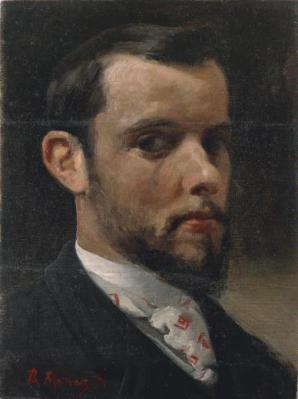
Self-portrait
Själen, personen och kroppens återuppståndelse
Det individuella själsbegreppet i de olika former det förelegat i den hellenska och hellenistiska filosofin kom med tiden att på olika sätt delvis förenas med den kristna religionens läroutformning. Redan NT uppvisar exempel på grekisk-filosofisk påverkan som skiljer det från GT. Något med platonismens jämförbart själsbegrepp återfinnes inte i GT. Det kristna själsbegrepp som småningom utvecklas, ännu, liksom det filosofiska men av ytterligare tillkommande skäl, behäftat med filosofiska oklarheter, fick emellertid stor betydelse på grund av den större vikt man här lade vid det värde den individuella själen förlänade varje “människa” redan här och nu.
Samtidigt måste man förstå att det inte enbart är själen som enligt den ortodoxt kristna läran förlänar människan detta värde. Själen sågs som på visst sätt nödvändigt förenad med den likaledes individuellt-unika kroppen. Enligt den rena, exoteriska bibliska läran var människan till hela sitt väsen skapad. Ingen förnuftssjäl eller väsensgrund förenade henne i sig med Gud och evigheten. Människan hade en själ, men den var liksom kroppen skapad och oskiljaktig från denna.
Hela detta synsätt erhåller nu en oerhörd förstärkning när den tidiga kristna kyrkan antog läran om kroppens återuppståndelse. Vi har redan sett hur Filon inom den judiska religionen vänder sig mot denna lära. Plotinos föraktar den som barbarisk. Den filonska såväl som hela den platonska och gnostiska förståelsen av själen och dess bestämmelse är, trots att fragment av den, som vi skall se, kommer att fortleva inom sektorer av teologin, oförenliga med denna av kyrkan antagna lära. Biggs framhåller det självklara förhållandet att “while it strengthened her [kyrkans] hold upon the masses, [it] was a great stumbling-block in the way of the educated”. [The Christian Platonists of Alexandria (1886 (1970)), 108.]
Sannolikt finner vi här något av det mest väsentliga för förståelsen även av personbegreppet i västerlandet. Med tiden utvecklas vad som i motsats mot Hirzels föreställning om die Seelenpersönlichkeit kan kallas die Körperpersönlichkeit, eller den nödvändigt förenade kropp-själ-personligheten, i vilken själen förstås på annat sätt än i den platonska traditionen.
Elaine Pagels analyserade hur läran om kroppens återuppståndelse övertogs som kristen dogmatik i kampen mot gnosticismen. Kyrkan betonade Kristi läras överensstämmelse med det residualt literalistisk-mytologiska GT och dess skapelsesyn contra gnostikernas “pessimistiska” filosofiska dualism. De kristna gnostikerna med sin uppfattning om själens nödvändiga befrielse från materiens fängelse medels den frihalsande kunskapen gjorde anspråk på att ha tillgång till direkta uppenbarelser från den uppståndne Kristus som bekräftade deras egen uppfattning i allmänhet och om Kristi väsen i synnerhet. [The Gnostic Gospels (1979 (1990)), 41-52] För att säkra den nyetablerade, till Rom centrerade kyrkoorganisationens ställning var det nödvändigt att hävda att endast dess egen ståndpunkt i frågan om Kristus var den rätta. [Ibid. 54.] Detta gjordes bäst genom att hävda att endast den egna successionen var i besittning av den autentiska uppenbarelsen från Kristus, trots att denna tolkning icke gjorde rättvisa åt alternativa tolkningar även i vad som kom att utgöra de kanoniska evangelierna. [Ibid. 37-40] Läran att endast vad man uppfattade som Kristi uppenbarelse för Petrus var den sanna fastslogs emedan denna gav den romerska kyrkan ett övertag över gnostikerna. [Ibid. 41, 59-70.] Enligt denna uppenbarelse hade Kristus nämligen uppstått kroppsligen, och de som inte som Petrus hade mött den kroppsligen uppståndne Kristus kunde inte anses ha mottagit någon sann uppenbarelse.
Gnostikernas anspråk på inre, andliga uppenbarelser från Kristus kunde därmed avvisas. [Ibid. 38, 40 f.] Genom sin uppfattning av kunskapens och uppenbarelsens inre, pneumatiska natur och den därur följande förståelsen av Kristi inte blott historiska utan också mer tidlöst-andliga gärning var gnostikernas lära oförenlig med de kyrkliga exklusivistiska och monopolistiska auktoritetsanspråken, den extrema version av det världsliga ordningssystemets exoteriska religion som så länge kom att forma västerlandet. Med anammandet av denna ståndpunkt följde också införlivandet och hävdandet av läran om den kroppsliga uppståndelsen i allmänhet. Den verkliga “personliga” identiteten är nu icke den som från kroppen åtskiljbar uppfattade själen, eller icke denna själ allena, utan den nödvändiga föreningen av kropp och själ, Människans enhet.
I själva verket låg läran om kroppens uppståndelse i sin bjärta exotericitet helt i linje med bibelns grundkonception ifråga om Skapelsen och Människan. Hela eskatologin och soteriologin kan förstås som bara en eternalisering av det Skapade. Den Skapade Människan, satt att Råda över Skapelsen och lägga den under sig, uppstår till evigt liv Som Sådan, på en likaledes eternaliserad Ny Jord. Parallellt med den klassiska hellenska Människoidealiseringen är detta den åskådningsmässiga huvudkällan för den Människocentrering, den rena Humanism, den Mänskliga Maktutövning över Skapelsen, som definierar västerlandet. Den är inte bara en produkt av moderniteten, vetenskapen, ateismen o.s.v., och inte ens bara av den klassiska grekisk-romerska antikens protomoderna filosofi och vetenskap, utan i hög grad ett med västerlandets Religion och förhanden även under dess mest Religiösa historiska epok, den kristna medeltiden. Med den bokstavliga, dogmetablerade läran om kroppens återuppståndelse och Människans eternalisering går västerlandets historiska religion i själva verket oändligt långt utöver den antika filosofin i denna Människocentrering. Det är bibeln, både det gamla och det nya testamentet, som är huvudkällan; den klassiska filosofin är sekundär.
När personbegreppet diskuteras under medeltiden finner vi därför hur vad som skulle komma att uppfattas som personskapet visserligen fortfarande ofta hänförs primärt till själen, men att dels det mänskligt-kroppsliga alltmer på ett nytt sätt börjar uppfattas som en nödvändig del av det, dels själen nu förstås som oskiljbar från denna kropp, tillsammans med den konstituerande den Skapade Människa allt enligt bibeln handlar om. Och när aristotelismen införs i den kristna teologin – den lära i vilken det kristet inspirerade kropp-själsliga enhetstänkandet hade en av sina tydligast jämförbara, partiella filosofiska föregångare eller paralleller – förmärks också ett mer principiellt åtskiljande av personbegreppet från själsbegreppet och ett mer konsekvent tillämpande av det förra på den nya Mänskliga enheten.
Giuseppe Sacconi: Il Vittoriano

The Exceptionality of Materialism
Keith Ward on Materialism, 5 1 2 3 4
“Materialism has rarely seriously been on the agenda of classical philosophy”, Ward says. Materialists are perhaps not quite as rare in European philosophy as in Indian thought (where it is necessarily represented only by those who – and I think there are, before the importation of Western scientisms and Marxism of course, only two schools – position themselves outside of the major spiritual traditions), but it is remarkable that they are not so much less rare as one might think. Before materialism became part of a political ideology, Marxism, they were in fact very few in the West.
The first philosophical formulation of materialism is still relevant to its definition or for accounts of what materialists mean: “Democritus’ theory that nothing finally exists except material particles with mass, position and velocity, interacting with one another in more and more complicated ways, did not have much appeal as a description of the value-laden, complex world of human experience, with all its depths of feeling and varieties of intellectual description.” This points to some of the experience that is part of the philosophical point of departure and basis of personalism, and to the reasons why this experience speaks against materialism. Personalism is, or should be, a form of idealism.
Ward remembers “the occasion when materialism first hit the world of Oxford philosophy”. This is remarkable. Ward was born in 1938. But he is of course not saying materialism had been unknown in Oxford philosophy. Many of the basic materialist positions became prominent in the nineteenth century and had been widely discussed since then, although materialism has certainly been further developed and radicalized in recent decades, a fact which Ward also discusses. What he means here is that materialism was not embraced and defended by Oxford philosophers – that it didn’t quite “hit” it.
Also, he is speaking only of materialism, not of atheism. It is quite possible to be an atheist without being a materialist, like Hume, and Ward notes elsewhere that there are more atheists than materialists in the history of Western philosophy. It is also possible to be a non-materialist but not an idealist. It is all a matter of various levels of experience, insight, and coherence and comprehensiveness of reasoning. But we define materialism here primarily in such a way as to make it impossible to be both a materialist and a theist, or one who affirms the spiritual view of the world – as the position that matter is all there is, the position of reductionist materialism. But the question of this kind of materialism turns out to be inseparable from a secondary definition, the one according to which materialism is merely the affirmation of the existence of such a thing as matter as understood by materialists in itself, with the exception of its quality of being that to which all reality can be reduced.
As late as the early 1960s, reductionist materialism was unknown in Oxford, Ward recounts. There were then “three main Professors of Philosophy in Oxford – Gilbert Ryle, A. J. Ayer, and R. M. Hare. Hare was an Anglican, Ryle an agnostic, and Ayer an atheist. But they all agreed that materialism was an over-dogmatic, impoverished and over-simplified form of belief that completely failed to account for the sheer diversity of the human world, the importance of human experience, and the exigencies of morality.” This is clearly important to note for those who object to other aspects of the work of those non-idealists.
Ward’s account of the “hitting” is fascinating: “I was sitting in one of Gilbert Ryle’s seminars in 1963 when a visiting Australian doctor, David Armstrong, presented a paper defending a materialist theory of mind. I still remember the sense of shock as this heretical Australian laid into Ryle’s concept of mind and insisted on the need for a purely materialist account of consciousness. It seemed so far beyond the bounds of plausibility that some of us were not sure if it was tongue-in-cheek or not.
Well, it was not. And in about forty years materialism, sometimes called ”physicalism”, has risen to a position of such prominence in philosophy that the materialist Daniel Dennett can say, quite falsely in fact, that virtually every serious philosopher is a materialist.”
Early on, I came to think that materialism was in fact philosophically refutable, in the sense in which things are at all refutable by philosophy. I.e., I came to think it was refutable not only in terms of spiritual experience and realization, but on the theoretical level, through the particular intellectual discipline of philosophy. Materialism – all possible variations of Democritus’ basic theory – always seemed unbelievable and often simply absurd to me. Therefore I could never take the materialist or physicalist development in the last forty years, which Ward mentions, quite seriously. I could hardly even really accept it as philosophical.
Not only did the materialists for the most part have an often clearly identifiable agenda and motivation, which are not in themselves of a philosophical nature. And these do require analysis in terms of political and cultural history, psychology, and other perspectives. They also made false claims of the kind Ward cites from Dennett. It is obvious, despite the recent development, not only how many serious philosophers are not materialists, but how many serious philosophers are idealists and personalists.
The exceptionality of materialism implied by the majority consensus is of course also in itself a part of the case, for the obvious reasons that follow from the ones that make the consensus such a part, although it is certainly not in itself a sufficient one.
 Olle Bengtsson