stiger av 12an vid Alvik
stiger av 12an vid Alvik

The Maharaja is wearing the mantle of the Order of the Star of India, of which he was Knight Grand Commander (GCSI).
 John Stuart Mill and the Religion of Humanity introduces material that requires significant reevaluation of John Stuart Mill’s contribution to the development of the liberal tradition. Through his influence, the radical anti-Christianity of the French tradition was incorporated into the Anglo-American political tradition. Mill’s nontheological utilitarianism also involved the equally important insinuation of Comtean “altruism,” with its notion of the superiority of social morality over personal morality, into Anglo-American consciousness. Linda C. Raeder’s study carefully examines the nature of modern secular liberalism, the chief political carrier of the Millian form of secular religiosity in the American context.
(This photo replaces the original content of this post.)
Modernity as Rationalized Sexual Misbehavior
Ignatius Press, 1993 Amazon.com
Back Cover:
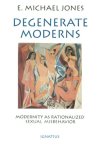 In this groundbreaking new book, Jones shows how some of the major determining leaders in modern thought and culture have rationalized their own immoral behavior and projected it onto a universal canvas. The main thesis of the book is that, in the intellectual life, there are only two ultimate alternatives: either the thinker conforms desire to truth or he conforms truth to desire.
In the last one hundred years, the western cultural elite embarked upon a project which entailed the reversal of the values of the intellectual life so that truth would be subjected to desire as the final criterion of intellectual value. In looking at recent biographies of such major moderns as Freud, Kinsey, Keynes, Margaret Mead, Picasso, and others, there is a remarkable similarity between their lives and thought. After becoming involved in sexual license early on, they invariably chose an ideology or art form which subordinated reality to the exigencies of their sexual misbehavior.
“Degenerate Moderns is a marvelous tour de force. Jones provides the reader not only with an overview of the sources of modern culture but also with a way of understanding what otherwise might seem simply surprising…at the root of many of the most influential books and theories lies the sexual problems of their authors. Sophisticated, informative and learned as this book is, it can be read as a high level corroboration of what your mother always told you. Jones is one of the most readable writers I know.” Ralph McInerny, University of Notre Dame
“In the Ethics, Aristotle pointed out that ‘Men start revolutionary changes for reasons connected with their private lives.’ This is also Michael Jones’ thesis in his profound new book. It is extraordinary how much of the modern landscape is illuminated by this perspective, as Jones dissects the moral lives of the progenitors of modernity and shows the intellectual consequences. His treatment of Mead, Kinsey, Freud and Jung is devastating. This is not an ad hominem attack, but a brilliant illustration of the inescapable relationship between the order of the soul and the order of everything external to it.” Robert Reilly, ‘Voice of America’
“A fascinating blend of biography, intellectual history, and investigative reporting. This book takes up where Paul Johnson’s Intellectuals leaves off. It should be required reading for anyone who wishes to understand the intellectual fashions of the Twentieth century.” William K. Kilpatrick, Author, Psychological Seduction
About the Author:
E. Michael Jones is a writer, former professor, media commentator and the current editor of Culture Wars magazine (formerly Fidelity magazine).
The Making and Unmaking of an American Myth
Bloomsbury Publications, 2012 Amazon.com
Book Description:
 In Search of the City on a Hill challenges the widespread assumption that Americans have always used this potent metaphor to define their national identity. It demonstrates that America’s ‘redeemer myth’ owes more to nineteenth- and twentieth-century reinventions of the Puritans than to the colonists’ own conceptions of divine election.
It reconstructs the complete story of ‘the city on a hill’ from its Puritan origins to the present day for the first time. From John Winthrop’s 1630 ‘Model of Christian Charity’ and the history books of the nineteenth century to the metaphor’s sudden prominence in the 1960s and Reagan’s skillful incorporation of it into his rhetoric in the 80s, ‘the city on a hill’ has had a complex history: this history reveals much about received notions of American exceptionalism, America’s identity as a Christian nation, and the impact of America’s civil religion.
The conclusion considers the current status of ‘the city on a hill’ and summarizes what this story of national myth eclipsing biblical metaphor teaches us about the evolution of America’s identity.
Reviews:
“A thought provoking analysis of how the biblical metaphor of ‘a city on a hill’ became a national myth. Gamble begins with a careful analysis of John Winthrop’s 1630 lay sermon in the context of its time and traces the ways in which the biblical image was employed by others to define American identity in the two hundred years that intervened between the time when Winthrop delivered his sermon and its recovery in the nineteenth century. The concluding chapters explore how politicians including John F. Kennedy, Ronald Reagan, Michael Dukakis, and Sarah Palin have appropriated Winthrop’s name and words to define American exceptionalism, and what this means for America as a nation and for Christians living within the nation.” Francis J. Bremer, author of John Winthrop: America’s Forgotten Founding Father (2003) and Building a New Jerusalem: John Davenport, A Puritan in Three Worlds (2012),
“In Search of the City on a Hill is the most important study of the origins and of the evolution of a national myth. For the second time Richard Gamble took it upon himself to reveal and prove the insidious and particularly American historical tendency to employ religion for political purposes – indeed, to subordinate matters of faith to populist publicity, to enhance the latter by the former. This is a lone cry in the midst of a deafening wilderness, but one enriched with a most serious scholarly amassing of historical evidence.” John Lukacs, author of Five Days in London: May 1940 and A New Republic
“’Civil religion is voracious and will gobble up anything it thinks useful’. That stark observation of Rowland Sherrill has never been more conclusively proven than by Richard M. Gamble’s In Search of the City on a Hill. His discovery of the recent and artificial provenance of a holy verse in the American Creed proves even more astounding for the evidence that doesn’t exist than for the evidence it unearths. This concise masterpiece of historical detection blew my mind. It will also blow the circuits of misguided conservatives, neoconservatives, and evangelicals who have been duped (or duped others) into an idolatrous interpretation of their nation, their history, themselves.” Walter A. McDougall, University of Pennsylvania, Pulitzer Prize-Winning Historian, author of Throes of Democracy: The American Civil War Era
“Instead of arguing over how best to frame the American mission in terms of the city on a hill, Gamble suggests we ought to ask a different question. We ought to have a debate ‘between exceptionalists of all sorts on one side and skeptics on the other, that is, between those who believe that the United States is somehow exempt from human finitude, the lust for domination, and the limits of resources and power, and those who do not.’ Richard Gamble’s book is an important first step toward that long-overdue debate.” Thomas E. Woods Jr., The American Conservative
About the Author:
Richard M. Gamble holds the Anna Margaret Ross Alexander Chair in History and Political Science at Hillsdale College, Michigan, USA. He taught at Palm Beach Atlantic University in West Palm Beach, Florida, USA from 1994 to 2006. His previous books include The War for Righteousness: Progressive Christianity, the Great War, and the Rise of the Messianic Nation and The Great Tradition: Classic Readings on What It Means to Be an Educated Human Being. He also serves as a contributing editor for The American Conservative.
In the French Revolution, J. L. Talmon observed, rationalism itself had been transformed into a passionate faith. [The Origins of Totalitarian Democracy (1970 (1952), 6.] Already Lamartine noticed that Mirabeau managed to make reason passionate. The social and political consequences of the idea that the voice of the People was really the voice of God now had to be drawn. The Roman-inspired constitutional aspiration were swept aside by the Jacobins with the help of the new, militantly impersonalistic political concept of la volonté générale, as the revived generalistic paradigm of Greek political philosophy combined with the new centralism and nationalism to produce the first Gnostic dictatorship of modernity. The rights of the secular individual – in Robespierre’s rhetoric sometimes under the nominal designation of personality – were proclaimed alongside the rights of the abstract universal Humanity which was somehow embodied in the new republic.
Described as an explosion of divine wisdom, the Revolution was immediately seized upon and further theorized by the politically powerless German romantics and idealists. [The reactionary side of romanticism is not seldom a superficial, aesthetic phenomenon, under the surface of which hide the same radical ideas. When it is real, what we find is often the use of some of the new intellectual resources in the defence of pre-revolutionary social and political formations which were already characterized by the relapse from differentiation. A more balanced, selective, non-revolutionary use of romantic ideas is found in Burke and similar thinkers.] Kant wrote a treatise on eternal peace which was followed by the outbreak of the most extensive wars in history. If the people were only released, some Germans proclaimed, a magnificent, spontaneous, peaceful harmony of individually different nations would arise, like a wonderful symphony. This vision, however, already swerved significantly from the French form of universalism. Crushed by Napoleon, yet incapable of rejecting the Revolution, the Germans devised their own popular, pantheistic nationalism as an ideology of resistance.
Pantheism thus provided the metaphysics of the revolution. The People was the real divinity which advanced irrepressibly while the empty abstractions of the Supreme Being or Reason were formally worshipped. In the absence of the differentiational framework – the transcendent sphere of values, the ontic logos, and the objective moral order – the asserted freedom was of the distinctly modern kind: the freedom of mere self-assertion, either as guided by self-protection and rational calculation of the maximization of pleasure, or in the form of the new emotional expressionism of the romantics. It was no more qualified than the simultaneously asserted equality: both were normless, tending towards abstract absoluteness and limitlessness and thus the illusory. They corresponded to a universe in which All is God. And if All is God, God cannot be the Father, and if there is no father, the assertion of general human brotherhood is meaningless. German idealism, at one early stage, conceptualized it all in the form of a Transcendental Jacobinism.
Romanticism was the cultural expression of the state of affairs after the divine explosion, where differentiation and structured order were theoretically and practically rejected on all levels. Drawing on the accumulated legacy of the esoteric tradition, the romantics further transformed nature/God into an evolving, holistic, and vitalistic process in which the individual was to be merged through intuition and feeling. Everything was included in the becoming in which nature/God strove to realize all its potentials, in nature, history, and art, and in which it became conscious in Man. Nature was visible spirit and spirit invisible nature. Illustrating the continuity of rationalism and romanticism, Carlyle proclaimed that the Enlightenment philosophers were right in asserting that the supernatural was not distinct from the natural; but this, he held, meant that the natural must be elevated to the supernatural and not, as they had thought, the reverse. [See Franklin L. Baumer, Modern European Thought: Continuity and Change in Ideas, 1600-1950 (1977), 274-6.] But if they were not distinct, the meaning of this position was hardly clear. If All is God, there is no difference between high and low, up and down. The position that All is God, that God alone exists, turned out to be difficult to distinguish from the position that Nothing is God, that Man alone exists.
The new totality was without any structure, any hierarchy. It was without rules, auto-evolved, no longer created and ordered according to an ontic logos. The endeavour to preserve the traditional distinctions of morality, society, art and religion were powerless against the underlying blurring momentum of the pantheistic revolution.
Mendelssohn sought to show that pantheism, rightly conceived, was congruent with religion and morality. Throughout the ages, similar strategies could seem to have been devised by monists. Christian mystics had claimed to uphold the Trinitarian theism of orthodoxy, Sufi mystics had defended Allah and his law, and advaita vedantists retained on one level the ishvara, the personal deity. But that was before the pantheistic revolution of modernity. In the context of the latter, the elevation of a wholly ineffable, impersonal oneness to the highest, ultimate or only true reality assumed new meanings and had different consequences. Its often neglected metaphysical diffculties were reproduced on all levels of the respective philosophical systems. The efforts to preserve, under this condition of the relegation of the distinct focus of the personal aspect of the transcendent Godhead to a lower level in the hierarchy of being, the structured order of the still lower, phenomenal levels of reality all seemed somehow sooner or later to fail. As the transcendence of the unity was lost in the ever-growing metaphysical confusion, phenomenal reality dissolved into chaotic formlessness, increasingly exposed to the manipulations of arbitrary human will.
De 1945 à nos jours
Perrin (2000) Amazon.fr (2004)
Quatrième de couverture:
 La France, dit-on, est le pays de la liberté. Dans le domaine des idées, cela reste à démontrer. Car tout se passe comme si un petit milieu détenait les clés de la vérité. Et ceux qui contestent son monopole sont victimes d’une censure insidieuse, qui les réduit au silence. Sur la scène politique, culturelle et médiatique, ce terrorisme intellectuel s’exerce depuis cinquante ans. En 1950, les élites exaltaient le paradis soviétique et chantaient la louange de Staline. En 1960, elles assuraient que la décolonisation suffirait à garantir le bonheur des peuples d’outremer. En 1965, elles s’enflammaient pour Fidel Castro, Hô Chi Minh ou Mao. En mai 1968, elles rêvaient de libérer l’individu de toute contrainte sociale. En 1975, elles saluaient la victoire des communistes en Indochine. En 1981, elles croyaient quitter la nuit pour entrer dans la lumière. En 1985, elles proclamaient que la France devait accueillir les déshérités de la terre entière. Dans les années 1990, l’idéologie libertaire et l’ultralibéralisme se rejoignaient pour affirmer que le temps des nations, des familles et des religions était terminé. Pendant cinquante ans, les esprits réfractaires à ces positions ont été victimes du terrorisme intellectuel, car ils ont été traités de réactionnaires, de fascistes, de capitalistes, d’impérialistes, de colonialistes, de racistes, de xénophobes, d’obscurantistes ou de partisans de l’ordre moral, même quand ils ont eu raison avant tout le monde. Le terrorisme intellectuel est une mécanique totalitaire. Pratiquant l’injure, l’anathème, le mensonge, l’amalgame, le procès d’intention et la chasse aux sorcières, il fait obstacle à tout vrai débat sur les questions essentielles qui engagent l’avenir. Quand on se sera enfin débarrassé de telles méthodes, la France redeviendra le pays de la liberté.
Not much needs to be said here about the impersonalistic import of classical physics and the conception of science to which it gave rise and which in important respects dominated the West for centuries. In the course of the Enlightenment, classical materialism and atomism, the minor traditions of Greek philosophy which had been rejected by the speculative philosophers of the differentiational shift and which could not enter into the grand synthesis that was Christian theology, were again taken up and deployed in theoretical support of the emerging scientific administration of modernity. With the differentiational tension abolished, the West’s dynamism and creativity was increasingly refocused on the material sphere.
The story of how the West came seriously to adopt as a worldview the mechanistic model of matter in motion, how it built a predominantly materialistic civilization focused on the control and exploitation of nature, and how it proceeded to spread it to the rest of the world, is at least in the perspective of comparative cultural history not only a history of beneficial material and even, indirectly, some cultural and political advancement, but also one of a cultural, moral, and spiritual abnormity. From the model’s beginnings in the early modern period, when Hobbes and others immediately began to apply it to human beings, it has also produced problematic and sometimes tragic results of a scale and a number which alone foreclose any interpretation of Western modernity as simple progress of the values of the person.
Renaissance individualism, even among the learned humanists, had been marred from the beginning by the relativism, egocentrism, vanity, Prometheanism, and sheer vulgarity of the new secularism. When modern individualism was philosophically formulated by Hobbes, it was the grossest doctrine of a living lump of matter, without any distinctly human nature in common with others, causally impelled by the drive for self-preservation and the satisfaction of desires. This is the doctrine which still dominates liberal political philosophy, political economy, and utilitarianism, and which, behind the added facade of Locke’s philosophically largely unsupported moral rhetoric, is the basis of the modern theory of natural rights. The problem of setting only abstractive reason and nature against convention became much more evident in the eighteenth century than among the Greeks. [Again, while they point to the potential dangers in Strauss’s return to the classics, the historicist conservatives also criticize the failure of his American followers properly to distinguish between the classics and the radicals of the Enlightenment. But, as could be gleaned from the previous section, both parties fail to recognize the difference made by Voegelinian experiential transcendence, especially as supplemented by the personalistic dimension.]
Both the concept of reason and the concept of nature were susceptible of continuous reinterpretation. Modern rationalism was in the process of cutting off the upper layers of classical reason which accounted for the differentiational intuition of transcendence, and of reinterpreting nature in accordance with the new science. And in the course of the transition from transcendence to immanence, from theism via deism and pantheism to romanticism, Rousseau only added further new dimensions of the definition of the concept of nature to those of the rationalists. The individual conceived in the terms of any of the versions of modern “nature” was far from the person.
Meanwhile, the secularization of the Renaissance, the Reformation, hosts of new ideologues, and the new technological resources together made possible the consolidation of the position of the territorial monarchs, who set about neutralizing the independent aristocracy, centralizing power, and re-divinizing both the state and themselves, to some extent after the pattern of the early pantheism of the cosmological civilizations, the pull of which was still strongly felt. Because of the still historically influential concrete social and cultural results of differentiation in the intervening classical and Christian civilization, they could never completely succeed, but in addition to the intellectual developments of the new pantheism, the new political form of absolutism ensured that the process of modernization often continued to proceed in a manner intrinsically inimical to the values of the person.
Although Rousseau remains the paradigmatic thinker of romanticism, adding the sentimental variation of modernity to its uncompromising rationalization, [After almost ninety years, Babbitt’s Rousseau and Romanticism is still the unsurpassed analysis of this phase of Western intellectual history, the objections even of critics like A. O. Lovejoy and I. Berlin tending to fall by the wayside. The latest edition (1991) contains a lengthy introduction by Ryn.] others before him had contributed powerfully to the development of this unavoidable complement. In the worldview of monistic mysticism and metaphysics, nature devolved from the absolute and perfect impersonal oneness, and it increasingly came to be thought that for this reason it could not contain evil in any sense except that of privation. On this view, no expansive desires and rational and emotional exploits could really be evil. The providential plan according to which man moved towards the secular kingdom of perfection was apprehended not only by the sinless certainty of unaided reason, but by the sinless certainty of the innocent heart.
Like the universe of immanentistic Hermeticism, man is good, and the Man Machine of Enlightenment materialism could not satisfy romantic man’s emotional side. Committed to his secularism, romantic man could not return to the differentiated reality of true personal identity. Despite his rejection of the rationalist materialism, atomism, and utilitarianism as well as the formalist conventions of the culture of the Enlightenment, he had to move forward, inevitably carrying with him most of the deeper legacy of the modern impersonalistic development. Instead of reversing its trend, he added to it supplementary dimensions.
In Rousseau we stand not only before the paradigmatic addition of the general romantic complement, but also before the equally paradigmatic prefiguration of its more specific dialectic of narcissistic individualism and egotism, on the one hand, and its longing for absorption in a larger whole, on the other. And the larger whole is both the womb of the good nature which is one with the cloudy haziness that is now the divine, as confessed by the Savoyard vicar in Émile, and the whole of the nation, of la volonté générale: rejecting the disruptiveness of Christianity, Rousseau praises the cohesive power of pagan civil religion as perceived through his distinctly new sensibility.
 Olle Bengtsson