Keith Ward on Materialism, 14 1 2 3 4 5 6 7 8 9 10 11 12 13
Having dismissed the theoretical arguments for materialism, Ward turns to what he is inclined to see as its real causes and underlying motivation, “the raw nerve and the emotional powerhouse of materialism”: What really drives much materialist philosophy is rage at the injustice and indifference of the universe. Things happen to people by chance; the innocent suffer and the evil flourish. There is too much suffering and pain in the universe for it to be designed by any half-way benevolent being. Better, then, to postulate unconscious laws operating without benevolent purpose, than to think of there being a great intelligence that has intentionally planned such pain and pointlessness.”
Theory remains, however, also when Ward focuses on the materialists argument from evil and suffering against the “great intelligence”, rather than on the question of the existence of matter as conceived by classical materialism. This is partly because materialism for Ward means primarily the rejection of the position that reality is ultimately spiritual, even though that position may also accept that there is some such a thing as matter as conceived by classical materialism. This is Ward’s broad category of idealism: any position that accepts the ultimacy of spirit is idealism, regardless of whether or not it accepts non-ultimate classical-materialist matter, i.e. their matter without their materialism (difficult as that may be).
I would prefer to define idealism more narrowly, as excluding also non-materialist, non-ultimate, classical-materialist matter. A distinction should be made between on the one hand materialism, the affirmation of classical materialist matter and the concomitant rejection of ultimate spiritual reality or even any spiritual reality, and on the other what could perhaps be called “matterism”, the mere affirmation of classical-materialist matter as such or indeed of any matter which shares at least some of the characteristics of classical-materialist matter, regardless of the position with regard to ultimate spirituality.
Of course, “matterism” is not a very felicitous term. First of all, it seems to signify precisely the same thing as “materialism”. But what I intend it to mean is simply the affirmation of the existence of matter in any form that is incompatible with the kind of idealism I think might be defended – which, I add, does not include classical idealist conceptions of matter, which are quite different from the classical materialist one. It would be better to speak of this not as an “ism”, and instead only of materialism as an “ism” that takes such affirmation so far as to assert such matter as the ultimately and perhaps exclusively real.
But it is inconvenient to have to repeat “the affirmation of the existence of matter in any form that is incompatible with the kind of idealism I think might be defended” each time this is referred to. A separate term signifying this is needed in order to avoid it, as well as avoiding the loose usage of “materialism” about any affirmation of the reality of matter regardless of the larger philosophical context. And it is impossible to take consistently the position that all “isms” are extreme exaggerations: “ism”-words must be used for all kinds of positions that are not of this kind at all. Thus matterism in itself is not an extreme and unusual position like materialism. It is compatible with Ward’s broadly defined idealism, which is not extreme either. Idealism more narrowly defined may be less common and is certainly viewed as extreme by many who have not studied it deeply yet are certainly not materialists. But positions that from some perspectives appear extreme cannot of course for that reason be rejected in philosophy. This holds for materialism too. Its extremism and unusualness in the perspective of the history of philosophy as well as contemporary philosophy which Ward has discussed is not, as Ward is of course aware, in itself a sufficient argument against it. For these reasons, “matterism” might perhaps be an admissible and useful term in discussions like this one. But other and better suggestions are welcome.
The argument against the “great intelligence”, remains, as I said, theoretical. But it is non-theoretical and based on the motives Ward is here beginning to describe and analyse inasmuch as it implies the affirmation of materialism in the sense of the position that what exists instead of that intelligence is matter. Even though the ultimate spiritual reality is rejected on the basis of experienced evil and suffering, this does not in itself imply that classical materialist matter takes it place in being made ultimate.
Thus something like classical-materialist matter is commonly brought in despite the weaknesses of the distinct arguments in favour of it as such. Perhaps the position resulting from the simultaneous rejection of ultimate spirituality and classical-materialist matter would still seem to resemble too much some other kind of idealism: the “unconscious laws” mentioned by Ward must be the laws of classical-materialist matter. But in view of the theoretical difficulties of such materialism, this affirmation cannot be accounted for except by the emotional factors involved, alongside the theoretical argument from evil, in the rejection of ultimate spirituality.
“These are entirely serious points”, Ward notes. “If the universe is morally unjust and indifferent to suffering, that counts strongly against the existence of a just and compassionate God. But perhaps part of the trouble is that we think of a cosmic mind as able and wanting to avoid all suffering, and as immediately and directly rewarding the good and punishing the wicked. For a moment, set such an overtly religious but basically naïve picture to one side, and think just of a consciousness that conceives all possibilities and generates a universe directed to evolving other intelligent information-processing intelligences.”
As we have already seen, Ward thinks in terms of Christian or Biblical creation, and we have also seen that although he certainly rejects “matterism” as the affirmation of classical-materialist matter, he accepts as congruent with his broader idealism (i.e., in his case, the affirmation of God as ultimate spirituality) some other form of matter more congruent with contemporary physics. Although it is unclear what that matter is, not least as Ward himself in fact, as I have pointed out, adduces arguments which would seem to be in favour of the rejection of any and all matterism, it is necessary to stress that matterism should be defined as including also the affirmation of modified, contemporary versions of matter which still, if this is possible, retain some of the metaphysical characteristics of classical-materialist matter that are relevant here.
Because of his acceptance of such non-ultimate and modified matter, Ward speaks of a generation and evolution of “other intelligent information-processing intelligences”, which involves and presupposes that alternative matter. This is a very different idealist position from the one I think could be defended. The broader idealism is somewhat hampered by the religious image-thinking of exoteric Biblical creation-theology, notwithstanding the expression of the latter in terms of evolution.
But what we are concerned with here is the analysis of materialism, and although the difference has to be pointed out for the sake of clarity, it is less important than the specific arguments Ward presents for the purposes of that particular analysis, arguments which are of importance for idealism in general, including the one I would try to defend. My point about materialism and matterism, or the proper meaning of materialism, is a minor one in this connection.
Ward is moving on here to the important analysis of what “really drives” materialism as the affirmation of matter, classical-materialist or modified, as ultimate or even exclusive. And this turns out to be the theoretical arguments for the rejection of spirit or God as ultimate that are not the specific theoretical arguments for materialism themselves, and that, as Ward will show and signals by his use of the words “raw nerve”, “emotional powerhouse”, and “rage”, are almost always combined with the motives that, without theory, reach for materialism as a replacement.
 This study of democracy goes to the heart of ethics and politics. Strongly argued and lucidly written, the book makes a crucial distinction between two forms of democracy. The author defends constitutional democracy as potentially supportive of the ethical life, while he criticizes the plebiscitary form of democracy as undermining man’s moral nature. The book includes an extensive interpretation and refutation of the ideas of Jean-Jacques Rousseau and offers a new perspective on the American Constitution and the relationship between moral community and self-interest. This edition includes an important new section on the common good and the state of Western democracy.
 This lucid synthesis of classical Greek, Judaeo-Christian, and modern ideas poses a challenge to positivism and moral relativism in modern sociopolitical thought. The true science of social life, Claes Ryn contends, is based on a humanistic and philosophical grasp of the moral nature of man.
 When Timothy Sprigge’s The Vindication of Absolute Idealism appeared in 1983 it ran very much against the grain of the dominant linguistic and analytic traditions of philosophy in Britain. The very title of this work was a challenge to those who believed that Absolute Idealism fell with the critiques of Bertrand Russell and G. E. Moore at the beginning of the 20th century. Sprigge, however, saw himself as providing an underrepresented position in the philosophical spectrum rather than as advocating an abandoned view. For him, idealism did not fall at any determinate point in the history of philosophy. The truth of any philosophical thesis cannot depend on what happens to be currently fashionable, but rather must stand on the soundness of philosophical argument. To this end, The Vindication of Absolute Idealism is a bold statement of his conclusions, a synthesis of panpsychism and absolute idealism, which he contends is the most satisfactory solution to the question of the nature of consciousness and the mind-body problem. Sprigge’s view of consciousness remains a challenge to mainstream physicalism and a viable option that addresses pressing contemporary concerns not only in metaphysics and philosophy of mind but also in environmental ethics and animal rights.
 Science and religion are often viewed as antagonists in the quest for truth. It may come as a surprise, then, to find that the leading physicists of the twentieth century were sympathetic to a mystical worldview. In this collection, Ken Wilber brings together the writings of eight great scientists – Heisenberg, Schroedinger, Einstein, de Broglie, Jeans, Planck, Pauli, and Eddington – with the aim of addressing several important questions: Do the findings of modern physics support the teachings of ancient mystics? How does the scientific method compare with contemplative techniques in the quest for truth? Is there really a “battle” between these two approaches to investigating reality? In revealing some answers, Wilber also points the way toward a genuine reconciliation between science and religion.
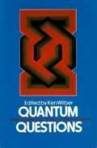 The popularity of recent books such as The Tao of Physics attests to the unprecedented interest in the relationship between modern quantum physics and mysticism that has arisen in the past decade. And yet nowhere before have th thoughts of the original founding physicists themselves been presented. Quantum Questions brings together for the first time the mystical writings of the world’s great physicists – Heisenberg, Schroedinger, Einstein, de Broglie, Jeans, Planck, Pauli, and Eddington – all of whom express a deep belief that physics and mysticism are somehow fraternal twins.
 Olle Bengtsson