
Category: Spirituality
Kocku von Stuckrad: Western Esotericism
A Brief History of Secret Knowledge
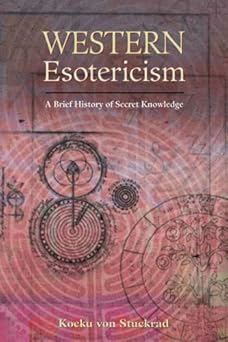
Routledge, 2005
Back cover:
A controversial issue of public debate during the recent years, esotericism can be described as the search for an absolute but hidden knowledge that people claim to access through mystical vision, the mediation of higher beings, or personal experience. In Western cultural history these claims often led to conflicts with more established forms of scriptural religions and with reductionist interpretations in science and philosophy.
In this highly readable book Kocku von Stuckrad describes the impact of esoteric currents from antiquity to the present and pursues the continuities and breaks in a tradition that significantly influenced the formation of modernity. When Hermes Trismegistos reveals wisdom of an absolute quality, the unveiling of hidden knowledge in Jewish Kabbalah is transformed by Christians, Renaissance thinkers speak of an ‘eternal philosophy,’ or when in the ‘New Age’ people try to get in contact with a source of superior understanding – in every case the dynamic of concealment and revelation is at stake and the ways this hidden knowledge can be made accessible for human curiosity.
About the Author:
Kocku von Stuckrad teaches at the Institute for the History of Hermetic Philosophy at the University of Amsterdam. Previously he was a professor of religious studies at the University of Bayreuth. His most recent work includes History of Western Astrology (published by C.H. Beck in German, 2003, and by Equinox in English, 2005) and Einfuhrung in die Religionswissenschaft (Introduction to the Science of Religion) with Hans G. Kippenberg published in 2003 in German by C.H. Beck.
Francis of Assisi

Tage Lindbom: Bortom teologin
Norma, 1986
Baksida:
 Den västerländska teologin har sedan århundraden steg för steg anpassat sig till världsliga tänkesätt. Det är främst under trycket av de vetenskapliga framstegen och de ideologier, som framburits av folkliga rörelser, som denna anpassning skett. I den moderna världen med nya samhällsklasser och sociala strider har teologin ej heller lyckats att formulera den socialetik, som hade varit nödvändig för att möta situationen.
Eftergifter och kompromisser med sekulära tänkesätt har framkallat ett sådant tillstånd av förvirring och hållningslöshet att västerländsk teologi kan liknas vid en ruinhög. Men det andliga livet är därför ej tillspillogivet – Sanningens ljus vägleder oss och den som söker han finner.
Bhaktivedanta Swami Prabhupada in Stockholm
Semi-totalitarian Swedish socialist state television reports that the Hare Krishna movement has been criticized by “many” for being a “romantic religious pop association” run for “commercial purposes”. 1973.
A. C. Bhaktivedanta Swami Prabhupāda: Bhagavad-gītā som den är
Svensk översättning av Ajit dāsa Adhikārī och Vegavan dāsa Adhikārī
Bhaktivedanta Book Trust, 1977 (Bhagavad-gītā As It Is, Macmillan 1972)
Baksida:
 Till skillnad från tidigare översättningar av Bhagavad-gītā till svenska är den här autentisk. Det autentiska ligger i att översättningen har gjorts av människor som är hängivna dess tro och som upplever texten, dess originalspråk – sanskrit – och dess centrala fromhetsbegrepp inifrån. Texten är försedd med förklaringar som förmedlar dess innebörd. Genom att varje strof blir föremål för sådan vederhäftig behandling kommer säkert många västerländska fördomar och missuppfattningar att skingras. Genom seriöst studium av denna bok öppnas vägen till en ny värld, som erbjuder många andliga upptäckter.
Är det något jag hoppas och vill tillönska inför denan utgåva så är det att den svenske läsaren ska få möta en levande hinduism och en fullödig bekännare av hinduisk tro!”
Dr theol Bertil Persson
“Jag finner en tröst i Bhagavad-gītā, som jag inte ens kan finna i Bergspredikan. När besvikelse stirrar mig i ansiktet och jag inte mer kan se en enda stråle av ljus, då vänder jag mig till Bhagavad-gītā. Jag finner en vers här och en vers där, och snart börjar jag le för mig själv mitt i överväldigande sorger – och mitt liv har utifrån sett varit fullt av tragedier, och att dessa inte har efterlämnat outplånliga spår, tackar jag undervisningen i Bhagavad-gītā.”
Mahatma Gandhi
“Ty Gītā är inte en bok. Den är den eviga visdomens läkande leende, ett ansikte klart vänt mot livets förfärlighet, men fyllt av en sådan frid, ett flöde av den eviga kärlekens ljus, som förtar fruktan, min största fiende.”
Dan Andersson
“Jag vet inte vad jag ska prisa mest, Bhaktivedanta Swamis översättning eller hans djärva förklaringar av texten. Jag har aldrig skådat en viktigare eller mer auktoritativ framställning av Bhagavad-gītā. Den kommer att uppta en betydande plats i den moderna människans intellektuella och etiska liv en lång tid framöver.”
Shaligram Shukla, Prof. i lingvistik – Georgetown Universitet [sic]
“Genom att delge oss en ny och levande tolkning av ett för många redan välkänt verk, har Bhaktivedanta Swami ökat vår förståelse många gånger om.”
Edward Dimock, Prof. i sydasiatiska språk – Chicago Universitet [sic]
JOBs kommentar:
Jag följer här förlagets – inkonsekventa – diakritism. Se mina inlägg Sanskrit Transliteration och Sanskrit Transliteration, 2
Wolfgang Smith: Cosmos and Transcendence
Breaking Through the Barrier of Scientistic Belief
Angelico Press/Sophia Perennis, 2008 (1984) Amazon
Book Description:
 In the present work, Wolfgang Smith presents an insider’s critique of the scientific world-view based upon the sharp but often overlooked distinction between scientific truth and scientistic faith. With elegance and clarity he demonstrates that major tenets promulgated in the name of Science are not in fact scientific truths but rather scientistic speculations – for which there is no evidence at all. Step by step the reader is led to the astonishing realization that the specifically “modern” world is based intellectually upon nothing more substantial than a syndrome of Promethean myths. But this is only half of what the book accomplishes. Its primary contribution is to recover and reaffirm the deep metaphysical and religious insights that have come down to us through the teachings of Christianity. And herein lies the true worth of this remarkable treatise: having broken the grip of scientistic presuppositions, the author succeeds admirably in bringing to view great truths that had long been obscured.
Reviews:
“Cosmos and Transcendence is an excellent book, and would be an asset in any course dealing with science and philosophy, or the history of science. It is also most fascinating reading, and would be a welcome addition to any library.” Harold Hughesdon, The Wanderer
“We are astounded to see the revival of philosophical doctrines long thought dead in a scientific context. . . . This book will repay study, especially its brilliant third chapter, ‘Lost Horizons’.” John C. Caiazza, Modern Age
“His chapter on ‘The Deification of the Unconscious’ is superb and totally destroys the pretensions of Jungian psychology…” Rama P. Coomaraswamy, Studies in Comparative Religion
“Having traced the degeneration of the mechanistic outlook into subjectivism and pseudoscience, Dr. Smith concludes his book with a profound reflection on the fall of man and its implications for the pursuit of knowledge…This is a serious work which will repay close attention.” Robert P. Rooney, Homiletic & Pastoral Review
“This is a very interesting book for the general reader as for the scientist.” Fellowship of Catholic Scholars Newsletter
“Wolfgang Smith is as important a thinker as our times boast.” Huston Smith, author of The World’s Religions
About the Author:
Wolfgang Smith graduated from Cornell University at age eighteen with majors in physics, philosophy, and mathematics. After taking an M.S. in physics at Purdue, he pursued research in aerodynamics, where his papers on diffusion fields provided the theoretical key to the solution of the re-entry problem for space flight. After receiving a Ph.D. in mathematics from Columbia University, Dr. Smith held faculty positions at M.I.T., U.C.L.A., and Oregon State University, where he served as Professor of Mathematics until his retirement in 1992. In addition to numerous technical publications (relating to differential topology), Dr. Smith has published three previous books and many articles dealing with foundational and interdisciplinary problems. He has been especially concerned to unmask conceptions of a scientistic kind widely accepted today as scientific truths.
Traditionalism and Academia
“It is not the function of this book to defend Traditionalism, but it seems clear that those who condemn Traditionalism as not serious are missing the point”, Mark Sedgwick writes in the final paragraph of the concluding chapter of his Against the Modern World: Traditionalism and the Secret Intellectual History of the Twentieth Century (2004); “Traditionalism makes a claim to represent the ultimate truth, just as religion or some types of philosophy do.” [Op.cit. 271.]
Those who condemn traditionalism as “not serious” are of course the non-traditionalist scholars, from Sylvain Lévi, who rejected Guénon’s Sorbonne doctoral thesis in 1921, to the pioneer of the renewed study of Western esotericism at the Sorbonne, Antoine Faivre, who is quoted by Sedgwick as saying that traditionalism “de-historicizes and de-spatializes its ontological predicates…Its propensity to search everywhere for similarities in the hope of finally finding a hypothetical Unity is evidently prejudicial to historico-critical research, that is to say empirical research, which is more interested in revealing the genesis, the course, the changes, and the migrations of the phenomena it studies.” [Ibid.]
At the same time, Sedgwick notes that “the entire field of contemporary religious studies bears the imprint of Eliade’s soft Traditionalism, and many leading Traditionalists have been scholars.” [Ibid.]
In important respects, Guénon’s thesis is certainly flawed, and it is perfectly understandable that it was rejected by an academic institution devoted to “historico-critical research”, “empirical research”, an institution that was “more interested in revealing the genesis, the course, the changes, and the migration of the phenomena it studies.” There are simply empirical errors of the kind historico-critical research cannot accept. “Guénon did submit his work to Lévi as a thesis, and so Lévi was right to recommend its refusal.” [Ibid.]
But Sedgwick is nonetheless right that critics like Lévi and Faivre miss the point, inasmuch as “the claim to represent the ultimate truth, just like religion or some types of philosophy do”, is not dependent on the positions or minor claims shown by critical scrutiny to be erroneous. “To judge Traditionalism as one would a university thesis”, Sedgwick says, “makes no more sense than to dismiss Christianity for having insufficient evidence of Christ’s divinity, or to dismiss Islam for ignoring crucial elements of the doctrine of the Trinity.” [Ibid.] But it also makes no more sense than condemning any claim to represent the ultimate truth in philosophy. In other academic institutions, or other departments of the same institutions, it would have been, and still is, perfectly legitimate to claim to represent the ultimate truth, although the modality of such claims is not precisely that of Guénon. Philosophy does it all the time, including philosophy which rejects the ultimate truth, i.e. claims to represent the ultimate truth that there is no ultimate truth.
For me, it is obvious that both pursuits are legitimate and that there should be no contradiction between them. Guénon should have avoided the historical errors, and perhaps avoided presenting his kind of study in a department devoted to historico-critical research. But it is quite as illegitimate, and in principle impossible, for historico-critical research to reject all studies that set forth non-historical and non-spatialized ontological predicates, which searches for similarities, which postulates a unity, as “evidently prejudicial” to itself. It is perfectly legitimate and indeed necessary to be “interested in” – even “more interested in” – other things than revealing the genesis, the course, the changes, and the migrations of phenomena. And it is so not only in religious institutions, but also in academia. The formulation about de-historicizing and de-spatializing ontological predicates is actually absurd, a clear illustration of the kind of historicist misunderstanding and distortion Guénon so sharply criticized.
Sedgwick thinks traditionalism has failed in its most ambitious project, as defined by Guénon: “Western civilization at the start of the twenty-first century is not observably any more based in spiritual tradition than it was in the 1920s. If there are more non-Western spiritualities in the West now than in the 1920s, their presence cannot be traced only to the efforts of a Traditionalist elite.” Yet at the same time, “Traditionalists have been among the most effective of those writers, lecturers, and educators who have introduced Western audiences to…a more sympathetic approach to non-Western religion generally, both within academia and beyond” (and also, one should add here, to a traditionalist interpretation of the Western religions). What Sedgwick rightly calls “soft Traditionalism” – “books that are informed by a Traditionalist analysis but do not stress it” – “has touched the lives of many who did not know it”. And, most importantly, the traditionalists “have succeeded to their own satisfaction in the earliest objective, that of reassembling the debris of the primordial tradition. Traditionalism is complete and internally coherent.” [Ibid. 268-9.]
Traditionalism and its claim to represent the ultimate truth must be judged in terms of philosophy, theology, and spiritual experience, and there is no theoretical contradiction in pursuing this judgement as a scholarly activity alongside historico-critical and empirical study of the respective traditions from which the debris is reassembled. From the scholarly point of view, in the regard that is here relevant, there is no formal difference between what the traditionalists and any philosopher or theologian is doing. And already from Sedgwick’s assessment, it is clear that their achievement is considerable – so considerable, in fact, that it is an open question whether or not it will in the future succeed also in its most ambitious project, that of reestablishing Western civilization on the basis of spiritual tradition, or at least in making a decisive contribution to this.
This is not to say that I agree with all of the positions of Guénon and his many followers; my readers, or at least those who have studied more closely my texts relevant to these issues published here or elsewhere, will know this is not so. It is rather the basic concepts and the general framework of traditionalist thought that I agree with and affirm. Which, in turn, means that the modifications and supplementations I would like to introduce are such as can be introduced within this same framework, that they are congruent with traditionalism, or a kind of creative traditionalism.
Can we know something of the ultimate truth? Is such knowledge important to us? Is there spiritual insight, wisdom, knowledge, realization? Are there timeless truths about human life that are related to these things? Is such insight etc. in fact decisive, does its achievement define the ultimate meaning of existence? Does that knowledge need to be transmitted, even perhaps to some extent institutionalized? Is it necessary to reestablish and acknowledge an authority that represents such truth?
Those are the obvious questions, or challenges, that arise in the minds of the students of the traditionalists in the modern, postmodern, and post-postmodern world. Or rather, they arise in the minds of those who come in contact with truth in any major religious tradition, or even in any serious spiritual teacher or writer more loosely connected with those traditions. But the traditionalists provide a more “complete and internally coherent” perspective than most others, a pespective in the light of which the questions can be more easily understood and in which the answers will more clearly emerge. And they are questions which can be not only explored, but to which answers can be set forth, both within and without academia.
For those who, like me, insist that the answer to the questions is yes, the traditionalist school should, I think, always be of central importance. It is obvious that there is truth, even ultimate truth, to be found in all major traditions and elsewhere too, and it is of course a basic and natural operation of intellect to compare and coordinate truth found in one place with truth found in another, quite regardless of time and space; and the interpretations made and the conclusion drawn by the traditionalists in terms of tradition and transcendent unity may simply be understood as elaboration on the basis of the necessary philosophical premise that “things are the way they are”.
One of the merits of Sedgwick’s book – despite its being generally critical of the school – is that it shows that traditionalism was not as entirely new as it has long appeared to many readers, especially of Guénon. This impression was of course produced by Guénon’s and his followers’ – primarily of course the “hard” traditionalists – sharp criticism of modern Western thought; it obscured the fact that much of the origins of his own position are nonetheless found precisely there, and precisely in the currents he devoted his most extensive, separate studies to refuting: the renewed forms of idealism and esotericism which first, and most eagerly, absorbed the newly discovered or rediscovered teachings of the East from the late 18th and through the 19th centuries. These currents in turn built on the legacy of Western Platonism and of the Western esotericism, not least since the Renaissance, that has been so richly explored in recent decades by scholars like Faivre.
Sedgwick does play down unduly the originality of Guénon’s criticism, but he is right that traditionalism is in many respects a historically comprehensible intrinsic development of Western thought. But it is the kind of Western thought that also seeks to assimilate and incorporate the truth of certain other traditions. As such, traditionalism too, in itself, as such, should be studied with the same historico-critical methods as are applied to its interpretations of the traditions it appropriates. And there is no contradition in holding that it should also, as I suggest, be selectively affirmed as a Western school that to a considerable extent succeeds, at least on a general level, in its aims.
For both of these purposes, I have always tried consistently to discuss it in terms of or at least in relation not only to the Western Platonic tradition in a broad sense, but also to modern, 19th century Western idealism. But I also find it desirable to transcend the obvious limitations and curiosities of Western esotericism, and to go, as far as possible, directly to the “Vedic” tradition in the broad sense sometimes accepted today, i.e. to the major darshanas and sampradayas as in various ways transposed and represented in the West today – and in this I am following Guénon’s main intention precisely in his thesis, which was subsequently published as his first book.
On the basis of its reassembling the elements, or at least some elements, of what it conceives to be and coherently presents as a primordial tradition, traditionalism thus credibly makes the claim to represent at least some aspects of the ultimate truth. The “many leading Traditionalists” who not only have been but still are scholars should be perfectly able to present that claim in academia in a way that does not conflict with the established canons and results of historico-critical research.
Mark Sedgwick on Sylvain Lévi’s Criticism of Guénon’s Thesis
(See the Contents and References pages for more traditionalism-related posts.)
Julius Evola: The Mystery of the Grail
Initiation and Magic in the Quest for the Spirit
Inner Traditions, 1994 (Il mistero del Graal, 1937)
From the Back cover:
“Evola writes in lively prose, filled with rfascinating and concrete details…Such an encounter with a totally original mind is a rarity in these days of bland consensus, and a thrilling one whetehr one agrees with Evola or not…To read his descriptions of the higher spiritual states is like watching a champion mountain-climber on a vertical glacier.”
Joscelyn Godwin, Gnosis
“Evola’s research, documentation, and grasp of mythic, pagan, and occult traditions is without equal.”
Critical Review
In this important explanation of the true meaning of the Grail, the brilliant and controversial Italian philosopher Julius Evola discloses the ancient sources of this legend that is so central to Western mythology and culture. He demonstrates how the main features of the legend are from an older tradition analogous to the great heroic sagas and cycles of the Nordic tribes, and that the Grail itself is a symbol of initiation. Evola unovers the hidden meaning in the often surreal adventures of the knights who searched for the Grail, explaining these adventures as inner tests for the seeker. He also examines the history of the myth in the Middle Ages, its use by the Knights Templar and the Cathars, its legacy during the decline of the Holy Roman Empire, and its link with Rosicrucianism, alchemy, and Masonry. This exploration of the legend of the Grail is sure to provoke radical insights into the true nature of this endlessly fascinating subject.
Sanskrit Transliteration, 2
The main objection is that my system of tranliteration makes no distinction between long and short vowels. This, it is claimed, must always be indicated, since it can lead both to semantic misconceptions and generally unacceptable pronunciation. Other sounds indicated by IAST can, it is agreed, be left out, but in addition to ṛ, ḷ, ś, ṣ och c, which I chose to mark in my system, the quantity of the vowels must always be indicated, not just in transliteration of verse. This, it is suggested, can be done – as historically it has been – in two ways: either by adding another vowel (Bhagavad-Giitaa), or by accent or circumflex (Bhagavad-Gítá, Bhagavad-Gîtâ).
I am inclined to think this is not a good solution. The double vowels simply do not look good, and the accent and circumflex would be just another system of diacritics. Both seem to me to have an unnecessarily alienating effect similar to that of IAST. The things indicated by ri, lri (not yet in my translated verses), sh, and ch must be indicated in order to avoid unacceptable pronunciation. But in these cases, the IAST virtually rules out correct pronunciation for those who have not learnt that system. The reason, on the other hand, that I left out the marking of the long and short vowels as less important is that this at least allows, as it were, the correct pronunciation, along with the incorrect one.
My general argument for my system and against the IAST is not that the latter is a bad system, that it is not excellent in academic works, or that it is difficult to learn. It is both an excellent system for some purposes, and very easy to learn. The argument is rather that it nonetheless appears unnecessarily alienating and pedantic in some connections. I have found one scholarly introduction to Indian philosophy where the author, normally using IAST, significantly feels compelled, in the difficult case of the word ṛṣi, to add rishi (my transliteration) in parentheses. That is certainly not a good solution. But quite as significantly, another such introduction, to Hinduism, consistently uses my system, without indicating long and short vowels.
It seems to me that this system is in many cases the best way to familiarize Western readers without any knowledge of Sanskrit or familiarity with IAST with the language. I submit that by transliterating the words in a way they recognize, a way that is congruent with their own languages (or some of them, like English and Swedish), not only will the pronunciation be much better, but it will also be easier for speakers of Western languages to recognize Sanskrit as their own language, as it were – to identify the close relation between these languages.
It is a fact that Westerners have already incorporated many Sanskrit words in their own languages in the way I suggest: atman, rishi, darshana, jnana, kshatriya, shakti, asana, guna, maya, samsara, lila, ashtanga, svami, chakra, jiva, ashram(a), shastra, kundalini, sadhu, ananda, moksha, avatar(a), and vedanta, written in this way, are today more or less common words in some Western languages – as are yoga, dharma, mukti, brahman, siddhi, japa, muni, karma, guru, tantra, advaita, bhakti, and mantra, which are written in the same way in my system and in IAST or in the system recommended by my critics as an alternative to it.
By using my system for verse transliteration as well as for single words in texts in the Western languages, it seems this process will be furthered and facilitated to a greater extent than if IAST is used. New words will be more quickly and easily incorporated. More people will then also be motivated to take up the proper study of Sanskrit, and incorrect or imperfect pronunciation (which, I repeat, is produced to an even greater extent by the IAST for those who are not familiar with it) will naturally be corrected and refined. Concepts conducive to spiritual enlightenment, to lifting the West out of the darkness of ignorance and illusion, will be more easily learned.
 Olle Bengtsson