Bhagavad-Gita 1.1

dhritarashtra uvacha

dharma-kshetre kuru-kshetre samaveta yuyutsavah

mamakah pandavash chaiva kim akurvata sanjaya

Assembled on the field of dharma, the field of the Kurus, eager to fight – what did my sons and those of Pandu do, o Sanjaya?

Församlade på dharmas fält, Kuruernas fält, ivriga att strida – vad gjorde mina söner och Pandus, o Sanjaya?

Paul Brunton: Reflections on My Life and Writings

The Notebooks of Paul Brunton

Volume Eight

Larson, 1987

Amazon.in

I have gathered my materials från the West as well as the East, from modern science as well as ancient metaphysics, from Christian mysticism as well as Hindu occultism…there is no cult, no organization, or group with which I associate myself or within whose limitations I would ask others to confine themselves.

– Paul Brunton

Paul Brunton (1898-1981) is among the most eloquent inspirers of independent, individualized modern spirituality. From his early years as an effective popularizer of meditation to the masterful West-East philosophical synthesis of his maturity, he was both a debunker and a revealer – with special gifts for evoking the living presence of the heart’s noblest ideals.

Reflections, volume eight in The Notebooks of Paul Brunton, contains primarily6 PB’s reflections about himself – 50 years of research, practice, and writing – and the people, influences and events he considered significant in his life.

Arthur Versluis: Magic and Mysticism

An Introduction to Western Esotericism

Rowman & Littlefield, 2007

Amazon.co.uk

Publisher’s description:

Magic and Mysticism: An Introduction to Western Esoteric Traditions is a concise overview, from antiquity to the present, of all the major Western religious esoteric movements. Topics covered include alchemy, Gnosticism, Hermeticism, Rosicrucianism, Theosophy and many more. Magic and Mysticism is ideal for students of Mysticism and New Religious Movements, as well as for general readers of Metaphysics and Esoterica.

Blurbs on the Amazon page, also appearing, mostly in shortened versions, on the back cover:

“Arthur Versluis’ prolific writings on Western esoteric thought continue to shape and define the field. His current work, Magic and Mysticism, provides lucid insight into a scarcely known tradition that continues to exert a tremendous influence on the way we see our lives, and beyond. The breadth of his coverage alone is a reason to read the book.”

David Appelbaum, SUNY New Paltz

Magic and Mysticism: An Introduction to Western Esoteric Traditions is an ambitious recasting of the gnostic insight that has inspired and influenced countless writers through the ages. Arthur Versluis, one of the generation’s more prolific scholars of esotericism, has produced a volume that is both comprehensive in scope and exacting in detail. Moving beyond previous studies that separate mysticism and magic, Versluis argues that these two products of human imagination, which are not entirely reducible to rational analysis, need to be juxtaposed, as they help us define the larger spectrum of the esoteric. I have little doubt that this work will be of great interest to specialist and non-specialist alike, to historians of mysticism and esotericism in particular, and to students of comparative religion more generally.”

Elliot R. Wolfson, New York University

“Persecuted throughout the ages by orthodox Christians and marginalized by scholars until recently, esotericism and esotericists have finally come into their own. In this succinct, deftly organized, and lucidly written account, Arthur Versluis presents a history of western esotericism from antiquity to the present. His book will appeal to anyone interested in the ‘third’ or ‘gnostic’ component of western thought, which provided and still provides a middle path between faith and reason for those striving for spiritual enlightenment.”

Alison Coudert, University of California, Davis

“A remarkably clear, erudite, and concise guide to a field that has been far too long neglected. Versluis manages to compress an enormous amount of research and insight into a short space. This will be an extremely useful tool for scholars and seekers alike.”

Richard Smoley, coauthor of Hidden Wisdom: A Guide to the Western Inner Traditions

“Versluis brings a delightful balance between scholarly attention to detail and a warm understanding of the subject and the characters involved. Magic and Mysticism is joy to read and ideal for anyone who wants to understand the importance of esotericism on Western culture and why it is still important to us today.”

Mark Stavish, Institute for Hermetic Studies, author of The Path of Alchemy

“Arthur Versluis has written a wonderfully concise overview and analysis of Western esotericism. The scholarship is wide-ranging and up to date, yet the tone is quite readable and not overly academic.”

Jay Kinney, former editor and publisher of Gnosis

“This newest work by an outstanding American scholar of Western Esotericism offers an integrative interpretation of three critical themes: gnosis, magic, and mysticism. Surveying the intertwined histories of these themes, the author provides a multitude of insights on the creative interactions between various historical schools, individuals, and historic periods, all set against the social dynamics of anti-esoteric and heresiophobic rhetoric. This is a crucial, transdiciplinary review that brings new definition and nuance to the study of Western Esotericism. In addition, the section on Theosophy give new scope and depths to that topic and shows its formative influence on contemporary esoteric thought and practice. Highly recommended.”

Lee Irwin, College of Charleston

About the Author:

Arthur Versluis is the founder and president of the Association for the Study of Esotericism and editor of the journal Esoterica. He is the author of many books and is a professor of writing, rhetoric, and American cultures at Michigan State University.

Arthur Versluis

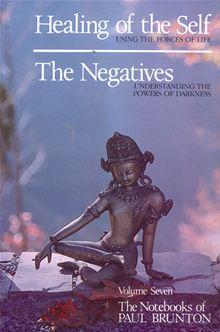
Paul Brunton: Healing of the Self/The Negatives

Using the Forces of Life/Understanding the Powers of Darkness

The Notebooks of Paul Brunton

Volume Seven

Larson, 1987

Amazon.com

Back Cover:

Unless we look behind the world’s problems into the real and spiritual problems which they reflect, we can not properly understand them or solve them.

-Paul Brunton

Part 1, Healing of the Self, treats the mind-body relationship and contrasts conventional, psychic, and spiritual approaches to healing. Recommending a combination of conventional and alternative methods, it gives a variety of practical techniques, many useful in self-healing.

Part 2, The Negatives, examines the nature and roots of evil and traces its activity in recent and impending world events.

Maharishi Mahesh Yogi on the Bhagavad-Gita

Chapter 7

Maharishi Foundation International, 2009

Back Cover:

“The Veda reveals the unchanging Unity of Life which underlies the evident multiplicity of Creation, for Reality is both manifest and unmanifest, and That alone is. ‘I am That, thou art That, and all this is That’ is the Truth; and this is the kernel of the Vedic teaching, which the Rishis extol as teaching ‘worthy of hearing, contemplating, and realizing’…

The purpose of this commentary is to restore the fundamental truths of the Bhagavad-Gita and thus restore the significance of its teaching. If this teaching is followed, effectiveness in life will be achieved, men will be fulfilled on all levels, and the historical need of the age will be fulfilled also.”

Maharishi, 12 January 1965

From the Publisher’s Note:

“When working on his commentary of Chapters 1-6 of the Bhagavad-Gita, Maharishi had the time to read, refine, and perfect the expressions and reflections on the very fine values of knowledge and experience in the verses, and to bring the profound teaching of these chapters of the Bhagavad-Gita to light in a manner that is understandable to all. The publication in print today of these first six chapters is Maharishi’s very complete and comprehensive commentary.

Regarding Maharishi’s commentary on Chapters 7-15 now in press, after the first draft Maharishi did not review or refine the commentary as he had done in the first six chapters, and as he would have liked to have done. His time did not allow for this as his global Movement expanded so rapidly in more than eighty countries, with millions of people learning the Transcendental Meditation Programme and its advanced techniques; and his revival of the forty areas of Vedic Science, and the practical application of his Vedic Science and Technology of Consciousness in all fields of life and living demanded his attention.

Nevertheless, Maharishi’s commentary of Chapters 7-15 is so illuminating, and his expressions so simple and enlightening, and the reality he expounds so profound, that even in their so-called ‘unfinished’ form these Chapters are now being made available for the benefit of all the seekers of Supreme Knowledge in the world, those who strive for perfection in life…”

JOB’s Comment:

See also my comments on Maharishi in the Spirituality category, and on his books on the References page. This book was published in a limited edition and now seems to be out of print, but will, I suppose, be made available again when the commentaries on the remaining chapters have been published.

Frithjof Schuon: Les Stations de la sagesse

L’Harmattan, 2011 (1958)

Fnac

Pris dans le tourbillon d’une vie survoltée, l’homme semble avoir perdu le sens du repos et de la contemplation; se nourissant volontier d’ecorces, c’est-à-dire de superficialité, il n’a plus conscience de la qualité du fruit. C’est pourquoi il croit volontier à la faillite des valeurs traditionelles et des religions, s’engage dans des voies sans issue et, désorienté, devient la proie d’un désespoir nihiliste.

Saisir les racines de l’impasse dans laquelle s’est engagé l’esprit moderne, tel est le propos de cette réédition des Stations de la Sagesse, un classique paru pour la première fois en 1953. Les essais réunis dans ce recueil visent à dégager le sens profond des doctrines religieuses et des sagesses traditionnelles pour satisfaire au besoin de causalité et d’intelligibilité propre à l’esprit humain, trop souvent méconnu et négligé par les enseignements religieux fondés sur la seule croyance.

La nature transcendante et primordiale de la Révélation, de l’intellect, de la foi et de la prière se trouve alors replacée dans un cadre qui permet de résoudre l’apparente incompatibilité entre la métaphysique – communément confondue avec la pensée rationelle – et l’amour de Dieu, si souvent envisagé du seul point de vue de la sentimentalité. Ainsi le lecteur prend-il consience que les religions parlent à son intelligence et a son sens de la beauté pour lui faire découvrir la “splendeur du vrai”, et le guider dans sa quête de la sagesse.