Tomas Lindbom ger ut en ny bok, Encountering the Quran, av sin far Tage Lindbom med artiklar från sekelskiftet, i engelsk översättning av Oliver Fotros och med förord av den mest kände levande traditionalisten, Lindboms vän Seyyed Hossein Nasr.

Tomas Lindbom ger ut en ny bok, Encountering the Quran, av sin far Tage Lindbom med artiklar från sekelskiftet, i engelsk översättning av Oliver Fotros och med förord av den mest kände levande traditionalisten, Lindboms vän Seyyed Hossein Nasr.


There is, it seems to me, an aesthetic problem with the communication of the spiritual truths of “Hinduism”, and not just in the west, but also, for example, in China, and indeed in the whole non-Indian world.
The concept of Hinduism is problematic since it is so exceptionally comprehensive and vague. There is much in Hinduism that I have problems with, and that I don’t count among the spiritual truths. For me, the latter are primarily found in vedanta, including its primary interpretive explications in more general metaphysical terms, and the way in which yoga – as one of the six classical darshanas – and samkhya are, as it were, sublated in vedanta (and here I have in mind not just the theoretical side of vedanta, but also the way in which, in combination with the modified affirmation of yoga, it also produces its own supplementary practice, which could be called jnana yoga).
Many non-Indians, and primarily westerners, their minds formed for millennia by Greek philosophy (of which science is one of many products) and Abrahamitic religion, i.e. the process of the west’s defining differentiation from the “compact” oriental civilizations, still instinctively react against Hinduism as simply the survival of a fantastic mythological belief in “thousands of gods”.
But even as Hinduism explains that it teaches a unifying reality above this plurality, indeed even when this unity is not conceived in teistic but strictly monistic and impersonal terms, the stories and images of the enormous vedic legacy of mythology seem still for the most part to be taken literally – although true and real only on a lower, phenomenal level of reality – and to shape the presentation of the spiritual truths. Hindu art relies entirely on its iconography.
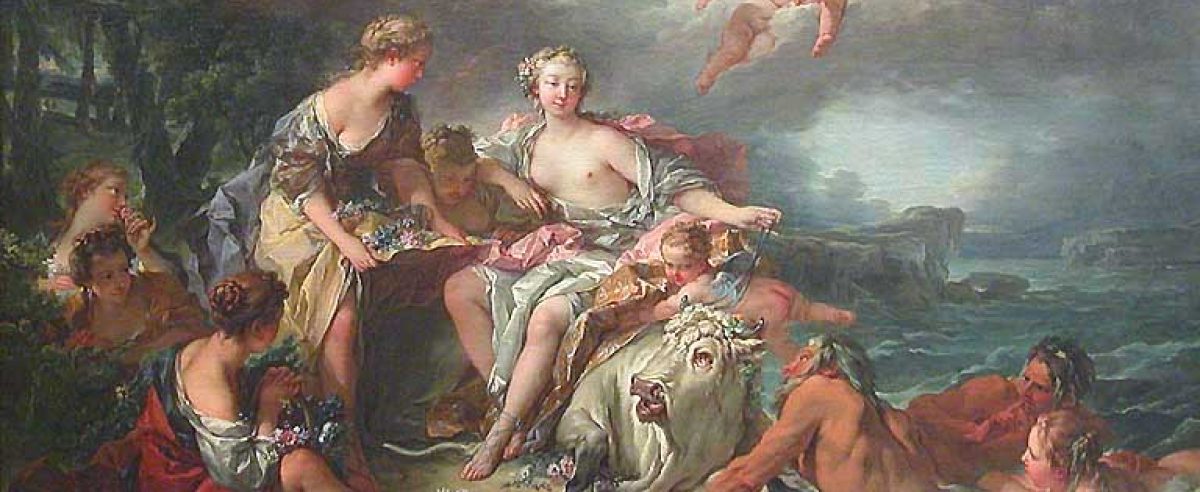
Needless to say, there are artistically advanced expressions of this throughout the history of India. The iconography of mythology is of course not necessarily in itself a problem for the communication of spiritual truths. The motifs of Hindu mythology have also been rendered by western Hindus in the formal terms of the tradition of Western painting and sculpture, which is itself historically often dominated by the iconography of Greek mythology. Problems arise for much of the non-Indian or non-Hindu-Indian world on the one hand when the mythological content of the tradition is insisted upon as literally true, and on the other when this world perceives that its artistic depiction is not on what it regards as a high artistic level.
The former problem causes immediate philosophical or more general intellectual and cultural obstacles to the assimilation of the spiritual truths. The latter produces a distinctive aesthetic obstacle, which is often connected with the former but could also be considered separately. Hindu mythological imagery abounds, and depictions of scenes from puranic and other stories often reach the world in what many perceive to be the particular modality of what could perhaps be called bazaar art, art with a characteristic quality of kitsch about it. And this particular aesthetic is seen by many to dominate also some of the temples and their decoration.
My point here is not to pass judgement on the aesthetic qualities of these expressions of Hinduism (there are certainly equivalents of bazaar art all over the world). This is not a matter of evaluative assessment, but of the historically conditioned facticity of different aesthetic sensibilities. And my motivation for addressing this is simply my long experience of the equally factual difficulties this produces for the reception of the decisively important truths of the Vedic tradition broadly conceived. My endeavour is similar to that of members of ISKCON like Cyril Wohrer (Chandrashekhara das), who argues that it is not necessary for western devotees to wear traditional Indian clothes, and also similar to the more general cultural bridge-building efforts, such as Hridayananda Swami’s “Krishna West” project.
My purpose is only to supplement my argumentation regarding the communicative problem of literalist mythologism with one focusing on the common, specifically aesthetic problem caused by many representations Hindu mythological iconography. It is a problem that is specific to the non-Indian world. A general cultural adaptation of the Indian aesthetic modalities, and indeed of much of the teachings and practices themselves, is, as I have suggested, needed for the core spiritual truths to be successfully transmitted to the west. And it is, I think, quite as necessary also in the rest of the world. The literalism problem is compounded by the bazaar problem.
The truths need to be presented in a manner that is properly adjusted not only to the general intellectual culture of long globalized differentiated civilization, but also attuned to the specific aesthetic sensibilities of the different parts of the world. This notion has long been at least indirectly questioned in the light of postcolonial and narrow, identity-political currents of thought. But these currents are themselves being questioned today, not least with regard to their problematic ideological and political assumptions, aims, and consequences.
I would keep to what modern Indian vedantic teachers have themselves always used to insist, namely that it should be possible for the world to assimilate the universal spiritual truths without becoming Indian, or indeed Hindu – just as so much of western civilization has been appropriated by other cultures, and just as any important ideas and values from any particular culture are in a certain manner universalizable in accordance with the principles of a higher cosmopolitanism based on a philosophy of value-centered historicism and what I call a “soft” traditionalism.


The “Perfect Knowledge” Reality-Teachings of His Divine Presence, Avatar Adi Da Samraj

The Dawn Horse Press, 2010
Publisher’s Description:
This book was conceived by Adi Da Samraj at the end of 2005. He was first moved to make his own rendering, or “interpretive translation”, of a traditional Advaitic text, The Heart of the Ribhu Gita, in order to elucidate (and thereby honor) its full meaning.
Adi Da Samraj then did the same with other great teachings from the traditions of Advaita Vedanta and Buddhism. In each case, he brought the essence of the instruction to the fore, with elegance and illumined understanding. Texts whose meanings were only partially (or cryptically) expressed even in the original suddenly shone forth, like rough gems cut by an expert hand.
Such was the original kernel of The Gnosticon, an anthology of these masterful “translations”, together with discourses about the traditional texts, given by Adi Da Samraj.
In the course of 2006, Avatar Adi Da transformed the nature of the book by adding many of his own teachings relative to “Perfect Knowledge” of Reality, such as Eleutherios and The Teaching Manual of Perfect Summaries, as well as essays on “radical” devotion and right life. In order to present these Reality-Teachings in their full context as the apex of human wisdom, Adi Da Samraj also added essays he had written over the years about the more preliminary stages of human understanding, including commentaries on popular “God” -religion.
Avatar Adi Da’s final work on The Gnosticon (only months before His passing in November 2008) included the addition of the essays Atma Nadi Shakti Yoga and The Boundless Self-Confession.
The words of Adi Da Samraj, as his devotees and others can confess, carry a potency that is vastly beyond the verbal meaning, a force that can activate fundamental transformations in the being. This potency is not restricted to hearing him speak. He invests himself spiritually in all of his writing. That transmission of his person can be received through reading any of his books – and certainly this 1200-page masterwork, The Gnosticon.
From the foreword to The Gnosticon:
Adi Da Samraj has created a body of work that surpasses in its force and insight that of any other author and teacher of our time. . . . The present book [is] a mature document that culminates forty or more years of reflection and articulation on Adi Da Samraj’s part. I can only add my own humble invitation to all to plunge into its ecstatic waters and savor The Gnosticon.
Paul E. Muller-Ortega, professor of religion, University of Rochester, author, The Triadic Heart of Shiva
About the Author:
On November 27, 2008, Adi Da Samraj, departed from the body. He passed on to humankind a legacy of inexhaustible profundity and limitless Blessing-Power. Adi Da’s primary gift is his own Eternal Transcendental Spiritual Being. The primary purpose of his human lifetime was to establish the means by which any and all beings could be truly connected to him and in devotional communion with him. Thus, he worked with utmost intensity, throughout his entire life, to develop and establish his Transcendental Spiritual Way.
Adi Da’s literary, philosophical, and practical writings consist of over sixty published books including The Knee of Listening, his Spiritual Autobiography, The Dawn Horse Testament, his magisterial revelation of the entire Spiritual Process from beginning to end, and The Aletheon, his final (and first and foremost) book. In addition to his writings, Adi Da gave thousands of hours of recorded discourse. Many discourses have been published by The Dawn Horse Press on CD and DVD.
Adi Da was a prolific artist, producing a remarkable body of work in different media. He was invited to show his work in a solo exhibition at the 2007 Venice Biennale, and also as part of the 2008 Winter in Florence and his work will be shown in New York. Among the publications of Adi Da’s art are The World As Light, Transcendental Realism, and The Spectra Suites.
Another dimension to Adi Da’s far-reaching legacy is the social wisdom embodied in his book Not-Two Is Peace. In it he calls for the establishment of a Global Cooperative Forum that mobilizes “everybody-all-at-once” on the basis of recognizing the prior (or inherent) unity of the entire human family. He proposes that such a forum is the necessary and effective means for addressing the world’s most pressing issues.
JOB’s Comment:
The Notebooks of Paul Brunton
Volume Thirteen

Larson, 1988
Back Cover:
“Science suppresses the subject of experience and studies the object. Mysticism suppresses the object of experience and studies the subject. Philosophy suppresses nothing, studies both subject and object; indeed it embraces the study of all experience.”
– Paul Brunton
Here are the pivotal elements of a fresh, vital teaching the intellect can accept and the conscience can approve…a transformative worldview adequate to the intellectual, moral, and spiritual opportunities of modern living.
The Reign of Relativity enlarges science’s understanding of relativity to include the waking, dream, sleep, and fourth states of individual human consciousness.
What Is Philosophy? presents a root attitude and an effective daily practice for developing the completeness and balance that fuse thought, feeling, and action in inspired living made conscious of its noblest purpose.
Mentalism explores the creative power of thought and reveals a deeper level of mind in which subject and object are substantially one.
Together these three sections of Relativity, Philosophy, and Mind construct an unusually broad bridge between the leading edge of modern science and the most stable insights of the perennial wisdom traditions.
The Notebooks of Paul Brunton
Volume Twelve

Larson, 1988
Back Cover:
“The essence of religion does not consist in dogma and ritual but in faith in a higher power, worship of that higher power, and moral purification to come closer to it.”
– Paul Brunton
“True prayer…is nothing less than making a connection – however loose, ill-fitting, and intermittent it be – with the life force within the universe.”
This volume stresses the importance of veneration for the source of Life at all levels of human development.
The Religious Urge distinguishes the heart’s ineradicable religious instinct from traditional religious forms, and clarifies the services and disservices of institutional religion.
The Reverential Life gives an individualized, practical approach to honest communion with the Sacred through intelligent prayer, rational devotion, and informed, mature humility.
This twelfth volume in The Notebooks of Paul Brunton answers such basic questions as “What is prayer?”, “How does it work?”, “How should I pray?”, “To whom or what should I pray?”, “How do prayer and meditation differ?”, “What is Grace?”
På måndag den 7:e februari 17.00 talar Tomas Lindbom om sin far Tage Lindbom med filosofen Bengt Kristensson Uggla i Mikaelskapellet på Karlbergsvägen 64 i Stockholm, i ett arrangemang av Svenska Kyrkan. Tomas Lindbom gav förra året ut den ypperliga biografin över sin far, I otakt med tidsandan, som jag skrev om här. Missa inte detta evenemang!