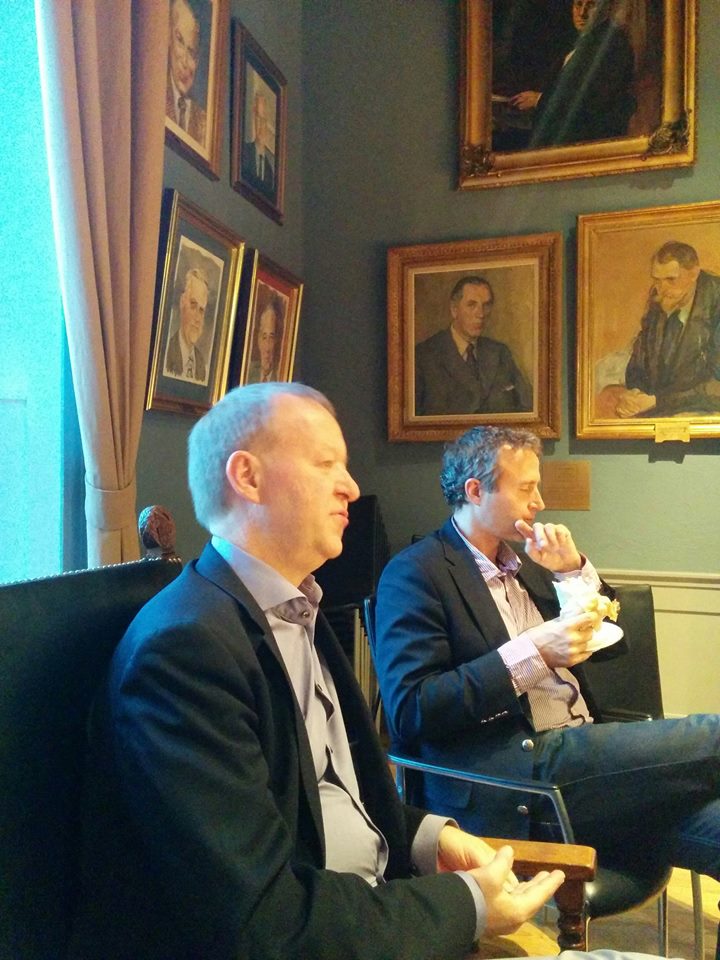
Igår kväll talade jag om socialkonservatism och nationalism för trevliga SD Danderyd på Djursholms slott.
Foto: Per Sefastsson
Igår kväll talade jag om socialkonservatism och nationalism för trevliga SD Danderyd på Djursholms slott.
Foto: Per Sefastsson
May 2014
The Emerging Left-Right Alliance to Dismantle the Corporate State
Nation Books, 2014
Summary:
 Ralph Nader has fought for over fifty years on behalf of American citizens against the reckless influence of corporations and their government patrons on our society. Now he ramps up the fight and makes a persuasive case that Americans are not powerless. In Unstoppable, he explores the emerging political alignment of the Left and the Right against converging corporate-government tyranny.
Large segments from the progressive, conservative, and libertarian political camps find themselves aligned in opposition to the destruction of civil liberties, the economically draining corporate welfare state, the relentless perpetuation of America’s wars, sovereignty-shredding trade agreements, and the unpunished crimes of Wall Street against Main Street. Nader shows how Left-Right coalitions can prevail over the corporate state and crony capitalism.
He draws on his extensive experience working with grassroots organizations in Washington and reveals the many surprising victories by united progressive and conservative forces. As a participator in, and keen observer of, these budding alliances, he breaks new ground in showing how such coalitions can overcome specific obstacles that divide them, and how they can expand their power on Capitol Hill, in the courts, and in the decisive arena of public opinion.
Americans can reclaim their right to consume safe foods and drugs, live in healthy environments, receive fair rewards for their work, resist empire, regain control of taxpayer assets, strengthen investor rights, and make bureaucrats more efficient and accountable. Nader argues it is in the interest of citizens of different political labels to join in the struggle against the corporate state that will, if left unchecked, ruin the Republic, override our constitution, and shred the basic rights of the American people.
Reviews:
“In Unstoppable, Ralph Nader argues that there are in fact surprising areas of convergence between the left and the right… These are profound observations…Mr. Nader rails so effectively.” David Asman, Wall Street Journal
“Activist Nader sketches out places of ‘convergence’ where liberals and conservatives can start working together for the public good…[he] lists reforms with which many lawmakers would agree, including breaking up too-big-to-fail banks, protecting children from commercialism and ending corporate personhood.” Kirkus Reviews
“One of Ralph Nader’s finest efforts. A bold and lucid handbook for the future.” Patti Smith
“Conservatives and liberals both look askance at the Leviathan state and realize that promises of ‘doing good’ often obscure the reality of ‘doing well’ at taxpayer expense. Those looking for opportunities for bi-partisan cooperation should look at the nexus of statism and cronyism. Unstoppable shows that opposing such corruption can bring activists of the right and left together to fight side by side.” Grover Norquist
“Ralph Nader’s timely book once again makes him prescient in his insights about American politics. His against-the-grain prediction of a Left-Right alliance is not just a hope, but it is grounded in emerging evidence.” Cornel West
“Nader at his best – original, indignant, idealistic, and on the lookout for new political alliances and possibilities. A tonic for the cynicism that’s poisoning the groundwater of our democracy.” Robert B. Reich, Chancellor’s Professor of Public Policy, University of California at Berkeley
“No American in recent decades has done more than Ralph Nader to construct a workable alliance between the principled Right and the sincere Left to salvage our country and our national prosperity, and Unstoppable outlines his vital mission.” Ron Unz, former publisher of The American Conservative
“Unstoppable is even-handed, erudite, practical and necessary. Nader harnesses his lifelong crusade for the public interest over the corporatist agenda into a treatise that is optimistic and patriotic. He demonstrably shows that effective Left-Right alliances aren’t pipe dreams, but historic realities in need of strategic cultivation, for the sake of our future.” Nomi Prins, author of All the Presidents’ Bankers
“I read Ralph Nader for the same reasons that I read Tom Paine. He knows what he thinks, says what he means, and his courage is a lesson for us all.” Lewis Lapham
“Thomas Jefferson fretted that, with the passing of the founding generation, the truer patriotism that he knew as the ‘Spirit of ’76’ would be lost. He need not have worried. Ralph Nader has recaptured the founding faith with an inspired call for a left-right coalition of conscience on behalf of democracy, liberty, fairness and peace.” John Nichols, Washington correspondent for The Nation and co-author of Dollarocracy
“For more than 50 years, Nader has backed the rights of citizens against the growing influence of corporations and government leaders tied closely to those businesses…The new book offers readers broad philosophical views, as well as many detailed suggestions, about how to promote and advance a growing political alliance between the left and the right that challenges the growing alliance between Big Business and Big Government.” The Charleston Gazette
“Mr. Nader has set out on a formidable mission here – nothing less than bringing corporations and government back under effective control of their constituents, and doing so with trans-political and ideological alliances. In effect, he proposes to transform entrenched contemporary politics.” The Washington Times
About Ralph Nader:
Ralph Nader is an author, a lecturer, an attorney, and an American political activist in areas of consumer and worker protection, humanitarianism, environmentalism, and democratic government. He is the best-selling author of many books, including Unsafe at Any Speed, a critique of the safety record of American automobile manufacturers. Nader is a four-time candidate for president of the United States, having run as the Green Party nominee in 1996 and 2000 and as an independent candidate in 2004 and 2008.
Symbols and Teachings of the Royal Art

Inner Traditions, 1995 (La tradizione ermetica, 1931)
From the Back cover:
Translated into English for the first time, this important survey of alchemical symbols and doctrines lays bare the mysterious worldview and teachings of the practitioners of the “Royal Art”. One of the leading exponents of the hermetic tradition, Julius Evola draws from a host of sources in the western esoteric tradition – works on alchemy, theurgy, magic, and mythhology from the Neoplatonic, Arab, Gnostic, and medieval sources – to demonstrate the singularity of subject mater hat lies behind the words of all adepts in all ages. He shows how alchemy – often misunderstood as primitive chemistry or a mere template for the Jungian process of “individuation” – is nothing less than a universal secret science of human and natural transformation.
The first part of The Hermetic Tradition outlines the symbols and teachings of the Art, while the second part is concerned with the techniques and effects of the practice. Throughout the exposition of this sacred tradition the reader is encouraged to listen with the “ear of the heart”; a leap of consciousness is required to leave our time-bound and analytical world and enter the timeless realm of nature’s continuous creation…[Evola’s] Hermetic Tradition is among the clearest works of alchemy ever written.
Der Kampf um die Ukraine und die Arroganz des Westens
C. H. Beck, 2015
 Antirussische Vorbehalte haben in Deutschland eine lange Tradition und sind in zwei Weltkriegen verfestigt worden. Auch in der Ukraine-Krise lässt sich ihre Wirksamkeit beobachten. Tatsächlich ist aber nicht nur das Verhältnis zwischen Russland, dem Westen und der Ukraine vielschichtiger als es der Medien-Mainstream suggeriert, sondern auch die russische Geschichte seit dem Ende des Kalten Krieges. Es liegt im ureigenen Interesse der EU, Russland als Partner zu haben. Wer diese Chance vertut, riskiert, dass Europa im Machtkampf künftiger Großmächte zerrieben wird.
Wie ist es um die politische Kultur eines Landes bestellt, in dem ein Begriff wie “Russlandversteher” zur Stigmatisierung und Ausgrenzung dient? Muss man nicht erst etwas verstehen, bevor man es beurteilen kann? Gabriele Krone-Schmalz zeigt in diesem Buch, wie einseitig das in den Medien vorherrschende Russlandbild ist und welche Chancen der Westen durch seine Arroganz verspielt hat.
“Es lohnt sich, Gabriele Krone-Schmalz‘ Worten Gehör zu schenken. Sie betreibt einen integren Journalismus, ohne den Transparenz (Glasnost) und Demokratie nicht existieren können.” Michail Gorbatschow
“Verstehen heißt versuchen, die Welt aus der Perspektive des Anderen zu sehen. Gabriele Krone-Schmalz ist eine Aufklärerin, die weiß wovon sie redet. Wir müssen ihr dafür dankbar sein.” Jörg Baberowski
Pressestimmen:
“Russland verstehen könnte den Frieden retten.” Michael Girkens, Stadtanzeiger Hamm
“Krone-Schmalz‘ Verdienst ist es, sich auf die verlässlichen Fakten zu stützen. Sie nimmt dem Leser die westlich gefärbte Brille ab.” Jens Dierolf u. Julia Neupert, Heilbronner Stimme
“Ein so informatives wie meinungsstarkes Buch.” Katharina Granzin, TAZ
“Eine Orientierungshilfe für all jene, die das gegenwärtig in den Medien vorherrschende feindliche Russlandbild ablehnen.“
Neues Deutschland
“Wer bereit ist, Russland nicht bloß als Bären zu betrachten, der von seinem Meiser am Nasenring durch die internationale Manege geführt wird, kann aus ihrem Buch eine Menge lernen.“ Franziska Augstein, Süddeutsche Zeitung
Über die Autorin:
Gabriele Krone-Schmalz ist Professorin für TV und Journalistik an der Hochschule Iserlohn. Sie war von 1987 – 1991 Russland-Korrespondentin der ARD und moderierte anschließend bis 1997 den ARD-Kulturweltspiegel. Sie ist Mitglied im Petersburger Dialog und als eine der führenden Russland-Experten Deutschlands regelmäßig im Fernsehen zu sehen. Weitere Autoreninformationen finden Sie auf dieser Website.
This is the abstract of my paper, ‘Further Considerations on Personalism and Idealism’, at the 13th International Conference on Persons in Boston earlier this month:

Boston personalism was originally, and has to some extent remained, an idealistic philosophy. Borden Parker Bowne’s work represents, as does that of his British contemporary, Andrew Seth Pringle-Pattison, not least a further, independent development of central themes in German Spätidealismus in the 19th century. In this respect it differs considerably from the – often converging – main forms of European personalism, which are related to distinctly non-idealist currents such as phenomenology, existentialism, and neo-Thomism. In this paper I reexamine some aspects of the question of the relationship between personalism and idealism in the light of recent idealism scholarship and of a partial assessment of what can be considered to be of lasting value and relevance in idealism. Taking into account the European background of idealistic personalism, it is necessary to raise anew the fundamental issue of the definition of idealism, and to distinguish between some of its main versions, including a brief recapitulation of its transformations in the 20th century. My conclusion is that, whether or not personalism, as Bowne argued, is intrinsically and necessarily idealistic, the insights and resources of idealism remain not just valid but important and badly needed precisely for personalism.
1950
Min gamle filosofiske vän och interlokutör, absolute idealisten Phillip Ferreira, i ännu en gemensam session med mig på 13:e ICP i Boston i förra veckan.

SD Stockholms stads kampanj, i samarbete med partiets kommunikationsavdelning, i Östermalmstorgs tunnelbanestation mot tiggeriet kan sägas ha blivit en världsnyhet, sannolikt den mest framgångsrika svenska politiska kampanjen av detta slag någonsin.
Och den blev det med de gamla radikalliberala medias och den gamla nihilistiska, ständigt alltmer förvirrade, bisarrt storkapitaltjänande, och numera tydligen även socialdemokratiska våldsvänsterns hjälp.
Men förvisso var kampanjen populistisk, och kritik har från olika håll riktats och fortsätter riktas mot den inte minst för bristfällig engelska – till den grad att jag för egen del känner att ett svar, utöver det som redan givits av kommunikationsavdelningen, är på sin plats.
Det första som måste sägas är att vi, SD, ju är folket – vi har, säger Mattias Karlsson, en folklig framtoning. Vi kan därmed självklart inte alltid förväntas använda korrekt engelska.
Några har spekulerat att det stavfel som smög sig in (men snabbt rättades med en ny affisch) skulle ha varit avsiktligt, skulle ha syftat till att förmedla det rätta, folkliga intrycket – på samma sätt som jag själv spekulerade att Jimmie Åkessons boktitel Satis polito, med en tolkning, skulle kunna vara en sofistikerad, medvetet felaktig användning av latin.
Det är en intressant möjlighet, men kommunikationsavdelningen har inte nämnt något sådant i de diskussioner som förts med Stockholmsstyrelsen, och dess chef Joakim Wallerstein förklarade i media att det var ett misstag. Jag vill dock påstå att ett så grovt fel, i synnerhet från de unga, begåvade, relativt välutbildade, politiskt engagerade personer som det här är fråga om, måste ha berott på slarv och inte okunnighet. Vi i styrelsen borde också ha upptäckt det när vi tittade på Wallersteins förslag.
Utöver detta fanns, vill jag också påstå, bara en folklig språklig svaghet: formuleringen “Welcome back to a better Sweden in 2018!”
Jag betvivlar att särskilt många av de svenskar som nu p.g.a. SD-fientlighet och/eller snobbism stämmer in i kritiken var medvetna om denna svaghet innan den påpekades av en brittisk tidning. Men jag håller med om att detta språkbruk är problematiskt, och jag menar att det är det även på svenska. Den grammatiska formen av “välkommen” är ju densamma på engelska och svenska (och för den delen franska, italienska, spanska och tyska), och den gör den svenska användningen i en mening av detta slag exceptionell och märklig. Den futurala betydelsen uttrycks inte av den enkla participformen.
Men denna användning är obestridligen mycket vanlig i svenskan, och jag tycker Wallerstein förklarade det bra när han sa att formuleringen här var avsiktlig. Kampanjen vände sig ju naturligtvis i verkligheten till svenskar, och s.a.s. endast skenbart, som ett uppmärksamhetsskapande grepp, till utländska och engelsktalande turister. Det vore svårt att på ett för de flesta svenskar naturligt sätt förmedla det avsedda budskapet på det begränsade tillgängliga utrymmet utan svengelskan. Dessutom har den alltså den ytterligare fördelen att ge det önskade folkliga intrycket – om än bara för den ytterst lilla minoritet som kan tänkas förstå det ovanliga i det svenska språkbruket.
I övrigt ser jag inga vare sig avsiktliga eller oavsiktliga brister. Språket diskuterades med viss utförlighet och i avsevärd detalj i Stockholmsstyrelsen, som bidrog med några ändringar i kommunikationsavdelningens redan från början bra utkast. Naturligtvis vinnlade sig alla inblandade om en formell och stilistisk anpassning till en nivå lämplig för denna typ av kampanj. Denna anpassning var helt naturlig och nödvändig, och innebar eller medförde inte några språkliga svagheter.
När det gäller den direkt omoraliska kritiken mot kampanjens innehållsliga budskap, byggd på uppenbara förvrängningar och falska projektioner, hänvisar jag till vårt svar på SD Stockholms stads hemsida.
 Olle Bengtsson