

Jonas Hansson: Humanismens kris
Bildningsideal och kulturkritik i Sverige 1848-1933
Brutus Östlings bokförlag Symposion, 1999
Baksida:
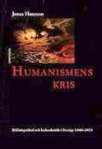 Ett av de centrala honnörsorden i den västerländska traditionen är humanism. Men vad betyder det egentligen? Sedan 1800-talets början har humanismens problematik varit ständigt aktuell. Man har frågat sig hur humanismen förhåller sig till den moderna utvecklingen, om det går att förena humanism och religion och om humanismen kan existera utan en klassisk bildning. Det hävdas också ofta att humanismen befinner sig i kris, men vilket är då ursprunget till denna kris? Finns det ett samband mellan humanismens kris och en kris för bildningen?
I Humanismens kris klargör Jonas Hansson de olika betydelser som begreppet humanism haft alltsedan det lanserades i början av 1800-talet. Mot en internationell bakgrund skildras hur begreppet humanism slår igenom i Sverige och hur latinets vänner, radikala skribenter och kristna kritiker diskuterar humanismen på 1800-talet. Genombrottet för slagordet humanism i början av 1900-talet sätts i samband med upplevelsen av en allmän kulturkris. Samtidigt ger Jonas Hansson i sin studie en bild av en epok i svensk idéhistoria då inflytande från Tyskland var starkt och begrepp som bildning och kultur representerade samhällets högsta värden.
Om författaren:
Jonas Hansson (f. 1967) är docent i idé- och lärdomshistoria vid Lunds universitet.
Maria Danielsson i Alvik
Ledamot av och SDs gruppledare i Stockholms kommunfullmäktige, och avgående ordförande för SD Stockholms stad.

Foto: Per Åkesson
Paul Edward Gottfried: Multiculturalism and the Politics of Guilt
Toward a Secular Theocracy
Front and Back Flaps:
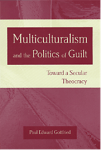 Multiculturalism and the Politics of Guilt extends Paul Gottfried’s examination of Western managerial government’s growth in the last third of the twentieth century. Linking multiculturalism to a distinctive political and religious context, the book argues that welfare-state democracy, unlike bourgeois liberalism, has rejected the once conventional distinction between government and civil society.
Gottfried argues that the West’s relentless celebrations of diversity have resulted in the downgrading of the once dominant Western culture. The moral rationale of government has become the consciousness-raising of a presumed majority population. While welfare states continue to provide entitlements and fulfill the other material programs of older welfare regimes, they have ceased to make qualitative leaps in the direction of social democracy. For the new political elite, nationalization and income redistributions have become less significant than controlling the speech and thought of democratic citizens. An escalating hostility toward the bourgeois Christian past, explicit or at least implicit in the policies undertaken by the West and urged by the media, is characteristic of what Gottfried labels an emerging “therapeutic” state.
For Gottfried, acceptance of an intrusive political correctness has transformed the religious consciousness of Western, particularly Protestant, society. The casting of “true” Christianity as a religion of sensitivity only toward victims has created a precondition for extensive social engineering. Gottfried examines late-twentieth-century liberal Christianity as the promoter of the politics of guilt. Metaphysical guilt has been transformed into self-abasement in relation to the “suffering just” identified with racial, cultural, and lifestyle minorities. Unlike earlier proponents of religious liberalism, the therapeutic statists oppose anything, including empirical knowledge, that impedes the expression of social and cultural guilt in an effort to raise the self-esteem of designated victims.
Equally troubling to Gottfried is the growth of an American empire that is influencing European values and fashions. Europeans have begun, he says, to embrace the multicultural movement that originated with American liberal Protestantism’s emphasis on diversity as essential for democracy. He sees Europeans bringing authoritarian zeal to enforcing ideas and behavior imported from the United States.
Multiculturalism and the Politics of Guilt extends the arguments of the author’s earlier After Liberalism. Whether one challenges or supports Gottfried’s conclusions, all will profit from a careful reading of this latest diagnosis of the American condition.
Reviews:
“It is a small, conservative, philosophical gem, and I love it.” Amos Perlmutter
“Gottfried’s book addresses multicultural ideology and its program: to fashion beliefs and behavior in conformity with the multicultural outlook on the world, which is one of victim and victimizer…His analysis of the situation both in the United States and in western Europe is devastating and brilliant, and in providing a precise analysis of what it is we are up against he has produced a book from which any authentic conservative would benefit.” The American Conservative
“Gottfried has seen an aspect of multiculturalism and political correctness that previous critics of these doctrines have failed adequately to stress. He uses his insight to develop a brilliant analysis and critique of the modern managerial and therapeutic state…Gottfried has dissected the social effects of the contemporary church better than anyone else of whom I am aware.” Mises Review
“For those who can handle the truth, Paul Edward Gottfried serves as a fusion of Aristotle, Joseph de Maistre, and Carl Schmitt. What Aristotle did for the Greek polis, Gottfried has done for the nation-states of the West…Gottfried makes a compelling case that political correctness has become a substitute for Christianity.” Chronicles
About the Author:
Paul Gottfried was Horace Raffensperger Professor of Humanities at Elizabethtown College. He is the author of numerous books, including After Liberalism: Mass Democracy in the Managerial State, The Strange Death of Marxism: The European Left in the New Millennium, and Conservatism in America: Making Sense of the American Right.
Presidiet i Alvik
Pavel Gamov och Paula Bieler leder SD Stockholms stads årsmöte assisterade av Jessica Ohlson och Alexander Jönsson.

Foto: Per Åkesson
Irving Babbitt: Character and Culture
Essays on East and West
With a new introduction by Claes G. Ryn and an index to all of Babbitt’s books
Transaction, 1995 (originally published as Spanish Character and Other Essays in 1940)
Publisher’s Description:
 Character and Culture by Irving Babbitt is the latest volume in the Library of Conservative Thought. Babbitt was the leader of the twentieth-century intellectual and cultural movement called American Humanism or the New Humanism. More than half a century after his death his intellectual staying power remains undiminished. The qualities that marked Irving Babbitt as a thinker and cultural critic of the first rank are richly represented in Character and Culture. First published togetherin 1940 (under the misleading title Spanish Character), these essays span his scholarly career and cover a wide range of subjects. The diverse topics discussed here – aesthetics, ethics, religion, politics, literature – are illuminated by the same unifying vision of human existence that informs and structures all of Babbitt’s writing.
Babbitt never took up a subject out of idle curiosity. All of his books and articles grew out of a desire to address certain fundamental questions of life and letters. The essaysin this volume are as worthy of attention now as when they were originally written. Set in then- philosophical and historical context by Claes G. Ryn’s new introduction, they are a good place to start for persons who wish to acquaint themselves not only with Babbitt’s central ideas but with the scope of his mind and interests. Readers familiar with other books by Babbitt may recognize particular ideas and formulations but will also find much new material to ponder.
Ryn’s introduction provides a comprehensive look at Irving Babbitt’s life, career, writings, and influence. He shows how Babbitt has survived and sustained often harsh criticism from representatives of dominant trends. Ryn describes his writing style as having “a kind of rugged American elegance.” The substantial critical introduction also elucidates Babbitt’s central ideas in relation to the volume. Character and Culture will be of interest to scholars of literature, philosophers, historians, theologians, and political theorists. The extensive index to all of Babbitt’s books, including this one, increases the value of the volume.
Contents:
Introduction to the Transaction Edition
–
Lights and Shades of Spanish Character
Are the English Critical?
Matthew Arnold
Croce and the Philosophy of the Flux
Pascal
Racine and the Anti-Romantic Reaction
The Bicentenary of Diderot
George Sand and Flaubert
A Century of Indian Epigrams
Interpreting India to the West
The Problem of Style in a Democracy
Humanist and Specialist
President Eliot and American Education
What I Believe: Rousseau and Religion
–
Bibliography of the Publications of Irving Babbitt
Index to the Collected Works of Irving Babbitt
Irving Babbitt (Author):
Irving Babbitt (1865-1933) was professor of French literature at Harvard University. He is a noted literary critic who helped start the New Humanism movement in the early twentieth century. His numerous books include On Being Creative, The Masters of Modern French Criticism, and Literature and the American College.
Claes G. Ryn (New Introduction by):
Claes G. Ryn is professor of politics at the Catholic University of America where he was chairman of his department. He has taught also at the University of Virginia and Georgetown University. He is chairman of the National Humanities Institute and editor of the journal Humanitas. In 2000 he gave the Distinguished Foreign Scholar Lectures at Beijing University His many books include A Common Human Ground, Will, Imagination, and Reason (2nd., exp. ed. published by Transaction), and Democracy and the Ethical Life.
Peter Viereck: Conservatism Revisited
The Revolt Against Ideology
With a major new study of Peter Viereck and Conservatism by Claes G. Ryn
Transaction, 2005 (1949)
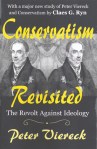 Peter Viereck, poet and historian, is one of the principle theoreticians of conservatism in modern American political thought. In this classic work, Viereck undertakes a penetrating and unorthodox analysis of that quintessential conservative, Prince Metternich, and offers evidence that cultural and political conservatism may perhaps be best adapted to sustain a free and reasonable society.
According to Viereck’s definition, conservatism is not the enemy of economic reform or social progress, nor is it the oppressive instrument of the privileged few. Although conservatism has been attacked from the left and often discredited by exploitation from the right, it remains the historic name for a point of view vital to contemporary society and culture. Divided into three parts, the book opens with a survey of conservatism in its cultural context of classicism and humanism. Rejecting the blind alley of reaction, Viereck calls for a discriminating set of principles that include preservation through reform, self-expression through self-restraint, a fruitful nostalgia for the permanent beneath the flux, and a preference for historical continuity over violent rupture.
Viereck locates our idea of Western political unity in Metternich’s Concert of Europe whose goal was a cosmopolitan Europe united in peace. This ideal was opposed by both the violent nationalism that resulted in Nazism and the socialist internationalism that became a tool of Soviet Russian expansionism. While not ignoring the extremely negative aspects of Metternich’s legacy, Viereck focuses on his attempts to tame the bellicosity of European nationalism and his little-known efforts to reform and modernize the Hapsburg Empire.
Reviews:
“This work is an excellent contribution to the study of post-WWII conservatism…Summing Up: Recommended. General readers and upper-division undergraduates and above.” M. Coulter, Choice
“A brilliant essay in historical paradox. Mr. Viereck’s witty vindication of the responsible conservatism of the past opens up new sources of moral strength for the perilous present.” Arthur M. Schlesinger, Jr.
“Conservatism Revisited is a fine demonstration of historical interpretation.” James Killian, Massachusetts Institute of Technology
“Brief, meaty and brilliant…It is a thoroughly helpful and constructive book.” Hans Kohn, historian and author of Force or Reason
About the Authors:
Peter Viereck (1916-2006) was a Pulitzer Prize-winning poet, critic, and historian. He held the Kenan Chair in History at Mount Holyoke College and was known as one of America’s early leaders of conservatism. He was the recipient of Guggenheim fellowships both in history and poetry. In addition to his contributions to Poetry Magazine and the Atlantic Monthly, his many books include Inner Liberty: The Stubborn Grit in the Machine; Metapolitics: From Wagner and the German Romantics to Hitler; and Conservative Thinkers: From John Adams to Winston Churchill.
William Hahne i Alvik
Ledamot av Stockholms kommunfullmäktige och ny ordförande för Sverigedemokraterna Stockholms stad.

Foto: Sven Pernils
Det finns ingen strid
Det finns ingen strid i Sverigedemokraterna i Stockholm.
Den nye ordföranden William Hahne och många andra ansåg att partiet lyckats för dåligt här och att det fanns brister i den tidigare ordförandens sätt att leda distriktets arbete.
Han ställde därför upp som ordförandekandidat med ett förslag till en ny, mer ambitiös styrelse, som på bättre sätt skulle kunna kommunicera vår socialkonservatism på nationalstatlig grund till just stockholmarna.
Det är allt. Ingenting kunde vara mer normalt i ett stort och vitalt parti.
Vi i den nya styrelsen kan i vissa frågor sägas stå något längre till höger i det särskilda slags mittenparti som SD är – i motsats till den gamla som stod något till vänster.
I ett mittenparti är det självklart ofrånkomligt att vissa vill svänga lite längre till höger och andra lite längre till vänster, liksom det givetvis också är det i alla vänster- och högerpartier: man står mer eller mindre långt till vänster respektive höger.
Att alla partiföreträdare alltid och oavsett bakgrund och lokala omständigheter skulle hålla sig till en absolut, exakt definierad mittpunkt är naturligtvis inte bara en omöjlighet, utan skulle också, om det vore möjligt, vara en svaghet.
Det som nu sker och kommer ske ryms med god marginal inom ramen för SD:s för alla självklart gemensamma principprogram och kommunikationsplan. I verkligheten är det bara fråga om olika tonvikter.
Vad vi i den nya styrelsen framför allt står för är en ny approach, en ny kommunikativ modalitet, som vi menar är nödvändig för att nå stockholmarna med vårt budskap. Här finns i själva verket en enorm mottaglighet och potential.
Därför säger jag: det finns ingen strid, ingen opposition, inga falanger, ingen spricka. SD är ett starkt och enat parti, och nu är det dags för vårt genombrott i huvudstaden.
Carlo Cignani: I cinque sensi

 Olle Bengtsson