Da Free John: Scientific Proof of the Existence of God Will Soon Be Announced by the White House!
Prophetic Wisdom about the Myths and Idols of mass culture and popular religious cultism, the new priesthood of scientific and political materialism, and the secrets of Enlightenment hidden in the body of Man
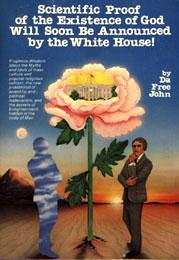
The Dawn Horse Press, 1980
Blurbs on the Back Cover:
This is a mighty book of insight… a penetrating, comprehensive critique of popular cults and mass culture. This book does two things absolutely critical for the survival of Man. First, it exposes the fundamental flaws of organized religion, science, and politics. Second, it gives clear indications for establishing a culture based on wisdom and love. Anyone who is the least bit concerned about his or her own well-being – physical, mental, spiritual – and that of the world should consider the words of Da Free John. He teaches and is a living demonstration of the present Divine Condition and evolutionary future of the human race.
John White, author, Pole Shift, and editor, The Highest State of Consciousness
If you read no other book in your lifetime, read this beautiful, profound, disturbing, and hopeful book.
Worth Summers, Ph.D., Professor of Sociology, California State University
The function of a great educational work is to lead thereader into a new awareness. The function of a great spiritual writing is to jolt and insipire the reader into a new state of Being. This book is both. No one can really read it without being changed in the process. It is like a rapid-fire succession of electric shocks, each carrying the message: Wake up!…A powerfully effective “de-hypnitizer”…that will not let you rest until you see clearly – and so seeing, choose to act. In modern society’s time of troubles, this is a much-needed book.
Willis Harman, President, The Institute of Noetic Sciences
If there is a man in this country today who is God-lllumined, that man is Da Free John. The proof is in this book. Here is the most ancient tradition of mankind expressed in a way that is startlingly modern. Da Free John is a force to be reckoned with.
Roy Finch, Professor of Philosophy, Hunter College, City University, New York
Da Free John’s teaching is, I believe, unsurpassed by that of any other spiritual teacher, of any period, of any place, of any time, of any persuation.
Ken Wilber, author, The Atman Project, and editor, Re-Vision Journal
In our world of political chaos and potential nuclear holocaust, there must be many men and women who are awake to the madness around us and ready to hear the voice speaking in these discourses. I pray that this book inspires them to expand in love and to become guides for the millions who are still blinded y fear and mistrust. The need for truth is urgent.
Robert Hall, M.D., Co-founder, Lomi School and the Gestalt Institute of San Francisco.
JOB’s Comment:
The main title of this book is entirely satirical, and aimed at the illusions of the “scientific worldview” (“scientific proof”), conventional and popular exoteric religion (“the existence of God”), and the materialist politics of our time (“announced by the White House”). This is one of Jones’s big books, and in its first chapters it focuses a little more on the general contemporary mass culture shaped by these forces than his other big ones, most of which, like The Enlightenment of the Whole Body, deal primarily with his spiritual teaching in itself. Its third chapter is entitled ‘Scientific Proof of the Existence of God Will Not Be Announced by the White House’.
Franklin Jones on Discipline
I think he called himself Da Avabhasa at this time (although it may still have been Da Free John). See also the essay in which I explain what I find to be his significance.
Bubba Free John: The Enlightenment of the Whole Body
A Rational and New Prophetic Revelation of the Truth of Religion, Esoteric Spirituality, and the Divine Destiny of Man

The Dawn Horse Press, 1978
Back Cover:
Since ancient times it has been acknowledged that the true Spiritual Master is a special manifestation of the Transcendental Heart or Spirit of Nature. Such individuals are born for their Work; they evolve quickly, and they generally begin instructing and transforming others while still relatively young.
Bubba Free John is such a “Heaven-Born” Teacher. Few Masters of his stature have ever appeared on the Earth, and none has ever appeared in the Western world. The Enlightenment of the Whole Body is Bubba’s Song to the All-Pervading Life and Transcendental Consciousness of God, the Divine Person, with whom Bubba is utterly and perfectly Identified, and for Whom he is a living Agent among men.
If we were to combine the most God-inspired Scriptures of Man into a single, focused, completely considered and authoritative expression, this is the kind of book that would emerge. It contains the moral and prophetic fire of the Old and New Testaments, the philosophical majesty of the greatest Hindu and Buddhist literature, and the Ecstatic Humor, or Transcendental Freedom, of the most Illumined testimonies of Divine Life that have ever appeared, in the East or the West. Bubba Free John’s confession of God-Realization is authentic poetry of Divine Transfiguration, comparable only to the Divine Utterances of Masters such as Krishna, Jesus, and Gautama.
Even so, Bubba Free John’s written and spoken Teaching is so rational and straightforward that every intelligent man and woman can benefit by it. Merely to contemplate this Revelation will bring you a radically transformed vision of life, an inspired and discriminating understanding of human religion, esoteric spiritual evolution, and the ultimate Destiny of Man. And, if you allow this Wisdom to enter your own life, you will also enjoy the Enlightened Happiness that is the Heart of all experience.
“The core of this Teaching is the Revelation that the human individual is structurally intended to be surrendered, body and mind and self, through love, into the Radiant Transcendental Consciousness or All-Pervading and Divine Current of Life. The ultimate Destiny of those who love in this manner is transcendence of both mind and body in the Divine. Our Destiny is not in Heaven or Earth, but in literal and total Sacrifice and Translation into the Transcendental Divine Radiance, Infinite Consciousness, and Absolute Personality that is the Truth and Support and Paradoxical Source of this world.” Bubba Free John
“The event of Bubba Free John is an occasion for rejoicing, for, without any doubt whatsoever, he is destined to become the first Western Avatar to appear in the history of the world. His Teaching contains the most concentrated wealth of transcendent wisdom found anywhere, I believe, in the spiritual literature of the world, modern or ancient, Eastern or Western.” Ken Wilber, author, The Spectrum of Consciousness, editor, Re-Vision Magazine
JOB’s Comment:
Richard Wilson: The Vale of Narni
Deism och pietism
Taylor vill understryka hur den värdighetskänsla, som följer med insikten i människans förmåga till rationell kontroll, hos Descartes, Locke och Kant alltid är insatt i ett allmänt teistiskt sammanhang: “The awesome powers of human reason and will are God-made and part of God’s plan; more, they are what constitutes the image of God in us.” [Sources of the Self, 315.] Men i det naturens ordning eller plan nu är “self-subsistent”, och i det vi äger direkt tillgång till dess principer i vårt eget inre, såväl i vårt tänkande som i våra känslor och instinkter, kan ur denna idéutveckling också med tiden lösgöras en icke-teistisk moral, en “independent ethic, in which nature itself will become the prime moral source, without its Author”. [Ibid.]
Taylor räknar alltså med en deism som bygger på känslan, kompletterande den ensidiga lockeska, rationalistiska deismen. Gränsen mellan känslodeism och den pietism som vi redan skönjt konturerna av och som ofta betraktas som en reaktion mot den rationalistiska upplysningsdeismen, blir då delvis oklar. Lindbom ser sambandet, och tolkar det i termer av sin allmänna analys av rationalismens och sentimentalismens ömsesidiga beroende och oskiljaktiga samhörighet (en analys som alltså i hög grad överensstämmer med Babbitts, fastän den är företagen från andra utgångspunkter).
Vad Martin Lamm kallade “upplysningstidens romantik”, såväl i dess känslomässiga som i dess irrationalistisk-mystika former, åtföljer i själva verket med inre nödvändighet den sekulära rationalismen. Sekulariseringen, den moderna vetenskapens etablerande av ett profant, självmedvetet subjekt, motställt en separativ objektiv tingvärld vars mekaniska lagbundenheter tillhandahåller de enda kvarvarande sammanhållande banden av generalitet och enhet, den pseudoobjektivism som i själva verket är den subjektivism som Lindbom stundom också benämner “en idealism”, [Så i Jakobs dröm (1978), 169.] har som sin “logiska följd…flykten in i deismen”.
Med Occam, ja i vissa avseenden redan med Thomas, är Gud skjuten i bakgrunden, och Descartes fullbordar verket genom att överföra hans frihet, kunskap och makt till människan: “Gud är därmed inte ‘avskaffad’, men människan har intagit en position, från vilken hon tror sig kunna behärska tillvaron därför att hon tror sig känna dess lagar. Därmed är vägen öppen för deismen: Gud är inte längre världarnas herre. Han har dragit sig tillbaka i sin himmel, osynlig och passiv.” [Ibid. 168.] När det intellektiva ljuset lyser med allt svagare sken, förkunnar deisterna att Gud inte längre deltager i sitt verk – och därmed börjar han framstå som “okänd”, hans närvaro och ingripande blir alltmer obegripligt. [Agnarna och vetet (1974), 88 f.] Med deismen har Gud “fällt ned en ridå mellan Sig och det skapade verket”, han endast “passivt betraktar sitt verk och överlåter verkets ‘fullkomnande’ åt människan”. Nåden, barmhärtigheten, domens dag och livet efter detta är därmed intet mer än “fåfängligt tal”. [Mellan himmel och jord (1970), 110.]
Den “underström av sentimentalisering” som ledsagar sekulariseringen innebär för religionens del att “inte minst den folkliga fromheten” i pietismen och kvietismen “får en tillflykt undan deism och förkvävande rationalism”: “Gudsgemenskapen förläggs till ‘det inre’, en innerlighet, som skulle vara en rik grund för förnyelse, om människans inre varit berett att förvalta det, som gör att hjärtats öga skådar den gudomliga Sanningen och gör himmelriket till en inre verklighet.” Men alltfort åsidosättande personalismens distinkta dimension måste Lindbom måste ånyo stanna blott vid den slutdom över denna moderitetens strömning som tar fasta på dess oförmåga att återerövra den monistiska intellektivitetens bevetenhet: “kvietismen förmår ej lyfta det andliga livet upp ur den sentimentalitet, som är förnuftsdyrkans oskiljaktiga följeslagare”. [Jakobs dröm, 170.]
Anna Netrebko: Quando me’n vo’
St Petersburg, 2005
Edmund Husserl

Francis S. Swales: Hotel Vancouver

Deismens ordning
Samvetets spontana sympatiska instinkter är det karaktäristiska för Shaftesbury, som identifierar common sense med den oegennyttiga medkänslan med mänskligheten, varför ju den riktning som utgår från honom och omfattar också Hutcheson och Hume hellre benämns moral-sense-filosofi. Enligt Shaftesbury är vissheten om den egna identiteten, om självet som substantiellt, immateriellt och enkelt förutsättningen för allt handlande, och självet sägs i platonisten Cudworths efterföljd som enhetsprincip ligga till grund för personligheten. Detta är teoretiskt riktigt, såtillvida som självet som medvetande ligger bakom och till grund för personligheten som den psykofysiska människan, är oberoende av denna, och konstituerar dess enhet som varhetsinnehåll.
Shaftesbury överför riktigt denna insikt också till världens, universums, helhetens plan, i det han hävdar att allnaturen måste sammanhållas och ledas av ett enhetligt “mind”: detta “principal and original self” ligger till grund för världens enhet och ordning, och är även grunden för de individuella själarnas verklighet och substantialitet. [Historisches Wörterbuch der Philosophie, ’Selbst’.]
Vi befinner oss här i ett viktigt filosofihistoriskt gränsland. Samtidigt som Shaftesbury fastslår dessa teoretiskt riktiga sanningar, markerar han övergången från platonismen sådan den fortlevt och förnyats i England till vad som kanske kan tillåtas sammanfattas som rousseauismen. Inte på så sätt att han själv fullbordar övergången, utan så att han balanserar på gränsen. Han gör det också på ett egenartat och självständigt sätt. Den cudworthska uppfattningen av självet såväl som förståelsen av allnaturens enhetsprincip är så “traditionella” i platonsk mening som filosofiska uppfattningar på detta område ännu kan bli. De uppblandas emellertid förutom med moral senses nya spontana emotionalism också med vissa distinkt modernt panteistiska tendenser. Men det egenartade ligger, som jag förstår det, i uppfattningen av allnaturens enhetsprincip som själv i analogi med det mänskliga självet: i denna uppfattning av Gud som själv finner vi en rörelse utöver såväl den traditionella platonismen som den moderna panteismen i riktning mot en på nytt sätt uppnådd teism.
I samband med Locke har vi redan tangerat grunddragen i den nu alltmer dominerande deistiska världsåskådning. Taylor förklarar skillnaden mellan deismens ordning och den i västerländsk mening traditionella. Den ordning som Pope vill få oss att beundra “is not an order of expressed or embodied meanings. What makes the collection of entities that make up the world an order is not primarily that they realize an interrelated whole of possibilities”. [Sources of the Self, 275.] Det är främst naturvetenskapens ifrågasättande av den klassisk-kristna kosmologin som gör att den ordning deismen urskiljer i universum är av ett annat slag än den klassisk-kristna kosmiska ordning som uttrycker ett ontiskt logos. Taylor beskriver det så att det som nu främst gör att världens enskildheter bildar en ordning är att “their natures mesh. The purposes sought by each, of the causal functions which each one exercises, interlock with the others so as to cohere into a harmonious whole. Each in serving itself serves the entire order.” [Ibid.] Den nya ordningen bygger på den moderna uppfattningen av “the nature of a thing as made up of the forces which operate within it. Each thing is seen as having its own purpose or bent. The goodness of the order consists in the fact that these don’t run athwart each other, but mesh.” [Ibid. 276.]
Detta gör att den nya tidens framväxande organismtanke också skiljer sig från sin föregångare under antiken. Även den traditionella organicismen innebar att universums olika enheter berodde av och stödde varandra, men “where that mutual dependence once flowed from the fact that each holds its ordered place in a whole, which would otherwise revert to chaos…now the support takes direct efficient-causal form: e. g., things feed each other”. [Ibid. 275 f.]
Leibniz blandar som vi sett moment från den klassiska världsbilden med nya och distinkt moderna inslag. Det nya låg främst i just synen på monadernas utveckling av sin egen inre natur, en utveckling som dock frambragte något helt annat än det Addison och Young inte långt senare hyllade. Leibniz’ individualism balanseras på det subtila sätt bl. a. Renaut och Frank diskuterar av hans universalism, och är ju också helt enkelt harmoniskt preetablerade. De
“can be seen as particulars which have, to a higher or lower degree, a purpose which they are bent to encompass. Leibniz thus combines something of Aristotelian teleology, in the notion that the nature of a thing provides for its unfolding in a certain fashion, with the modern idea that the nature of a thing is within it. Because the forms are internal, in a way that they are not with Aristotle, the harmony of the world has to be ‘pre-established’ by God.” [Ibid. 276 f.]
Även enligt den antika uppfattningen var liv i enlighet med naturen detsamma som liv i enlighet med förnuftet (κατὰ φύσιν = κατὰ λόγον), eftersom vår verkliga natur är förnuftigt liv. Deismens nya uppfattning definierar emellertid ej längre detta förnuftets liv som liv och handling i enlighet med en fix, hierarkisk ordning, utan i enlighet med Guds eller försynens plan. Därmed blir även kallelsen, det vardagliga arbetet och familjelivet likvärdiga i förnuftighet med den upphöjda kontemplation som det antika tänkandet prioriterat:
“‘living according to nature’…means…living according to the design of things…what makes the proper way of life good is not that it reflects the inherent rank of certain activities as rational, but that it follows the design of nature, according their proper significance to those activities marked as significant by this design. This design…aims at concord through interlocking purposes. What it marks are, for each kind of thing, the purposes which bring the thing into mesh with all the others.” [Ibid. 279.]
Dessa Guds avsikter, även med oss själva, kan vi nu emellertid också på olika sätt direkt avläsa från naturen – vi är icke längre enbart hänvisade till uppenbarelsen.
Hos Pope står egenkärleken och förnuftet icke längre i någon konflikt med varandra. Egenkärleken tillhandahåller motivationen för vår strävan, och förnuftet är det instrumentella förnuft som förmår uppfatta naturens “interlocking design”, varigenom vi kan befrämja vårt omedelbara egenintresse, men också uppnå den högre tillfredsställelse som följer av att vi befrämjar själva planen. Pope är ett gott exempel på hur klassicismen lierar sig med en i jämförelse med de antika förebildernas drastiskt förytligad nuftsuppfattning.
Taylor beskriver försyns- och plan-idéerna sådana de vid denna tid började uttolkas:
“the good life requires that in carrying out the activities which have been marked as significant, one espouse the spirit of whatever has so marked them. In the theistic variant, this latter phrase designates God; in Deism it slides towards designating Nature’s design. But in either case, humans are called to a broader perspective, to embrace the whole…The importance of (instrumental) reason then comes from its being the way that we are intended to play our part in this design…now something is the proper way of life in virtue of how things, including me, are designed.” [Ibid. 281 f.]
Kopplad till de samtidiga lärorna om egenintresset förföll denna uppfattning snabbt till vad som kanske skulle kunna kallas en platt metafysisk “marknadsekonomi”: Guds osynliga hand ordnar hela tillvaron till det bästa, oavsett etisk standard ifråga om våra egenskaper och handlingar. Renaut ägnar i själva verket stort utrymme åt att spåra en antihumanistisk heteronomi från Leibniz’ lära om den preetablerade harmonin över liberalismens och den klassiska nationalekonomins osynliga hand till världsandens list hos Hegel.
Den nuftsmässiga insikten i den nyförstådda planen gäller nu lika mycket uppfattningen av vår egen natur som av vårt förhållande till helheten. Och vår egen natur kan uppfattas icke endast av nuftet utan också genom våra egna känslor, begär och böjelser. Taylor ser konsekvent såväl deismen i sin helhet som den nya känslouppfattningen i samband med den moderna subjektiviseringen och internaliseringen. Med Shaftesbury och Hutcheson växer en alternativ eller kompletterande deism fram, som går utöver den subjektivisering och internalisering som ligger redan i det lockeska instrumentella nuftet och som tog sin utgångspunkt i de egna nimmelserna av njutning och smärta.
Vi står inför en ny känslomoral, i vilken “[w]hat was charity now merges into benevolence”, och i vilken vi når kontakt med naturens plan genom vårt eget inre, “in the natural sentiments of sympathy and benevolence…Knowing the good… requires rather that I come to know my own inclinations…Our moral sentiments are an integral part of the whole providential order.” [Ibid. 282.] Känslan blir nu normativ i den meningen att den utgör det medium genom vilket jag äger tillgång till den Guds/naturens plan som etablerar vad som är gott och ont: “This sentiment can be corrected by reason when it deviates, but the insight it yields cannot be substituted for by reason.” Naturens normativitet har därmed fått en helt annan innebörd än såväl den antika som den moderna förnyade klassicismens och pseudoklassicismens. Naturen är källan till den rätta impulsen eller handlingen, men “we encounter nature…not in a vision of order, but in experiencing the right inner impulse. Nature as norm is an inner tendency”. [Ibid. 284.]
I vad gäller de etiska konsekvenserna av detta har vi fortfarande att göra med en förfinad eudaimonism, men steget är inte långt till Rousseau och den inre rösten, till Young, till romantiken, som Taylor är benägen att tolka i positiva termer som “a richer and deeper inwardness” [ibid] och dennas uttryck. Denna tolkning kompletterar i vissa avseenden en Babbitts kritik såväl som de modernitetsanalyser som betonar den “tomma” subjektiviteten. Men det problematiska i deismens nya ordning, rationellt eller emotivt uppfattad, och inte minst i försyns- och planföreställningarnas sammansmältning med den sekulära framstegstanken, upphävs eller övervinns inte i sig av romantiken. Det överförs snarare till och förvandlas i dess egen, väl främst genom Goethe, förnyade och varierade version av panteismen.
Vi är redan långt inne i det nödvändiga samspelet, bortom alla ytliga motsättningar, mellan modernitetens av Babbitt och Lindbom från deras olika utgångspunkter på likartat sätt analyserade vingar, empirismens/rationalismens och sentimentalismens/romantikens.
 Olle Bengtsson