
Reflections on the United States of Amnesia
Nation Books, 2004 Amazon.com
Book Description:
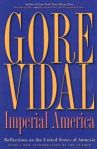 Following the publication of Perpetual War for Perpetual Peace and Dreaming War comes award-winning Gore Vidal’s long-awaited conclusion to his landmark, best-selling trilogy. Now, Vidal has written his most devastating exploration of Imperial America to date. “Not since the 1846 attack on Mexico in order to seize California,” Vidal writes, “has an American government been so nakedly predatory”. Bush’s apparent invincibility, and what he might or might not know – especially about those new “black box” voting machines being installed all over the country – is one of the central themes of “State of the Union 2004,” a magnificent and witty Olympian survey of American Empire, where the war on terror is judged as nonsensical as the “war on dandruff,” where America is an “Enron-Pentagon prison,” a land of ballooning budget deficits thanks to the growth of a garrison state, tax cuts for the privileged, and the creeping totalitarianism of the Ashcroft justice department. Collected in this volume are Vidal’s earlier State of the Union addresses, a tradition inaugurated on the David Susskind show in the early seventies as a counterpoint to “whoever happened to be president.”
Book Description (second edition):
Gore Vidal has been described as the last “noble defender” of the American republic. In Imperial America, Vidal steals the thunder of a right wing America – those who have camouflaged their extremist rhetoric in the Old Glory and the Red, White, and Blue – by demonstrating that those whose protest arbitrary and secret government, those who defend the bill of rights, those who seek to restrain America’s international power, are the true patriots. “Those Americans who refuse to plunge blindly into the maelstrom of European and Asiatic politics are not defeatist or neurotic,” he writes. “They are giving evidence of sanity, not cowardice, of adult thinking as distinguished from infantilism. They intend to preserve and defend the Republic. America is not to be Rome or Britain. It is to be America.”

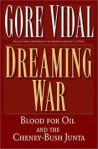 When Gore Vidal’s recent New York Times bestseller Perpetual War for Perpetual Peace was published, the Los Angeles Times described Vidal as the last defender of the American republic. In Dreaming War, Vidal continues this defense by confronting the Cheney-Bush junta head on in a series of devastating essays that demolish the lies American Empire lives by, unveiling a counter-history that traces the origins of America’s current imperial ambitions to the experience of World War Two and the post-war Truman doctrine. And now, with the Cheney-Bush leading us into permanent war, Vidal asks whose interests are served by this doctrine of pre-emptive war? Was Afghanistan turned to rubble to avenge the 3,000 slaughtered on September 11? Or was “the unlovely Osama chosen on aesthetic grounds to be the frightening logo for our long contemplated invasion and conquest of Afghanistan?” After all he was abruptly replaced with Saddam Hussein once the Taliban were overthrown. And while “evidence” is now being invented to connect Saddam with 9/11, the current administration are not helped by “stories in the U.S. press about the vast oil wealth of Iraq which must- for the sake of the free world – be reassigned to U.S. consortiums.”
 The United States has been engaged in what the great historian Charles A. Beard called “perpetual war for perpetual peace.” The Federation of American Scientists has cataloged nearly 200 military incursions since 1945 in which the United States has been the aggressor. In a series of penetrating and alarming essays, whose centerpiece is a commentary on the events of September 11, 2001 (deemed too controversial to publish in this country until now) Gore Vidal challenges the comforting consensus following September 11th and goes back and draws connections to Timothy McVeigh’s bombing of the federal building in Oklahoma City. He asks were these simply the acts of “evil-doers”?
 “John Kekes’s Against Liberalism offers compelling argumentation for the position that liberalism denies the very conditions it requires for its sustenance. As a consequence, liberal policies are inconsistent and self-defeating. Rarely has such a forthright and well-constructed argument been made against liberalism’s misguided flirtation with utopianism.” Herbert London
 Olle Bengtsson