“Rule by the Rich”

Återigen: hur det underlättar att det finns så många som tydliggör åtminstone centrala politiska och ekonomiska aspekter av en den nödvändiga de överordnade värdenas socialistiska konservatism, så att man s.a.s. inte behöver göra det själv och i stället kan försöka ägna sig mer åt just de överordnade dimensioner som anges i undertiteln till denna blogg och i beteckningarna av flera av ämneskategorierna, och som saknas hos dessa viktiga analytiker.

Men som jag också framhållit: hur beklagligt det är att det just nu i Sverige inte finns något parti som representerar den nödvändiga nya politiken, inget parti som motsvarar vad jag en gång hoppades att SD och AfS inom en inte alltför avlägsen framtid skulle kunna utvecklas i riktning mot. Eller ens en annan typ av politisk organisation. Att bara kunna signalera, nämna, hänvisa till att man är medlem i ett sådant parti eller en sådan organisation skulle ju mycket effektivt kommunicera det politiska budskapet utan att man behövde gå igenom allt själv och skriva om det hela tiden, och därmed nedprioritera det som, i tingens yttersta ordning, verkligen är entydigt överordnat och därmed väsentligare – sådant som även den rätta politiken och samhällsordningen i slutändan är beroende av.

Nu kan man bara hänvisa till – dela, posta – de essentiella, partiella analyserna av andra, vid behov kommentera dem, och, när det känns särskilt påkallat eller t.o.m. oundvikligt, fortsätta skriva egna politiska inlägg. Och kanske därmed i bästa fall på avstånd, genom att bara tillhandahålla det här på internätet, bidra med något litet mått av uppmuntran och förslag, ett och annat djupare åskådningsmässigt perspektiv, till någon av dem som vill ägna sig åt ny politisk organisering och aktivism. Någon vars intressen, bakgrund, utbildning och allmänna mänskliga betingadhet gör det naturligt, ja just nu gör det till det optimala att ägna sig åt denna organisering och aktivism.

Naturnödvändigtvis kommer det ju alltid finnas oräkneliga människor som primärt eller rentav uteslutande vill ägna sig åt politik, för att inte tala om ekonomi. Just nu måste det bara bli tydligare vilken politik, vilken ny politik, som behövs.

Norton igen, 19:e juli:

Beskrivning av detta avsnitt av Geopolitical Economy Report:

Western governments claim to be models of democracy, and demonize their geopolitical adversaries as “authoritarian”, but empirical evidence shows that the USA and European countries are oligarchies dominated by economic elites and large corporations. Billionaire Donald Trump is the perfect symbol of this, but he’s by no means the only one. Ben Norton explains.

Topics: 0:00 Narrative of Western “democracies” 0:26 (CLIP) Joe Biden on “democracy vs autocracy” 0:37 Western governments are oligarchies 1:54 Summary of oligarchic Western leaders 2:54 Scientific research shows USA is an oligarchy 4:29 US public opinion on healthcare 5:20 Money buys 80-90% of seats in US Congress 6:27 Citizens United ruling 7:21 Donald Trump: perfect symbol of US oligarchy 7:57 Robber barons 8:44 One Big Beautiful Bill: class war by the rich 9:49 Billionaires pay lower tax rate than most Americans 10:42 US Treasury Secretary Scott Bessent 11:35 Ex US Treasury Secretary Steve Mnuchin 12:16 Steve Bannon worked for Goldman Sachs 12:58 US Commerce Secretary Howard Lutnick 13:07 Crypto was taken over by Wall Street 14:08 Trump is the symptom, not the cause 15:07 Biden promised nothing would change 16:07 Barack Obama: funded by Wall Street 17:53 Mitt Romney: servant of Wall Street 18:48 Super PACs 19:32 Bloomberg funded Biden’s 2020 race 19:56 Billionaires funded Trump’s 2024 race 20:35 Elon Musk donated $288 million for Trump 20:57 (CLIP) Elon Musk bought 2024 US election 21:11 World’s richest man buys US politics 21:34 Wall Street wages war on Zohran Mamdani 22:46 Democratic Party sabotaged Bernie Sanders 24:34 UK Labour Party sabotaged Jeremy Corbyn 26:18 British spy agencies sabotaged Jeremy Corbyn 28:15 Symbol of UK oligarchy: Rishi Sunak 31:37 Neoliberal Keir Starmer: Tony Blair reincarnated 32:35 France’s President of the rich: Emmanuel Macron 36:04 BlackRock’s man in Germany: Friedrich Merz 37:40 Goldman Sachs’ man in Italy: Mario Draghi 39:10 Goldman Sachs’ man in Canada: Mark Carney 40:22 Summary of oligarchic Western leaders 41:35 Western governments are not democracies 42:45 Outro

Ingen egentligt intelligent person kan på allvar tro och framför allt inte vilja att det primitiva, vilda system Norton beskriver, och den undermänskliga kultur och troglomentalitet det alstrar, har en framtid. Det är ett enda stort, tungt, mörkt evolutionärt och andligt hinder för mänskligheten, ett hot mot alla högre värden och mot den mänskliga framtiden som sådan.

Paul Brunton: Essays on the Quest

A Posthumous Anthology of Original Unpublished Writings by the Late Dr Brunton

Rider, 1984

Amazon.com

From the back cover of the second printing, 1985:

Dr. Paul Brunton has written many books about the quest for spiritual consciousness, and his personal search for peace proved so valuable for readers that his works were translated into many languages. Because this search helped so many, Essays on the Quest has been published after his death, gleaned from material in Dr. Brunton’s files. In this book, the reader is given a chance to look at the man who was Paul Brunton, for he shares his ideas with us in a conversational manner – ideas ranging from a discussion of karma as the law of consequences to how we can develop insight. He shows us how to cleanse ourselves of petty emotions so that we can rise above the ego. An important discussion for seekers is the chapter on self-reliance, for Dr. Brunton looks at the problems that may develop when students place themselves totally in the hands of a teacher (or guru, or master). Limited growth, lack of responsibility, and other pitfalls of the spiritual aspirant – such as becoming involved in the “glamour” of the occult, and the danger of obsession – are mentioned. This is necessary information for serious students on the path for it provides us all with a chance to re-evaluate where we are.

Front flap of the first printing:

These hitherto unpublished essays, culled from the files of the late Dr Paul Brunton, represent his first work to see print since The Spiritual Crisis of Man was published in 1952. As such they will be eagerly welcomed by his many readers worldwide.

Paul Brunton’s writings are as immediate and relevant today as when first he put pen to paper. They teach us much about the divine source of his inspiration. In Essays on the Quest he explains why God allows so-called ‘evil’ to exist in the world. He provides a new technique which facilitates meditation. He gives a full and detailed account of the law of Karma and how it operates in our lives. And he poses the question of whether one needs a spiritual guide or not.

Written with the profound simplicity which is his hallmark, Essays on the Quest is an original and illuminating contribution to philosophical literature. It is an important book for our time.

Back flap of the first printing:

“There is something in us of which we are not normally conscious. It is only at rare moments that we become aware – and that dimly – of a second self, as it were, of a nobler and serener self. We may have experienced such an uplift for only a few minutes but we will be haunted for ever afterwards by a sense of its tremendous importance. For we sense that we have then been in contact with something other than our ordinary self, sublimer than our ordinary self yet despite that somehow related to it.

“Those of us who have passed through such an inspired mood, who have felt its serenity, tasted its power and obeyed its monitions, know well enough that only then have we been fully alive.”

From ‘The Adventure of Meditation’

Back cover of the first printing:

CONTENTS

The Mystery of Evil

The Adventure of Meditation

Karma: The Law of Consciousness

Is the Soul in the Heart?

The Interior Word

Is the World an Illusion?

Ascetic Mysticism Reconsidered

Insight

Self-Reliance or Discipleship?

Cleansing the Emotions

Ethical Qualifications of the Seeker

Surrender of the Ego

The Probations and Tests of the Aspirant

What Can we Do for Philosophy?

JOB’s Comment:

The image is of the second printing, but only the colours differ.

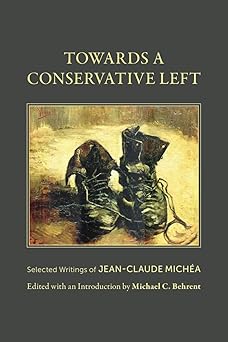
Jean-Claude Michéa, den konservative kommunisten

Förutom den av Michael Behrent redigerade Towards a Conservative Left: Selected Writings of Jean-Claude Michéa, kommer även en bok med samtal mellan Michéa och Behrent, Conversations américaines, publiceras senare i år av Éditions Albin Michel.

En tyvärr betalväggad artikel av Behrent har också publicerats i Compact (amerikanska, inte tyska). Thomas Fazi anser den vara en “Great article about…one of the fathers of conservative communism”, men tillägger överdrivet att denna senare “is really just communism, which is (used to be) inherently culturally conservative”. Kulturkonservativa inslag, och åtminstone s.a.s. implicerade potentialer, finns ju utan tvekan hos både Marx och Lenin, och de blir förstås centrala och avgörande idag. Men Fazi går för långt.

Compacts grundar-redaktör Sohrab Ahmari, författare till bl.a. The Unbroken Thread: Discovering the Wisdom of Tradition in an Age of Chaos (2021), menar att Michéa “has elucidated perhaps the only political and intellectual framework that might yet save the West. If this seems obvious in retrospect, it is only thanks to his yeoman labor.” Till detta bör väl läggas att det gäller den mer allmänna inriktning som titlarna på Behrents publikationer anger; inom dess ram finns ju utrymme för stor variation, bättre och sämre specifika former.

Michael C. Behrent, ed.: Towards a Conservative Left

Selected Writings of Jean-Claude Michéa

Vauban Books, forthcoming, September 9, 2025

Publisher’s Description:

Towards a Conservative Left offers the first comprehensive English-language introduction to the thought of Jean-Claude Michéa. Over the past three decades, Michéa has staked out a place for himself as France’s foremost “left populist.” A fierce critic of the illusions of progress and champion of the “common decency” that should (but no longer does) inform left politics, Michéa shows how the left’s focus on cultural liberalism has become a crucial element in today’s neoliberal economic order. At a time when the old divisions between “left” and “right” have never seemed less self-evident, Michéa invites us all to rethink our positions and imagine politics afresh.

The book opens with an introduction by its editor, the intellectual historian Michael C. Behrent, who situates the development of Michéa’s thought in the context of contemporary French political life and shows how its guiding preoccupations, far from being limited to that context, speak directly to our own political moment.

About the Editor:

Michael C. Behrent is a professor of history at Appalachian State University.

Blurbs:

“Jean-Claude Michéa has elucidated perhaps the only political and intellectual framework that might yet save the West. If this seems obvious in retrospect, it is only thanks to his yeoman labor.” Sohrab Ahmari, US Editor, UnHerd

“Americans tend to think French intellectual life is all Foucault and postmodernism. By introducing Jean-Claude Michéa, this volume helps us see how much more vibrant contemporary French thought is. Even when one firmly disagrees with Michéa, one cannot but see him as a thinker of extraordinary relevance to our period of ideological realignment.” Gregory Conti, Associate Professor of Politics, Princeton University

JOB’s Comment:

Article by Behrent in Compact: Jean-Claude Michéa, the Conservative Communist

A book with conversations between Behrent and Michéa, Conversations américaines, will also be published later this year, by Éditions Albin Michel.

Charles Robin: La gauche du capital

Charles Robin: Itinéraire d’un gauchiste repenti

Reformisterna och vänsterpopulismen

Socialkonservatism eller nyliberalism?

Anrika

Mitt i allt det tragiska krigsallvaret en liten språkobservation. Plötsligt har flera gamla erfarna journalister i de stora ljudmedia – tillsammans, på en gång – obegripligen börjat uttala ordet anrika fel.

När det är ett verb som betyder “göra rikare”, det som de avser, det Iran sägs inte få göra med uran, uttalas det med kort a, på samma sätt som i antaga, anföra, anmärka, angripa, ansluta, anklaga, anledning, ansats, o.s.v.

Men journalisterna uttalar det nu med långt a. Så uttalat är det ett adjektiv som betyder personer eller fenomen (exempelvis gamla hotell eller bokförlag) med rika anor.

Felet är märkligt i beaktande av den sedan långt över ett halvsekel pågående kärnkraftsdebatten i Sverige, av vilken frågan om anrikning av uran alltid varit en viktig del och där ordet tidigare alltid uttalats rätt.

Quinn Slobodian: Hayek’s Bastards

The Neoliberal Roots of the Populist Right

Allen Lane, 2025

Amazon.co.uk (Amazon.com, with different subtitle)

Publisher’s Description:

‘Bracingly original…Hayek’s Bastards demonstrates how a history of ideas can be riveting. Slobodian grounds intellectual abstractions in the lives of the people who espoused them…His book offers an illuminating history to our current bewildering moment, as right-wing populists join forces with billionaire oligarchs to take a chain saw to the foundations of public life, until there’s nothing left to stand on’ Jennifer Szalai, The New York Times

A revelatory exploration of how today’s rightwing authoritarianism emerged not in opposition to neoliberalism, but from within it

After the end of the Cold War, neoliberalism, with its belief in the virtues of markets and competition, seemed to have triumphed. Communism had been defeated – and Friedrich Hayek, the spiritual father of neoliberal economics, had just about lived to see it. But in the decades that followed, Hayek’s disciples knew that they had a problem. The rise of social movements, from civil rights and feminism to environmentalism, were now proving roadblocks in the road to freedom, nurturing a culture of government dependency, public spending, political correctness and special pleading. Neoliberals needed an antidote.

In this illuminating new book, historian Quinn Slobodian reveals how, from the 1990s onwards, neoliberal thinkers turned to nature, in an attempt to roll back social changes and to return to a hierarchy of gender, race and cultural difference. He explores how these thinkers drew on the language of science, from cognitive psychology to genetics, in order to embed the idea of ‘competition’ ever deeper into social life, and to advocate cultural homogeneity as essential for markets to truly work. Reading and misreading the writings of their sages, Friedrich Hayek and Ludwig von Mises, they forged the alliances with racial psychologists, neoconfederates, ethnonationalists that would become known as the alt-right.

Hayek’s Bastards shows that many contemporary iterations of the Far Right, from Javier Milei to Donald Trump, emerged not in opposition to neoliberalism, but within it. As repellent as their politics may be, these supposed disruptors are not defectors from the neoliberal order, but its latest cheerleaders.

Reviews:

“Indispensable…Entertaining. Slobodian’s wry commentary offers welcome respite from both the difficulty and the moral odiousness of his subject.” Becca Rothfeld, Washington Post

“As Quinn Slobodian makes clear in his bracing history of the intellectual origins of the alt-right, the conventional story misses out big part of the picture.” David Runciman, London Review of Books

“With real empirical depth and analytical subtlety, Hayek’s Bastards traces the origins of today’s far-right to a split within neoliberalism, and a ‘new fusionism’ of liberal economy and hard-hereditarian ‘race science’ – and all is made clear. One of the sharpest guides to the new reaction, it also casts light on the seemingly contradictory formation of libertarian-authoritarianism, of free trade and closed borders, and of an extreme monetary populism that is also extremely deferential to the wealthy.” Richard Seymour

“Quinn Slobodian has established himself as one of the sharpest intellectual historians of neoliberalism.” Bartolomeo Sala, Jacobin

“A bravura performance of intellectual inquiry.” Publishers Weekly, starred review

“Fascinating…Slobodian’s book draws our attention to what might appear an astonishing fact…that it has proven very easy to support capitalism while being hostile to other fundamental liberal liberties.” Matt McManus, Illiberalism

“Slobodian’s thesis is novel: he suggests that what is unfolding in Washington is the culmination of a strategic shift by neoliberal planners to achieve more populist support for their particular cause…One of Slobodian’s key achievements…is in showing that the entire weight of the extraordinarily successful neoliberal project rests on a foundation of pseudoscientific mumbo-jumbo.” Dave Vetter, The Climate Laundry

“Slobodian marshals impressive archival research…dazzling.” Aris Roussinos, Unherd

“A rousing relitigation of the 1990s’ ideological scorecard.” Jon Skolnik, Vanity Fair

“Slobodian charts clearly how today’s far right is simply a further degeneration from neoliberalism’s celebration of economic inequality and the primacy of economics as the measure of man. We are all living in a world being plundered by Hayek’s bastards now.” Ian Hughes, Irish Times

Hayek’s Bastards is an important book…As with Slobodian’s previous books, Hayek’s Bastards shows remarkable thoroughness in terms of research and in pursuing the connections among the thicket of figures populating the netherworld of the new fusionist right. Slobodian has provided his readers with nothing less than a counter-history of the nexus of politics, economics, and ideology in our world. The results are breathtaking but also terrifying.” John Foster, The Battleground

“A creative and engaging intellectual detective story that cuts through the far right’s smoke-and-mirrors claims of rupture and novelty, tracing the movement’s deep neoliberal roots and exposing a shared set of supremacist beliefs about which lives have value and which lives do not. Ideas have consequences and very few scholars take the history of ideas as seriously as Slobodian, even when the ideas themselves are absurd, patently false, and deeply dangerous.”  Naomi Klein, author of Doppelganger and The Shock Doctrine

“The brilliant Quinn Slobodian has done it again: overturned orthodoxy on the history of neoliberalism by paying attention to its fissures, mutations, and ideological foundations. Neoliberals confessed that tearing down the Berlin Wall did not address the real threat to liberty: welfare, immigrants, and demands for racial, gender, disability, and environmental justice. Anyone who believes neoliberal ideology is dead must read this book. Thanks to the Charles Murrays, Murray Rothbards, Peter Brimelows, and Richard Spencers of the world, it is alive and well in the alt-Right and the self-proclaimed cognitive elite bent on restoring the natural order of things in order to make the West Great Again.”  Robin D. G. Kelley, author of Freedom Dreams: The Black Radical Imagination

“In this work of historical erudition and sharp political analysis, Quinn Slobodian explains how the myth of neoliberal freedom can be sustained only through a deeply illiberal world view. Through a painstaking reconstruction of how Hayek’s offspring appeal to science served to naturalize hierarchy, and resist the calls for social equality, we come to see how rightwing authoritarianism emerged not as an alternative to neoliberalism but as its brainchild. An essential read to understand the times in which we live.”  Lea Ypi, author of Free: Coming of Age at the End of History

About the Author:

Quinn Slobodian is professor of international history at Boston University and the author or editor of seven books translated into ten languages. He contributes regularly to the New York Times, Guardian, and New York Review of Books. In 2024, Prospect UK named him one of the World’s 25 Top Thinkers.