
The Meaning of Materialism
Keith Ward on Materialism, 14 1 2 3 4 5 6 7 8 9 10 11 12 13
Having dismissed the theoretical arguments for materialism, Ward turns to what he is inclined to see as its real causes and underlying motivation, “the raw nerve and the emotional powerhouse of materialism”: What really drives much materialist philosophy is rage at the injustice and indifference of the universe. Things happen to people by chance; the innocent suffer and the evil flourish. There is too much suffering and pain in the universe for it to be designed by any half-way benevolent being. Better, then, to postulate unconscious laws operating without benevolent purpose, than to think of there being a great intelligence that has intentionally planned such pain and pointlessness.”
Theory remains, however, also when Ward focuses on the materialists argument from evil and suffering against the “great intelligence”, rather than on the question of the existence of matter as conceived by classical materialism. This is partly because materialism for Ward means primarily the rejection of the position that reality is ultimately spiritual, even though that position may also accept that there is some such a thing as matter as conceived by classical materialism. This is Ward’s broad category of idealism: any position that accepts the ultimacy of spirit is idealism, regardless of whether or not it accepts non-ultimate classical-materialist matter, i.e. their matter without their materialism (difficult as that may be).
I would prefer to define idealism more narrowly, as excluding also non-materialist, non-ultimate, classical-materialist matter. A distinction should be made between on the one hand materialism, the affirmation of classical materialist matter and the concomitant rejection of ultimate spiritual reality or even any spiritual reality, and on the other what could perhaps be called “matterism”, the mere affirmation of classical-materialist matter as such or indeed of any matter which shares at least some of the characteristics of classical-materialist matter, regardless of the position with regard to ultimate spirituality.
Of course, “matterism” is not a very felicitous term. First of all, it seems to signify precisely the same thing as “materialism”. But what I intend it to mean is simply the affirmation of the existence of matter in any form that is incompatible with the kind of idealism I think might be defended – which, I add, does not include classical idealist conceptions of matter, which are quite different from the classical materialist one. It would be better to speak of this not as an “ism”, and instead only of materialism as an “ism” that takes such affirmation so far as to assert such matter as the ultimately and perhaps exclusively real.
But it is inconvenient to have to repeat “the affirmation of the existence of matter in any form that is incompatible with the kind of idealism I think might be defended” each time this is referred to. A separate term signifying this is needed in order to avoid it, as well as avoiding the loose usage of “materialism” about any affirmation of the reality of matter regardless of the larger philosophical context. And it is impossible to take consistently the position that all “isms” are extreme exaggerations: “ism”-words must be used for all kinds of positions that are not of this kind at all. Thus matterism in itself is not an extreme and unusual position like materialism. It is compatible with Ward’s broadly defined idealism, which is not extreme either. Idealism more narrowly defined may be less common and is certainly viewed as extreme by many who have not studied it deeply yet are certainly not materialists. But positions that from some perspectives appear extreme cannot of course for that reason be rejected in philosophy. This holds for materialism too. Its extremism and unusualness in the perspective of the history of philosophy as well as contemporary philosophy which Ward has discussed is not, as Ward is of course aware, in itself a sufficient argument against it. For these reasons, “matterism” might perhaps be an admissible and useful term in discussions like this one. But other and better suggestions are welcome.
The argument against the “great intelligence”, remains, as I said, theoretical. But it is non-theoretical and based on the motives Ward is here beginning to describe and analyse inasmuch as it implies the affirmation of materialism in the sense of the position that what exists instead of that intelligence is matter. Even though the ultimate spiritual reality is rejected on the basis of experienced evil and suffering, this does not in itself imply that classical materialist matter takes it place in being made ultimate.
Thus something like classical-materialist matter is commonly brought in despite the weaknesses of the distinct arguments in favour of it as such. Perhaps the position resulting from the simultaneous rejection of ultimate spirituality and classical-materialist matter would still seem to resemble too much some other kind of idealism: the “unconscious laws” mentioned by Ward must be the laws of classical-materialist matter. But in view of the theoretical difficulties of such materialism, this affirmation cannot be accounted for except by the emotional factors involved, alongside the theoretical argument from evil, in the rejection of ultimate spirituality.
“These are entirely serious points”, Ward notes. “If the universe is morally unjust and indifferent to suffering, that counts strongly against the existence of a just and compassionate God. But perhaps part of the trouble is that we think of a cosmic mind as able and wanting to avoid all suffering, and as immediately and directly rewarding the good and punishing the wicked. For a moment, set such an overtly religious but basically naïve picture to one side, and think just of a consciousness that conceives all possibilities and generates a universe directed to evolving other intelligent information-processing intelligences.”
As we have already seen, Ward thinks in terms of Christian or Biblical creation, and we have also seen that although he certainly rejects “matterism” as the affirmation of classical-materialist matter, he accepts as congruent with his broader idealism (i.e., in his case, the affirmation of God as ultimate spirituality) some other form of matter more congruent with contemporary physics. Although it is unclear what that matter is, not least as Ward himself in fact, as I have pointed out, adduces arguments which would seem to be in favour of the rejection of any and all matterism, it is necessary to stress that matterism should be defined as including also the affirmation of modified, contemporary versions of matter which still, if this is possible, retain some of the metaphysical characteristics of classical-materialist matter that are relevant here.
Because of his acceptance of such non-ultimate and modified matter, Ward speaks of a generation and evolution of “other intelligent information-processing intelligences”, which involves and presupposes that alternative matter. This is a very different idealist position from the one I think could be defended. The broader idealism is somewhat hampered by the religious image-thinking of exoteric Biblical creation-theology, notwithstanding the expression of the latter in terms of evolution.
But what we are concerned with here is the analysis of materialism, and although the difference has to be pointed out for the sake of clarity, it is less important than the specific arguments Ward presents for the purposes of that particular analysis, arguments which are of importance for idealism in general, including the one I would try to defend. My point about materialism and matterism, or the proper meaning of materialism, is a minor one in this connection.
Ward is moving on here to the important analysis of what “really drives” materialism as the affirmation of matter, classical-materialist or modified, as ultimate or even exclusive. And this turns out to be the theoretical arguments for the rejection of spirit or God as ultimate that are not the specific theoretical arguments for materialism themselves, and that, as Ward will show and signals by his use of the words “raw nerve”, “emotional powerhouse”, and “rage”, are almost always combined with the motives that, without theory, reach for materialism as a replacement.
Hugues de Saint-Victor

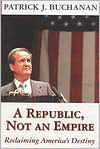
Patrick J. Buchanan: A Republic, Not an Empire
Reclaiming America’s Destiny
Regnery, 2002 (1999) Amazon.com
Back Cover with Quotes from the New Introduction:
“‘If we continue of this course of reflexive interventions, enemies will one day answer our power with the last weapon of the weak – terror, and eventually cataclysmic terrorism on U.S. soil.’ So I predicted in these pages in 1999.”
 “On September 11, 2001, ‘cataclysmic terrorism’ struck America as three Boeing 767s crashed into the World Trade Center and Pentagon, bringing down the towers and burning to death three thousand people.”
“Now let me repeat the warning: If this Prodigal Nation does not cease its mindless interventions in quarrels and wars that are not America’s concern, our lot will be endless acts of terror until, one day, a weapon of mass destruction is detonated on American soil. What is it about global empire that is worth taking this risk?”
Back Cover of the First Edition:
“Present U.S. foreign policy, which commits America to go to war for scores of nations in regions where we have never fought before, is unsustainable. As we pile commitment upon commitment in Eastern Europe, the Balkans, the Middle East, and the Persian Gulf, American power continues to contract – a sure formula for foreign policy disaster.”
“The day is coming when America’s global hegemony is going to be challenged, and our leaders will discover they lack the resources to make good on all the war guarantees they have handed out so frivolously; and the American people, awakened to what it is their statesmen have committed them to, will declare themselves unwilling to pay the price of empire.”
“A day of reckoning is approaching. It is my hope that the price in blood, treasure, and humiliation America will eventually be forced to pay for the hubris, arrogance, and folly of our reigning foreign policy elites is not, God forbid, war, defeat, and the diminution of this Republic – the fate of every other great nation or empire that set out on this same course.”
First Edition Flaps:
America is a great power now…will it be in the future, or will it collapse from imperial overstretch?
A Republic, Not an Empire is presidential candidate Pat Buchanan’s erudite and eloquent plea for a new American foreign policy. To avoid a future of endless war, he offers a new policy rooted in America’s greatest traditions.
This is the story of how American statesmen, through vision and courage, quadrupled the size of our Republic in a single century to create the most remarkable nation the world had ever seen. This is also the story of how twentieth-century presidents abandoned George Washington’s “great rule” – to avoid permanent alliances and stay out of foreign wars – and led this country into global conflagrations that changed America and the world forever, and not always for the better.
The United States has piled commitment upon commitment to nations and regions around the world – the Balkans, Eastern Europe, the Persian Gulf, the Middle East, Taiwan, Japan, and South Korea. Buchanan shows how America is reenacting the ancient folly of imperial overstretch that has led to the ruin of every other great power in history – and to the catastrophic world wars of this blood-soaked century.
He argues for a new foreign policy rooted in the wisdom of the Founding Fathers and giants fo American statesmanship – George Washington, Thomas Jefferson, Alexander Hamilton, John Adams, John Quincy Adams, Henry Clay, and Andrew Jackson – as well as modern warrior herors like Dwight Eisenhower and Doublas MacArthur.
Surveying the sweep of our nation’s history, Buchanan demonstrates how America’s liberty is best protected when the United States pursues its own vital interests, and how our liberty is most endangered when we embark on international crusades that are divorced from those interests.
The White House, Washington, D.C.
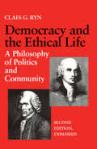
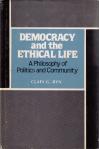
Claes G. Ryn: Democracy and the Ethical Life
A Philosophy of Politics and Community
The Catholic University of America Press, 1990 (1978) Amazon.com
Back Cover:
 This study of democracy goes to the heart of ethics and politics. Strongly argued and lucidly written, the book makes a crucial distinction between two forms of democracy. The author defends constitutional democracy as potentially supportive of the ethical life, while he criticizes the plebiscitary form of democracy as undermining man’s moral nature. The book includes an extensive interpretation and refutation of the ideas of Jean-Jacques Rousseau and offers a new perspective on the American Constitution and the relationship between moral community and self-interest. This edition includes an important new section on the common good and the state of Western democracy.
“One of the more important studies in critical thought to be published in recent decades…Claes Ryn, like Alexis de Tocqueville, understands the American social edifice better than do those reared within it.” – Russell Kirk in The Review of Metaphysics
“One of the best books on the terrain where politics and morality precariously overlap, recommended vigorously to all who are concerned with the loss of political morality. Combines scholarly research with an ornery independent mind.” – Peter Viereck
Front Flap of the Cover of the First Edition (Louisiana State University Press, 1978):
 This lucid synthesis of classical Greek, Judaeo-Christian, and modern ideas poses a challenge to positivism and moral relativism in modern sociopolitical thought. The true science of social life, Claes Ryn contends, is based on a humanistic and philosophical grasp of the moral nature of man.
Viewing democracy in the light of such an understanding of human nature and politics – an understanding gained in part through an extensive interpretation and refutation of Rousseau’s view of man and politics – Ryn develops here the idea that constitutional democracy is potentially supportive of ethical ends, whereas plebiscitarian democracy undermines the pursuit of such ends by basing public policy on the momentary majority.
Ryn presents an interpretation of human nature, stressing the tension within man between higher and lower potentialities and explaining “ethical conscience” as a check on spontaneous responses. Constitutionalism in its highest dimensions, he argues, is the political counterpart of moral self-discipline. Constitutional provisions must be used to ally the self-interest of man with the moral ends of society.
In this defence of constitutional restraints on the majority, Democracy and the Ethical Life offers not only a subtle and penetrating theory of democracy but also a philosophy of man.
JOB’s Comment:
Readers of this blog will be familiar with Ryn from a number of posts in the category Value-Centered Historicism. Here I wish to draw the reader’s attention to the briefly formulated supplementation with regard to the definitions of and distinction between constitutionalism and plebiscitarianism in view of the case of corruption of formally constitutional government, which I provide in my Swedish post Till frågan om populismen and elsewhere in this blog. These additional considerations do not involve any rejection of Ryn’s position but only a kind of extended application.
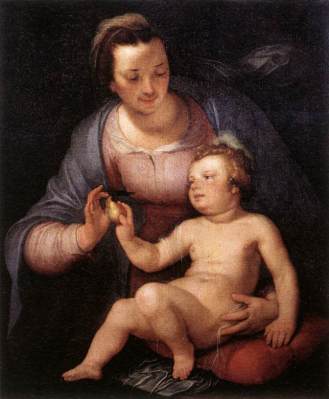
Cornelis van Haarlem: Madonna and Child
Kognitivism, realism, idealism, 4
Kognitivism, realism, idealism, 1
Kognitivism, realism, idealism, 2
Kognitivism, realism, idealism, 3
Motivet bakom Cupitts icke-realism är utöver hans accepterande av strukturalismens, perspektivismens och postmodernismens allmänna ståndpunkter också hans kritik mot den traditionella religionens världsbild, väsen och funktion, i synnerhet kristendomens. Delvis kritiserar alltså också idealismen detta. Men vad Cupitt i mycket gör är att filosofera om religionen som fenomen i vidare mening, inte att filosofera om de frågor som religionen såväl som den traditionella filosofin gemensamt väcker och roterar kring.
Det ligger i postmodernismens väsen att förneka tidlösa frågor. I stället blir dess religionsfilosofi, som vi redan antytt (den är naturligtvis inte ensam om detta) en filosofisk religionsfenomenologi som behandlar långt mer än, och snarare helt andra saker än, de klassiska frågorna, såsom realismfrågan. Det är därför viktigt att framhålla att den kritik jag här framför gäller Cupitts icke-realism, och att det sannolikt delvis torde vara möjligt att uppskatta exempelvis hans narratologiska insikter oberoende av denna position.
Cupitts kritik av uppenbarelsereligionernas absoluta, fundamentalistiska och exklusivistisk-monopolistiska anspråk (“heavy, crude, gloomy and terroristic…barbarous…frightful excesses of power and guilt, cruelty and sentimentality” [Runzo, 54.]) träffar självfallet inte den överkonfessionella religionsfilosofin i äldre mening som ju själv utmärks just av att den vänder sig mot allt detta. Poängen är att denna i den tradition jag skulle vilja försvara, vad vi än mån anse om betydelsen av uppenbarelsereligionernas konkret-institutionella sammanhang för det religiösa livet, rent åskådningsmässigt de facto förmådde rädda religionernas realistiska essens samtidigt som den övervann deras dogmatisk-konfessionalistisk-institutionella begränsningar. Och det är om dessa rent åskådningsmässiga frågor diskussionen i Runzos bok handlar.
Men här finner vi alltså hos Cupitt samma svaghet som hos Hick. Han framstår helt enkelt som omedveten om denna religionsfilosofis existens. Liksom det för Hick – efter att idealismen alltså som vanligt överhoppats, med en enda mening – endast finns traditionell uppenbarelsereligion å ena sidan och kritisk realism å den andra, finns det för Cupitt bara traditionell uppenbarelsereligion å ena sidan och icke-realism å den andra.
Visserligen säger han, med en pejorativ formulering, att filosofin inför kriticismen “fought a determined rear-guard action in favour of necessary truth”, [Ibid. 45.] men vad han syftar på är delvis oklart. Kant och Hegel nämns, men längre fram figurerar “German Idealist philosophy” och Hegel också som exempel på de strömningar som format de senaste tvåhundra årens helt dominerande “fully secularised and incarnational vision of things”. [Ibid. 50.] Detta är inte motsägelsefullt såtillvida som den nödvändiga sanning Hegel försvarade förvisso kan sägas vara helt sekulariserad och “inkarnationell”, det vill kort sagt säga långtgående panteistisk, men det är motsägelsefullt såtillvida som det senare citatet tyder på att den enligt Cupitt inte enbart var vad denne (med ytterligare inkonsekvent kvardröjande positivism) uppfattar som en “rear-guard action”.
Det väsentliga här är emellertid att Cupitt helt förbiser den i alla västländer förekommande och ibland dominerande idealism som var både kritisk och realistisk i vad gäller frågan om den transcendenta verkligheten. Att som Cupitt om den tyska idealismen generellt säga att den i likhet med övriga samtida strömningar hyste “a desire to escape from the legacy of Plato” och att den t. o. m. var “naturalistic” o.s.v., [Ibid.] är filosofihistoriskt helt enkelt felaktigt.
Men Cupitts religionskritik går utöver den som också framförs av den överkonfessionella, kritiska idealistiska filosofin, och riktar sig mot den realistiska essens som denna idealism i likhet med den traditionella religionen försvarar. Cupitts närmast programmatiska fladdrande i tidsandan – vad som annars skulle kunna beskrivas som det epigoniska och opportunistiska accepterandet av postmodernismen – hävdas vara just postmodernismens eget ideal: filosofen måste vara “an interpreter of the times”. [Ibid. 51.] Cupitt säger sig fullgöra denna uppgift i en “undogmatic and post-authoritarian spirit”: [Ibid. 52.] “I am not telling you how things are absolutely, but only offering you an interpretation of the way they seem, just now”. [Ibid.]
Inte minst här blir väl emellertid den sofistiska självupplösningen av Cupitts ståndpunkt uppenbar. Postmodernismens kritik träffar förvisso delvis den moderna rationalismen och positivismen. Men Cupitts icke-realism “faller”, s.a.s., tillsammans med den övriga postmodernismens – och dess föregångares – misslyckande i dekonstruktionsförsöken också av all idealism, metafysik, transcendens och andlighet, vad som här tar form som attacken mot “logocentrismen”, som i Derridas delvis avsiktligt subversiva föreställningsvärld också rymmer allt detta, utöver teknokratins instrumentellt-exploaterande rationalism.
Cupitt och postmodernismen “faller” dessutom tillsammans med all ren skepticism och relativism. Den filosofiska kritiken mot den s.a.s. totala skepticismen och relativismen är välkänd, men dessa återkommer ständigt i nya förklädnader, och med viss nödvändighet, genom hela filosofihistorien utan att till sitt väsen förändras. Det är därför också åter nödvändigt att granska dem, när de nu dyker upp i den cupittska icke-realistiska religionsfilosofins form. Cupitt presenterar en för en religionsfilosof ovanligt enkel version utan några som helst referenser till vare sig äldre eller samtida filosofisk diskussion om de här oundvikligen involverade problemen.
Bonaventura

Thomas Darnstädt: Der globale Polizeistaat
Terrorangst, Sicherheitswahn und das Ende unserer Freiheiten

Deutsche Verlags-Anstalt, 2009 Amazon.de
Kurzbeschreibung:
Wie zur Abwehr des Terrorismus Recht und Freiheit geopfert werden
Aus Angst vor dem Terrorismus riskiert die Politik die Grundlagen des freiheitlichen Verfassungsstaates. Der Kampf gegen den Terror führt Polizei, Militär und Geheimdienste immer öfter ins rechtliche Niemandsland. Völker- und Staatsrechtler, die westliche Regierungen beraten, arbeiten am Modell eines globalen Polizeistaates, in dem die Bürgerrechte bei Bedarf eingeschränkt und für Risikobürger Internierungslager eingerichtet werden könnten.
Seit dem 11. September 2001 verschwimmen im Kampf gegen den internationalen Terrorismus die Grenzen zwischen Krieg und Frieden, zwischen Polizei- und Militäreinsätzen, zwischen Inland und Ausland. Der von den USA erklärte “Krieg” gegen den Terror stellt die Partner vor politische und rechtliche Probleme: Was soll erlaubt sein in einem Krieg, der keiner ist, gegen einen schwer greifbaren Gegner, der weder feindliche Macht noch einfache Verbrecherbande ist? Im Graubereich zwischen Krieg und Frieden, dort, wo die Jagd auf international agierende Terroristen stattfindet, entsteht derzeit fast unbemerkt ein neues Recht. Auf internationalen Konferenzen, in vertraulichen Zirkeln europäischer und amerikanischer Sicherheitsexperten werden Pläne für einen Weltpolizeistaat geschmiedet, der sich über Recht und Gesetz der einzelnen Nationen legt. Und namhafte deutsche Juristen entwickeln Pläne für ein Recht der “Dritten Spur”, wo eine Mischung aus Kriegsrecht und Verfassungsrecht gelten soll: ein brisanter Mix, der den freiheitlichen Rechtsstaat und mit ihm die Bürgerrechte in Gefahr bringt.
– Schildert Bestrebungen von internationalen Politikern und Völkerrechtlern, im Notfall nationale Rechte und Garantien zu begrenzen
– Zeigt, wo im Namen des Antiterrorkampfes bereits Übergriffe von internationaler Seite geschehen
– Beschreibt die gravierende Bedrohung für die Demokratie und rechtsstaatliche Sicherheiten weltweit
Über den Autor:
Thomas Darnstädt, geboren 1949, promovierter Jurist mit Schwerpunkt Staatsrecht, ist seit 1984 Redakteur beim Spiegel und leitete einige Jahre lang das Ressort Deutsche Politik. Er schreibt heute als Spiegel-Autor über die aktuelle politische Entwicklung in Deutschland und Europa.
 Olle Bengtsson