Carl Wilhelm Nordgren

The prominent British conservative, Gregory Lauder-Frost, posted this image of Kaiser Franz Joseph on Facebook today. On the 28th of July 1914, Austria-Hungary declared war on Serbia, after Serbia’s rejection of the ultimatum following what Mr Lauder-Frost rightly calls the “organised murder in cold blood” of the Archduke Franz Ferdinand, the heir to the throne, and Countess Sophie. Mr Lauder-Frost adds: “What should have been a localised conflict became a World War. We should all bear this in mind with the present situation in the Ukraine.”
The image actually appeared on a later occasion, attached to the Kaiser’s note “An meine Völker!”, issued after Italy’s declaration of war against Austria on 23 May 1915 (the so-called “intervento”). According to the only site on which I have been able to find it on the internet, it is a “Graphikpostkarte”. The message reads: “Der König von Italien hat Mir den Krieg erklärt. Ein Treubruch, dessengleichen die Geschichte nicht kennt, ist von dem Königreiche Italien an seinen beiden Verbündeten begangen worden. Nach einem Bündnis von mehr als dreißigjähriger Dauer, währenddessen es seinen Territorialbesitz mehren und sich zu ungeahnter Blüte entfalten konnte, hat uns Italien in der Stunde der Gefahr verlassen und ist mit fliegenden Fahnen in das Lager unserer Feinde übergegangen.”
But it is easy to imagine that the Kaiser could have looked like this on the 28th of July 1914 too. At least it is clear, from our perspective, that he should have looked like this. Certainly not in every way, but all in all, or at the very least in central and decisive respects, a hundred years of European decline followed. Ours are the lessons to learn.
Intercollegiate Studies Institute Books, 2003 (?) (1974)
From the Publisher’s Website:
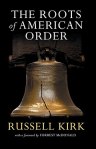 What holds America together? In this classic work, Russell Kirk describes the beliefs and institutions that have nurtured the American soul and commonwealth. Beginning with the Hebrew prophets, Kirk examines in dramatic fashion the sources of American order. His analytical narrative might be called “a tale of five cities”: Jerusalem, Athens, Rome, London, and Philadelphia. For an understanding of the significance of America at the dawn of a new century, Russell Kirk’s masterpiece on the history of American civilization is unsurpassable. This edition includes a new foreword by the distinguished historian Forrest McDonald.
What They’re Saying:
“The Roots of American Order is destined to be accorded a distinctive status…. Kirk is one of the few intellectuals with the breadth and depth of knowledge necessary to place the American experience in the broader historical perspective of our Judaic-Christian tradition.” The Wall Street Journal
“[T]his is a most impressive affirmation of faith in American ideals and institutions.” Publisher’s Weekly
“[A]nyone who wishes to reflect and talk on the topic ‘America,’ and especially any Christian who wishes to do so, will do himself a favor if he reads Kirk’s book.” Christianity Today
“Kirk’s book is exactly what people need to read, and he has made it easy, even pleasurable, for them to do so.” Esquire
From the Front and Back Flaps of the First Edition:
What holds America together? In this big lively book, Russell Kirk describes the beliefs and the institutions which have nurtured the order of the soul and the order of the commonwealth in the United States.
Beginning with the Hebrew prophets, Dr. Kirk examines in dramatic fashion the sources of inner and outer order – which Simone Weil calls “the first need of all”. His analytical narrative might be called “a tale of five cities”: Jerusalem, Athens, Rome, London, Philadelphia. For understanding the significance of America’s bicentenary, we need to look at both ancient and modern roots.
Among the powerful influences which Kirk discusses are the Hebrew understanding of the Covenant, Hellenic philosophy, Roman law and moral concepts, Christian doctrine, English common law and parliamentary government, medieval universities, the Protestant Reformation, seventeenth-Century controversies in church and state, the American colonial experience, and eighteenth-century political speculation.
Solon, Plato, Cicero, St. Paul, St. Augustine, John of Brienne, Pico della Mirandola, Richard Hooker, John Knox, John Bunyan, Jonathan Edwards, Abraham Lincoln, Orestes Brownson – these are a few of the men of mark whom Kirk depicts colorfully, reminding us of T. S. Eliot’s lines, “The Communication of the dead is tongued with fire beyond the language of the living”. He renews the meaning of such political thinkers as Aristotle, Hobbes, Locke, Montesquieu, Hume, Blackstone, and Burke; and he offers original reflections upon the Declaration of Independence and the Constitution.

Click to enlarge
“Österrikes försommar är bedövande vacker. På Bad Gasteins ljusgröna bergssluttningar betar i varma junidagar kor och lamm, medan de välfyllda bäckarna för ned vinterns sista smältvatten från alptopparna. Landskapet andas idyll. De första vandringstusisterna samlas och tar sig med starka kängor och vandringsstavar uppför branten till dagens strapatser.
Idyllen verkar på en besökare tidlös. Men har den alltid rått? Här bland bergen stred man en gång häftigt om rätten att ha egna åsikter och egen religion. Det är en för många glömd historia som ändå förskräcker när den återberättas.
I vår tid godtar såväl den katolska som den evangelisk-lutherska kyrkan trots teologiska meningsskiljaktigheter rätten att fritt välja sitt religiösa hemvist. I Europa betraktas denna frihet som ett självklart arv.”

 Olle Bengtsson