How Indian Spirituality Changed the West
Harmony, 2013 (2010) Amazon
Book Description:
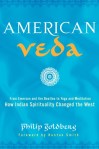 In February 1968 the Beatles went to India for an extended stay with their new guru, Maharishi Mahesh Yogi. It may have been the most momentous spiritual retreat since Jesus spent those forty days in the wilderness.
With these words, Philip Goldberg begins his monumental work, American Veda, a fascinating look at India’s remarkable impact on Western culture. This eye-opening popular history shows how the ancient philosophy of Vedanta and the mind-body methods of Yoga have profoundly affected the worldview of millions of Americans and radically altered the religious landscape.
What exploded in the 1960s actually began more than two hundred years earlier, when the United States started importing knowledge as well as tangy spices and colorful fabrics from Asia. The first translations of Hindu texts found their way into the libraries of John Adams and Ralph Waldo Emerson. From there the ideas spread to Henry David Thoreau, Walt Whitman, and succeeding generations of receptive Americans, who absorbed India’s “science of consciousness” and wove it into the fabric of their lives. Charismatic teachers like Swami Vivekananda and Paramahansa Yogananda came west in waves, prompting leading intellectuals, artists, and scientists such as Aldous Huxley, Joseph Campbell, Allen Ginsberg, J. D. Salinger, John Coltrane, Dean Ornish, and Richard Alpert, aka Ram Dass, to adapt and disseminate what they learned from them. The impact has been enormous, enlarging our current understanding of the mind and body and dramatically changing how we view ourselves and our place in the cosmos.
Goldberg paints a compelling picture of this remarkable East-to-West transmission, showing how it accelerated through the decades and eventually moved from the counterculture into our laboratories, libraries, and living rooms. Now physicians and therapists routinely recommend meditation, words like karma and mantra are part of our everyday vocabulary, and Yoga studios are as ubiquitous as Starbuckses. The insights of India’s sages permeate so much of what we think, believe, and do that they have redefined the meaning of life for millions of Americans – and continue to do so every day.
Rich in detail and expansive in scope, American Veda shows how we have come to accept and live by the central teaching of Vedic wisdom: “Truth is one, the wise call it by many names.”
Reviews:
“American Veda is an illuminating, gracefully written and remarkably thorough account of India’s spectacular impact on Western religion and spirituality.” Deepak Chopra
“American Veda shows us how we got to where we are. It chronicles a revolution in consciousness and describes India’s lasting influence on our culture, from gurus, meditation, and yoga to sitar music and aromatic curries. Savor it.” Michael Bernard Beckwith, author of Spiritual Liberation: Fulfilling Your Soul’s Potential
“This book demonstrates the far reach of Indian thought into the American psyche and sense of spiritual self. A well written, superbly researched book, it should be read by all the 15 million Americans practicing meditation and yoga!” Christopher Chapple, Doshi Professor of Indic and Comparative Theology, Loyola Marymount University
“Wonderfully comprehensive, positive, tremendously insightful, and illuminating. For anyone interested in the deep influence of yoga philosophy in American culture, I highly recommended this masterful book.” John Friend, Founder of Anusara Yoga
“Immensely smart, wise and brilliantly written. This book should be required reading for everyone interested in ecumenical spirituality which is the one hope for the survival of the human race, and India’s great gift to us in our crisis.” Andrew Harvey, author of The Hope: The Guide to Social Activism and The Sun at Midnight
“In this important and engaging book, Philip Goldberg chronicles the long neglected history of Hinduism’s encounter with the US. He astutely examines how Hinduism has been constructed and consumed within the larger American spiritual landscape. A must read for those interested in Hinduism and its transmission.” Varun Soni, Dean of Religious Life, University of Southern California
“American Veda documents an important cultural change and is an impressive book: informed and informative, well researched and readable.” Roger Walsh MD, Ph.D., University of California Medical School, author of Essential Spirituality: The Seven Central Practices
“Intriguing reading, fascinating profiles and great storytelling of Yoga luminaries adapting the teachings to fit modern American life. This book inspires us to continue to deepen in our body, mind, and spiritual journey.” Lilias Folan, PBS Host and author Lilias! Yoga Gets Better with Age
“Goldberg weaves a tale as only a true storyteller can, drawing the reader into this Vedic web that has no weaver, providing us with a fresh view of how Vedic strands have woven their way into the daily fabric of every American. He masterfully unfolds this ancient play of spiritual unfolding that is just now beginning to emerge into early adolescence in America.” Richard Miller, PhD, author of Yoga Nidra: A Meditative Practice for Deep Relaxation and Healing, co-founder of the International Association of Yoga Therapy and the founding president of the Integrative Restoration Institute.
“A breathtaking trek across time, American Veda shows us something extraordinary, surprising, and precious about where we come from, who we are at this moment, and what we may yet become.” Chip Hartranft, author of The Yoga-Sutra Of Patañjali: A New Translation With Commentary
“In a delightful, compelling way, American Veda shows how India’s ancient wisdom has permeated our lives, including many of the self-improvement teachings that have benefited millions. I loved reading this book.” Marci Shimoff, NY Times bestselling author, Happy for No Reason and Chicken Soup for the Woman’s Soul
“Nothing short of remarkable. Within the pages of this fairly short volume, Goldberg manages to cover every major figure, movement, and idea that originated in India’s spiritual terrain and arrived on our shores to forever alter the landscape of our thought and culture…Writing with empathy and discernment, he covers highly controversial issues regarding the impact of the transmission of Indian spiritual culture in a way that inspires deeper understanding. American Veda is an insightful guide to the fascinating history of a phenomenon that will be seen in the future as one of the watershed moments of American history.” Rita D. Sherma, Ph.D., Executive Director, School of Philosophy & Religious Studies, Taksha University
“American Veda is a bright light on the historical path to enlightenment in America. Philip Goldberg is an acharya of words and research. Highly recommended.” Larry Payne Ph.D., coauthor, Yoga for Dummies, Yoga Rx and The Business of Teaching Yoga
“We imagine the United States as a Christian island far from the exotic teachings of India. We imagine wrong. As Phil Goldberg’s masterful American Veda shows we have been under the sway of Hindu spiritual thought for centuries. If you want to understand American spirituality today, and get a glimpse into its future, read this book.” Rabbi Rami Shapiro, author of Recovery, the Sacred Art
“This book, American Veda is a landmark! Easy to read it shines a light of understanding on the American Vedic Hindu path which started with the transference of knowledge from India, and equally important by its acceptance by the Americans of western orientation. It is a path on which now, the immigrant Vedic Hindu community and its progeny are grafting on to and traveling along with many in the mainstream community, resulting in, we hope increased understanding. The integrated approach of this book helps fill in the gaps of this historical journey, especially for those of us who see ourselves as fellow travelers working to bridge the east-west divide.” Anju Bhargava, Management Consultant and Founder of Hindu American Seva Charities
About the Author:
Philip Goldberg is the author or coauthor of nineteen books, including Roadsigns: On the Spiritual Path and The Intuitive Edge. Based in Los Angeles, he is an ordained interfaith minister, a public speaker and seminar leader, and the founder of Spiritual Wellness and Healing Associates. He is director of outreach for SpiritualCitizens.net and blogs regularly on religion for the Huffington Post.
JOB’s Comment:
Then one of course has to start looking at everything described in this book with the proper kind of discernment… It is desperately needed.
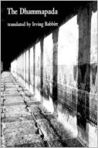 The 423 verses in the collection known as The Dhammapada (pada: “the way”; dhamma: “the teaching”; hence, “The Path of Truth”) are attributed to the Buddha himself and form the essence of the ethics of Buddhist philosophy. There are a number of English translations of The Dhammapada, but this version by Irving Babbitt, for many years professor at Harvard and founder, with Paul Elmer More, of the movement known as “New Humanism”, concentrates on the profound poetic quality of the verses and conveys, perhaps more than any other, much of the vitality of the original Pali text.
 Over the years, His Holiness Maharishi Mahesh Yogi recorded brilliant and inspiring lectures on the literary process, as well as on critical theory and technique, emphasizing the relevance of the state of consciousness of both writer and reader. He explained how only from an expanded basis can the writer spontaneously experience and express refined emotions and ideas and only from such a basis can the reader hope to understand and enjoy such writings. A fully developed consciousness can express the ocean in a drop, and from that drop flows a river of meaning, power, and enjoyment. Literature itself can be a means to evolve one’s consciousness through sound, rhythm, and meaning, swinging the reader’s attention from concrete to abstract, thus purifying consciousness and producing bliss.
 Det är i den västliga världen – och särskilt i teologiska kretsar – en utbredd uppfattning att gnosis är en form av andlig förvillelse. Tage Lindbom vill med denna skrift påvisa att det finns en äkta gnosis, en mänsklig kunskap om den eviga Sanningen, sacra scientia, att denna universella kunskap vunnit sitt inträde i Västerlandet främst genom Platon, att vi möter denna gnosis i evangelierna, hos apostlarna och kyrkofäderna.
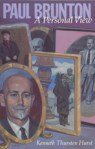 Paul Brunton is generally recognized as a major contributor to the spiritual renaissance of modern Culture. His first book, A Search in Secret India, was an instant popular success in 1934, vividly recounting his fascinating spiritual odyssey seeking out the genuinely holy men of India. It was followed by A Search in Secret Egypt, which highlighted his awesome experience of spending a night alone in the Great Pyramid. Nine more books followed in quick succession, including his monumental twin works The Hidden Teaching Beyond Yoga and The Wisdom of the Overself.
  Olle Bengtsson