I think he called himself Da Avabhasa at this time (although it may still have been Da Free John). See also the essay in which I explain what I find to be his significance.
Category: Spirituality
Frithjof Schuon: Leitgedanken zur Urbesinnung
Maurer 2009 (1935) Amazon.de
Kurzbeschreibung:
 Leitgedanken zur Urbesinnung ist ein Frühwerk Frithjof Schuons, des international bekannten und hoch geehrten Religionsphilosophen. Bei dieser Ausgabe handelt es sich um die dritte deutsche Auflage (nach: Zürich 1935 und Freiburg i. Brsg. 1998). Doch der Begriff Frühwerk soll nicht in die Irre führen, handelt es sich doch um einen Text von außergewöhnlicher Tiefe und geistiger Brillanz. In einzelnen, längeren und kürzeren Betrachtungen und Gedanken versucht Schuon, die Urlehre zu ergründen, jenes sich in Formen verhüllte, sich in Formen kundgebende, durch Menschenalter hindurch stets neugestaltig wiederkehrende und ewig sich gleich bleibende Wissen von den letzten Zusammenhängen . Mit seinen Gedanken, die Frucht sind rein geistiger Besinnung, möchte der Autor den Leser zu einer Weltanschauung führen, die den ganzen Menschen umfasst und gleichzeitig lebendig und tiefgründig ist. Äußerlich betrachtet reihen sich Schuons Betrachtungen beinahe zusammenhanglos aneinander, doch innerlich sind sie geschlossen und eindeutig. So liegt dieses Buch vor uns wie ein nie gewordener und nie beschlossener Gedankenkreis; es scheint ohne Ursprung und ohne Ende zu sein. Schließlich sei noch Folgendes gesagt: in einer Zeit, da die Missachtung und Zerstörung der deutschen Sprache an der Tagesordnung sind, stellt der Sinn für die Würde, ja die Heiligkeit der Sprache mehr denn je einen ganz wesentlichen Wert dar; und ich möchte ohne falsche Bescheidenheit hervorheben, dass dieses Anliegen gleichsam am Rande des metaphysischen Inhalts zur geistigen Botschaft dieses Buches gehört.
Über den Autor:
Frithjof Schuon wurde 1907 in Basel geboren. Sein Vater war Schwabe, seiner Mutter Elsässerin. Früh ging Schuon nach Frankreich und wandte sich dem Studium traditioneller Kulturen zu. Im Alter von 26 Jahren wurde er von einem bedeutenden Sufi-Meister selbst zu einem Sufi-Scheich ernannt. Später wurde er ehrenhalber in den nordamerikanischen Lakota-Stamm aufgenommen. Wie kaum ein anderer vor ihm durchdrang Schuon die geistige Essenz aller traditionellen Lehren und vermittelte sie mit äußerster Klarheit und Präzision an seine Schüler. Obwohl er deutsche Wurzeln hat und einige seiner Werke immer wieder einmal aufgelegt wurden, ist er in Deutschland immer noch ein großer Unbekannter. Er verstarb 1998 in den USA.
Paul Brunton: The Body
The Notebooks of Paul Brunton
Volume Four, Part 2
Larson, 1986
Back Cover:
The body is as much a divine projection as the planet on which it dwells.
– Paul Brunton
The Body is a balanced course in perceiving and perfecting the physical body’s potential to become an eloquent expression of the divine force within. All the exercises, breathings, hygienic and dietary suggestions collected in this volume have a two-fold purpose. First, to make the development of intuition and the depening of meditation easier. And second, to assure physical, psychological and spiritual safety when awakening and directing the spirit-energy locked within the unregenerated psysical organism. With the ultimate goal of transmuting “sexual” energy to its higher octave. The Body presents a sane and effective graduated sexual ethic that acknowledges individual levels of development and spiritual commitment.
The Body is the second part of Volume Four in The Notebooks of Paul Brunton series.
“…vigorous, clear-minded and independent…a synthesis of Eastern mysticism and Western rationality…”
Library Journal
“…a person of rare intelligence…thoroughly alive, and whole in the most significant, ‘holy’ sense of the word.”
Yoga Journal
René Guénon: Orient et Occident
Éditions Véga, 2006 (1924) Amazon.fr
Présentation de l’éditeur:
 On peut diviser sommairement l’oeuvre de René Guénon (1886-1951) en 2 grandes parties: d’une part l’exposé purement métaphysique – tel qu’on le découvre par exemple dans les États multiples de l’être ou Le Symbolisme de la croix – et d’autre part la critique du monde moderne qui présuppose d’ailleurs cet éclairage doctrinal.
Orient et Occident – dont la parution en 1924 eut un retentissement considérable dans les milieux intellectuels – appartient à cette seconde partie du message guénonien. Grâce justement au point de vue intemporel de l’auteur, le caractère véritablement prophétique de ce livre nous apparaît plus clairement encore qu’aux contemporains puisque les tares et les menaces qu’il dénonce n’ont fait que s’aggraver depuis lors.
Le propos de Guénon était d’éviter ce qu’il est convenu d’appeler aujourd’hui le “choc des civilisations”, en présentant, un Occident en déshérence oublieux de son propre patrimoine spirituel, les richesses d’un Orient largement ignoré, ou défiguré. Comme on l’a dit très justement, ce métaphysicien fut un passeur entre les mondes, un artisan de paix entre des peuples qui se haïssaient faute de se connaître.
Que le désordre occidental se soit depuis lors largement étendu à l’Orient et que la haine ait encore creusé le fossé entre les peuples, cela n’invalide en aucune façon l’exposé de Guénon qui n’en revêt au contraire qu’une actualité plus brûlante. Et les dernières lignes d’Orient et Occident sonnent plus de 80 ans après comme une exhortation destinée à ceux qui, au sein du chaos actuel, doivent préparer qu’on le veuille ou non, un véritable renversement des pôles intellectuels: “Quand on a pour soi la puissance de la vérité, n’eût-on rien d’autre pour vaincre les plus redoutables obstacles, on ne peut céder au découragement car cette puissance est telle que rien ne saurait prévaloir finalement contre elle; il n’y a pour en douter, que ceux qui ne savent pas que tous les déséquilibres partiels et transitoires doivent nécessairement concourir au grand équilibre total de l’Univers.”
Mark Sedgwick on Sylvain Lévi’s Criticism of Guénon’s Thesis
In his book Against the Modern World: Traditionalism and the Secret Intellectual History of the Twentieth Century (2004), Mark Sedgwick lists Sylvain Lévi’s three main reasons for rejecting the Sorbonne “thesis form” of René Guénon’s Introduction générale à l’étude des doctrines hindoues. Sedgwick cites Lévi’s report to Dean Ferdinand Brunot as quoted in Marie-France James, Ésoterisme et Christianisme: Autour de René Guénon (1981). The first reason (I will comment on the other reasons later) is that the thesis “ma[de] light of history and historical criticism”.
Sedgwick remarks that this was “a criticism of Guénon’s methodology that was in many ways justified”, and that Guénon “made no pretense of following the standard scholarly methods of Indology: for reasons examined later, his approach was theological rather than anthropological or sociological. For Guénon, Hinduism was a repository of spiritual truth, not the body of beliefs and practices modified over time that late nineteenth-century Western scholarship recognized.” [Sedgwick, 22-3; James, 194.]
Having only read the book published in 1921, I don’t know what the difference is between it and the thesis form. Sedgwick does not – as far as I can see right now – say anything about this. It is hard to think there could be no difference. The book does not have the form of a doctoral thesis at all. But if there is no difference, or if there is no difference with regard to what Lévi criticized and Sedgwick discusses, Sedgwick’s formulations, while certainly true, are at the same time a little strange in view of the nature of the thesis.
For reasons discussed in the thesis/book, Guénon would have objected to the description of his approach as “theological”. He would not even have accepted that his approach is a “methodology” at all: not only did he not make any “pretense of following the standard scholarly methods of Indology” – he did not follow any standard modern scholarly methods. And something needs to be said about the relation between “history and historical criticism” on the one hand and an anthropological or sociological approach. But these are not the main reasons why I find Sedgwick’s formulations somewhat curious.
The reader unfamiliar with Guénon’s work would, I think, be inclined to take Sedgwick to mean that Lévi’s criticism, the criticism from the position of historical criticism, is justified “in many ways” but not in every way since Guénon does not only “make light of” historical criticism but also to some extent, alongside the theological approach, himself correctly applies or practices historical criticism.
The problem for such a reader is that this interpretation is impossible in light of Sedgwick’s other formulation that Guénon “made no pretense of following the standard scholarly methods of Indology”. If, or since, this is so, i.e. since there is in Guénon’s book no historical criticism but only a “theological” approach, Sedgwick must mean something else.
The reader might then think that what Sedgwick means to say is that criticism from the point of view of historical criticism is not in every way justified, that it is in some ways acceptable to make light of historical criticism, that a “theological” approach is also in some ways valid, and that Lévi is wrong not to allow this. Lévi’s criticism is thus justified “in many ways” but not in every way.
Unfortunately, Sedgwick does not make clear that this is what he means, and, left to itself, there is nothing in the formulation except the barest semantic possibility to indicate that this could indeed be what he means. It is not a natural interpretation.
If, quite regardless of the legitimacy of other approaches, it is not acceptable to make light of historical criticism, Lévi’s criticism is justified in every possible way. Probably there were also other formulations in Lévi’s report, which Sedgwick and perhaps James do not cite. But taken alone, even Lévi’s formulation that Guénon’s thesis just “makes light of” historical criticism is a little surprising.
For the thesis, if the same as the book or the same as the book in the respects here discussed, cannot be said to be one that simply applies a “theological” “methodology” and that also, alongside it, “makes light of” historical criticism. The thesis is a Guénonian traditionalist exposition of Hinduism related to a continuous, extensive polemic against the non-traditionalist approach of modern scholarly methodologies, primarily historical criticism. There is almost as much criticism of historical criticism as traditionalist exposition. The criticism, the “making light” of historical criticism, is a basic theme. Throughout the book, Guénon seeks to show that, how, and why the historical critics have failed to understand the “spiritual truth” of which Hinduism is “a repository”. Indeed, several separate chapters are devoted to this subject alone.
Thus, it is not just the case that Lévi’s criticism is justified in every possible way if making light of historical criticism is inadmissible. It is also the case that the statement that the thesis makes light of historical criticism is justified in every possible way as a description of the thesis. There is no way in which it is not justified to say this about the thesis. The statement that it is “in many ways” justified to say by way of description that it “makes light of” historical criticism while adopting instead a “theological” approach would be much too weak, absurdly weak. Lévy must have rejected the thesis as the totally uncompromising, elaborate attack on historical criticism that in reality it is.
Of course, one cannot doubt that Sedgwick must be thoroughly familiar with the thesis, the foundational work in the whole intellectual current which his book is about. It is a little difficult to understand how he could describe it in the way I have discussed. But this is a minor criticism. After all, his book is not a philosophical or theological study of traditionalism, nor does the lack of philosophical and theological and other analysis qualify it as a proper work in intellectual history. Rather, it is an ambitious piece of a kind of journalism (as is signalled already in the subtitle’s sensationalist use of the word “secret” – at the most, the intellectual history he writes about could be said to be comparatively “unknown”); but in that genre, it sometimes does a good job.
The real, substantial questions that must be asked here are related to what, if Sedgwick had meant it, he would have made much clearer. To what extent – in how many ways and in which ways – is the justified descriptive statement about Guénon’s thesis also justified as criticism, and to what extent it is not? And these are important questions indeed, which I hope to be able to return to shortly.
Bhaktisiddhanta Sarasvati
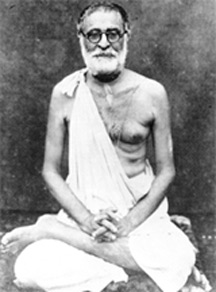
Ferdinando Sardella: Modern Hindu Personalism
The History, Life, and Thought of Bhaktisiddhanta Sarasvati
Oxford University Press, December 2012 (estimated) Amazon.com
From the publisher’s website:
 – This is the first monograph about the life and thought of a key religious figure of modern Hinduism
– It questions the perception of an alleged nondualistic (monistic) essence within modern Hinduism and presents an alternative view
– It contributes to a global history of bhakti movements in the modern period
– It presents an important aspect of the modern development of Vaishnavism in Bengal based on little known or previously unknown primary sources in Bengali and other languages
– It provides a comprehensive history of the roots in Bengal of the Hare Krishna movement
– It fills a gap in the history of the interactions between India and the West during the colonial period with particular reference to Britain and Germany
Modern Hindu Personalism explores the life and works of Bhaktisiddhanta Sarasvati (1874-1937), a Vaishnava guru of the Chaitanya school of Bengal. Ferdinando Sardella examines Bhaktisiddhanta’s background, motivation and thought, especially as it relates to his forging of a modern traditionalist institution for the successful revival of Chaitanya Vaishnava bhakti. Originally known as the Gaudiya Math, that institution not only established centers in both London (1933) and Berlin (1934), but also has been indirectly responsible for the development of a number of contemporary global offshoots, including the International Society for Krishna Consciousness (Hare Krishna movement). Sardella provides the historical background as well as the contemporary context of the India in which Bhaktisiddhanta lived and functioned, in the process shedding light on such topics as colonial culture and sensibilities, the emergence of an educated middle-class, the rise of the Bengal Renaissance, and the challenge posed by Protestant missionaries. Bhaktisiddhanta’s childhood, education and major influences are examined, as well as his involvement with Chaitanya Vaishnavism and the practice of bhakti. Sardella depicts Bhaktisiddhanta’s attempt to propagate Chaitanya Vaishnavism internationally by sending disciples to London and Berlin, and offers a detailed description of their encounters with Imperial Britain and Nazi Germany. He goes on to consider Bhaktisiddhanta’s philosophical perspective on religion and society as well as on Chaitanya Vaishnavism, exploring the interaction between philosophical and social concerns and showing how they formed the basis for the restructuring of his movement in terms of bhakti. Sardella places Bhaktisiddhanta’s life and work within a taxonomy of modern Hinduism and compares the significance of his work to the contributions of other major figures such as Swami Vivekananda. Finally, Bhaktisiddhanta’s work is linked to the development of a worldwide movement that today involves thousands of American and European practitioners, many of whom have become respected representatives of Chaitanya bhakti in India itself.
Author Information:
Ferdinando Sardella is a researcher and the Director for the Forum for South Asia Studies for the Humanities and Social Sciences at Uppsala University. He is a fellow at the Oxford Centre for Hindu Studies. In 2010 he received the Donner Institute Prize for outstanding research in the field of Religious Studies at the Åbo Akademi University in Finland.
Da Free John: Scientific Proof of the Existence of God Will Soon Be Announced by the White House!
Prophetic Wisdom about the Myths and Idols of mass culture and popular religious cultism, the new priesthood of scientific and political materialism, and the secrets of Enlightenment hidden in the body of Man
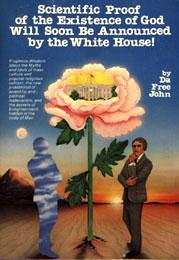
The Dawn Horse Press, 1980
Blurbs on the Back Cover:
This is a mighty book of insight… a penetrating, comprehensive critique of popular cults and mass culture. This book does two things absolutely critical for the survival of Man. First, it exposes the fundamental flaws of organized religion, science, and politics. Second, it gives clear indications for establishing a culture based on wisdom and love. Anyone who is the least bit concerned about his or her own well-being – physical, mental, spiritual – and that of the world should consider the words of Da Free John. He teaches and is a living demonstration of the present Divine Condition and evolutionary future of the human race.
John White, author, Pole Shift, and editor, The Highest State of Consciousness
If you read no other book in your lifetime, read this beautiful, profound, disturbing, and hopeful book.
Worth Summers, Ph.D., Professor of Sociology, California State University
The function of a great educational work is to lead thereader into a new awareness. The function of a great spiritual writing is to jolt and insipire the reader into a new state of Being. This book is both. No one can really read it without being changed in the process. It is like a rapid-fire succession of electric shocks, each carrying the message: Wake up!…A powerfully effective “de-hypnitizer”…that will not let you rest until you see clearly – and so seeing, choose to act. In modern society’s time of troubles, this is a much-needed book.
Willis Harman, President, The Institute of Noetic Sciences
If there is a man in this country today who is God-lllumined, that man is Da Free John. The proof is in this book. Here is the most ancient tradition of mankind expressed in a way that is startlingly modern. Da Free John is a force to be reckoned with.
Roy Finch, Professor of Philosophy, Hunter College, City University, New York
Da Free John’s teaching is, I believe, unsurpassed by that of any other spiritual teacher, of any period, of any place, of any time, of any persuation.
Ken Wilber, author, The Atman Project, and editor, Re-Vision Journal
In our world of political chaos and potential nuclear holocaust, there must be many men and women who are awake to the madness around us and ready to hear the voice speaking in these discourses. I pray that this book inspires them to expand in love and to become guides for the millions who are still blinded y fear and mistrust. The need for truth is urgent.
Robert Hall, M.D., Co-founder, Lomi School and the Gestalt Institute of San Francisco.
JOB’s Comment:
The main title of this book is entirely satirical, and aimed at the illusions of the “scientific worldview” (“scientific proof”), conventional and popular exoteric religion (“the existence of God”), and the materialist politics of our time (“announced by the White House”). This is one of Jones’s big books, and in its first chapters it focuses a little more on the general contemporary mass culture shaped by these forces than his other big ones, most of which, like The Enlightenment of the Whole Body, deal primarily with his spiritual teaching in itself. Its third chapter is entitled ‘Scientific Proof of the Existence of God Will Not Be Announced by the White House’.
Franklin Jones on Discipline
I think he called himself Da Avabhasa at this time (although it may still have been Da Free John). See also the essay in which I explain what I find to be his significance.
Bubba Free John: The Enlightenment of the Whole Body
A Rational and New Prophetic Revelation of the Truth of Religion, Esoteric Spirituality, and the Divine Destiny of Man

The Dawn Horse Press, 1978
Back Cover:
Since ancient times it has been acknowledged that the true Spiritual Master is a special manifestation of the Transcendental Heart or Spirit of Nature. Such individuals are born for their Work; they evolve quickly, and they generally begin instructing and transforming others while still relatively young.
Bubba Free John is such a “Heaven-Born” Teacher. Few Masters of his stature have ever appeared on the Earth, and none has ever appeared in the Western world. The Enlightenment of the Whole Body is Bubba’s Song to the All-Pervading Life and Transcendental Consciousness of God, the Divine Person, with whom Bubba is utterly and perfectly Identified, and for Whom he is a living Agent among men.
If we were to combine the most God-inspired Scriptures of Man into a single, focused, completely considered and authoritative expression, this is the kind of book that would emerge. It contains the moral and prophetic fire of the Old and New Testaments, the philosophical majesty of the greatest Hindu and Buddhist literature, and the Ecstatic Humor, or Transcendental Freedom, of the most Illumined testimonies of Divine Life that have ever appeared, in the East or the West. Bubba Free John’s confession of God-Realization is authentic poetry of Divine Transfiguration, comparable only to the Divine Utterances of Masters such as Krishna, Jesus, and Gautama.
Even so, Bubba Free John’s written and spoken Teaching is so rational and straightforward that every intelligent man and woman can benefit by it. Merely to contemplate this Revelation will bring you a radically transformed vision of life, an inspired and discriminating understanding of human religion, esoteric spiritual evolution, and the ultimate Destiny of Man. And, if you allow this Wisdom to enter your own life, you will also enjoy the Enlightened Happiness that is the Heart of all experience.
“The core of this Teaching is the Revelation that the human individual is structurally intended to be surrendered, body and mind and self, through love, into the Radiant Transcendental Consciousness or All-Pervading and Divine Current of Life. The ultimate Destiny of those who love in this manner is transcendence of both mind and body in the Divine. Our Destiny is not in Heaven or Earth, but in literal and total Sacrifice and Translation into the Transcendental Divine Radiance, Infinite Consciousness, and Absolute Personality that is the Truth and Support and Paradoxical Source of this world.” Bubba Free John
“The event of Bubba Free John is an occasion for rejoicing, for, without any doubt whatsoever, he is destined to become the first Western Avatar to appear in the history of the world. His Teaching contains the most concentrated wealth of transcendent wisdom found anywhere, I believe, in the spiritual literature of the world, modern or ancient, Eastern or Western.” Ken Wilber, author, The Spectrum of Consciousness, editor, Re-Vision Magazine
JOB’s Comment:
 Olle Bengtsson