The University of Warsaw has a department of philosophy of culture, and that department has a humane philosophy project, in collaboration with Oxford. All who have followed this blog will understand how promising that sounds to me. I just came back from a one-day conference on Saturday organized by the department as part of the project, on Personhood, Law and the Idea of the Tragic, to which, at a late stage, I had been kindly invited as a guest. The speakers were Przemysław Bursztyka (Warsaw), Janusz Ostrowski (Warsaw), Marcin Rychter (Warsaw), Ferenc Hörcher (Hungarian Academy of Sciences), Jonathan Price (Leiden and Oxford), Randall Auxier (Southern Illinois University), Marija Selak (Zagreb), Ralph Weir (Cambridge and Oxford), and Mikołaj Sławkowski-Rode (Warsaw and Oxford). To some extent a political dimension was added to the discussion at the excellent dinner at Akademia Smaku when I discovered that three of the speakers, Hörcher, Price, and Sławkowski-Rode, were members of the Vanenburg Society, or the Centre for European Renewal.
Johannes Benk: Franz-Joseph-Denkmal, Wien

SD och värdlandsavtalet
Oenighet råder enligt Expressen i SD:s partiledning om Mikael Janssons utmärkta ja till “vilandeförklaring” av det s.k. värdlandsavtalet, och beslutet ska tydligen tas upp till ny behandling i ett möte med riksdagsgruppen nu på eftermiddagen (tisdag 24:e maj). Är så fallet är det ett mycket allvarligt bevis för partiets radikalisering och övergivande av sin mest grundläggande åskådningsmässiga profil. Läs Simon O. Petterssons inlägg i Samtiden i februari, Stoppa smyganslutningen till Nato.
Grand Parade, Eastbourne

Skrift och tradition
Kim Petrusson missförstår kanske arten av min argumentation rörande abrahamismen när han återkommer med följande kommentar:
“En kristendomskritik baserad på sola scriptura blir alltid torr, märklig och patetisk. Jag vet inte om det är ett medvetet grepp från Bengtssons sida att bortse från kyrkofäderna, asketerna, liturgierna, mysterierna och allt annat utanför ‘det bibliska stoffet’ som definierar kristet liv – och har gjort så i tusentals år. Exempelvis läses aldrig Uppenbarelseboken i ortodoxa liturgier, och har allmänt en svag dogmatisk ställning i Östkyrkan.”
Jag reducerar på intet sätt kristianismen till skriften, tolkar den på intet sätt enbart utifrån den. Tvärtom har jag ju hela tiden betonat omtolkningsprocessens innebörd, den kristianska överhuvudtaget, den filosofiska, den esoteriska, som en partiell supergression av skriften. Detta kontrasterar mot det jag försökt frilägga som abrahamismens allmänna sär- eller grunddrag, som jag identifierat som den skriften huvudsakligen bestämmande historiska immanent-framtidsorienterade historien med dess olika moment. Ja, jag har understrukit att även skriften själv innehåller viktiga passager som strider mot dessa grunddrag; d.v.s. abrahamismen i sig har även andra drag, som inte är särdrag utan som religionsfilosofiskt och -fenomenologiskt kan ses som mer universella och traditionella; redan skriften i sig uppvisar därmed på ett för mig s.a.s. positivt sätt åskådningsmässig självmotsägelse. Detta är centralt i min helhetliga bedömning.
Men att utvärdera särdragen är i sig en komplex uppgift; de har under den långa tid du nämner bidragit till att ge hela västerlandet vissa särdrag. Jag vill här åter hänvisa inte minst till Eric Voegelins djuplodande studier rörande detta, inte minst i första delen av Order and History. Även han ger emellertid en distinkt tolkning som inte i allo är självklar, och inte i allo baserad på sola scriptura. Mitt intryck är att en hel del här återstår att göra när det gäller belysningen av sambandet mellan den abrahamitiska historiecentreringen och eskatologin och tolkningen av västerlandets senare framstegstanke, och därmed väsentliga grunddrag av moderniteten.
För min del gäller att jag försöker betrakta allt detta med urskillning utifrån ett i vid mening traditionalistiskt perspektiv. Det är inte fråga om någon ensidig negativ kritik, om något onyanserat avfärdande. Jag har ägnat en stor del av mitt liv åt inträngande i kristianismen och i viss mån övrig abrahamism, och bejakar selektivt kristianismens historiska, kulturella och andliga värden. Jag är positivt inställd till den kontinuerliga omtolkningen när den sker utifrån ett i min mening traditionalistiskt perspektiv (just föreställningen om en “New Age” o.s.v., i vars sammanhang så mycket av omtolkningen länge skett, är väl sannolikt själv en del av särdragets typ av epoktänkande och därmed s.a.s. inte i sig omtolkad).
Det följer givetvis av detta att jag mindre än någon annan vill “bortse från kyrkofäderna, asketerna, liturgierna, mysterierna och allt annat utanför ‘det bibliska stoffet’ som definierar kristet liv – och har gjort så i tusentals år”. Tvärtom är det just detta för den rätta omtolkningen nödvändiga, allt det som katolikerna kallar just “traditionen”, om än i annan mening, i motsats till “skriften”, som jag vill bejaka; ja, som framgått vill jag bejaka ännu mer sådant – filosofin vars bidrag i viss utsträckning redan från början definierar teologin, de mångfaldiga skrifttolkningsprinciperna.
Det enda jag säger är att det historiskt samexisterar med och inte kunnat ta sig definitivt utöver de grunddrag som det efter skriftkanons definitiva fastställande aldrig varit möjligt att helt förneka. Detta är i och för sig inte att säga lite. Östkyrkans nedtonande av Uppenbarelseboken är en styrka, men den är otillräcklig. Kyrkofäderna kan givetvis aldrig entydigt gå utöver särdragens gränser: även de grekiska rör sig inom dem inte minst såtillvida som deras eskatologi uppvisar alla de notoriska oklarheter jag pekat på; ja t.o.m. de alexandrinska uppvisar dessa, om än i deras egen variant. Man kan förvisso inte basera en kristianismkritik på sola scriptura. Men en kristianismkritik sine scriptura vore än mer märklig.
Diana Johnstone Interview
16 September, 2015
Diana Johnstone: Queen of Chaos
The Misadventures of Hillary Clinton
CounterPunch, 2015 Amazon
 United State wars are getting repetitive. Always the same old scenario. The mainstream media alert public opinion to the latest “villain” supposedly threatening to slaughter “his own people”. The U.S. does the job instead with its drones and missiles. The new “villain” is soon forgotten, but his country is left in a shambles, with competing fanatics vying to dominate the chaos. Something new is needed. How about a Woman War President? Hillary Rodham Clinton has painstakingly groomed herself for the role. Her record as Secretary of State shows that she is fully qualified to be the first woman to be known as the “mother of all drones” or even to launch World War III.
Reviews:
“Veteran journalist Diana Johnstone captures the imperial worldview of Hillary Clinton in memorable detail. Hillary the Hawk, as U.S. Senator and Secretary of State, never saw a weapons systems she did not support nor a U.S. war practice she did not endorse. This included her hyper-aggressive launch of the war on Libya (against the opposition of Secretary of Defense Robert Gates) and the resulting sprawling chaos, violence and weapons dispersal spilling beyond Libya’s war-torn society to larger regions of central Africa. Johnstone documents Hillary Clinton as ‘the top salesperson for the ruling oligarchy’ and ‘the favorite candidate of the War Party.’ That is what is at stake in November 2016.” Ralph Nader
“If you are still fooled by Bill and Hillary Clinton, as well as the Democratic Party, then Diana Johnstone’s book will dispel the myth that either they or the party are redeemable. Hillary, like her husband, Barack Obama and the Democratic leadership, are controlled by corporate money and willing accomplices in the crimes of empire. Her appeal to gender holds no more promise for the poor, the working class or the wretched of the earth we tyrannize around the globe than Obama’s appeal to race. The predatory engines of corporate capitalism and the security and surveillance state will run as smoothly under her direction as they did under her predecessor. If you doubt this, read this book.” Chris Hedges
“Diana Johnstone has written an extremely valuable book on Hillary Clinton, which not only examines in detail Mrs. Clinton’s political history and record, but places them in their evolving political context, which enlightens readers on the domestic and international political environment within which she works and into which she adapts.and serves.” Edward S. Herman
About the Author:
Diana Johnstone was European editor of In These Times and press officer of the Green group in the European Parliament from 1990 to 1996. She is the author of The Politics of Euromissiles and Fools’ Crusade. She lives in Paris.
Thomas Moore: Soul Mates
Honoring the Mysteries of Love and Relationship
Harper Collins, 1994
Front Flap:
 A companion volume to the national bestseller Care of the Soul, this new book from Thomas Moore explores how relationships of all kinds – with all their difficulties – deepen our lives and help fulfill the needs of the soul.
As Thomas Moore pointed out in Care of the Soul, the soul thrives under certain conditions, especially intimacy, attachment, and involvement. Unlike many books that are concerned with making relationships work better, Moore’s new book, Soul Mates, finds meaning in endings, separations, jealousy, sexual conflicts, and other obstacles we may encounter in the pursuit of intimacy. The book emphasizes that if we are willing to live through these difficulties, life is enriched and the soul thrives. Moore describes how “soul-intimacy” can be cultivated in simple ways that are often overlooked – writing thoughtful letters and engaging in heartfelt conversation, for instance. On another level, he investigates ways to create soulful community and a profound sense of conviviality in society and among nations. For insight he appeals to a wide range of literature and mythology – Emily Dickinson, Sufi poetry, Native American folktales, and classical mythology. In all of these sources Moore finds intimacy depicted as a matter of soul rather than interpersonal dynamics.
Everyone whose heart, mind, and soul were touched by Care of the Soul will find in Soul Mates the same kind of empathy, caring, and wisdom as Thomas Moore expands on his ideas about life and explores all human relationships.
Reviews:
“In richly textured and shaded prose, he evokes mythology, poetry and sacred and philosophical traditions to speak not to our agendas but to our souls.” San Francisco Chronicle
“I devoured Soul Mates like some comfort food for the spirit…Moore moves love off the fast track and into the realm of mystery and imagination where it belongs.” New Woman
“An eloquent, passionate, often mystical exploration of how we mere mortals might better understand ourselves and others in a late-20thcentury society in which so much emphasis is placed on interpersonal dynamics and so little on introspection, care, grace, gratitude and honor.” Detroit News
“[Moore] delights in plainness, things imperfect, ragged edges, loose ends, failures, flops, incompletions, annoyances, dissatisfactions. The comfort he offers is that in such shortfalls from ultimacy and salvation, we may find our richest reality. The soul’s fertility is slow and organic.” New Orleans Times Picayune
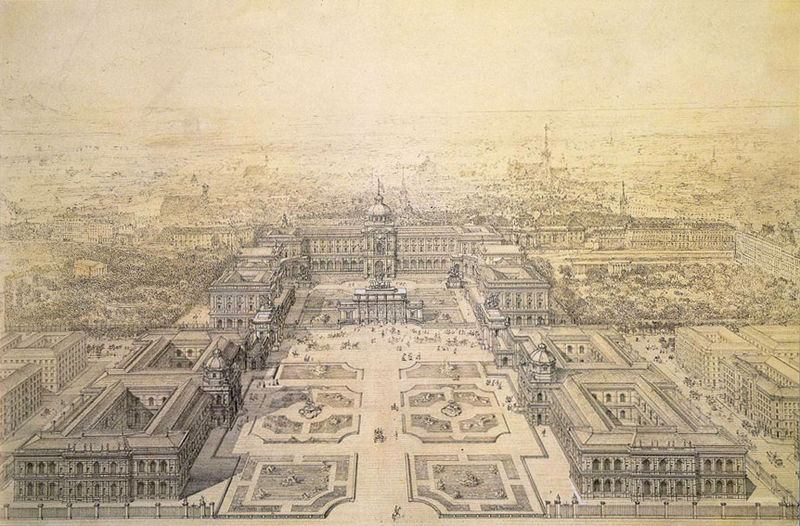
Gottfried Semper: Kaiserforum, Wien
Harikeśa Swami Viṣṇupāda: Varṇaśrama Manifesto for Social Sanity
The Bhaktivedanta Book Trust, 1981
Back Cover:
 A treasure for those seriously pondering the destiny of the world, this manifesto persuasively argues that the day of the materially based nation-state is over. Challenging the economic and political goals most of us tacitly accept, the author uncovers a massive yet hidden flaw in the foundation of modern social systems and offers a new blue-print for the restructuring of human society.
Preface by Jay A. Matsya, editor:
The increasing social chaos, economic decay and military confrontation throughout the world should not receive the full measure of our resentment and scorn. We all desire that our national and international environments yield as much happiness, comfort, and serenity as possible. Times of upheaval and testing, however, do have their value. An ancient Indian pundit once commented that a truly intelligent person should know how to extract nectar from a stock of poison, perceive a rare jewel amid a pile of garbage, and acquire wisdom from a low-class but qualified teacher. At first glance, perilous epochs in history seem to offer participants nothing beyond hardship, suffering, and despair. But one should not fail to note that during adverse years, when the human grasp on reality shakes, the world’s thinkers are sometimes moved to exert their intellects with a special profundity.
Whether man is heading in the right direction or completely off course is a question phrased earnestly in the sea of troubles, not on Easy Street. Hence, the present world climate of materialistic unrest and failure holds great import for sage thinkers. Now the impetus is generously available for intense re-evaluation of the foundation and structure of human society. Distressing circumstances mercifully press us to take a more careful look at ourselves and our civilization. Thus, humanity may inch closer to clues of lasting social prosperity and peace.
After ten years of rigorous thought, supplemented with extensive travels on each continent, the author decided – hesitantly, he admits – that at last he was ready to write this book and that human society might be ready to receive it. The Varṇaśrama Manifesto for Social Sanity presents sociological, political and economic perspectives and information never before considered by modern man. Its unique proposals derive from a reservoir of knowledge most learned persons have yet to tap. I hope troubled mankind will take advantage.
 Olle Bengtsson