
Den framväxande historicismen
Moral-sense-filosofin motbalanserade i viss mån den radikala upplysningens rationalistiska och mekanistiska materialism, och den anglo-franska upplysningskulturen, befrämjad och befäst också av den ekonomiska och administrativa utvecklingen, uppvisar därför i viss mån en komplex och bild. Dess huvuddrag sammanfattas emellertid av Taylor på ett sätt som klargör dess i väsentliga avseenden entydiga konsekvenser ifråga om individualitetens och subjektivitetens betydelse:
“It is a culture which is individualist in…three senses…: it prizes autonomy; it gives an important place to self-exploration, in particular of feeling; and its visions of the good life generally involve personal commitment. As a consequence, in its political language, it formulates the immunities due people in terms of subjective rights. Because of its egalitarian bent, it conceives these rights as universal.” [Sources of the Self, 305.]
Denna sammanfattning tydliggör individualitetens betydelse under upplysningen utan att beakta den roll det framväxande historiemedvetandet brukar anses spela redan under denna tid. Tidigare historiska epokers lärde i väst var i vissa centrala avseenden på ett självklart sätt mer historiemedvetna än den tid vi nu behandlar, dels p.g.a. allmän traditionalism och vilja till upprätthållande eller nyuppväckande och förnyelse (och här gäller detsamma för andra högkulturer), dels eftersom den distinkta tidiga differentieringsprocessen under antiken resulterade just i en på vissa sätt ny medvetenhet om historien. Vad det handlar om är snarare dels en gradvis vidgad omfattning av de historiska kunskaperna, dels en ny typ av filosofisk medvetenhet om och konceptualicering av historicitetens implikationer eller möjliga sådana, i hög grad utvecklad som reaktion mot den nya typ av ohistorisk generalism som representerades av den moderna rationalismen och naturvetenskapen eller naturfilosofin. I sådana avseenden kan man förvisso tala om en distinkt modern historicism. [Om historietänkandets och historieskrivningens förändringar, exempelvis Leonard Krieger, Time’s Reasons: Philosophies of History Old and New (1989).]
Weintraub betonar hursomhelst i sitt kapitel om Vico och Gibbon till skillnad från Taylor hur den uniforma rationaliteten, naturrätten och vetenskapen tidigt utmanades av den framväxande historicismen. När han hävdar att “The self-conception we call individuality came into prominence as a by-product of a profound change in Western man’s historical outlook”, är väl detta emellertid kanske ett uttryck för den motsatta, alltför ensidiga tolkningen. [The Value of the Individual, 261.]
Men efter att ha sammanfattat de huvudsakliga faktorer som ligger bakom utvecklingen av det nya historiemedvetandet gör Weintraub några viktiga distinktioner rörande olika sätt att uppfatta historien under 1700-talet. Man kunde å ena sidan se kulturens utveckling som en utveckling i betydelsen en gradvis manifestation av “a preformed destiny or nature”, lägga vikten huvudsakligen vid “causation within the historical actor”, vid “something…like Shaftesbury’s ‘inner form’, a spiritual power that gives shape to matter”, vid det historiskt närvarande som “an imperfect expression of the ideal nature toward which it is moving, and thus only a step on the road to indefinite perfectibility or even perfection.” Å andra sidan kunde man se historien som en oförutsägbar process av skilda yttre faktorers – bland dem exempelvis geografins – kontingenta interaktion, där varje epok äger ett värde sui generis och helt enkelt avlöses av nästa i en den blotta, ännu icke av framsteget präglade olikhetens seriellt manifesterade mångfald. [Ibid. 262 f.] Weintraub vill hävda att den framväxande rikare uppfattningen av historien i viss mån var en frukt av att dessa olika synsätt kunde förenas.
Och en av frukterna av denna nya syn var “our self-conception as individualities”: “The emergence of individuality…depended on the gradual fusion of two ideas: the idea of genuine historical development and the idea of individuality as a value.” [Ibid. 263.] Den sistnämnda meningen leder över till den typ av formuleringar där ensidigheten väl övervunnits och historiemedvetandet och individualitetsvärderingen ses som parallella, men som samtidigt blivit oklara och tenderande mot det tautologiska: “Our modern sense of history and of individuality grew from the fusion of an emergent genetic sense and a growing concern for singularity.” [Ibid. 332.] Weintraub tillstår emellertid att individualitetsvärderingen och historiemedvetandet länge kunnat parallellt samexistera utan att förenas. Redan med Montaigne var, som han själv konstaterar, individualitetsvärderingen åtminstone i någon mån utvecklad utan att vara kopplad till historiemedvetandet, liksom historiemedvetandet hos Vico och Gibbon är förhanden utan att vara förenat med en hög värdering av individualiteten. [Ibid.]
Vico framhöll den historiska kunskapen som överlägsen den naturvetenskapliga, men sökte inte ställa den i motsats till filosofin: hans strävan var att förena den historiska kunskapen, och den historiska kunskapen om det individuella, med filosofins kunskap uppfattad som kunskapen om det universella. Men som Weintraub framhåller tenderade han även i sin historiefilosofi att slutligen framhäva det allmännas primat framför det individuella i det han i sin historiska morfologi alltmer betonade utvecklingens allmänna mönster. [Ibid. 291; ett senare verk som behandlar Vicos självbiografi är Donald Phillip Verene, The New Art of Autobiography: An Essay on the ‘Life of Giambattista Vico Written by Himself’ (1991).]
I empirismen och dess kritik av cartesianismens medfödda idéer och ohistoriska uppbyggnad av rationell kunskap låg implicit uppfattningen att kunskapens växt krävde processer i tiden, och det är denna förståelse som av Condorcet teoretiskt utvecklas till en explicit framstegsfilosofi. Även för Voltaire var det historiska perspektivet oundgängligt för belysningen av nuets (miss)förhållanden, och “[t]he past could be explained only by telling its story”. [Weintraub, 292] Men medvetandet om och uppskattningen av den komplexa mångfald verkligheten uppvisade var dock i den franska upplysningen alltfort starkt begränsat av generalistiska tendenser, av sökandet efter de uniforma lagarna, de fasta mönstren på skilda områden: i den rationella naturrättens form, i sökandet efter det perfekta samhällets tidlösa modell, i den kvardröjande, med upplysningens tankegods alltmer utspädda klassicismen.
Därför var det i stället i det splittrade Tyskland och delvis i England som medvetandet om den historiska mångfalden och individualitetsmedvetandet först bragtes till mogen syntes. [Hur detta förbereds redan under den tyska upplysningen undersöks av Peter H. Reill i The German Enlightenment and the Rise of Historicism (1975).] Det historiska medvetandet, de genetiska förklaringarna, förståelsen av livet, såväl det andliga som det materiella, som process, rörelse och förändring, stod inte minst i Tyskland också i sammanhang med det framväxande nyhumanistiska bildningstänkandet. Ty hela detta betraktelsesätt var ju tillämpbart icke blott på samhället och kulturen utan också på den mänskliga individen, på personligheten och dess egenskaper och karaktär.
Den radikala, deismen förnekande, rent materialistiska upplysningens förflackade reduktion till “kroppspersonlighetens” plan, och i synnerhet i den mån detta plan förstods i mekanistiska termer, motsades emellertid också i Frankrike, nämligen av Rousseau, som gav avgörande impulser till den utveckling som skulle fullbordas i den efterföljande epokens tyska filosofi.
The Temple of Vespasian
Da Free John: Scientific Proof of the Existence of God Will Soon Be Announced by the White House!
Prophetic Wisdom about the Myths and Idols of mass culture and popular religious cultism, the new priesthood of scientific and political materialism, and the secrets of Enlightenment hidden in the body of Man
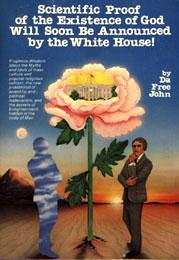
The Dawn Horse Press, 1980
Blurbs on the Back Cover:
This is a mighty book of insight… a penetrating, comprehensive critique of popular cults and mass culture. This book does two things absolutely critical for the survival of Man. First, it exposes the fundamental flaws of organized religion, science, and politics. Second, it gives clear indications for establishing a culture based on wisdom and love. Anyone who is the least bit concerned about his or her own well-being – physical, mental, spiritual – and that of the world should consider the words of Da Free John. He teaches and is a living demonstration of the present Divine Condition and evolutionary future of the human race.
John White, author, Pole Shift, and editor, The Highest State of Consciousness
If you read no other book in your lifetime, read this beautiful, profound, disturbing, and hopeful book.
Worth Summers, Ph.D., Professor of Sociology, California State University
The function of a great educational work is to lead thereader into a new awareness. The function of a great spiritual writing is to jolt and insipire the reader into a new state of Being. This book is both. No one can really read it without being changed in the process. It is like a rapid-fire succession of electric shocks, each carrying the message: Wake up!…A powerfully effective “de-hypnitizer”…that will not let you rest until you see clearly – and so seeing, choose to act. In modern society’s time of troubles, this is a much-needed book.
Willis Harman, President, The Institute of Noetic Sciences
If there is a man in this country today who is God-lllumined, that man is Da Free John. The proof is in this book. Here is the most ancient tradition of mankind expressed in a way that is startlingly modern. Da Free John is a force to be reckoned with.
Roy Finch, Professor of Philosophy, Hunter College, City University, New York
Da Free John’s teaching is, I believe, unsurpassed by that of any other spiritual teacher, of any period, of any place, of any time, of any persuation.
Ken Wilber, author, The Atman Project, and editor, Re-Vision Journal
In our world of political chaos and potential nuclear holocaust, there must be many men and women who are awake to the madness around us and ready to hear the voice speaking in these discourses. I pray that this book inspires them to expand in love and to become guides for the millions who are still blinded y fear and mistrust. The need for truth is urgent.
Robert Hall, M.D., Co-founder, Lomi School and the Gestalt Institute of San Francisco.
JOB’s Comment:
The main title of this book is entirely satirical, and aimed at the illusions of the “scientific worldview” (“scientific proof”), conventional and popular exoteric religion (“the existence of God”), and the materialist politics of our time (“announced by the White House”). This is one of Jones’s big books, and in its first chapters it focuses a little more on the general contemporary mass culture shaped by these forces than his other big ones, most of which, like The Enlightenment of the Whole Body, deal primarily with his spiritual teaching in itself. Its third chapter is entitled ‘Scientific Proof of the Existence of God Will Not Be Announced by the White House’.
Franklin Jones on Discipline
I think he called himself Da Avabhasa at this time (although it may still have been Da Free John). See also the essay in which I explain what I find to be his significance.
Bubba Free John: The Enlightenment of the Whole Body
A Rational and New Prophetic Revelation of the Truth of Religion, Esoteric Spirituality, and the Divine Destiny of Man

The Dawn Horse Press, 1978
Back Cover:
Since ancient times it has been acknowledged that the true Spiritual Master is a special manifestation of the Transcendental Heart or Spirit of Nature. Such individuals are born for their Work; they evolve quickly, and they generally begin instructing and transforming others while still relatively young.
Bubba Free John is such a “Heaven-Born” Teacher. Few Masters of his stature have ever appeared on the Earth, and none has ever appeared in the Western world. The Enlightenment of the Whole Body is Bubba’s Song to the All-Pervading Life and Transcendental Consciousness of God, the Divine Person, with whom Bubba is utterly and perfectly Identified, and for Whom he is a living Agent among men.
If we were to combine the most God-inspired Scriptures of Man into a single, focused, completely considered and authoritative expression, this is the kind of book that would emerge. It contains the moral and prophetic fire of the Old and New Testaments, the philosophical majesty of the greatest Hindu and Buddhist literature, and the Ecstatic Humor, or Transcendental Freedom, of the most Illumined testimonies of Divine Life that have ever appeared, in the East or the West. Bubba Free John’s confession of God-Realization is authentic poetry of Divine Transfiguration, comparable only to the Divine Utterances of Masters such as Krishna, Jesus, and Gautama.
Even so, Bubba Free John’s written and spoken Teaching is so rational and straightforward that every intelligent man and woman can benefit by it. Merely to contemplate this Revelation will bring you a radically transformed vision of life, an inspired and discriminating understanding of human religion, esoteric spiritual evolution, and the ultimate Destiny of Man. And, if you allow this Wisdom to enter your own life, you will also enjoy the Enlightened Happiness that is the Heart of all experience.
“The core of this Teaching is the Revelation that the human individual is structurally intended to be surrendered, body and mind and self, through love, into the Radiant Transcendental Consciousness or All-Pervading and Divine Current of Life. The ultimate Destiny of those who love in this manner is transcendence of both mind and body in the Divine. Our Destiny is not in Heaven or Earth, but in literal and total Sacrifice and Translation into the Transcendental Divine Radiance, Infinite Consciousness, and Absolute Personality that is the Truth and Support and Paradoxical Source of this world.” Bubba Free John
“The event of Bubba Free John is an occasion for rejoicing, for, without any doubt whatsoever, he is destined to become the first Western Avatar to appear in the history of the world. His Teaching contains the most concentrated wealth of transcendent wisdom found anywhere, I believe, in the spiritual literature of the world, modern or ancient, Eastern or Western.” Ken Wilber, author, The Spectrum of Consciousness, editor, Re-Vision Magazine
JOB’s Comment:
Richard Wilson: The Vale of Narni
Deism och pietism
Taylor vill understryka hur den värdighetskänsla, som följer med insikten i människans förmåga till rationell kontroll, hos Descartes, Locke och Kant alltid är insatt i ett allmänt teistiskt sammanhang: “The awesome powers of human reason and will are God-made and part of God’s plan; more, they are what constitutes the image of God in us.” [Sources of the Self, 315.] Men i det naturens ordning eller plan nu är “self-subsistent”, och i det vi äger direkt tillgång till dess principer i vårt eget inre, såväl i vårt tänkande som i våra känslor och instinkter, kan ur denna idéutveckling också med tiden lösgöras en icke-teistisk moral, en “independent ethic, in which nature itself will become the prime moral source, without its Author”. [Ibid.]
Taylor räknar alltså med en deism som bygger på känslan, kompletterande den ensidiga lockeska, rationalistiska deismen. Gränsen mellan känslodeism och den pietism som vi redan skönjt konturerna av och som ofta betraktas som en reaktion mot den rationalistiska upplysningsdeismen, blir då delvis oklar. Lindbom ser sambandet, och tolkar det i termer av sin allmänna analys av rationalismens och sentimentalismens ömsesidiga beroende och oskiljaktiga samhörighet (en analys som alltså i hög grad överensstämmer med Babbitts, fastän den är företagen från andra utgångspunkter).
Vad Martin Lamm kallade “upplysningstidens romantik”, såväl i dess känslomässiga som i dess irrationalistisk-mystika former, åtföljer i själva verket med inre nödvändighet den sekulära rationalismen. Sekulariseringen, den moderna vetenskapens etablerande av ett profant, självmedvetet subjekt, motställt en separativ objektiv tingvärld vars mekaniska lagbundenheter tillhandahåller de enda kvarvarande sammanhållande banden av generalitet och enhet, den pseudoobjektivism som i själva verket är den subjektivism som Lindbom stundom också benämner “en idealism”, [Så i Jakobs dröm (1978), 169.] har som sin “logiska följd…flykten in i deismen”.
Med Occam, ja i vissa avseenden redan med Thomas, är Gud skjuten i bakgrunden, och Descartes fullbordar verket genom att överföra hans frihet, kunskap och makt till människan: “Gud är därmed inte ‘avskaffad’, men människan har intagit en position, från vilken hon tror sig kunna behärska tillvaron därför att hon tror sig känna dess lagar. Därmed är vägen öppen för deismen: Gud är inte längre världarnas herre. Han har dragit sig tillbaka i sin himmel, osynlig och passiv.” [Ibid. 168.] När det intellektiva ljuset lyser med allt svagare sken, förkunnar deisterna att Gud inte längre deltager i sitt verk – och därmed börjar han framstå som “okänd”, hans närvaro och ingripande blir alltmer obegripligt. [Agnarna och vetet (1974), 88 f.] Med deismen har Gud “fällt ned en ridå mellan Sig och det skapade verket”, han endast “passivt betraktar sitt verk och överlåter verkets ‘fullkomnande’ åt människan”. Nåden, barmhärtigheten, domens dag och livet efter detta är därmed intet mer än “fåfängligt tal”. [Mellan himmel och jord (1970), 110.]
Den “underström av sentimentalisering” som ledsagar sekulariseringen innebär för religionens del att “inte minst den folkliga fromheten” i pietismen och kvietismen “får en tillflykt undan deism och förkvävande rationalism”: “Gudsgemenskapen förläggs till ‘det inre’, en innerlighet, som skulle vara en rik grund för förnyelse, om människans inre varit berett att förvalta det, som gör att hjärtats öga skådar den gudomliga Sanningen och gör himmelriket till en inre verklighet.” Men alltfort åsidosättande personalismens distinkta dimension måste Lindbom måste ånyo stanna blott vid den slutdom över denna moderitetens strömning som tar fasta på dess oförmåga att återerövra den monistiska intellektivitetens bevetenhet: “kvietismen förmår ej lyfta det andliga livet upp ur den sentimentalitet, som är förnuftsdyrkans oskiljaktiga följeslagare”. [Jakobs dröm, 170.]
Anna Netrebko: Quando me’n vo’
St Petersburg, 2005
Edmund Husserl

 Olle Bengtsson