1880
1880
 The Quest of the Overself shows Western readers how to achieve serenity of mind, control of thought and desire, and the power to use higher forces by means of simple exercises. These include breathing and visualization as well as mental control through meditation. These ideas, which the author gained by extensive travel in India, are as relevant to us today as they were when first published in 1937. Paul Brunton was a British philosopher, mystic and traveller. He left a successful journalistic career to live among yogis and holy men and studied a wide variety of Eastern and Western esoteric traditions. As he explains in the still fresh and fascinating The Quest of the Overself meditation and the inward quest are by no means exclusively for monks and hermits but also support those living everyday, active lives in the West.
“…a great gift to us Westerners who are seeking the spiritual.” Charles T. Tart
“A person of rare intelligence…thoroughly alive, and whole in the most significant, ‘holy’ sense of the word.” Yoga Journal
“Paul Brunton was a great original and got to a place of personal evolution that illumines the pathways of a future humanity.” Jean Houston
“A simple, straightforward guide to how philosophical insights of the East and West can help create beauty, joy, and meaning in our lives…His keynote is balance, and his uplifting message encompasses all phases of human experience.” East West Journal
“…sensible and compelling. His work can stand beside that of such East-West bridges as Merton, Huxley, Suzuki, Watts and Radhakrishnan. It should appeal to anyone concerned personally and academically with issues of spirituality.” Choice
“Any serious man or woman in search of spiritual ideas will find a surprising challenge and an authentic source of inspiration and intellectual nourishment in the writings of Paul Brunton.” Jacob Needleman
About the Author (from the same Rider edition):
Born in London in 1898, Paul Brunton published thirteen books between 1935 and 1952. He is generally recognized as having introduced yoga and meditation to the West, and for presenting their philosophical background in non-technical language. He died in Switzerland (where he lived for 20 years) in 1981.
JOB’s Comment:
See my earlier Brunton posts, in the References and Spirituality categories.
Leibniz’ överensstämmer med Locke i betonandet av att personligt ansvar förutsätter den självmedvetna identifikationen med förflutna handlingar. [Ayers, 266, inkl. not 85.] Odödligheten består för Leibniz inte endast i monadens “perpetuella subsistens”, utan också i det självmedvetna minnet av dess förflutna tillstånd.
Skillnaden mellan moralisk och rent ontologisk betydelse är emellertid hos Leibniz minimal. Själsmonaderna minns sina tidigare föreningar med “kropps”-monader, och endast själsmonaderna gör det – eller monaderna minns endast som utvecklade till den själsliga bevetenhetsnivån. Inte heller hos Leibniz är det fråga om ett rent moraliskt personbegrepp. Till skillnad från Lockes är det, om än på originellt sätt, ontologiskt i en strikt substantiell mening, men det bygger samtidigt, med den komplexitet vi vid det här laget vant oss vid, på en viss kombination av själs- och “kropps”-monader.
Klart är emellertid som vi sett att, och varför, vi lika litet som hos Descartes, samtidigt trots och på grund av den långt mer utvecklade individualismen hos Leibniz finner någon intersubjektivitet eller någon ömsesidighetsaspekt i personförståelsen. Vi har sett hur relation för Leibniz ingalunda betyder reciprocitet. Varje monad är sluten i sig och sin specifika förnimmelse av och “uppgift” i helheten, en värld i sig som, som logiskt subjekt, rymmer alla sina predikat och som kraftbesittande form också hela sin framtid latent och potentiellt i sitt nu. Emedan monaderna är fönster- och, som det också heter, dörrlösa bestäms deras perceptionsrelationer och deras fenomenella förändringar endast av Guds prestabilerade harmoni.
Med läran om monadernas utveckling vill Leibniz förena den fenomenella mekaniska kausaliteten med den teleologi som följer av att det preetablerade helhetliga systemet genom Guds, den högsta monadens, intelligens och vilja är harmoniskt orienterat mot ett gemensamt mål, förverkligandet av moralens och nådens sfär i den “fysiska naturens”, eller en harmoni mellan dessa båda sfärer. Med sitt förnyande av de äldre, av den kristna skolastiken övertagna temata rörande entelekins och teleologins roll vill Leibniz motverka några av de typiska nytida uppfattningarna om radikalt självskapande och självbestämmande, i synnerhet som de kom till uttryck hos Locke: självet äger för Leibniz ett givet innehåll, ehuru dettas karaktär förblir oviss och sättet att beskriva och närma sig det skiljer sig avsevärt från Augustinus’.
Men viktigt är också att vi som historiefilosofi i dessa hans läror finner en Leibniz’ variant av den kristna eskatologin. Vi har sett kristendomens, och inte minst den kristna eskatologins, betydelse för överförandet av personbegreppet från själs- till kroppsplanet. Hos Leibniz bevittnar vi den märkliga process genom vilken denna specifikt kristna, eskatologiska, immanentistiska monisms uppfattning om kroppspersonligheten genom ett nytt spekulativt drag i ett slag berövas sin materialitet och åter rör sig mot själspersonalism, i det hela verkligheten ytterst, i sig, förklaras vara andlig.
Men själspersonalism är likafullt här en mindre meningsfull beteckning, emedan själva dualiteten på nytt sätt upphävts. Kvar står en ny dualitet mellan monadens fenomenella självmedvetande och fenomenella värld, inklusive dess kropp och den personlighet som tillsammans med de denna uppbyggande monaderna uppkommer, å ena sidan, och dess icke-fenomenella tillstånd som monadiskt jag å den andra.
Det är inte osannolikt att vi här står inför en huvudsaklig orsak till försvinnandet bortom den nytida filosofins horisont av de frågor som – ibland – skilde en Origenes från den kristna ortodoxin i frågorna om själens eller den uppståndna kroppens eviga liv och om ny skapelse eller skapelsens cykliska återtagande. Den monumentala oklarhet som präglar all efterföljande åtminstone tysk filosofi i dessa även för personförståelsen avgörande frågor, och den bekymmerslöshet med vilken man synes godtaga denna oklarhet som självklar, måste kanske till ganska stor del förstås som möjliggjord av att själva frågornas borttrollande genom Leibniz’ manövrer på det hela taget invändningsfritt accepterades.
Reflections on the United States of Amnesia
Nation Books, 2004 Amazon.com
Book Description:
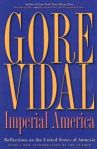 Following the publication of Perpetual War for Perpetual Peace and Dreaming War comes award-winning Gore Vidal’s long-awaited conclusion to his landmark, best-selling trilogy. Now, Vidal has written his most devastating exploration of Imperial America to date. “Not since the 1846 attack on Mexico in order to seize California,” Vidal writes, “has an American government been so nakedly predatory”. Bush’s apparent invincibility, and what he might or might not know – especially about those new “black box” voting machines being installed all over the country – is one of the central themes of “State of the Union 2004,” a magnificent and witty Olympian survey of American Empire, where the war on terror is judged as nonsensical as the “war on dandruff,” where America is an “Enron-Pentagon prison,” a land of ballooning budget deficits thanks to the growth of a garrison state, tax cuts for the privileged, and the creeping totalitarianism of the Ashcroft justice department. Collected in this volume are Vidal’s earlier State of the Union addresses, a tradition inaugurated on the David Susskind show in the early seventies as a counterpoint to “whoever happened to be president.”
Book Description (second edition):
Blood for Oil and the Cheney-Bush Junta
Nation Books, 2002 Amazon.com
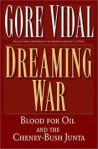 When Gore Vidal’s recent New York Times bestseller Perpetual War for Perpetual Peace was published, the Los Angeles Times described Vidal as the last defender of the American republic. In Dreaming War, Vidal continues this defense by confronting the Cheney-Bush junta head on in a series of devastating essays that demolish the lies American Empire lives by, unveiling a counter-history that traces the origins of America’s current imperial ambitions to the experience of World War Two and the post-war Truman doctrine. And now, with the Cheney-Bush leading us into permanent war, Vidal asks whose interests are served by this doctrine of pre-emptive war? Was Afghanistan turned to rubble to avenge the 3,000 slaughtered on September 11? Or was “the unlovely Osama chosen on aesthetic grounds to be the frightening logo for our long contemplated invasion and conquest of Afghanistan?” After all he was abruptly replaced with Saddam Hussein once the Taliban were overthrown. And while “evidence” is now being invented to connect Saddam with 9/11, the current administration are not helped by “stories in the U.S. press about the vast oil wealth of Iraq which must- for the sake of the free world – be reassigned to U.S. consortiums.”
2009

Bill Kauffman, ‘The Last Republican’ (2008 review of Selected Essays of Gore Vidal)
Brian Doherty, ‘Goodbye to Gore Vidal, America’s Biographer and Champion’
Edit, August 3:
Justin Raimondo, ‘Patriotic Gore’ (2004 review of Inventing a Nation: Washington, Adams, Jefferson)
Michael Lind, ‘Gore Vidal: The Virgil of American Populism’
Cf. my post ‘Till frågan om populismen‘ (in Swedish)
How We Got to Be So Hated
Nation Books, 2002 Amazon.com
Book Description:
 The United States has been engaged in what the great historian Charles A. Beard called “perpetual war for perpetual peace.” The Federation of American Scientists has cataloged nearly 200 military incursions since 1945 in which the United States has been the aggressor. In a series of penetrating and alarming essays, whose centerpiece is a commentary on the events of September 11, 2001 (deemed too controversial to publish in this country until now) Gore Vidal challenges the comforting consensus following September 11th and goes back and draws connections to Timothy McVeigh’s bombing of the federal building in Oklahoma City. He asks were these simply the acts of “evil-doers”?
“Gore Vidal is the master essayist of our age.” Washington Post
“Our greatest living man of letters.” Boston Globe
“Vidal’s imagination of American politics is so powerful as to compel awe.” Harold Bloom, The New York Review of Books
Reviews:
“Vidal writes with verve, passion and style that complements [his] controversial views.” Walter Russell Mead, Foreign Affairs, Sept/Oct 2002
“[Vidal] provides plenty of examples to sustain his shimmering abhorrence for current American politics…Challenging as ever.” Kirkus Reviews, March 15, 2002

 Olle Bengtsson