Michael Henkel: Eric Voegelin zur Einführung

Junius Verlag, 1998

Kurzbeschreibung:

Das Werk des deutsch-amerikanischen Politikwissenschaftlers, Philosophen und Theologen Eric Voegelin (1901-1985) erfährt hierzulande seit einigen Jahren verstärkte Aufmerksamkeit. Im Zentrum des OEurvres steht eine Theorie der Ordning von Mensch, Gesellschaft und Geschichte. Die Ordnungstheorie bildet den Hintergrund u.a. für Voegelins Ideologiekritik, sein Konzept der politischen Moderne, seine Grundlegung einer neuen philosophischen Wissenschaft der Politik sowie die damit verbundene Wissenschaftstheorie.

Die vorliegende Einführung von Michael Henkel macht die zentralen Argumentationslinien des Werkes transparent, undem sie seine Entwicklung und systematischen Zusammenhänge nachzeichnet.

Über den Autor:

Michael Henkel ist Privatdozent am Institut für Politikwissenschaft der Universität Leipzig.

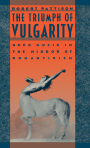
Robert Pattison: The Triumph of Vulgarity

Rock Music in the Mirror of Romanticism

Oxford University Press, 1987     Amazon.com

Flaps:

The Triumph of Vulgarity in a thinker’s guide to rock ‘n’ roll. Rock music mirrors the tradition of nineteenth-century Romanticism, Robert Pattison says. Whitman’s “barbaric yawp” can still be heard in the punk rock of the Ramones, and the spirit that inspired Poe’s Eureka lives on in the lyrics of Talking Heads.
Rock is vulgar, Pattison notes, and vulgarity is something that high culture has long despised but rarely bothered to define. This book is the first effort since John Ruskin and Aldous Huxley to describe in depth what vulgarity is, and how, with the help of ideas inherent in Romanticism, it has slipped the constraints imposed on it by refined culture and established its own loud arts.
The book disassembles the various myths of rock: its roots in black and folk music; the primacy it accords to feeling and self; the sexual omnipotence of rock stars; the satanic predilictions of rock fans; and rock’s high-voltage image of the modern Prometheus wielding an electric guitar. Pattison treats these myths as vulgar counterparts of their originals in refined Romantic art and offers a description and justification of rock’s central place in the social and aesthetic structure of modern culture. At a time when rock lyrics have provoked parental outrage and senatorial hearings, The Triumph of Vulgarity is required reading for anyone interested in where rock comes from and how it works.
Reviews:
“This is the most brilliant study yet written of the modern phenomenon of rock music.” – National Review

“An articulate elucidation of rock ‘n’ roll as the heir apparent to 19th-century romantic pantheism…Makes a convincing case for rock as the central aesthetic manifestation of our culture…Pattison writes amusingly and his rock ‘n’ roll fever is infectious.” – Kirkus Review

“A provocative, opinionated study about the origins of rock and about rock as an idea.” – Library Journal

About the Author:

Robert Pattison is Professor of English at Long Island University. Among his other books are On Literacy, Tennyson and Tradition, and The Great Dissent.

JOB’s Comment:

Yes, this is by far the best book on rock music, and a good book on romanticism too. Pattison makes reference to Babbitt’s Rousseau and Romanticism and seems strongly influenced by his analysis, although he does not share his assessment. He should have shared more of his assessment.

Idealism under medeltiden

Pseudo-Dionysios var av stor betydelse för den platonismens fortlevnad i dess mest esoteriska form under medeltiden, och genom distinktionen mellan apofaticism och katafaticism som är viktig både för den mer allmänna idealismtematiken här och i viss mån, som jag framhållit på annat håll, för personalismen. Ett nyare verk med filosofisk tonvikt är här Eric D. Perls Theophany: The Neoplatonic Philosophy of Dionysius the Areopagite från 2007.

Ytterligare en tänkare som representerar en från den teologiska ortodoxin i hög grad självständig form av idealism är Scotus Eriugena. Det finns ett grundligt arbete av Dermot Moran, The Philosophy of John Scottus Eriugena: A Study of Idealism in the Middle Ages från 1989, som inte bara såvitt jag förstår mer exakt än tidigare går igenom hans förbindelser med den klassiska idealismen, utan även och framför allt visar hur han föregriper den moderna subjektstematiken och även andra aspekter av den mer specifikt moderna idealismen på ett sätt som är relevant även för en del av det jag tog upp i samband med mysticismen.

Vi har betonat idealismens fortlevnad, men också hur den förändrades i den syntes med de bibliska lärorna som kom att bli den kristna teologin (i den judiska fortsatte denna utveckling i mindre utsträckning, eftersom man i den framväxande rabbinska och talmudistiska huvudriktningen snart vände sig mot den filonska, alexandrinska syntes och allmänna hellenisering som under den första delen av den romerska kejsartiden var på god väg att universalisera även judendomen.

Mycket viktig är förstås under medeltiden också idealismens fortsättning i alla dess huvudformer inom islam, där förutsättningarna för dess kontinuitet länge var betydligt bättre än i västerlandet. Detsamma gäller om mystikens utveckling.

Twitter

Jag har bara twittrat en gång. I det twittrandet frågade jag mig vad jag skulle twittra om, vad jag skulle använda Twitter till. Jag har ännu inte riktigt kommit på något bra svar på denna fråga.

Jag måste säga att jag tycker Twitter ger ett intryck som är precis lika ytligt och oseriöst som namnet låter. Det är svårt för mig att förstå hur inte minst journalister men även politiker plötsligt kunnat ägna sig i sådan ofattbar omfattning åt detta.

Facebook var bra med de funktioner det hade i början, enligt vad jag skriver på min Facebook-sida här i bloggen. Men Twitter saknar väl allt detta? För mig ser det ut att vara Facebook reducerat till status updates, och av kortaste slag.

Finns det inte något löjligt i att avsätta så mycket tid till att följa och skriva alla dessa ofta ogenomtänkta, triviala och föga briljanta oneliners? Det framstår som ett tyckarnas fåfänga spciala spel av inte sällan ängsliga signaler och markeringar, som ersätter eftertanke och fördjupad skriftlig framställning och kommunikation.

Men det är lätt att förhastat döma ut ny teknologi av detta slag. Jag kan ha missat någon vetting användning. Därför har jag lagt in Twitter-länkar under mina poster, och en länk i högerkolumnen till mitt Twitter-konto med den hittills enda enradingen.

Daniel Boëthius

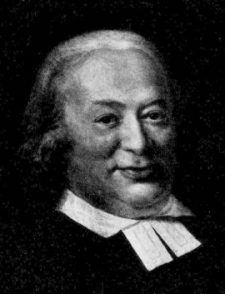
BoëthiusBoëthius, Daniel, svensk filosof, f. 1751 i Västerås, student 1765 i Uppsala och 1773 fil. magister därstädes, 1775 docent i teor. filosofi och från 1783 till sin död 1810 professor i praktisk filosofi.

B. omfattade ursprungligen Lockes filosofi men blev efter bekantskapen med Kants kritiska arbeten dennes ivrige anhängare. Någon slavisk eftersägare var han likväl ej utan sökte – delvis under inflytande från Fichte – utbilda kantianismen i självständig riktning. Sin största betydelse äger han därigenom, att han först gjort Kants läror bekanta i Sverige och därmed verksamt influerat främst på Höijer men även på Grubbe och Biberg. I likhet med dessa bör han alltså räknas till dem, som utbildat den svenska personlighetsfilosofien.

B:s egna undersökningar äro huvudsakligen riktade på den praktiska filosofiens grundproblem. Även här utgick han från Kant men sökte i likhet med Fichte bringa den praktiska filosofien i närmare gemenskap med den teoretiska än Kant. Medan för Kant religionen är helt och hållet grundad på sedligheten, söker B. påvisa, att det tvärtom är denna, som måste grundas på religionen, i det att den sedliga viljan måste tänkas som det gudomligas inneboende i människan. I dessa tankegångar framträder han som föregångare till Biberg, Grubbe och Boström.

Bland B:s utgivna skrifter märkas: Utkast till föreläsningar i den naturliga sedeläran (1782), Om den filosofiska undervisningens ordnande (1794), Om moralitetens grund (en replik till Leopold med anledning av dennes kritik av den kantska etiken), Anvisning till sedeläran såsom vetenskap (1807).

B. översatte även Kants ‘Grundlegung zur Metaphysik der Sitten’ till svenska.

Alf Ahlberg i Filosofiskt lexikon (1925)

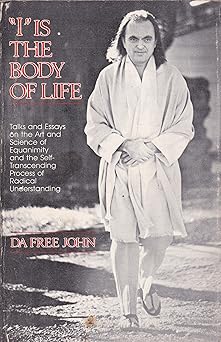
Da Free John: “I” is the Body of Life

Talks and Essays on the Art and Science of Equanimity and the Self-Transcending Process of Radical Understanding

Dawn Horse Press, 1981

Amazon.com

Publisher’s Presentation:

Consider the “I” and understand. “I” is Narcissus, the self-contraction, or the avoidance of relationship. “I” does not know what anything is. “I” is not an observer that is utterly separate from anything. “I” is, therefore, incapable of ultimate knowledge. “I” is the body. “I” is the context of ordinary association with phenomena. “I” is itself part of the total world of phenomena. “I” is the activity of contraction, separation, and independence. “I” is the effort to be different from and immune to the limitations of phenomenal existence. “I” seeks independent self-satisfaction via forms of knowledge and experience. “I” cannot be satisfied, fulfilled, or released. “I” is itself and inherently a problem. “I” is an inappropriate and futile action in relation to the conditions of phenomenal existence. There is no ultimate option except to understand the “I.” Such understanding, made operative in the context of every moment of phenomenal existence, is free of the dilemma or inherent problem of Narcissus, or the futile effort of “I” to achieve independence, immunity, ultimate satisfaction, perfect fulfillment, complete knowledge, total experience, or permanent release. In every moment the “I” is understood and directly transcended, the body is released from the illusion, the problem, and the activity of “I.” Therefore, in every moment of active understanding, the independent “I” dissolves – by becoming identical to the body. Apart from present understanding, “I” is not transcended, and the bodily Realization of the Radiant Spiritual Divine is impossible. Apart from understanding, the “I” is the basis of all knowledge and experience. Understanding is the Wisdom of the seventh or free stage of life. Therefore, consider the “I” and understand.

JOB’s Comment:

The titles of Jones’s books are not always easy to understand in themselves, without familiarity with his teaching. Some are hard to understand even with such familiarity.

Paul Brunton: Practices for the Quest/Relax and Retreat

The Notebooks of Paul Brunton

Volume Three

Larson, 1986

Amazon.com

Back Cover:

Intellectual definitions of transcendental states merely leave us in the dark. We must practice walking on the divine path, and not merely talk about it, if we would know what these states really are.

The world clamours for attention and participation. God alone is silent, undemanding, and unaggressive.

– Paul Brunton

The third volume of The Notebooks of Paul Brunton is of immediate practical use.

Part 1, Practices for the Quest, goes directly to the heart of exercises, techniques, and mental attitudes useful at various stages of spiritual self-discovery and self-development. It explains what qualities must be developed, why they must be developed, how they can be developed, and how their development will be tested and proved by life itself.

Part 2, Relax and Retreat, lays the cornerstone for amodern life of inspired sanity. It offers simple, effective and viable antidotes for the tensions produced by excessive outer activity and over-attachment to the personal ego.

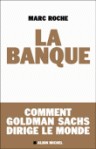
Marc Roche: La Banque

Comment Goldman Sachs dirige le monde

Albin Michel, 2010     Amazon.fr

Prix du livre d’économie 2010

Présentation de l’éditeur:

Une nouvelle puissance a surgi sur la scène mondiale. C’est celle d’une banque privée ultrasecrète.
Créé en 1869 cet établissement s’est longtemps contenté d’exercer son métier de banque d’affaires, avant de spéculer sur tous les marchés (boursiers, matières premières, or, produits dérivés…).

Depuis une dizaine d’années ses dirigeants ont pénétré les cercles les plus fermés de Washington. Et le krach de septembre 2008 est arrivé, faisant disparaître leur principal concurrent, Lehman Brothers. La “maison Goldman” est alors devenue à ce jour la banque la plus prospère de l’histoire.

Conseiller des Etats on l’a vu récemment avec la Grèce mais il y a d’autres pays concernés recruteur du staff du président des Etats-Unis Bush hier, Obama aujourd’hui , interlocuteur des grandes organisations internationales et du FMI, Goldman Sachs est au centre d’une gigantesque toile d’araignée. Aujourd’hui mise en cause pour avoir trahi ses clients, la banque reste une puissance, une pieuvre tentaculaire disent ses détracteurs.

Pour la première fois cette passionnante enquête livre un récit riche d’anecdotes sur les rapports de force entre le capitalisme et les gouvernements du monde entier et dresse le portrait de ses redoutables dirigeants, et notamment celui de son président, Lloyd Blankfein.

2ème édition, Points, 2011:

Le culte du secret : voilà ce qui fait la force de Goldman Sachs, la Banque d’affaires la plus puissante du monde. Journaliste à Londres, l’auteur met au grand jour les rouages sulfureux de cet empire financier qui peut faire basculer les gouvernements. OPA brutales, spéculation à outrance, relations secrètes avec de grandes multinationales : cette enquête très documentée livre un récit riche en anecdotes sur de redoutables pratiques.

Biographie de l’auteur:

Marc Roche, 58 ans, est correspondant du Monde à Londres depuis vingt ans [et spécialiste des investigations financières]. Il est l’auteur de plusieurs ouvrages dont le dernier paru chez Albin Michel en 2009, Un ménage à trois.