The Council on Foreign Relations and the American Decline
Western Islands, 1988 Amazon.com
Back Cover:
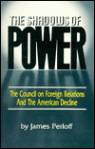 Does America have a hidden oligarchy?
Is U.S. foreign policy run by a closed shop?
What is the Council on Foreign Relations?
It began in 1921 as a front organization for J.P. Morgan and Company. By World War II it had acquired unrivaled influence on American foreign policy. Hundreds of U.S. government administrators and diplomats have been drawn from its ranks – regardless of which party has occupied the White House. But what does the Council on Foreign Relations stand for? Why do the major media avoid discussing it? What has been its impact on America’s past – and what is it planning for the future? These questions and more are answered by James Perloff in The Shadows of Power.
“An eye-opening account of a private group that has helped shift American foreign policy away from America’s best interests. Highly recommended.” David B. Funderburk, Former U.S. Ambassador to Romania
“Policies linked to the organization described in this book have helped visit a number of tragedies on the free world. There may be more forthcoming. James Perloff has cut through a litany of myths to bring out the facts. To not read this book is to live dangerously.” Philip Crane, United States Congressman
“If we want to avoid the disaster of one-world government, if we wish to preserve our priceless national sovereignty and live through all time as free men, then it is imperative that the American people read The Shadows of Power.” Meldrim Thomson, Jr., Governor of New Hampshire (1973-1979)
“There have been many books purporting to explain the ‘real’ reasons for what happened to us in Vietnam. Unfortunately, most of these have been part of the same old smokescreen from the actual architect of the war, the American Establishment. Our veterans deserve more than memorials – they deserve the truth. Here at last is a book where they can find it.” Andrew Gatsis, Brigadier General, U.S. Army (Ret.)
About the Author (p. 254):
As a student of Colby College and Boston University during the latter years of the Vietnam War, James Perloff included himself in the new generation that had gone radical left – an outlook he voiced as a school columnist and cartoonist. However, when he probed America’s power structure deeply, he was shocked to learn that he and his fellow strudents had moved in the precise direction intended by the Establishment – that unofficial ruling entity they thought they had been rebelling against. Several years of research persuaded him that the American Establishment was a far more clever organism than anyone had ever dreamed, and culminated with his writing The Shadows of Power. Mr Perloff is a contributing editor to The New American, the biweekly journal of news and opinion.
JOB’s Comment:
Like William F. Jasper’s book on the UN, this book represents a development and improvement of the JBS worldview, although to a lesser extent; some interpretations are still clearly twisted, exaggerated, or simply false, and the political philosophy that is always the point of departure, the classical liberalism plus conservative moral values, the kind of “free” society that the criticism aims to defend, are all flawed and unhistorically conceived. Still, there are partial truths and elsewhere ignored facts in the JBS’s presentations that must be taken into account. Jasper’s and Perloff’s books are updates with more such truths and facts.











 “The question of what it is to be a human person is the biggest intellectual question of our day.” Keith Ward has taught philosophy and theology in British universities for the past 40 years, and he is now weighing in on a major intellectual battle: whether human persons are purely materialistic – nothing but matter – or whether there is another, deeply valuable part of us, which transcends our bodies in nature and moral worth: the soul. For centuries philosophers have debated the question, but the battle has taken the limelight through the works of the New Atheists. In this book Professor Ward guides the reader through a panoply of thinkers and traditions, arguing that there is more to humanity than bodies. In fact, he argues, there is more to the entire universe than the naked eye perceives. (And contrary to the New Atheist assertions, there are good philosophical arguments to back this up.)

 Olle Bengtsson