
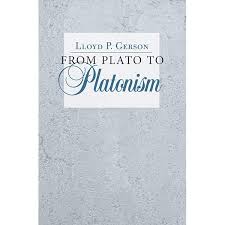
Cornell University Press, 2013
Publisher’s Description:
Was Plato a Platonist? While ancient disciples of Plato would have answered this question in the affirmative, modern scholars have generally denied that Plato’s own philosophy was in substantial agreement with that of the Platonists of succeeding centuries. In From Plato to Platonism, Lloyd P. Gerson argues that the ancients are correct in their assessment. He arrives at this conclusion in an especially ingenious manner, challenging fundamental assumptions about how Plato’s teachings have come to be understood. Through deft readings of the philosophical principles found in Plato’s dialogues and in the Platonic tradition beginning with Aristotle, he shows that Platonism, broadly conceived, is the polar opposite of naturalism and that the history of philosophy from Plato until the seventeenth century was the history of various efforts to find the most consistent and complete version of “anti-naturalism.”
Gerson contends that the philosophical position of Plato – Plato’s own Platonism, so to speak – was produced out of a matrix he calls “Ur-Platonism.” According to Gerson, Ur-Platonism is the conjunction of five “antis” that in total arrive at anti-naturalism: anti-nominalism, anti-mechanism, anti-materialism, anti-relativism, and anti-skepticism. Plato’s Platonism is an attempt to construct the most consistent and defensible positive system uniting the five “antis.” It is also the system that all later Platonists throughout Antiquity attributed to Plato when countering attacks from critics including Peripatetics, Stoics, and Sceptics.
In conclusion, Gerson shows that Late Antique philosophers such as Proclus were right in regarding Plotinus as “the great exegete of the Platonic revelation.”
Reviews:
“[T]he book is an important achievement. It is full of precious observations and suggestions. Even if someone is not fully convinced by the application of such an historical set of criteria he will find the book a highly rewarding reading.”
Péter Lautner, The International Journal of the Platonic Tradition
“Gerson’s book is a highly valuable, well-written contribution to Plato nism research. It persuasively makes a case for understanding Plato’s philosophy as a coherent system that has an intricate and meaningful relation to later Platonistic philosophical positions. From this point, Plato appears as a Platonist indeed.”
Claas Lattman, The Classical Journal
“In From Plato to Platonism, Lloyd P. Gerson formulates in a new way the basic presuppositions behind Platonism and works them out with proper attention to the Old Academy, the New Academy, and the ‘Middle’ Platonists in a way that has not been done before, as well as bringing Aristotle into the fold. This work enhances Gerson’s considerable reputation as an interpreter of the Greek philosophical tradition.”
John Dillon, Emeritus Fellow, Trinity College, author of The Heirs of Plato: A Study of the Old Academy
“This is a fascinating book – erudite yet accessible – that rejects the nineteenth-century split, widely accepted in the modern world, between a supposed originary ‘Plato’ and the subsequent history of Platonism. Lloyd P. Gerson argues persuasively, on the basis of the overall thought embedded in Plato’s dialogues and on indirect evidence from Aristotle onward, not only that Plato was a ‘Platonist’ but that Plotinus’s interpretation of Plato’s thought deserves to be taken more seriously as exegesis (as it was so understood by Proclus and others in late Antiquity).
Kevin Corrigan, Samuel Candler Dobbs Professor of Interdisciplinary Humanities and Director, the Graduate Institute of the Liberal Arts, Emory University
About the Author:
Lloyd P. Gerson is Professor of Philosophy at the University of Toronto. He is the author of many books, including Aristotle and Other Platonists, also from Cornell, and Knowing Persons: A Study in Plato, and editor of The Cambridge History of Philosophy in Late Antiquity.


