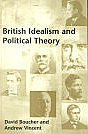
David Boucher & Andrew Vincent: British Idealism and Political Theory

Edinburgh University Press, 2000

Back Cover:

Boucher Vincent“An original project, both in its conception and execution. The authors have risen magnificently to the challenge…(they) write as acknowledged experts in the field; but while they draw on their own previous work, they extend and deepen it by asking many new questions.”  Peter Nicholson, University of York
“A first-rate contribution to contemporary scholarship on the British Idealists…What makes the book especially valuable is the attempt to relate the work of the British Idealists to concerns in contemporary political philosophy or to major figures in modern philosophy outside the Idealist movement.”  Professor William Sweet, St Francis Xavier University, Canada

British Idealism – influenced by the character of German Idealist thought at the end of the eighteenth century, developed by Kant, Fichte and Hegel – began to establish its roots during the middle of the nineteenth century and rapidly became the dominant British philosophy. It began to be challenged at the turn of the century by philosophers including Bertrand Russell and by the end of the First World War it was on the retreat, although its philosophical reverberations are still evident. Testimony to this fact is the considerable renaissance in all aspects of Idealist studies, and particularly in the works of its most recent twentieth-century exponents Michael Oakeshott and R.G. Collingwood.

This book offers an introduction to British Idealism through a study of each of the seven key thinkers – T. H. Green, Bernard Bosanquet, F. H. Bradley, Henry Jones, David Ritchie, R. G. Collingwood and Michael Oakeshott. It explores the background religious, political, moral, ideological and economic themes which underpin the work of the thinkers and shows the relevance of their philosophy – with the emphasis on social cohesiveness and the relationship between individual and collective responsibility – to current politics.

Written by two of the leading experts in the field, this is a valuable text that will introduce the theory of British Idealism to a broad range of readers.

Contents:

Introduction

1.  T. H. Green: Citizenship as Political and Metaphysical

2.  F. H. Bradley: Ethical Idealism and Hedonism

3.  Bernard Bosanquet: The Sociology of Philosophy and the Philosophy of Sociology

4.  David Ritchie: Evolution and the Limits of Rights

5.  Henry Jones: Beyond Socialism and Liberalism

6.  R. G. Collingwood: The Enemy Within and the Crisis of Civilization

7.  Michael Oakeshott: The Non-Economic Character of Civil Association

About the Authors:

David Boucher is Professor of Political Theory at Cardiff University. Andrew Vincent is Professor of Political Theory at the University of Sheffield.

Geijer, Boström och den svenska personlighetsfilosofin

En hel del återstår, tror jag, att säga om förhållandet mellan den idealistiska personalismen, eller den i sak i mycket personalistiska strömning som genom hela 1800-talet utvecklas mer eller mindre inom, och oftast som en egen variant av, den idealistiska filosofin, å ena sidan, och 1900-talets fenomenologiska personalism å den andra. I själva verket har nästan ingenting sagts om det, utöver påvisandet av vissa tematiska likheter.

Jag har brukat uttrycka det så att hos en tidig fenomenolog som Scheler, framför allt i hans tidiga huvudverk Der Formalismus in der Ethik und die formale Wertethik, återfinns ett slags fenomenologisk transposition av flera av de karaktäristiska temata i 1800-talets proto-personalism, och ställt frågan i vilken utsträckning han kan tänkas ha upptagit dessa som sådana, som förhandenvarande i den äldre traditionen utan att där ha nåtts fram till genom den nya fenomenologins distinkta metod, genom direkt kontakt med den tyska senidealismens opposition mot Hegel, exempelvis genom sin lärare Eucken.

Ursprunget till denna tematik återfinns ju också hos betydligt mer kända tänkare som Schelling och Jacobi, även om, som jag uppfattat det, inte minst Schelers senare utveckling knappast uppvisar något som bekräftar ett djupare och mer bestående inflytande från dem i detta avseende. Det är signifikativt att en tänkare som Buber först sent i livet, när han redan självständigt utvecklat sin dialogiska personalism, upptäckte de personalistiska inslagen hos Jacobi. I sak hade det förstås legat närmare till hands om de tidiga fenomenologerna upptäckt den hundra år tidigare proto-personalismen hos de mer distinkt idealismkritiska tänkarna än hos deras partiella efterföljare bland senidealisterna.

Det föreligger således ett filosofihistoriskt glapp här, mellan proto-personalismen under 1800-talet, med dess hos de enskilda tänkarna varierande spänningsfält i förhållandet till idealismen, och den tidiga fenomenologin. Å ena sidan är likheterna, oaktat skillnaderna i filosofiska utgångspunkter, ofta mycket påfallande och väsentliga. Å den andra framstår den direkta påverkan hittills som närmast obefintlig. Det upplevda behovet av en ny början och frigörelsen inte bara från den då dominerande nykantianismen utan från hela den idealistiska traditionen var alltför starkt, åtminstone fram till den punkt när fenomenologin självständigt utvecklats i sådan utsträckning att Heidegger från dess färdigetablerade positioner kunde på nytt sätt tänka igenom vissa ansatser i den.

Denna diskontinuitet mellan proto-personalismen och den personalism som, i allt väsentligt byggande på fenomenologin, i Europa betecknas som sådan och som själv började använda termen som självbeteckning är dock något mindre i USA, eftersom den idealistiska 1800-talstraditionen av personalistisk idealism genom Borden Parker Bownes lärjungar levde vidare i högre grad än i Europa och därmed med tiden kunde möta och ingå synteser med den nya fenomenologin. (Detta hade naturligtvis varit teoretiskt möjligt även för de sena representanterna för den personalistiska idealismen i Europa, men så skedde tyvärr mig veterligen inte.) Till detta bidrog även det faktum att vad som måste betecknas som personalistiska ståndpunkter i så stor utsträckning återfanns hos andra ledande tänkare, och mer kända sådana än Bowne under den amerikanska filosofins “Golden Age”, tänkare som aldrig förlorat sin aktualitet som de typiska representanterna för den amerikanska filosofin, och hos vilka man ofta finner gradvisa och subtila övergångar inte minst mellan idealismen, pragmatismen, pluralismen och personalismen.

Ny forskning behövs för att belysa frågan om brott och kontinuitet i Europa. Inte minst i Sverige, där den s.k. personlighetsfilosofin ansågs som den helt dominerande svenska tankeströmningen under 1800-talet, framstår diskontinuiteten som anmärkningsvärt stor. Det beror förstås delvis på att det, liksom i andra länder, dröjde länge innan fenomenologin överhuvudtaget systematiskt introducerades. Under den första hälften av 1900-talet fanns visserligen en avsevärd mottaglighet. Om vi ser till de personalistiska exemplen på detta kunde John Cullberg producera ett s.a.s. tidsenligt arbete som byggde även på hans djupa förtrogenhet med den svenska tidiga 1800-talstraditionen, Das Du und die Wirklichkeit: Zum ontologischen Hintergrund der Gemeinschaftskategorie (1933). Även för John Landquist var Geijer central, och hans vidareförande av dennes personalism förenades och utbyggdes med samtida influenser. Men någon mer fullständigt genomförd integration med just fenomenologin i mer distinkt mening skedde inte under denna period – och ännu mindre under efterkrigstiden.

I samband med 150-årsminnet av Geijers död 1997 införde Ord & Bild en temasektion om denne med en lång rad kortare bidrag (nr 3-4, 1997). Cullbergs avsnitt om Geijer återges i svensk översättning. I övrigt representeras det filosofiska perspektivet av Jan Bengtsson, väl en av de första svenskar som fullt tillägnat sig fenomenologins huvudströmning, och som bl.a. skrivit den fenomenologiska rörelsens historia – och lika mycket icke-historia – i Sverige. “Vad är fortfarande levande av Geijers verk?” frågas det i ingressen till hans bidrag, ‘Ut ur solipsismens mörka hörn…: Geijers personlighetsfilosofi’. “Personlighetsfilosofin är…högst aktuell”, lyder svaret. “Moderna tänkare bearbetar idag teman som Geijer utforskat långt tidigare.”

Men efter att kort ha pekat på Buber, Heideggers tänkande kring “medvaron”, Lévinas’ båda huvudverk, K.E. Løgstrups begrepp “interdependens” i hans Den etiske fordring, Michael Theunissens Der Andere, sin egen lärare Bernhard Waldenfels’ Das Zwischenreich des Dialogs, och Mounier, tvingas Bengtsson signifikativt nog konstatera följande rörande vårt förhållande till Geijer: “För alla som finner stimulans i Buber, Levinas, Løgstrup eller någon av alla andra filosofer världen över som ägnat sig åt intersubjektivitetens grundläggande frågor – och svarens sprängkraft för andra filosofiska problem – kan Geijer säkert också berika. Det ligger nära till hands att tänka på det gamla ordspråket att man inte ska gå över ån efter vatten. Men egentligen förhåller det sig precis omvänt. Geijers personlighetsfilosofi har i stor utsträckning blivit främmande, för att inte säga obekant. Den rinner fram i ett annat rike. De internationella storheterna kan vi däremot utantill.”

Och sådan förblir situationen än idag, tjugo år senare. För att förstå varför det förhåller sig så räcker det inte att konstatera att vi ännu inte har någon kontinuerlig, avancerad filosofihistorisk forskning om våra egna filosofiska klassiker, på samma sätt som man självklart har i Tyskland – och stora delar av den övriga världen – om den tyska idealismen, eller ens en forskning av den omfattning som i den angloamerikanska världen vuxit fram om 1800-tals- och den tidiga 1900-talsidealismen i Storbritannien och USA. Av detta skäl förblir exempelvis, förskräckligt nog, ett enormt handskriftsmaterial av en på sin tid och för 1800-talets svenska eftervärld så betydelsefull tänkare som Nils Fredrik Biberg i Lunds universitetsbibliotek än idag helt outforskat, aldrig någonsin läst.

Men det finns en annan faktor som jag tror i lika hög grad förklarar Geijers bortglömdhet och det förhållandet att hans i verkligheten så aktuella personalistiska insikter inte hänvisas till och sammankopplas med vår tids filosofiskt helt centrala intersubjektivistiska fenomenologi. Bengtsson skriver om Geijers filosofiska utgångspunkter:

“Geijers filosofi rörde sig till en början inom ramarna för de idealistiska strömningar som var filosofiskt allmängods i hans samtid. Men med åren utvecklade han en ståndpunkt som både till innehåll och form var relativt självständig. Till sitt innehåll vände den sig mot idealismens utgångspunkt i det ensamma självmedvetandet. På svensk mark företräddes en sådan filosofi av Benjamin Höijer. Men den vände sig också mot idealismens intellektuella åskådning, bland annat så som den hade utvecklats av Nils Fredrik Biberg och Samuel Grubbe, och dess historielöshet. Till sin form var Geijers senare filosofi mer intresserad av den konkreta verkligheten än av logiska egenskaper hos ett tankesystem. Det senare synsättet var utmärkande för svensk idealism och rationalism.”

Detta är något förenklat och orättvist ifråga om Geijers föregångare, i synnerhet Biberg och Grubbe men även i viss mån Höijer, och de kvarstående momenten av idealism hos Geijer underskattas. Trots diskontinuiteter av den typ Svante Nordin, pekat på i Romantikens filosofi: Från Höijer till Hegelianerna (1987) finns också verkligen viktig kontinuitet i den tidiga utvecklingen av vad som kom att kallas den svenska personlighetsfilosofin. Det är signifikativt att Nyblaeus talar om “den svenska personlighetsidealismen” – “personlighetsfilosofin” blev, tror jag, den vanliga beteckningen först under 1900-talets första hälft, när idealismen befann sig på tillbakagång eller redan hade ersatts av andra skolor. Men det som är sant i Bengtssons beskrivning kan i viss icke betydelselös utsträckning, om än med viktiga modifikationer om vi går närmare in på och och utvecklar hans karaktäristik, sägas både om Geijer och om hans efterträdare. Och det är här vi finner vad som antagligen är den viktigaste förklaringen till det anmärkningsvärda avståndet mellan Geijer och vår tids mer eller mindre personalistiska fenomenologi.

Geijers efterföljare – och inte bara enligt Nyblaeus’ teleologiska framställning – är nämligen Boström och boströmianerna, som kom att dominera den svenska filosofin under resten av 1800-talet. Den boströmska skolan uppvisade förvisso en mer renodlad idealism, en högre grad av rationalism, och, i en mening eller på ett plan, ett mått av “historielöshet”, som väl delvis kan beskrivas som en återgång till motsvarande tendenser hos vissa av Geijers föregångare och samtida.

Men även Bengtsson beskriver faktiskt Boström som representerande en personalism, om än med en “metafysisk utformning” som gör att den skiljer sig från Geijers, liksom Renouviers personalism skiljer sig från hans genom sin “individualistiska” utformning. Det “metafysiska” framställs här som något som direkt, i sig, strider mot det personalistiska, även när även det senare erkänns som sådant. Det är denna bild av boströmianismen som en från Geijer radikalt skild metafysik, en extrem, ohistorisk idealism och rationalism, ja i sin förmenta tidsotypiskhet närmast en filosofisk fantasmagori och kuriositet, som skapat en unik svensk effekt av distansering och alienation i förhållande till hela det filosofiska 1800-talsarvet, inklusive det tidiga, ja t.o.m. inklusive boströmianernas motståndare hegelianerna, som först genom Nordins senare forskning återupptäcktes.

Den svenska personlighetsfilosofin förvaltades och förmedlades under andra hälften av 1800-talet och början av 1900-talet av den boströmska skolan, och kom därför trots sin personalistiska särart att bekämpas som blott idealism. Och i den begränsade svenska kulturradikala optiken alltifrån 1880-talet var idealismen uteslutande konservativ, föråldrad, en del av det förhatliga etablissemanget. Det är anmärkningsvärt hur annorlunda situationen i detta avseende var i Sverige i jämförelse med Frankrike, Storbritannien och USA, där idealismen just vid denna tid upplevde sina glansdagar och ingalunda alltid bedömdes i samma politiska termer. Utan tvekan är det Boströms speciella statslära som, trots lärjungarnas avsevärda revisioner, i hög grad förklarar den exceptionella utsträckning i vilken idealismen som sådan, även i dess erkänt personalistiska form, kom att tillbakavisas i Sverige. Boströmianismen har av positivister, marxister och andra kunnat avfärdas som blott en rationalisering av den svenska statsmakten i dess dåvarande konstitutionella form, en ämbetsmannafilosofi, ja blott ideologisk legitimering av den svenska statliga byråkratin, en “statsidealism”.

Som sådan har den ofta kommit att uppfattas som fallande utanför filosofin överhuvudtaget, som en märklig, långvarig parentes. Även det som föregick partentesen blev fördunklat av den, föll i glömska p.g.a. dess långvarighet och massiva dominans. Endast det nya som frigjorde sig från den kom att räknas som av betydelse för den svenska filosofin och dess historia.

Det är, menar jag, en mycket beklaglig situation, en situation som fortfarande råder, efter långt över hundra år. Nordins Den Boströmska skolan och den svenska idealismens fall (1981) gjorde tyvärr inte mycket för att förändra den dominerande analytisk-filosofiska och marxistiska bild som präglade denna förvrängda svenska filosofihistoriska självförståelse. Den historicistiska och hermeneutiska marxism Nordin vid denna tid omfattade var nyanserad och sofistikerad, men detta var inte tillräckligt för någon större inlevelse i och förståelse för idealismen i allmänhet. Bokens värde låg i att den slutligen tog sig an hela denna försummade period, Boströmianismen som helhetlig skolbilnding. Men dess regurgitation av de gamla, vid det här laget slitna kulturradikala klichéerna, de enkla, förutsägbara historiematerialistiskt-reduktiva förklaringarna, de trötta, råa sarkasmerna, hela den grova naturalistiska sensibilitet, jargong och attityd som kommit att bli obligatorisk inom vänstern, uppvisade ingenting nytt och originellt. Den mer strikt idealistiska varianten av den svenska personlighetsfilosofin avfärdades alltfort i dess helhet som en typisk och restlöst kontextspecifik produkt av ett av det skinande nya radikalmodernistiska Sverige ersatt och en gång för alla övervunnet samhälle.

Vad som hade behövts var en historisk fördjupning och nyansering som förmådde i större utsträckning skilja den politiska, sociala och kulturella radikalismens allmänna åskådning och strider från den filosofiska bedömningen och värderingen, och som åtminstone uppnådde den typ av partiellt erkännande även av boströmianismens förtjänster som vi återfinner hos liberala och i vid mening “80-” och “90-talistiska” filosofer under det tidiga 1900-talet som Hans Larsson och hans lärjunge Alf Ahlberg. Men bara några år senare visade sig Nordins genuina teoretiska insikter komma till sin rätt i hans nästa filosofihistoriska arbete. Faktum är att Från Hägerström till Hedenius (1984) uppvisar ett annat men ofta nästan lika stort sarkastiskt förringande av den svenska idealismens motståndare och efterträdare, Hägerström och Phalén och deras skola, såväl som, och framför allt, av den därpå följande analytiska filosofin. Här började nu, även om boken kritiseras av Bengtsson för att förbise fenomenologins inflytande, Nordins verkliga självständighet och betydelse som filosofihistoriker med stor tydlighet framträda – för att efter ytterligare några år rikligen bekräftas i Romantikens filosofi, där de förfelade analyserna, förklaringarna och värderingarna från Den Boströmska skolan redan i stort är försvunna.

Kvar står dock det olyckliga resultatet att just ifråga om den boströmska skolan det helt otillräckliga, genom hela 1900-talet vidareförda och vidareutvecklade s.a.s. “80-talistiska” perspektivet fortfarande är förhärskande. Det är, tror jag, framför allt detta som fortsätter göra det värdefulla svenska personlighetsfilosofiska arvet, i vilket Geijers bidrag är centralt, i praktiken oåtkomligt, generation efter generation.

Jag har länge hoppats att inte bara den ständigt pågående och aktuella tyska och internationella forskningen om den tyska idealismen, utan kanske i ännu hög grad de senaste årtiondenas nya, rika forskning om idealismen i Storbritannien, där man senare under 1900-talet p.g.a. den analytiska filosofins dominans kom att få en liknande negativ syn på idealism i allmänhet som i Sverige, skulle kunna bidra till att förändra den svenska förståelsen på detta område. Den moderna idealismen, och inte bara Hegel, är en integrerande del av den moderna filosofihistorien, och förtjänar studium, i många av dess varianter. På vägen mot en återupptäckt av Geijer och den svenska personlighetsfilosofin kunde dagens filosofistudenter passa på att ta del av den sedan mycket länge akut behövliga och idag möjliggjorda återupptäckten och återupprättelsen av idealismen som sådan.

Och det gäller även fenomenologerna, som ju ofta kvarhåller den tidiga ansatsen att, liksom analytikerna, “börja om” med en helt ny ansats för filosofin, med kritisk udd bland annat mot 1800-talsidealismen. Förvisso lyckades de med sin specifika nystart att rädda filosofin undan och utöver inte minst den tidiga, innehållsbestämda analytismens i verkligheten antifilosofiska och delvis ideologiska projekt, och på ett sätt som med tiden också skapade ett nytt, fruktbart förhållande till filosofihistorien – och inte bara filosofins första början hos grekerna. Dock kvarstår från den ursprungliga fenomenologins tidssituation och som nödvändig upplevda polemiska negation en disproportionerlig Verfremdung i förhållande till senare former av idealism och inte minst av personalistisk eller proto-personalistisk idealism. Och även när andra aspekter av den sene Schelling (alltsedan en relativt tidig Heidegger) och väl också Jacobi nu tillägnas förblir kanske just de för den senare idealistiska personalismen avgörande personalistiska dimensionerna av deras verk otillräckligt införlivade. Det är inte några enorma revisioner som skulle helt omkullstjälpa fenomenologins egna grundantaganden som jag här talar om, men vissa öppningar och nyläsningar framstår åtminstone från mitt perspektiv som önskvärda.

En annan sak som kunde bidra till ny insikt om att idealismens bestående relevans delvis gäller också den i flera avseenden faktiskt originella och unika boströmianismen är kanske läsning av en allmän introduktion skriven inifrån denna skola själv, av en boströmian – ett kort verk som Lawrence Heap Åbergs Den boströmska verldsåsigten från 1882. Åtminstone några av de grövsta och ytligaste karikatyrmässiga missuppfattningarna hos skolans många filosofiska och filosofihistoriska motståndare borde falla bort. Det borde bli synligt hur och i vilken usträckning även den boströmianska idealismen faktiskt tillhör filosofin och dess historia. Och på vilket sätt den faktiskt upptar och vidareför åtminstone åtskilligt även av de geijerska personlighetsfilosofiska insikterna på alla filosofins stora huvudområden sådana dessa definierades vid denna tid och ofta i mycket fortfarande definieras.

På så sätt kunde den boströmianska barriär som skiljer oss från Geijers personlighetsfilosofi brytas ned, genom ett nytt perspektiv på, en omtolkning av själva barriären: vi inte bara bryter ned den, utan vi förstår att den i själva verket kan vara något helt annat än en barriär, att även denna period i den svenska filosofihistorien faktiskt kan vara en framkomlig väg till personlighetsfilosofins väsentliga innehåll. Och på så sätt kunde, för att återknyta till Bengtsson, den egna åns vatten åter rinna fram i vårt eget rike, och blandas med det vatten vi hämtar från den internationella fenomenologiska debatt han refererar.

14th International Conference on Persons

This year the International Conference on Persons will take place in late May (24-29), instead of early August as has been the norm. The reason for this is that it will be held at the Università della Calabria, just outside Cosenza, and some of the non-Italian organizers thought southern Italy would be too hot in August.

The local organizer this year is Giusy Gallo, who first attended the ICP at the University of Nottingham in 2009 and also participated at Lund in 2013. She is a philosopher of language who came in contact with personalism through her work on the relation between linguistics and Michael Polanyi’s concept of tacit knowledge, and she is the editor of the Rivista Italiana di Filosofia del Linguaggio (rifl.unical.it).

The conference website is found at icp2017italy.it (there is something wrong with the links function here right now).

Papers from the Boston ICP

Some of the papers from the 13th International Conference on Persons in Boston in 2015 have now been published in the Vernon Press Series in Philosophy under the title In the Sphere of the Personal: New Perspectives in the Philosophy of Persons. The volume is edited by James Beauregard and Simon Smith, who both first joined the ICP at the 12th meeting at Lund in 2013, and, I am pleased to note, have now become leading forces in the institution that is the ICP. At least one volume of ICP papers have been published in the past, but it was a long time ago; the Lund papers should, as I understood it, have been published by two of the American participants, but this never happened. My friends and colleagues Jim and Simon deserve all credit for reviving ICP proceedings publication and bringing together this valuable volume. They also provide a long introduction, and there is a foreword by Thomas O. Buford, one of the ICP’s founders.

beauregard-smith

All conference papers are seldom included in volumes like this, which are almost always selections only. Yet it is somewhat surprising that the papers by Ralph Ellis, James McLachlan, and Phillip Ferreira are missing, as is Robert Cummings Neville’s introduction to the closing panel which, as far as I can remember, would have been quite possible to publish in this volume.

In this connection, I should perhaps explain why I declined to have my own paper – which was presented in a plenary session, together with Phillip Ferreira, on idealistic personalism – included. The reason is that I have discontinued all adademic publication after the decision last year of Prof. Thomas Kaiserfeld and Dr Monica Libell in the department of the history of ideas at Lund University that I can no longer teach there because of what they call my ideology, by which they mean my political views, and their public announcement of this in the biggest Swedish daily newspaper, Dagens Nyheter.

It is not just that this decision left me without any academic institutional affiliation, so that I no longer know how to present myself in connection with publication. More important is the unacceptable reason given by them for this measure taken against me. Except for my writing in this very modest blog, I have in fact withdrawn from all publication, teaching and lecturing because of the appalling things that are suddenly being said or suggested about me by some people who do not approve of my political positions.

It could have been the case that Lund had found someone more competent to take my place, and if so, I would not have protested in any way. I never held a formal position in the university. Given the strange political control of the academy in Sweden, it always seemed to me impossible to obtain such a position, and I hardly even tried. I taught regularly for twelve years, but only as an adjunct, and very little. In that sense at least, my teaching was not of any importance whatsoever for the university. My protest concerns only the violation of the principle of academic freedom that Lund’s decision represents as explained by them with regard to its motive, and not least the public announcement of this motive.

As to what they meant by my ideology, no explanation was given, although it was clear from Dagens Nyheter’s article that they shared its view of what my ideology was, and I had also been privately informed that this was the case. The background of and the reason for Lund’s decision and statement was the attack on me and a few others by the Expo foundation in Sweden, published on the website of their magazine in February 2015, an attack which had been referred to and repeated several times by Dagens Nyheter elsewhere in the press. But Expo has since withdrawn their article (written by Jonathan Leman) under threat of legal action.

It is not only that Expo’s and Dagens Nyheter’s allegations are untrue, as is obvious to anyone who has actually read what I have written on politics. The university’s motive, and statement about this motive, i.e. about my political positions, are unacceptable quite regardless of this. There has, to my knowledge, never been any complaint from either students or colleagues about my limited teaching, my few publications, or any other of my minor contributions to the life and work of the university, and none of this has ever been considered to have been unduly influenced by my political views.

Libell’s public statement to Dagens Nyheter – about Kaiserfeld’s decision and motive – means that what we have to do with here is an indefensible, explicitly political act on their part. I wish to draw attention to this fact, and to insist that this kind of measures from professors, department heads and university administrators must not be accepted or tolerated, even in such insignificant cases as mine. Their ideology should be rejected, they should not, in their academic capacities, embrace the ideology that is the basis of their action against me, they should be dismissed from the university.

I wish to thank those of my colleagues in the academic community as represented in other countries who have shown support in this new situation, and to thank them also for the kind interest in and great appreciation of my work that they have shown in the past. I may continue to attend the ICP because of my organizational responsibilities there, and perhaps also other conferences, but I don’t plan to present papers.

Whether or not my paper would have added anything of value to the present volume, it seems clear that the papers of the others mentioned above would. But even without them, there are several important ones, not least those contributed by Juan Manuel Burgos who also joined the ICP at Lund, and the ICP veteran Richard Prust. One of the papers on which I was the commentator in Boston is indeed so important that I should devote a separate post to it. Among arguments related to a misleading title, we find Rolf Ahlers discussing recent German scholarship on Jacobi – one of the central figures in my book The Worldview of Personalism – that confirms my own argument about the relation between him and German idealism, and is of considerable importance not only for personalism but for idealism studies.

K. Reinhold Geijer

Geijer, Karl Reinhold, f. 23 april 1849 i Nyed (Värml.), d. 27 mars 1922 i Uppsala. Föräldrar: bruksägaren Christoffer Wilhelm G o. Justina Maria Augusta Wennérus. Studentex. vid Karlstads h. a. l. vt 66, inskr. vid UU 28 jan. 67, FK 14 dec. 71, disp. 21 maj 72, FD 31 maj s. å., doc. i praktisk filosofi vid UU 28 dec 76, vid LU 7 maj 80, förest. för teoretiska provårskursen vid Lunds h. a. l. ht 80-vt 88, prof. i teoretisk filosofi vid UU 6 juli 88-1 juni 14, ordf. i styr. för Uppsala läns folkhögskola 91-96…

GeijerReinhold G studerade först romanska språk och disputerade 1872 på ett ämne ur äldre fransk litteraturhistoria. Han ägnade sig därefter åt filosofiska studier och blev 1876 docent i praktisk filosofi vid Uppsala universitet efter att offentligt och framgångsrikt ha försvarat en venia legendi-avhandling om förutsättningarna för en praktisk filosofi inom den leibnizska metafysikens ram. 1880 blev han docent i samma ämne vid Lunds universitet. Efter en dramatiskt spännande befordringsstrid med Pontus Wikner, då prof. i Kristiania, och Uppsaladocenten E. O. Burman som farligaste medtävlare, utnämndes han 1888 till Sigurd Ribbings efterträdare som prof. i teoretisk filosofi vid Uppsala universitet.

Aktstyckena i denna befordringsstrid, ej minst G:s egna gransknings- och besvärsskrifter kastar ett smickrande ljus över hans filosofiska forskartyp och forskargärning både som filosofihistoriker och kritiker. Under studier i Göttingen 1879 och 1880 hade han trätt i beröring med Hermann Lotze och dennes närmaste efterträdare, den ej minst som psykolog framstående G. E. Muller. G räknade sig till Lotzes “varmaste beundrare” (jfr G:s genmäle, Humanistiska sektionen contra den sakk. nämden…, 1887, s. 40, 45), trots sin mot dennes rums- och tidsläror övade kritik. Kring honom kom i fortsättningen hans viktigaste arbeten att kretsa. Genom att i ett av dem påvisa samt på behörigt sätt utfylla en “lucka” i Lotzes teori för de s.k. lokaltecknen (såsom de för vår rumsåskådning närmast grundläggande förutsättningarna) vann G stort bifall bland sv. såväl som utländska fackmän. Denna insats visade honom tillika väl förtrogen med samtidens psykologiska och psykofysiologiska forskning. Han kom också senare att verka som en kraftfull pionjär såväl för psykologins som för pedagogikens studium i vårt land. Enligt G borde psykologin behandlas “närmast såsom en erfarenhetsvetenskap”. För en idealistisk filosofi besitter den såsom sådan “en alldeles omätligt stor propedeutisk betydelse”, då den verksamt förbereder “den analytiska regress, som i sin fortgång leder eller skall leda till rent spekulativa…principer för världsförklaringen”. Gentemot Harald Höffding hävdar han därför (i Underdåniga besvär öfver det större akad. konsist:s förslag…, 1888, s. 54) den enligt Lotze såväl som enligt honom själv “icke blott ur religiös och religionsfilosofisk synpunkt oumbärliga, utan redan för allt slags positiv metafysik lika grundväsentliga tanken om…ett i och för sig existerande i allra eminentaste mening absolut och oändligt väsen såsom all (relativ och ändlig) verklighets yttersta grund”. Trots sin stegrade, mer tidsenliga uppskattning av den empiriska forskningens landvinningar innebär detta, att G fasthåller vid ett kämstycke i den boströmianism, han i Uppsala hade insupit hos Sigurd Ribbing och C. Y. Sahlin och i Lund kunnat befästa under tankeutbyten med Axel Nyblæus och P. J. H. Leander.

Som vetenskaplig skriftställare uppställde G och motsvarade själv höga krav på åskådlig konkretion och klarhet. Han fordrade innehåll i tänkandet. Han var även angelägen om att vinna och behålla personliga kontakter med utländska tänkare och tankeströmningar och var en flitig besökare av internationella fackkongresser. Sitt intresse för den högre allmänbildningen betygade G bl. a. genom att 1882-00 utge och redigera Ny svensk tidskrift.

Alf Nyman i Svenskt biografiskt lexikon

Europeisk idealism

Det är viktigt att förstå att den “moderna” idealismen inte bara var ett tyskt fenomen, utan att den var utbredd och tidvis dominerande i hela Europa.

De olika franska idealistiska riktningarna, genom hela 1800-talet och in på 1900-talet, har länge varit förbisedda och väntar såvitt jag förstår på mer allmän filosofihistorisk återupptäckt och återupprättelse. I Italien är kontinuiteten bättre: där var intresset för de transalpinska idealistiska impulserna alltifrån början oerhört. Man utmärkte sig inte minst genom den rika sekundärlitteraturen, men ledande tänkare var också idealister, och de tre stora italienska 1900-talstänkarna, Croce, Gentile och Evola, var alla på avgörande sätt, om än i olika avseenden, formade av idealismen. Den svenska idealismen behöver jag inte nämna här, utan bara påminna om att idealismen också var rikt representerad i övriga Norden.

Det viktigaste och mest signifikativa som behöver framhållas och betonas är emellertid den mycket betydande brittiska idealistiska strömningen, tidigare ofta ensidigt benämnd “anglo-hegelianismen”. Ansatser till den hade funnits alltsedan Coleridge och den tidiga introduktionen av Kant och Hegel, men den blev dominerande när den genom T. H. Green fick fäste i Oxford. Det kan ha haft viss betydelse att Oxford ligger på maximalt avstånd från alla kuster: de gamla, mer typiska, thalassiska brittiska tankeströmningarna kunde där under en längre tid ersättas av den naturligt kontinentalanknytande idealismen.

Balliol College blev under andra hälften av 1800-talet ett centrum för idealismen, som genom de där utbildade imperieadministratörerna spred sig i alla kolonierna, där den i flera fall erhöll en självständig utgestaltning. Inte minst viktigt är att den ömsesidiga påverkan som i Indien ägde rum med den Vedantistiska traditionen, och därigenom senare även i Storbritannien och inte minst Oxford, där resultaten av den i imperiets hägn räddade, återupprättade och utforskade traditionen från 1886 kom att samlas av Indian Institute och dess bibliotek. Medvetenheten om dessa sammanhang har förhoppningsvis överförts också till det nya Oxford Centre for Hindu Studies, som tillkom under min tid vid universitetet; i dess hittills blygsamma bibliotek finns redan verk från tidigt 1900-tal om indiskt tänkande av åtminstone en brittisk, i Indien verksam filosof.

Den idealistiska traditionen i Oxford fortsattes av Edward Caird, Bernard Bosanquet och Francis Herbert Bradley. Den distinkt personalistiska varianten av idealismen kom i Storbritannien att representeras främst av Andrew Seth Pringle-Pattison. Många andra betydande namn i den brittiska idealismen kunde nämnas, och alla behandlas i William Manders utmärkta British Idealism: A History. Detta verk är ett av många resultat av den renässans för forskningen om den brittiska idealismen som ägt rum under de senaste årtiondena, och som utöver det rent filosofihistoriska intresset i allt större utsträckning också präglats av ett aktuellt filosofiskt intresse, d.v.s. av det korrekta urskiljandet av idealismens bestående relevans.

Inte minst är det den brittiska idealismens etik och sociala och politiska filosofi, motsvarigheten till den för dagens socialkonservatism relevanta tyska idealistiska och historicistiska socialfilosofiska och nationalekonomiska skolan, som stått i centrum för denna förnyade forskning. Alltifrån Green stod naturligt nog kritiken av den inhemska thalassiska dominansen i centrum, den klassiska liberalismen, utilitarismen o.s.v., men de logiska, epistemologiska, metafysiska och estetiska frågorna förbisågs för den skull ingalunda, och så sker inte heller hos dagens forskare.

Även den amerikanska idealismen uppmärksammas ofta av samma krets av forskare. Josiah Royce var väl den som kom närmast den europeiska idealismen, och Borden Parker Bowne fortsätter direkt den europeiska personalistisk-idealistiska riktningen. En tidig hegeliansk skola fanns i St Louis. Fastän de idealistiska filosoferna senare oftast förblir i Boston, eller vid Harvard, hotar den amerikanska idealismen nästan redan från början att flyta ut i den för Amerika mer karaktäristiska pragmatismens utmarker, bort från det europeiska ursprunget och det europeiska centrum. Men det är signifikativt för förståelsen av vad Amerika djupast sett är att denna filosofi dock fått fotfäste även där, och att intresset för den är bestående; även den historiska forskningen om den europeiska idealismen, och inte bara den tyska utan även den brittiska, är ofta framstående.

Vad som är viktigt att förstå här är att vi har att göra med en i hög grad åskådningsmässigt sammanhängande, allsidig, filosofiskt väl elaborerad tankeströmning, en karaktäristisk, central produkt av den europeiska kulturen, med utbredning i hela den i vid mening europeiska världen, som också representerar en oavslutad kulturell ansats och utveckling av avgörande betydelse för dagens såväl kulturella som politiska utmaningar. Den förnyade forskningens resultat måste därför i större utsträckning börja översättas till och operationaliseras i dagens debatt.

Av stor pedagogisk betydelse är därvid utan tvekan också de kopplingar, utöver den ursprungligen i stor utsträckning tyska idealismen, som kan och måste göras till de partiellt motsvarande och alltid relevanta, gemensamma, all-europeiska strömningarna av idealism alltifrån antiken. Deras mobilisering bidrar också till att möjliggöra den kritiska urskillning som de av modernitetens specifika rationalistiska och romantiska dynamik genererade problemen kräver, även och inte minst när det gäller den moderna idealismen. Såväl en “klassicistisk”, etisk uppstramning som en inordning och partiell omtolkning inom ramen för en större, andligt-traditionalistisk förståelse är, som jag ser det, oundgänglig för ett framgångsrikt vidareförande och fullbordande av den stora, kvintessentiellt europeiska ansats som den idealistiska filosofin representerar.

Boström’s Idealism

The first and most basic comment that needs to be made about Lawrence Heap Åberg’s Den Boströmska världsåskådningen (The Boströmian Worldview), or, through it, on Boström’s philosophy as such, concerns the nature of Boström’s idealism in general. In my first separate post with comments, Comments on Boström, I made very big, broad and sweeping claims for this idealism, suggesting, in fact, that it was superior, in general and with regard to its central positions, to all subsequent non-idealist currents of Western philosophy that have been dominant throughout the 20th century, and in some respects even to other versions of 19th-century idealism. This will certainly have seemed quite remarkable to most readers, and the first thing that has now to be added by way of further commentary is more support for those claims. But first of all, I want to say something more about my understanding of the role and meaning of idealism today.

The defence of idealism, including some of the forms of idealism that first developed in 19th-century Europe, has for me a broader significance than its metaphysical, ethical and other positions. It is part of a whole cultural dynamic, a natural development of the European spirit in the 19th century that, contrary to how it has been perceived by 20th-century historians of philosophy, in reality points ahead to the specific needs of the 20th century, including those of its cultural, social and political life. Broadly speaking, idealism represented a decisive advance in relation to the empiricist, lower rationalist, utilitarian and materialist legacy of the Enlightenment, which was also intrinsic to the liberal and capitalist social and political order (or disorder). Clearly distinct from the Marxist reaction to this order, as it remained tied to these obsolete philosophical currents even in its mobilization of its distorted reinterpretation of a selective Hegelianism, idealism in a broad sense was the 19th century’s own important alternative contribution, answering the questions raised and the problems caused by both of these historical forces, carrying forward and bringing to fruition the inner impulses, needs and exigencies of the development not only of philosophy but of culture in general at this point in the history of Europe.

Thus idealists not only in Germany but also in other European countries also characteristically offered, in outline, a social and political philosophy of their own, which sought to synthesize a historical legacy of values and insights that was in many respects threatened by the forces of radical modernism, with its own ways of meeting the undeniable social requirements of the new historical circumstances produced by modernity’s vast transformations. Boström himself, admittedly, did not yet perceive fully the necessity of developing this side of idealist thought, but some of his disciples and later followers, belonging to generations of European thinkers where these new issues were central to the social thought of idealism, understood the need to revise and develop further their positions in this regard – and, significantly, they found it possible to do so while preserving some of the distinct principles of Boström’s theory of the state.

Idealism, in its full and comprehensive meaning, thus constitutes the central, decisive advancement of the 19th century in relation to the Enlightenment and its lingering, typical philosophies, at its most developed a comprehensive cultural paradigm not only answering the needs of its day but pointing ahead to the situation of world-historical challenges that Europe would have to face in the 20th century. And since, as can be understood, for instance, from the list of philosophical schools which I provided, suggesting they were all inferior to and represented distinct forms of retrogression in relation to idealism, Europe did not, to put it mildly, successfully meet the challenges in the 20th century, it still stands before these challenges, now vastly aggravated. And hence the general idealist paradigm is in fact more relevant than ever.

Already in the title of his introduction to Boström or Boströmianism, Heap Åberg correctly emphasizes that what we are dealing with is a worldview, and thus the importance of the kind of comprehensiveness and coherence that a worldview implies. On a general level, the principles and the general orientation to which also specifically 19th-century expressions of idealism contributed, and which, as I briefly indicated, comprise distinctive social and political dimensions, remain not just relevant but, in a sense, necessary for the spiritual, cultural, moral and political defence and renewal of Europe. At the same time, it offers a far superior point of departure for authentic, historically based intercultural exchange with the rest of the world of the kind that is of course inevitable. Both through its philosophical penetration and its practical applications, it facilitates the search for, brings us closer to, the “common human ground”, the unity of universality and particularity in a multicultural world, that Claes Ryn speaks of, while at the same time representing the distinctly European manifestation of this synthesis that is needed for Europe’s own present purposes. It was always obvious that there is a natural limit to and an inevitable reaction against romantic, liberal-democratic and postmodern fragmentation, relativization, dispersion.

Idealism in the broad sense here indicated, in a general sense alone adequate to the challenges of modernity and even, in my view, in a sense inevitable for a European future, can of course, as a more general movement of cultural, social and political renewal, be assimilated in different aspects and on many levels for the various needs in all the fields of theory and practice. But for the purpose of its deeper understanding, the more difficult and exclusively philosophical issues of metaphysics, epistemology etc. must also be revisited and taught at least to a sufficient extent. In his Introduction to The Boströmian Worldview, Heap Åberg discusses the reasons why it is so much more difficult to explain the idealist position to the general reader than the widespread philosophical positions based on “common sense”. And he immediately proceeds to use a formulation that can be said to exemplify not only the difficulties in this regard with 19th century idealism more generally, but the specific difficulties with Boströmianism, with that aspect of it, or one of the aspects of it, which sets it apart from or goes beyond the dominant, originally German current of modern idealism.

This concerns the most basic, general position of Boström, reminiscent of and indeed developed with reference to Berkeley, but also bringing Boström closer than other forms of contemporary idealism to one aspect of Neoplatonism and, in substance, to aspects of Vedanta and some Buddhist schools in a way that clearly goes beyond Berkeley and his specifically modern empiricist concerns: what we experience as the external, material, corporeal world is in reality “a whole”, a totality, “of our own perceptions” (“ett helt av våra förnimmelser”). Formulations like this immediately produce a number of familiar misconceptions whose familiarity has never made them any less difficult to clear up or even reduce. They are almost always taken to mean that the phenomenal world is less real according to this kind of idealism than according to the common-sense view or philosophical materialism or physicalism, that it is a subjective experience only, perhaps just an illusion.

In reality the meaning of the position thus expressed is precisely the opposite. Although it does of course emphasize that this totality of perceptions, being our perceptions as finite beings, is limited, imperfect, relative etc., it also strongly emphasizes, in contradistinction precisely to common-sense realism, materialism, and physicalism, that within such general limitation caused by our own finitude, the world is really as we perceive it. The qualities of things, of the whole space-time world, are really there, are real and objective, not just secondary qualities incomprehensibly produced by our own sensual apparatus out of the inexplicable stimuli of merely primary-quality “matter”, unknowable in itself and somehow floating about out there (and in the course of the 20th century increasingly reduced to mere mathematical models). In a different sense, this idealist position could be said to be “realist”, whereas materialism turns out to be a bizarre speculative concoction of never ascertainable postulates. There is no “nothing but” about the world as a whole of our perceptions.

Now, I will not further elaborate this argument here. I have prepared these comments by posting in the References category a number of books by Bernardo Kastrup, in which can be found the most extensive and complete non-technical formulation, explanation and defense of this idealist position that I have ever seen. For the full comprehension of the most central and essential and at the same time most difficult and controversial idealist position in Boström’s system I therefore simply refer to Kastrup, and especially his book Why Materialism Is Baloney from 2014, but see also his other books under Philosophy on the References page; I have also posted a video where he gives a brief account of some aspects of his argument in this blog’s Idealism category.

Kastrup’s “popular” yet sophisticated statement of the argument is not only extensive, careful, and detailed, but also highly creative, innovative, and original. There is no reason for my purposes to add to it or even further comment on it here. This is the basic idealist position that people find to be the hardest to understand, the one that has always been the greatest challenge in all Boströmian idealist pedagogy. Once it has been understood – and I hope Kastrup will strongly and, for many, even decisively contribute to this – the most important task, the explanation of this most difficult yet decisive tenet of this form of idealism, will have been accomplished.

Further comment is needed only with regard to the positions where, within the general idealist framework thus established, Boström differs from Kastrup, namely in the distinctly “personalist” aspects of the former’s philosophy – a differentiation within idealism to which counterparts can also, as I have often emphasized, be found in the broader and older traditions referred to above. It could be argued that Kastrup’s articulation of this general idealist position as such implies precisely the distinctively “impersonalist” version or interpretation that Kastrup espouses, and that it does so to the extent that the position as formulated by him is not in reality a common position, shared by Boströmianism.

There are deep issues involved here having to do with the nature of the finitude of our perception of the world, and, as related to this, the nature of our existence as finite beings. But the fact that, at the present stage of the development of his thought at least, Kastrup differs in his conclusions regarding these things does not, in my view, invalidate or in any significant way minimize the relevance of the general argument from the “personal idealist” standpoint. I.e., the argument and the general idealist position it establishes are indeed, at least to a sufficient extent, common ones, they do provide a shared idealist framework within which, at a later point of more specific analysis, the differentiation of positions with regard to “finite centres” etc. emerges and can be contained. In this respect, the situation is similar to the relation – as discussed by me in The Worldview of Personalism and elsewhere – between what can for some purposes be called idealism in general, as affirmed also by forms of 19th-century impersonal absolutism, on the one hand, and at least some central versions of personal idealism.

Kastrup’s analysis of the world as a whole of perceptions can thus be affirmed even as his specific position regarding the nature of such centres and their relation to the absolute is bracketed, as it were, and identified as susceptible to certain modifications not unknown in the history of idealism – although clearly, for the purpose of relating them to Kastrup’s specific renewal of the idealistic argument and explaining them in terms of a modification precisely of his articulation, they stand in need in some respects of a correspondingly innovative reformulation. Needless to say, the resulting analytical and argumentative presentation would then also have to be related to and coordinated with the partly – certainly not entirely – different terminology of the earlier idealists.

If this position and its various implications are understood and accepted, it makes about as dramatic a difference as philosophical argument and theoretical insight can ever make. Given human nature, even that difference is not always sufficient to effect concrete changes in life and action, or even permanent insight. In most cases, it must be consolidated and supplemented by several other factors, having to do not least with the moral life, character, and faith, as also quite extensively discussed by Heap Åberg in Boströmian terms. Yet it can be concluded that, to the extent that such a thing is at all possible, the problematic legacy of the radical Enlightenment in philosophy that the idealists confronted (primarily in its 19th-century manifestations), with all of its moral, social and cultural ramifications, has been refuted.

The real consequences, once fully discovered, and by whichever supplementary means the discovery comes about, are vast, and often beautifully explained and illustrated by Kastrup in his other books, as affecting our lives and the way we live them. The implied necessary preconditions of the reality of the world being as explained by this idealistic analysis and argument of course involve several further positions, not least with regard to consciousness and spirituality. And these, in turn, are such as to make it easier to understand what I meant by my sweeping claims about this form of idealism in relation to twentieth-century philosophy. One important part of the metaphysics of idealism has in this way been established, in the sense and to the extent that things can be established in the specific Western institution of philosophy. There is more to the metaphysics of idealism than this. But without the core of insights reached and established in this and other ways, the further developments and applications of the idealistic worldview in the various fields of theory and practice cannot be correctly made, and the historic role of this worldview in the life of Europe and of European culture cannot be properly fulfilled.

George A. Panichas & Claes G. Ryn, eds: Irving Babbitt in Our Time

CUA Press, 1986

Front Flap:

panichas-rynWell before his death in 1933, Irving Babbitt had been internationally recognized as an American literary scholar and cultural thinker of unusual intellect, learning, and insight. Literature and life, he insisted, are indivisible. The study of literature must, in effect, become a discipline of ideas and imagination: a discipline that must distinguish between the significant and the insignificant, between literature with an ethical or moral center and literature subservient to the flux of relativism.

Babbitt’s admirers include Paul Elmer More, T. S. Eliot, Louis Mercier, Gordon Keith Chalmers, Walter Lippmann, and, in a later generation, Nathan Pusey, Walter Jackson Bate, and Peter Viereck. Among his critics are Edmund Wilson, Sinclair Lewis, H. L. Mencken, Ernest Hemingway, and Allen Tate. Although not always mentioned by name, Babbitt has remained a presence in American intellectual consciousness and literary criticism. Even his critics have been indelibly affected by his ideas.

Irving Babbitt in Our Time draws together the essays of ten recognized scholars for a reconsideration and critical reassessment of his work and to demonstrate Babbitt’s relevance to contemporary criticism.

Contents:

George A. Panichas & Claes G. Ryn: Introduction

Russell Kirk: The Enduring Influence of Irving Babbitt

George A. Panichas: Babbitt and Religion

Claes G. Ryn: Babbitt and the Problem of Reality

Folke Leander: Irving Babbitt and Benedetto Croce

Joseph Baldacchino: Babbitt and the Question of Ideology

Peter J. Stanlis: Babbitt, Burke and Rousseau: The Moral Nature of Man

T. John Jamieson: Babbitt and Maurras as Competing Influences on T. S. Eliot

Richard B. Hovey, Jr.: Babbitt and Contemporary Conservative Thought in America

Mary E. Slayton: Irving Babbitt: A Chronology of His Life and Major Works, 1865-1933

Joseph Baldacchino, ed.: Educating for Virtue

National Humanities Institute, 1988 (There are still problems with adding links here, but go to the publisher’s website or amazon and buy the book!)

Essays by Solveig Eggerz, Paul Gottfried, Russell Kirk, Claes G. Ryn, Peter Stanlis

Back Cover:

Baldacchino“If there is a single thread that runs through these essays, it is the recognition of a universal order that transcends the flux of human life and gives meaning to it. Insofar as men act in accordance with this order, they experience true happiness and are brought into community with others who are similarly motivated. But men are afflicted with contrary impulses that are destructive of universal order. When acted upon, these impulses bring suffering and a sense of meaninglessness and despair; the result is disintegration and conflict – within both the personality and society at large. Yet so tempting are the attactions of these impulses that they frequently prevail and must be taken into account in any realistic assessment of human affairs. This tension within the person between competing desires – the conflict between what Plato called the One and the Many – is the ultimate reality of human experience. To apprehend this reality, and to act in the light of the transcendent purpose with appropriate reverence and restraint, is the essence of wisdom; and to help deepen and strengthen this apprehension – through philosophy, history, literature, and the arts and sciences – is the overarching purpose of any education worthy of the name.”

From the Foreword [by Baldacchino]

Contents:

Claes G. Ryn: The Humanities and Moral Reality

Russell Kirk: The Ethical Purpose of Literary Studies

Paul Gottfried: Education and the American Political Tradition

Peter J. Stanlis: The Humanities in Secondary Education

Solveig Eggerz: Permanence and the History Curriculum