Paul Brunton: Perspectives
The Timeless Way of Wisdom
Volume One
The Notebooks of Paul Brunton
A Creative Synthesis of Eastern and Western Ideas
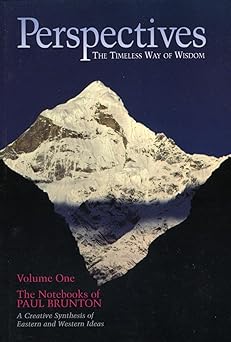
Larson, 1984
Back Cover:
Those immense silences of the Himalayas…helped me to quet the mind as nothing else…The sharp air freshened the mind, the endless space gave it new perspectives.
Paul Brunton
Perspectives is an inspiring insight into the essence of East-West spiritual philosophy. Going to the heart of virtually every aspect of the spiritual quest, it introduces a major series: The Notebooks of Paul Brunton.
Paul Brunton (1898-1981) was one of this century’s most dynamic spiritual authors. His ten early books (1934-1952) awakened millions in the West to the treasures of oriental wisdom and mystical practice. From 1952 to 1981 he sought relative anonymity and compiled extensive notebooks dedicated to synthesizing Eastern and Western, ancient and modern approaches to the discovery of the Soul. Perspectives is an introductory survey of those mature writings, which he reserved for posthumous publication.
“His ‘Notebooks’ provide a veritable treasure trove of philosophic-spiritual wisdom.”
Elisabeth Kübler-Ross
“A simple, straightforward guide to how philosophical insights of East and West can help to create beauty, joy, and meaning in our lives.”
East-West Journal
“…a person of rare intelligence…thoroughly alive, and whole in the most significant, ‘holy’ sense of the word.”
Yoga Journal
“Sensible and compelling. His work can stand beside that of such East-West ‘bridges’ as Merton, Suzuki, Watts, and Radhakrishnan.”
Choice
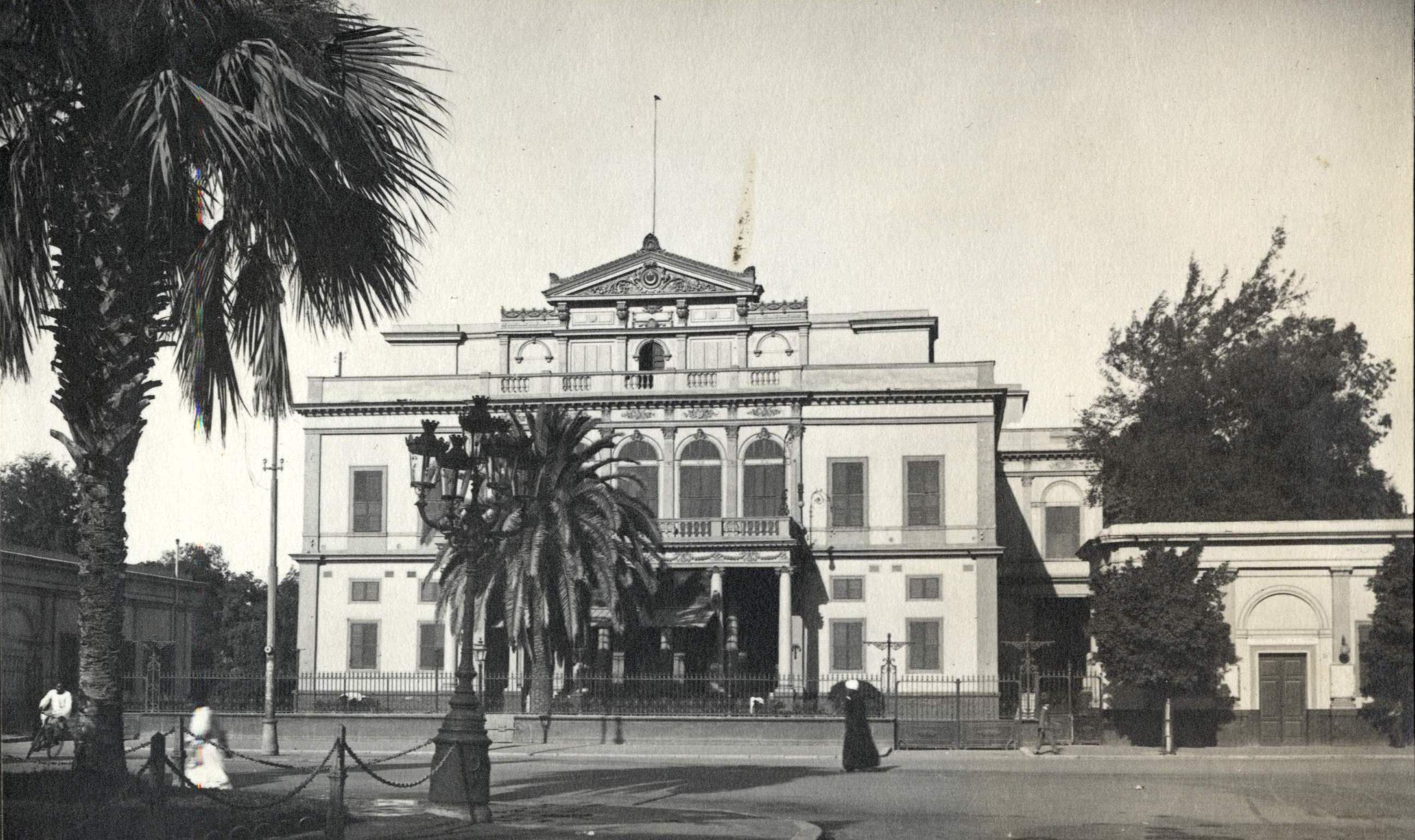
Pietro Avoscani: Khedivial Opera House, Cairo
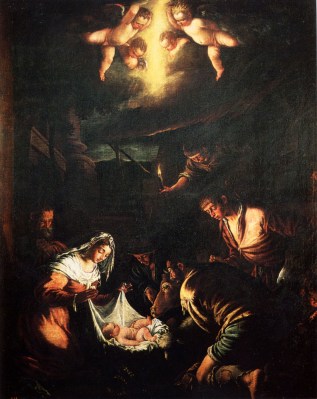
Jacopo Bassano: Adorazione dei pastori
Ontoteologi och skapelselära
I västkyrkan skulle efter de långdragna patristiska striderna och kyrkomötenas avgöranden inte någon rent fideistisk-literalistisk linje etablera sig som den dominerande, trots motståndet mot filosofin. Alltjämt skulle filosofin ha en plats inom den kristna läroutformningen, och det var alltså just detta som skapade vad vi kallar teologin i västerlandet. Inom denna nya ram kunde platonismen i vid mening delvis fortleva, hos Augustinus och senare medeltida riktningar, och framför allt i de ortodoxin minst närstående riktningarna, som hos Pseudo-Dionysios och Scotus Eriugena, där den emellertid genomgick andra icke oviktiga förändringar.
Från de fideistiskt och literalistiskt inriktade tidiga fäderna upptog ortodoxin dock lärorna om frälsningens natur och den kroppsliga uppståndelsen. Den filosofi som kunde användas av den nya kristna ortodoxin måste därför underordnas och tjäna dessa dogmer. Senare visade det sig att aristotelismen tjänade dem bättre än platonismen. Detta innebar emellertid mest att nya teoretiska redskap tillfördes för den allmänna och principiella förklaringen av “kroppspersonlighetens” och “själspersonlighetens” nödvändiga förening, och kanske inte något nytt erkännande och betonande av den unika individualiteten av det slag som i övrigt följde med dessa läror.
Men filosofin måste också underordna sig den grundläggande, bokstavligt-exoteriskt förstådda läran om skapelsen. Den platonska uppfattningen om det högsta som höjt över varat avfärdas som oförenlig med Gudsuppfattningen: Gud som det högsta varat blir istället den kristna uppfattningen, vilket naturligtvis motsvarade den gamla den bibliska läran (Septuagintas ὁ ὤν). Men stundom började genom filosofiskt inflytande skapelsens vara nu anses bero av delaktighet i Guds vara inom en enhetlig varaordning. Gränsen blir ibland mindre skarp mellan å ena sidan den åskådning som etablerar ett nödvändigt sammanhang mellan skapelsen som manifesterad ur Guds väsen, och därmed Gud som del av denna helhetsordning, och å andra sidan vad som kan utläsas som den bibliska läran enligt vilken Gud visserligen förlänar världen vara, men i sin radikala “personliga” frihet gör detta i en skapelse ur intet genom sin blotta viljeakt.
Skillnaden mellan Gud och det skapade betonades i den senare alltså inte bara starkare utan på annat sätt, på annan åskådningsmässig grund. Nedtoning av den så förstådda olikheten kunde misstänkas dölja människoförgudande eller Gudsförringande irrläror. I vissa former kunde den ontoteologiska kontinuitetsläran förvisso vara oförenlig med den personliga, teistiska Gudsuppfattningen – hur vag den än vid denna tid fortfarande var i sin teologiska utformning – och leda till en deterministisk panteism. Men i andra kunde såväl denna teism som den ontologiska kontinuiteten bibehållas. Så exempelvis hos både Augustinus och, långt senare, Thomas av Aquino.
Ignazio Marabitti: Santa Lucia

Philosophy and Science
Keith Ward on Materialism, 9 1 2 3 4 5 6 7 8
“For good old-fashioned materialists”, Ward says, “everything that exists, or the one and only stuff out of which everything is made, is matter – solid particles located in three-dimensional space, with definite masses and velocities.” This old-fashioned materialism was basically the same from Democritus to the nineteenth century, built on the atomic theory that Ward here describes. Ward speaks as a philosopher about philosophy, although philosophy at a time when it was not clearly distinct from science. At the time of Democritus, philosophy and science were rising not together, but as an undifferentiated unity, and this unity was also very much real in the case of revived classical philosophy and emergent classical physics during the Renaissance or the “early modern” period.
I mention this because one of the importance of the question of the legitimacy of drawing, as a philosopher, on natural science, now that philosophy and science are considered separate in principle, not just institutionally but theoretically or conceptually. I would like to broaden the dicsussion here to address this more general issue of philosophy and science. Is the appeal of philosophy to contemporary science and some of its representatives against other representatives who defend materialism on scientific and not philosophical grounds admissible and recommendable?
I suggest it is. Not that it is sufficient, and not even that it is necessary. But that it is legitimate and natural as part of and for some clearly delimited purposes of the larger case I am discussing. Clearly, philosophy must on one level or within some of its sub-disciplines relate to and deal with science too. This is not the same as relying on it or becoming dependent on it, or being committed to certain current theories that will soon be obsolete. It is a question of a quite natural relation, indeed a factual necessity determined by the nature of philosophy itself.
Moreover, science needs philosophy for its own self-understanding, if only in a very different sense than the one intended by the original and main tradition of misconceived scientism within analytic philosophy. Agreeing to some extent with the perennialist so-called traditionalist school, I will now cite the controversial Italian thinker Julius Evola, whom I too find problematic, although I reject his dismissal as simply a fascist. In Ride the Tiger, he gave a radical description of the “commonplace” understanding of science as pragmatic:
“None of modern science has the slightest value as knowledge; rather, it bases itself on a formal renunciation of knowledge in the true sense. The driving and organizing force behind modern science derives nothing at all from the ideal of knowledge, but exclusively from practical necessity, and, I might add, from the will to power turned on things and on nature. I do not mean its technical and industrial applications, even though the masses attribute the prestige of modern science above all to them, because there they see irrefutable proof of its validity. It is a matter of the very nature of scientific methods even before their technical applications, in the phase known as ‘pure research’. In fact, the concept of ‘truth’ in the traditional sense is already alien to modern science, which concerns itself solely with hypotheses and formulae that can predict with the best approximation the course of phenomena and relate them to a certain unity. And as it is not a question of ‘truth’, but a matter less of seeing than touching, the concept of certainty in modern science is reduced to the ‘maximum probability’. That all scientific certainties have an essentially statistical character is openly recognized by every scientist, and more categorically than even in recent subatomic physics. The system of science resembles a net that draws ever tighter around a something that, in itself, remains incomprehensible, with the sole intention of subduing it for practical ends.”
And: “These practical ends only secondarily concern the technical applications; they constitute the criterion in the very domain that belongs to pure knowledge, in the sense that here, too, the basic impulse is schematizing, an ordering of phenomena in a simpler and more manageable way. As was rightly noted, ever since that formula simplex sigillum veri (simplicity is the seal of the true), there has appeared a method that exchanges for truth (and knowledge) that which satisfies a practical, purely human need of the intellect. In the final analysis, the impulse to know is transformed into an impulse to dominate; and we owe to a scientist, Bertrand Russell, the recognition that science, from being a means to know the world, has become a means to change the world.”
We need not discuss here Evola’s particular evaluation of pragmatic science and his general perspective on it; I would just add that within a larger whole, represented by philosophy as well as the broader culture, pragmatic science can be perfectly legitimate, as a limited discipline. The pragmatic nature of scientific concepts is also discussed by Folke Leander and Claes Ryn, whose thought – in this area a partial, Crocean Hegelianism – I have often referred to. Concluding as they do that scientific concepts are largely pragmatic is, they point out, a conclusion reached by means of philosophy, a conclusion which goes beyond science itself. For contrary to the pragmatic concepts of science, the concept of a pragmatic concept itself is not a pragmatic concept, but a “categorial”, philosophical one.
This does not mean that scientists do not, within science, sometimes go beyond pragmatic concepts, develop theories of a kind that involves speculation in a manner that overlaps with and makes use of philosophy, whether or not they are themselves aware of it, and quite regardless of pragmatic applicability in science or technology. Distinctly philosophical issues that are not adequately dealt with by science itself inevitably arise all the time in science and its linguistic communication. One of the problems with some of the speculative scientists who address the question of God is that they do not see this. But basically, science, and contemporary physics, do not seem to go beyond pragmatic concepts. The fact that this includes their use of mathematics seems to raise some fundamental questions, as we will see.
“When, around 1911, Rutherford bombarded atoms with alpha particles, the indivisibility and solidity of the atom was shattered”, Ward continues. Here it could perhaps be argued that Ward is already talking about something beyond the scope of philosophy. But is it not arbitrary to allow him to speak of Democritus simply because he is considered a philosopher, or about Marx, but not of Rutherford, when Rutherford too speaks about atoms? If philosophers can speak about atoms, it would seem they could also speak about divided atoms and use such concepts in their philosophizing. If Ward’s account of Rutherford is not wrong and misleading, it seems this is something that it is legitimate do discuss among philosophers. If it is not, philosophers should perhaps not deal with Democritus’ and Marx’s materialism either, but leave that too to the scientists alone? Where precisely does philosophy turn into science of a kind that philosophers should no longer make use of in their philosophizing? How could philosophers possibly avoid dealing with and refering also to such science?
Again, in the earliest period, when philosophy and science were a new, unitary, speculative enterprise, Democritus argued that reality consisted of atoms falling through space and combining in different ways. Although the atomic theory remained well-known, and was revived during the Renaissance and the Enlightenment, very few, indeed hardly anyone, reasserted the full metaphysical position of the materialism which it constituted in Democritus, namely that atoms (and space) were the whole of reality. Atoms were of course accepted by some and matter by most, but not materialism.
Only with Marx, whose doctoral dissertation dealt with the relation between Democritus’ and Epicurus’ versions of materialism, did materialism in the strict philosophical sense that is what Ward is concerned with become a significant force in Western thought – i.e., only when it became part of a political ideology, and politically organized. Even so, it was still not a common position in philosophy. In recent decades, it has, as Ward has described, become more common in philosophy. Still, it is not philosophers who are its main protagonists in the general public debate, but speculative scientists and journalists who insist on its truth in popular books aimed at the reading public. If a philosopher asserts, as almost all philosophers have done between Democritus and Marx, that reality is not such as Democritus or any later version of materialism describes it, or even that matter as described by materialism does not exist at all, he must of course address the arguments of those scientists and journalists. And if other speculative scientists say things about matter that correspond to what he himself claims, is it not perfectly natural and obvious that he should mention this as part of his case in a debate about the nature of reality started precisely by the materialist scientists and journalists?
In no way does such an appeal to science imply that the philosopher has made himself dependent on science or committed himself to its current hypotheses. Rather it is a legitimate consequence of a relation and dialogue that is both inevitable and desirable. Science can of course never be a replacement and substitute for philosophy, which goes far beyond it and includes areas of thought which science can never adequately deal with at all within the necessary confines of its constitutive framework.
Some speak of the poor self-confidence of philosophy or of philosophers in the face of the success of modern science and its technological application as well as its influence on public discussion, but I have never been able to understand this. It must be something found only among philosophers in the misconceived and failed scientistic tradition within analytic philosophy, which sought to prove the relevance and necessity of philosophy by making it the theoretical ancilla of science, but was rejected by science itself and its own intrinsic development. If other philosophers too suffer from it, it can only be because they have not really understood the true nature of philosophy at all.
It is evident that Ward does not belong to those philosophers, but is perfectly well aware of the distinctiveness of philosophy, and indeed that it is not just necessary but sufficient within the areas in which, by its own nature, it transcends other disciplines of human thought and research. Nicholas Capaldi’s The Enlightenment Project in the Analytic Conversation, is an excellent analysis of the relationship between misconceived modern philosophy and science.
But while science is thus neither sufficient in itself as a replacement of and successor to philosophy, nor necessary for philosophy, it is of course one of the most important cultural achievements of Western civilization (although certainly not exclusively of Western civilization). And it is a fragile one which is in the long perspective threatened, as so much else, by the decline of this civilization. It is something philosophers should certainly ever continue to take an interest in, and take into account in their own thinking. And vice versa: in the past, when the living cultural tradition still shaped and set the tone of society, scientists often had a good philosophical and humanistic education. This they should again acquire.
Ward gives more relevant examples for the fate of materialism of the development of science: “In 1924, de Broglie…argued that sub-atomic particles could be treated as waves. In 1925 the first formalism for quantum theory was produced. From that point on, matter itself was subsumed under the wider concept of ‘energy’, which could take many forms. Electrons, from being tiny precisely locatable particles, were seen as probability-waves in Hilbert space, only collapsing into particles under specific conditions of measurement. Even then, only the probability of finding them at a specific location could be predicted, and Heisenberg proved that such waves/particles could not be assigned both a determinate position and momentum at the same time.”
Is a line crossed somewhere in this paragraph, where the philosopher should have stopped talking about this development in physics and left it all to the physicists alone? If so, where precisely is it, and why is it drawn there and not somewhere else?
“In modern quantum cosmology, virtual particles of indefinitely many different sorts flash in and out of existence in accordance with quantum laws, from a vacuum (lowest-energy) state of precisely balanced, but fluctuating, energies. Time and space are only four or ten or eleven dimensions that emerge from such a vacuum state, and there may be many space-time universes (of which ours is only one) that fluctuate in and out of existence from a more primal quantum foam, far beyond the forms of space-time with which we are familiar in experience.”
Is Ward now, as a philosopher, far beyond the pale? Is the account even roughly adequate? Is this misleading popularization and distortion? Have New Age dreamers taken the place of the leading physicists in Oxford colleges? If it is admitted that it is at all legitimate and relevant for Ward to refer as a philosopher to these developments in science and to discuss them as parts of his case, then those who reject the truth of the account must point out where and why it is false.
“Things have proceeded so far in quantum cosmology that physicists like Chris Isham, of Imperial College, and Stephen Hawking, of Cambridge, tend to say that ‘imaginary time’ is more real than real time, that the human belief that time passes (or that we pass through time) is an illusion of consciousness, and that human consciousness of three-dimensional space is a narrow subjective selection out of a multi-dimensional reality that we are unable to perceive.”
It is inevitable that a simplified account must be given, although that does not really make all the pragmatic concepts in the cited passages very much more comprehensible to the non-physicist. Nonetheless, it seems to me the account does succeed in communicating what it is intended to communicate, namely that in science, “it has become increasingly hard to say just what ‘matter’ is”. Whatever it is said today that matter is, it is not that “everything that exists, or the one and only stuff out of which everything is made, is matter – solid particles located in three-dimensional space, with definite masses and velocities”. In other words, contemporary physics does not accept “old-fashioned materialism”.
And what it does say that matter is, is not, it seems to me, something that can easily be described in terms of some other materialism, in terms of materialism at all. Contemporary physics – which is neither more nor less than that, not physics as such, not future physics, not categorial concepts, not the absolute truth, but also not the physics of the past and not some insignificant, marginal and arbitrary theoretical speculation – thus says something about how matter is conceived today, something that is of relevance for the case against materialism and thus also for the case for idealism and personalism.
Yes: The Revealing Science of God
Live at San Luis Obispo, 1996. From the album Tales from Topographic Oceans (1973).
–
The full title is ‘The Revealing Science of God – Dance of the Dawn’.
Idealism as Alternative Modernity, 2
Idealism as Alternative Modernity, 1
The concept of what I call an ”alternative modernity” and what others have called a ”second moderntiy” has recently come under attack, along with figures such as Vico, Burke, Herder, Carlyle, Croce, and even Isaiah Berlin, as part of the reactionary counter-Enlightenment discourse, in turn alleged to be intrinsically related to the rise of fascism. I suggest that Zeev Sternhell’s criticism in his latest, somewhat surprising book, The Anti-Enlightenment Tradition, must be rejected as part of an inadmissibly simplified discourse on modernity.
The concept of an alternative modernity is necessary, inevitable. There is and there will be no consensus on a modernity that is monolithic and unidirectional to the extent such critics seem to want. Almost all important thinkers have been strongly critical, on various grounds, of the mainstrem of modernity. An alternative to this dominant form of modernity and its ideological expressions, which shape not least the current problematic direction and substance of globalization, is badly needed. There may be more than one alternative, and all alternatives may not be desirable. But being an alternative modernity, the alternative which is desirable and to which I suggest idealism could decisively contribute, is not just a new, creative defence of elements of tradition, and not just an affirmation of the new factors of the economy and of technology as compatible with unchanged tradition, but, per definition, an alternative, selective defence of elements of modernity’s own Enlightenment and Romantic constituents and partial truths.
Since I am best known for my work on personalism, and among personalists and personalism scholars, some wonder about my interest in idealism. Personalism is no longer always conceived as an idealistic philosophy, not even in America, where the dominant personalist school was started by the obviously idealistic philosopher Borden Parker Bowne. Personalism has increasingly been conceived in terms of the phenomenology, existentialism, and Thomism of its twentieth-century European representatives. The facts that there was, even before the emergence of those best known schools of European personalism, a school of idealistic personalism in America, and that, as I have tried to show, this school was in itself a continuation of an even earlier, heretofore largely ignored European form of idealistic personalism, do not in themselves, from the point when I discovered them, account for my interest in idealism.
I am pleased to have been able to represent the field of personal idealism or idealistic personalism at quite a few personalism and idealism conferences over the years and, not least, to see a little bridge being built between idealism and personalism scholars inasmuch as they now to some extent attend each others’ meetings. A case can, I suggest, be made, along the lines of the personal idealists, that personalism is of necessity implicitly idealistic, and vice versa.
But my interest in idealism in some respects predates my interest in personalism. I became convinced of what was in substance some of the epistemological and purely metaphysical truths of idealism in a very broad sense early on, including not only central themes of Platonism and Neoplatonism, but also what could be regarded as some broadly ”Berkeleyan” ones, although there are problems with Berkeley’s more precise formulations of them.
In school, I was struck by what I found to be the unbelievability of the accounts of my physics textbooks of how sensation is produced by impressions from external, material objects which presupposed objective or absolute time and space out there in which those objects were floating about, impressions somehow received by the likewise objectively material senses, tranformed to signals transmitted through the nervous system to the brain, and there miraculously transformed again, into conscious perceptions completely distinct in nature from the originating objects themselves. I of course also soon discovered that leading modern physicists had long had strong doubts about that account themselves and often even rejected it outright, despite the limitations in principle of their particular perspective.
The ideas of those physicists were increasingly being taken up by the so-called New Age movement, which, while rejecting recent centuries of Western civilizational development as an old, invalid paradigm of gross materialism, in fact for the most part represented in unbroken yet strangely unconscious continuity the nineteenth-century revival of the Western tradition of esotericism which goes back to the Renaissance and to antiquity, a revival which was sometimes closely and reciprocally related to aspects of nineteenth-century idealistic philosophy.
And alongside the various expressions of what could often easily be seen to be the somewhat extreme romantic, distinctly modern pantheism of the New Age movement and of the residual countercultural movement, representatives of the Eastern spiritual traditions continued to appear in the West and feed their wisdom into the more and less congenial Western currents of thought. My study of some of the most important strands of Vedantic as well as Buddhistic thought confirmed my early idealist intuitions and suspicions regarding some forms of empiricism and of course naturalism and materialism or physicalism, reductive as well as so-called non-reductive. It made large chunks of Western philosophy seem irrelevant to me even before I hade made any proper study of them.
I had thus become an idealist long before I became an academic stundent o idealism. But it was of course only when I began my academic study Western philosophy and its history that I could conceptualize and express, to the extent that it was possible, the basic insights thus acquired in its terms and with reference to its thinkers. I then also came to understand how from certain perspectives, certain points of departure of the human mind, or certain levels of understanding, those parts and types of Western philosophy that had seemed irrelevant to me sometimes in fact have legitimate and even necessary functions in the dialectical systematicity of philosophy as a whole. They even to some extent had counterparts in Indian philosophy. But none of this made them any more true on the higher levels of that same philosophical systematicity.

 Olle Bengtsson