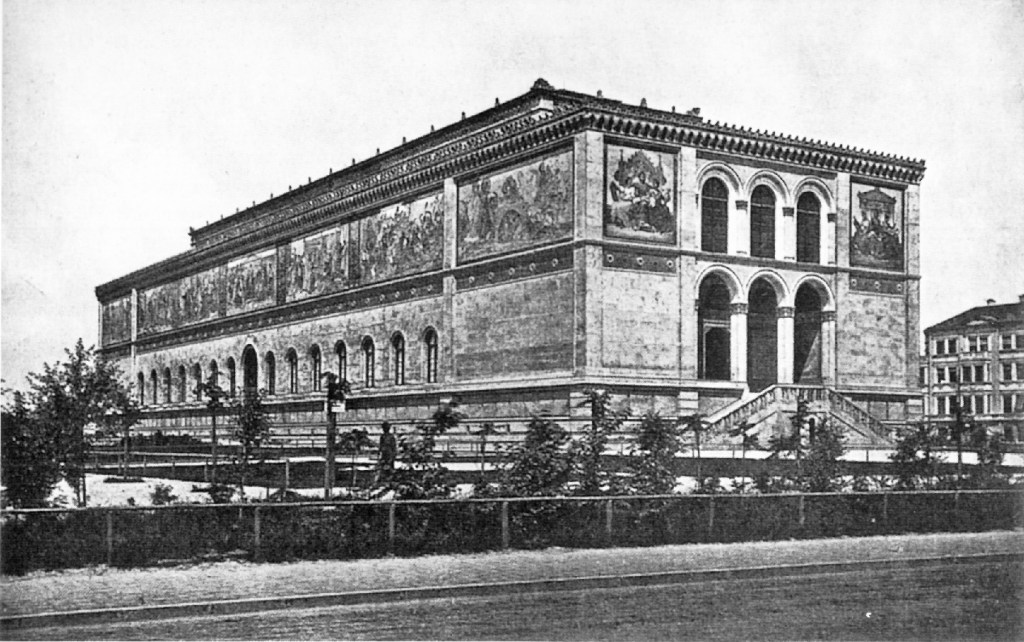
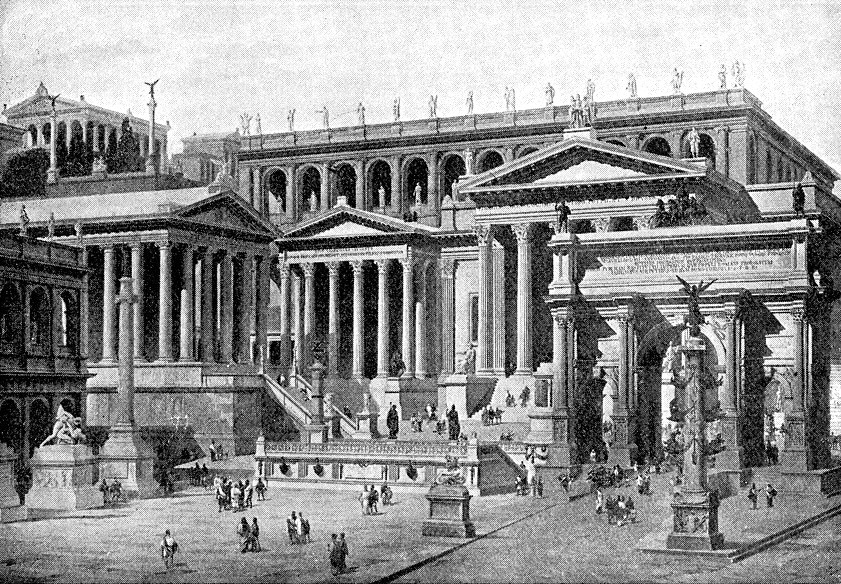
Friedrich von Gärtner & August von Voit: Neue Pinakothek, München
När jag i våras skrev om en artikel som den, som jag uppfattade det, ännu inte formellt lanserade tankesmedjan Oikos producerat, lyfte jag fram den rudimentära ideologiska programförklaring som tillfogades efter undertecknarnas namn: “Oikos är en nystartad, partipolitiskt obunden tankesmedja som syftar till att befrämja en konservativ samhällsutveckling, bidra till ökad kunskap om konservativ ideologi, verka för konservativ fusionism och stimulera till en mer livfull idédebatt.” Jag noterade att det enda som i den stack ut var ordet “fusionism”, och att det fanns anledning att återkomma till det.
Ordet fusionism, i sammanställningen “konservativ fusionism”, stack ut av det skälet att Mattias Karlsson på senare tid starkt anknutit till den amerikanska konservatismen och etablerat kontakter och samarbete med den i samband med bildandet av den nya tankesmedjan, och att fusionism historiskt varit ett viktigt begrepp i just den amerikanska konservativa rörelse som växte fram på 50-talet. Tankarna gick oundvikligen till det specifika amerikanska ideologiska fenomenet. Senare har jag också sett Karlssons föredrag vid University of Colorado i februari förra året på temat ‘National Conservatives and Traditional Conservatives: A Call for Unity’, i vilket han också använde detta ord.
Huvudströmningen i den amerikanska konservativa rörelsen har i själva verket karaktäriserats av försök att förena konservatism och libertarianism. “Fusionism” var det namn en av medarbetarna i William F. Buckleys National Review, Frank S. Meyer (1909-1972), gav sitt försök under 50-talet att filosofiskt förena libertarianism och vad han kallade traditionalism (i den burkeanska meningen) på ett nära, inre, organiskt sätt, ett sätt som gick utöver det blotta så att säga externa sammanställandet. Det var för Meyer fråga om just en konservativ fusionism: sammansmältningen av libertarianism och traditionalism definierade enligt Meyer konservatismen. En god uppfattning av Meyers åskådning får man i In Defense of Freedom and Related Essays från 1996, en sammanställning av några av hans viktigaste uppsatser och artiklar. Buckley själv, som på flera sätt var central i den tidiga rörelsen, var starkt påverkad av detta projekt.
Med tanke på detta substantiella innehåll i Meyers politiska filosofi framstod det dock som mindre sannolikt att det verkligen var denna riktning som åsyftades av Oikos. Det är kanske inte fel att säga att Meyers fusionism betonade libertarianismen mer än traditionalismen. Han angrep i alla fall på signifikativt sätt de typer av konservatism i den amerikanska efterkrigsrörelsen som avvisade libertarianismen, såsom Russell Kirks och Peter Vierecks. Det rådde inte bara en spänning och ofta ett motsatsförhållande mellan konservatismen (eller vad som i USA på grund av denna bakgrund kommit att kallas den traditionalistiska konservatismen) och libertarianismen, utan också mellan konservatismen och detta försök till fusion av den, eller av traditionalismen, och libertarianismen. De ledande konservativa kunde helt enkelt inte godta Meyers fusion.
Innebörden av detta måste sägas vara att fusionismen misslyckades, åtminstone om dess anspråk inte bara var att utgöra ännu en individuell politisk-filosofisk position bland många andra, utan att på ett sätt som kunde accepteras av båda parter filosofiskt överbrygga motsättningen och få parterna att faktiskt mötas och enas i en gemensam åskådning. Detta hindrade emellertid alltså inte att den amerikanska konservativa rörelsen, som slutligen formellt erövrade makten med Reagan på 80-talet, hela tiden fortsatte att präglas av den instabila samexistensen av konservatism och libertarianism, på det sätt som först skildrades av George Nash i The Conservative Intellectual Movement in America since 1945. Den nyliberala revolutionen i USA hade åtminstone ideologiskt ett starkare konservativt inslag än i Sverige, men det hindrade inte att den i lika hög grad präglades av libertarianska idéer. De neokonservativa, som från 70-talet alltmer dominerade etablissemangskonservatismen, kan sägas ha gjort sitt eget försök att balansera och förena dessa olika komponenter.
Några av de andra i Oikos’ “förtroenderåd” kan förvisso antas stå betydligt närmare Meyers fusionism än Karlsson, framför allt Naweed Khan. Men Karlsson själv har ju tidigare definierat SD som ett socialkonservativt parti och kunde knappast misstänkas plötsligt ha lagt sig till med några libertarianska böjelser. Även det sammanhang i vilket Karlsson använde termen fusionism i sitt föredrag i USA talade entydigt mot att det handlade om en anslutning till Meyer och Buckley. Vad det där var fråga om var en fusion mellan den gamla, etablerade högerns konservatism och de framgångsrika nya partiernas av den typ han själv representerar, en konservatism han nu beskriver som patriotiskt eller nationellt konservativ i stället för socialkonservativ. Det handlade alltså om vad som också är SD:s nya linje sedan valrörelsen 2018: det “konservativa blocket”. Det stod klart att det primärt var detta som Oikos skapats för att befrämja.
Som jag försökt belysa i en rad artiklar finns det uppenbara problem med denna andra typ av fusion. Den är en fusion av populistnationalismen med dagens etablissemangshöger, både i Sverige och i USA, en höger som alltså, framför allt i USA, innehåller ett starkt libertarianskt moment, och i Sverige åtminstone ett lika starkt nyliberalt. Fastän det är en helt annan fusion än Meyers, som inte laborerade med någon populistnationalism (åtminstone inte av dagens typ), finner vi dock även här det stora anspråk som ligger i själva termen fusion. Etymologiskt betyder fusion smältning, vilket ger den exakta aktuella betydelsen: sammansmältning. Karlsson menar inte att, å ena sidan, Moderaternas och Kristdemokraternas typ av konservatism (om de nu verkligen ens i begränsad utsträckning gör anspråk på att omfatta en sådan) och de amerikanska Republikanernas konservatism bara ska externt sammanställas med hans egna åskådning å den andra, i en politisk allians, utan att de två faktiskt ska bli ett. Det är ett anmärkningsvärt projekt i ljuset av Karlssons egna tidigare ideologiska programformuleringar för SD.
Men det stannar inte här. Att döma av en ny intervju med Karlsson av Ronie Berggren kan min här redovisade hittillsvarande förståelse av Karlssons och Oikos’ användning av termen fusionism ha varit felaktig, eller åtminstone nu ha blivit det. Karlsson kopplar nämligen i denna intervju själv sin egen användning av termen konservativ fusionism till Buckley!
Man vill tro att Karlsson bara noterat förekomsten av termen fusionism i USA utan att närmare studera dess begreppsliga definition, och tyckt att den är bra och användbar för sitt eget syfte. Men det är inte lätt. Karlsson knyter explicit termen till Buckley, hos vilken den har en mycket distinkt betydelse, en betydelse helt skild från hans eget projekt sådant han själv beskrivit det. Kan han verkligen ha missat det?
Misstanken att det handlar om mer än en uppskattning av Buckley för att han använde ett bra ord som Karlsson kan använda på annat sätt förstärks av hela intervjun med Berggren. Denne har länge med tvärsäker, smalspårig, närmast maskinmässig enständighet ivrat för just den amerikanska konservatismen i Republikanernas form och dess efterbildning i Sverige. Han har skrivit en bok om sin idol George W. Bush, och uppmålat en republikansk kontinuitet mellan denne och Trump. I den nu aktuella intervjun framstår det som om Karlsson instämmer i allt Berggren säger i denna anda om den amerikanska konservatismen. Det låter märkligt för dem som fortfarande minns Karlssons socialkonservatism.
Karlsson gör helt klart att han med konservativ fusionism för svensk del menar det konservativa blocket. Högern måste i hela västerlandet enas under konservatismens paraply: framtiden är fortfarande att “de nya patriotiskt inriktade konservativa rörelserna” och “gamla institutionella partier som Tories” enas. I Sverige betyder det att det konservativa blocket, enheten av SD, M och KD, måste vinna nästa val. Detta block ska dock, i enlighet med Berggrens anvisningar, nära knytas till den amerikanska konservatismen sådan den representeras av Republikanerna. Berggren själv fyller i: vi bör, för det nya blockets syften, lära av amerikansk konservatism, hur den skapade ett brett tält.
Liksom Karlssons paraply, ja block, ligger uttrycket brett tält konceptuellt långt från fusion även i största allmänhet. De olika partierna ska, säger Karlsson, enas om kärnvärden och vinna i de till dem relaterade centrala frågorna, men kan agree to disagree om annat. Men vilka gemensamma kärnvärden finns när det gäller socialkonservatism contra nyliberalism? Måste man inte agree to disagree på hela detta område? Måste inte kärnvärdena definieras endast med avseende på frågor som på något sätt kan anses falla utanför det? Det är svårt att se hur detta skulle kunna innebära en fusion. I ljuset av allt vad Karlsson nu håller med Berggren om ser det åtminstone ut att betyda att Karlsson menar att det går att vinna i de för SD centrala frågorna även utan SD:s socialkonservatism. Att det inte är något problem för SD att acceptera M:s och KD:s nyliberalism i tältet. Att fusionen inte innefattar SD:s socialkonservatism, det som Karlsson själv 2011 framlyfte som det primära i sitt partis ideologiska självdefinition. Att den kan kompromissas bort.
Karlsson talar om “den fusionism som skedde” i USA: Buckley var enligt honom avgörande för att de konservativa har lyckats “hålla emot”; hade de inte haft den fusionistiska idén så hade det varit “svårare”. Det är “något liknande” han “skulle vilja se i Sverige och i hela västvärlden”. Kanske är det verkligen bara ett missförstånd av, en okunnighet om, innebörden av den amerikanska fusionismen. Men hur är det möjligt, när Karlssons referens blir så specifik att han nämner just Buckley, den man som förkroppsligar den amerikanska konservatismens grundläggande, karaktäristiska strävan att förena konservatism och libertarianism?
Den akuta nödvändigheten av blockbildning med den gamla borgerliga högern, faciliterad av en gemensam “konservativ” amerikanisering, kommer enligt Karlsson av hotet från den extrema identitetspolitiska vänstern (med en åtminstone i ljuset av det substantiella politiska innehållet litet märklig jämförelse säger Karlsson att denna vänster är “nästan maoistisk”). Karlsson verkar i princip likställa de amerikanska Demokraterna med denna vänster: Republikanerna och Demokraterna har “totalt olika ideal, ideologier och visioner”. I det senare uttalandet blir otillräckligheten i Karlssons i sig viktiga politiska fokus på kultur och identitet uppenbar (när han själv samtidigt talar om detta och om vänsterns identitetspolitik borde han tematisera det faktum att även han driver en sådan politik, och att det alltså finns olika slags identitetspolitik). Det saknas helt en övergripande politisk och ekonomisk systemanalys. Följden blir vad som ser ut som en naivitet inför den helhetliga såväl amerikanska som svenska samhälleliga verkligheten.
Berggren beskriver entusiastiskt hur SD har omorienterat sig i angloamerikansk riktning, och Karlsson bekräftar. Karlsson säger sig vara inspirerad av både Republikanernas och Demokraternas “professionella” organisatoriska kolosser. Republikanerna är smarta, spännande, sofistikerade och snygga, och svensk höger måste alltså följa Berggrens länge drivna linje att liera sig med dem. Berggren får också Karlsson att oreserverat instämma i sin hyllning av Margaret Thatcher. Det blir här högst oklart hur man egentligen ska förstå vad Karlsson säger om sin likgiltighet och pragmatism inför högerns vanliga, ekonomiska frågor. Klart är att de inte möjliggör någon djupare reell förståelse. En konservatism som är så här blind för den atlanticistiska kapitalismens verkliga natur och funktionssätt kommer inte kunna åstadkomma mycket, kommer långtifrån vara tillräcklig för att rädda västerlandet.
På en analysnivå är Karlssons beröm för Trump en del av denna ytlighet. Men på en annan, i ett mer begränsat perspektiv, har han rätt, även om det inte ens där går att begripliggöra ett uttalande som att Trump är en “med alla objektiva mått mätt…framgångsrik president”. I skarp kontrast till SD-ledningens tidigare kritik mot Trump tycker Karlsson nu att denne på positivt sätt skakat om Republikanernas apparat och skänkt den en ny dynamik; partiets gamla strukturer har förändrats mycket, till det bättre, och på kort tid, vilket öppnar för nya aktörer att komma in. Karlsson är klar över hur Trump haft en stor del av etablissemanget mot sig. Så långt låter det, på denna nivå, bra. SD ingår ju nu i ett internationellt nätverk av gamla konservativa partier, inklusive Republikanerna, och det enda sätt på vilket det kan legitimeras utifrån SD:s ännu gällande, av Karlsson skrivna principprogram är givetvis denna omprövning av Trump, ett starkt betonande av att denne förändrat Republikanerna och fört dem närmare SD:s populistnationalistiska form av konservatism, även om det inte går att påstå att Trump står för någon socialkonservatism. Samtidigt är det begripligt att Karlsson fortfarande vill distansera sig från åtskilligt i Trumps persona, hans ledarstil, hur han för sig.
Berggrens respons på det sistnämnda är emellertid att tolka det som att Karlsson egentligen inte är för just Trump, utan bara för Republikanerna. Även om han väl delvis kan hålla med Karlsson om Trumps positiva förändringar, vill Berggren här säkert få det till att Karlsson också är för hans egen omhuldade republikanska kontinuitet, att Karlsson ger sitt stöd även till det gamla partietablissemang som Trump besegrade för fyra år sedan när Bush III, Jeb, stod i spetsen för det. Berggren är sannerligen inte ensam i SD i sin beundran för detta etablissemang.
Karlsson bekräftar Berggrens tolkning: Republikanerna är nu helt enkelt som sådana bra. Inte heller i DN:s korta intervju med Karlsson den 16:e september betonar han med tillnärmelsevis tillräcklig styrka att hans stöd för Trump beror på det nya som just denne president står för, det som för honom i närhet till SD och den europeiska populistnationalismen. Dels betonar han inte bara detta, utan även annat, och mer problematiskt, i Republikanernas politik. Dels, och på ett sätt som hänger samman med detta, nämner han inte allt det nya Trump representerar.
Konkret: Karlsson framlyfter – i en förlängning av SD:s överdrivna antiryska hållning som jag länge ifrågasatt, även om Trump har en rimligare inställning till Ryssland – Trumps fientlighet mot Kina som en merit. Här vet vi att extrema och världskrigsriskerande hökar med det största inflytande hela tiden opererar i Trumps närhet och sätter tryck på honom. Och han underlåter att nämna Trumps partiella och ofullkomliga försök – mycket mer är det ännu inte, men här finns utan tvekan åtminstone en ny och god intention – att dra sig ur några av de katastrofala amerikanska krigsinterventionerna i Mellanöstern som är orsaken till så mycket av både vår invandringsproblematik och vår problematik med muslimsk extremism.
Här kommer vi in på den amerikanska konservatismens faktiska politik, sådan den trots Trump, trots Trumps förbättringar, kvarstår hos det gamla, “institutionella” högerpartiet, och till stor del understöds av den svenska högern trots dess av Berggren och Karlsson beklagade avstånd från amerikanerna. Det är även med detta konkret-politiska utfall av “konservatismen” som “fusionen” ska åstadkommas, det är detta paraply vi ska in under, detta tält vi ska in i. Också som jag från början tolkade det var Oikos’ begrepp konservativ fusionism problematiskt. Med Karlssons senaste intervjuuttalanden framstår det som än mer så.
Trots allt detta finns som vanligt också mycket gott att säga om Karlsson, även sådan han framstår i den nu aktuella intervjun. Det är svårt att tänka sig någon annan svensk politiker som skulle kunna tala om sin ideologi och utvecklingen av sin politiska förståelse på det även i kulturella och allmänintellektuella termer relativt djupgående sätt Karlsson ändå gör, och gör på ett sätt som samtidigt präglas av en påfallande ödmjukhet. Hans beskrivning av hur Roger Scruton fick honom att upptäcka det konservativa tänkandet och överskrida sin tidigare enkla och snäva nationalism är entydigt sympatisk och lovvärd. I allmänna termer motsvarar detta en väsentlig del av den inriktning för SD som jag själv önskat mig och försökt artikulera alltsedan jag upptäckte och började försvara partiet. Bara en sådan sak som att Scruton, som gick bort i februari, hade lovat ställa upp som medarbetare i Oikos visar att detta Karlssons projekt inte kan avfärdas. Scruton var utan all tvekan en av vår tids främsta filosofer.
Vidare är Karlssons berättelse om vad det är i konservatismen, ja i politiken i allmänhet, som han verkligen intresserar sig för likaledes attraktiv. Intressant nog säger han i förbigående att han kände ett relativt främlingskap inför 80-talets amerikanska konservatism, innan han blivit närmare förtrogen med den konservativa rörelsen. Men man frågar sig vilka amerikanska konservativa tänkare det nu är han lärt sig uppskatta: hittills har han mig veterligen inte hörts nämna något av de stora namnen: Kirk, Voegelin, Nisbet, Weaver, Burnham, Viereck, Strauss, Gottfried, nej inte heller vår svenske filosof Claes Ryn, som initierat en sedan länge inflytelserik egen riktning.
Alltnog, även Karlssons redogörelse för hur han upptäckte att Moderaterna inte stod för någon konservatism, och att SD måste fylla tomrummet, är, liksom hans markering mot Timbro, föredömlig. Men det är helt enkelt omöjligt att sammanjämka detta med den nya strävan efter blockbildning baserad på fusion. Samtidigt som konservatismen rymmer essentiella tanketraditioner av bestående, ja ständigt ökande värde och relevans i dagens värld, är det tyvärr lätt att hamna fel på grund av den lösliga användningen av den konservativa etiketten. Och än värre: den vanliga borgerliga konservatismen, som Karlsson, Oikos och SD nu binder upp sig till, har konstitutiva begränsningar som gör den rent principiellt otillräcklig för lösandet av vår tids problem.
Med SD:s högerblockstrategi och med den nya amerikansk-konservativa orientering som får ett mycket långtgående uttryck i Berggrens intervju, och nu senast med Oikos, vars verksamhet helt ska ligga i linje med och befrämja dessa, har det blivit viktigare än någonsin att insistera på nödvändigheten inte bara av kritisk urskillning i tillägnelsen av konservatismen, utan också av teoretisk vidareutveckling och fördjupning av den. Det enda i SD:s hittillsvarande ideologi som äger relevans för detta är Karlssons tidigare, i europeisk mening socialkonservativa ansats.
Den utmärkte essäisten, romanförfattaren och teologen Christian Braw har av Per Dahl med rätta kallats “en av Svenska kyrkans få kulturpersonligheter”. Under 80-talet publicerade han sig under pseudonymen F. J. Nordstedt. Jag minns att jag recenserade hans essäsamling I Sverige, och att jag dessförinnan mycket uppskattat samlingarna I kampen och Kulturkampen. Särskilt viktiga blev de för mig eftersom det var genom dem som min uppmärksamhet första gången riktades mot Tage Lindbom och hans författarskap. Braw stod mycket nära Lindbom.
Nu skriver Braw i Dagen en krönika med rubriken ‘Det socialistiska kätteriet är en varningssignal’ (4/9) om Johan Sundeens förtjänstfulla bidrag till den nya, av P. J. Anders Linder och Kurt Almqvist redigerade antologin Vänsterns idéer, som han tidigare anmält i Svensk Tidskrift. Sundeens bidrag bygger på en analys delvis av Eric Voegelins slag, men också av den typ vi finner i exempelvis Thomas Molnars Utopia: The Perennial Heresy, och som inte heller ligger långt från Lindboms traditionalistiska kritik. Socialismen är ett “kristet kätteri”: “Ett kätteri”, skriver Braw, “består inte enbart av lögner. Kätteriets kärna är alltid en sanning.”
Kritiken är central och av bestående värde, ja bestående nödvändighet. Den berör inslag i det socialistiska tänkandets allmänna världsåskådning och människosyn, som ofta varit förödande, fört socialismen bort från verkligheten, använts för att legitimera oförsvarliga övergrepp. Delvis överlappar den också med den mer allmänna kritiska analysen av den sekulära humanismen, sådan den formulerats av exempelvis Henri de Lubac. Det finns så att säga också mer banala ateistiska inslag i socialismen som immanentistisk-utopistisk eskatologi.
Men i några formuleringar i den nu aktuella artikeln undrar jag om inte den gode Braw förenklar och överdriver något. Han var alltid starkt påverkad av Solzjenitsyn. Dennes erfarenhet och vittnesbörd är utan tvekan viktiga och gripande, och de hade ofta en avgörande betydelse i uppgörelserna med marxismen på 70-talet. De präglades också på karaktäristiskt sätt av hans ortodoxt-kristna andliga djup. Men vad som nästan alltid glöms är att Solzjenitsyn var romanförfattare. Som historiskt källmaterial har hans verk begränsat värde. Framför allt är hans ofta åberopade siffror för antalet “dödade av kommunismen” uppenbara fantasiskapelser.
“Har ni hört det här någon gång”, frågar Braw: “‘Socialismen är en bra idé, skada bara att den misslyckas?'” Återgivningen är litet märklig. Jag har inte hört just detta. Vad som däremot ofta sagts, alltifrån Trotskij under andra hälften av 20-talet, är att den så kallade realexisterande, historiska socialismen inte är en “riktig” socialism, att den är en förvrängning, en urspårad socialism. Men i det att man – Trotskij och väl alla dem som Braw syftar på – hävdat att socialismen fortfarande är en “bra idé”, har de knappast accepterat att den som sådan har misslyckats.
Braw upprepar här förstås en mycket vanlig liberalkonservativ talking point: “Men är det en bra idé, när den alltid misslyckas?” Socialismen har alltid misslyckats, var den än har prövats: detta är något man menar sig kunna kategoriskt konstatera. I det speciella argumentatoriska sammanhang vi här har att göra med kan man kanske tolka det som att det kristna kätteriet är en särskilt viktig orsak till detta misslyckande. Men kritiken blir ändå på karaktäristiskt sätt ohistorisk, och den närmast aprioriska visshet omdömet vittnar om – socialismen kommer också i framtiden alltid att misslyckas – tvingar oss, tror jag, att titta närmare på frågan om socialismens mer exakta definition. Måste den nödvändigtvis innefatta detta kätteri?
Redan på 20-talet började Stalin inse att bolsjevikernas ateism och allmänna, extrema kulturradikalism aldrig skulle gå hem hos folket. När han gradvis gjorde kompromisser och eftergifter när det gällde kyrkan, familjen, konsten, nationen och annat, skedde det alltså inte enbart för krigets syften. Idag har de flesta socialistiska regeringar i världen sedan länge omprövat socialismens äldre förhållningssätt till religionen. Inte minst i Central- och Latinamerika är de explicit kristna, kristendomen ingår som ett konstitutivt, definierande element i deras ideologi och deras paroller, och såvitt jag förstår inte enbart i radikalmodernistiskt omtolkade former; de är så att säga goda katoliker.
Dagens socialistiska länder är mer kultur-, moral- och värdekonservativa än USA. Även Kina, idag världens största och viktigaste socialistiska land, har omprövat sin hållning gentemot de åtskilliga religioner som utövas inom dess gränser, och infört en ny, långtgående tolerans, där gränsen går endast vid regimfientlig och terroristisk extremism. Det är såvitt jag förstår fullt möjligt att vara traditionell kristen, muslim och buddhist i Kina idag. Och när det gäller kristet kätteri är detta av uppenbara skäl knappast något självklart naturligt för Kina. Nationella, konfucianska särdrag i den kinesiska socialismen har nu starkt betonats av Xi Jinping.
Socialismen, fortsätter Braw, “har ju skapat de mest fasansfulla samhällen världshistorien har sett”. Han nämner Nordkorea som “bara ett av många exempel”. Med all respekt för Solzjenitsyns vittnesbörd, och med full medvetenhet om både socialismens problematiska historiska erfarenhet och dess i många avseenden lika problematiska historiska teori och pseudoreligiösa mentalitet, som förklarar denna erfarenhet, måste man fråga sig om detta verkligen är ett fullt rimligt påstående.
Går vi bakåt i historien är det inte svårt att finna exempel på samhällen som, allt vägt och mätt, måste ha varit betydligt mer fasansfulla. Jag undrar om Braws konservativa kristna kriterier är tillräckliga här. Riskerar man inte att helt enkelt förbise alltför mycket i det jämförande perspektivet av det moderna och det förmoderna? Och i vad socialismen faktiskt åstadkom ifråga om ekonomiska förhållanden, utbildning och sjukvård för den överväldigande majoriteten av de socialistiska ländernas befolkningar, i jämförelse med föregående, icke-socialistiska samhällen – slavsamhällen, feodala samhällen, halvfeodala, ja borgerliga? En rimlig balans och proportion måste finnas även i den antisocialistiska kritiken, om den ska vara trovärdig. Detta är viktigt, eftersom kritiken i så många avseenden förblir nödvändig. Ensidig kallakrigspropaganda har fortsatt prägla mycket av den västliga historieskrivningen.
Dessutom måste man fråga sig: om socialismen alltid misslyckas, vilka är då kriterierna för att lyckas? Vilka tidigare samhällen har lyckats? Vad innebär det för ett samhälle att lyckas? Och än viktigare, eller åtminstone mer påträngande idag: menar Braw att det samhälle – vad vi nu ska kalla det, liberalt, borgerligt, kapitalistiskt – som dominerat världen efter Sovjetunionens upplösning har lyckats? För mig blir frågan om kriterierna här akut nödvändig. Jag tror inte det är någon överdrift att säga att detta politiska och ekonomiska system på tre årtionden, på ett sätt som det inte är helt orimligt att anta är definitivt, helt enkelt har har förstört västerlandet. Inte minst Sverige är idag ett långt mer fasansfullt samhälle än på 70-talet. Det är för mig inte lättare än ifråga om socialismen att tänka att detta system ändå är en “bra idé”.
Braws största betydelse för mig låg alltså i att jag genom honom upptäckte Tage Lindbom. Denne var utan tvekan en mycket djupgående kritiker av socialismen. I synnerhet hans bok Är religionen en social utopi? från 1980 visar också i vilken utsträckning Braws och Sundeens analys även var hans. Men Lindboms kritik av liberalismen, borgerligheten och kapitalismen var inte mindre djup. Socialismen införde, enligt hans analys, en ny ordning, som reaktion mot liberalismens icke-ordning; i förhållande till Lindboms andliga traditionalism var denna ordning en “mot-ordning”, en inverterad ordning. I Lindboms historiska beskrivning framstod den endast som ett ytterligare steg, utöver den föregående liberalismen, i “människorikets” – Lindboms term för den sekulära humanismens värld – gudlöshet, materialism och så vidare, ett ytterligare stadium av vad René Guénon analyserade som västerlandets dégénérescence. I åtminstone vissa tidiga former av västerländsk liberalism fanns enligt Lindbom ett aristokratiskt drag i frihetsuppfattningen, som inom kort gick förlorat i de rationalismens och sentimentalismens flodvågor som moderniteten släppt fria.
Men Lindbom hade ju själv varit socialist; vid tiden för sin omprövning på 50-talet hade han en framgångsrik karriär som ledande intellektuell i den svenska arbetarrörelsen bakom sig, en karriär som också skänkt honom en avsevärd internationell utblick. Och efter omprövningen betonade han starkt att denna inte handlade om någon övergång från det socialistiska till det borgerliga lägret. Däri låg hela tiden en otvetydig och omisskännlig traditionalistisk “radikalitet” i viss mening, av samma slag som den vi finner hos de andra ledande företrädarna för den så kallade traditionalistiska skolan. Borgerligheten visade emellertid ofta stort intresse för honom. Han recenserades nästan undantagslöst positivt i Svenska Dagbladet, Gösta Bohman nämnde honom, och han framträdde själv många gånger i borgerliga sammanhang.
Det var inte självklart naturligt. Jag minns när han vid ett offentligt evenemang talade om franska revolutionen och motsägelsen mellan friheten och jämlikheten. Diskussionen blev märkbart beskuren, så att säga. Hans helhetliga perspektiv, där även den liberala frihetsuppfattningen – som för honom givetvis långtifrån enbart var aristokratisk – problematiserades, kom inte fram. I verkligheten gick ju hans analys långt utöver denna klassiska borgerliga, eller konservativt borgerliga, tematik. Det var helt enkelt omöjligt att inordna honom i den nyliberala ideologiska offensiven, och det fanns tydliga gränser för hur långt han kunde gå borgerligheten till mötes.
I den krets kring Lindbom på 90-talet som samlades till regelbundna möten där han berättade om sitt liv – möten som föranleddes av den utbredda uppfattningen att hans memoarvolym Omprövning var alltför kort – talade han mest, förutom om barndomsminnen, om sin erfarenhet av arbetarrörelsen och socialismen. De individuella samtal jag hade med honom handlade visserligen huvudsakligen om rent andliga, teologiska, religionsfilosofiska frågor, såsom olika tolkningar av Vedanta, och den moderna idealismens förhållande till traditionalismens esoterik. Men även där uppehöll han sig också ofta vid socialismen.
Här finns, vågar jag föreslå, en okänd dimension av Lindboms tänkande. I likhet med Marx såg han alltså även efter sin omprövning den borgerliga liberalismen och den socialistiska arbetarrörelsen som på bestämt kausalt sätt förbundna, successiva historiska fenomen, om än från ett helt annorlunda perspektiv. Men när mot slutet av hans liv Sovjetunionen och dess världsomspännande allianser upplöstes, förändrades den historiska bilden radikalt, eller åtminstone gjorde den det ur västerländsk synvinkel. Den historiskt senaste samhällsformationen tycktes försvinna. Den föregående, den näst senaste, föreföll vara den enda som kvarstod.
Vad innebar det för Lindboms historiska analys? När det gäller den marxistiska analysen kunde det förstås som att den helt enkelt inte stämde. För liberalerna, för borgerligheten, för kapitalisterna var återgången givetvis ett entydigt framsteg. Kunde detsamma gälla för Lindbom? Minskade plötsligt vår tidsålders andliga mörker, bröt plötsligt ett nytt ljus in – med Reagan och Thatcher?
Svaret är nej. Det är inte svårt att förstå att en sådan uppfattning var omöjlig för honom. Det historiska skeende i vilket det borgerliga, liberala och kapitalistiska samhället övergick i det socialistiska var en sak. Detta samhälle så att säga efter socialismen var en annan. Att någon historisk vändpunkt, något som från hans egen traditionalistiska utgångspunkt kunde beskrivas som ett framsteg för honom inte ägt rum, blir uppenbart i hans sista böcker, dem han skrev under 90-talet.
Vad som inte är allmänt bekant är hur tydligt, direkt och explicit han uttryckte sig om just detta. Det hade inte blivit bättre. Lindbom gick så långt att han i privata samtal ibland, och i vissa avseenden, helt enkelt försvarade socialismen mot det nyliberala system som följt efter och ersatt den. I jämförelse var den att föredra. Det väsentliga i denna uppfattning var att “Sovjetunionen var i alla fall en ordning“. Det vill säga, även en mot-ordning var för honom bättre än en icke-ordning som förnyats i ett historiskt stadium av människorikets ytterligare konsolidering. En icke-ordning som därför nu hotade att bli eller redan blivit värre än dess för-socialistiska version.
De här omdömena och värderingarna rör sig förstås inom historiens principiella relativitet. Lindbom uppgav naturligtvis inte sin kritiska analys av socialismen, kommunismen och marxismen. Och självklart förblir denna kritik av avgörande betydelse. Dagens socialisters omprövning av förhållandet till religionen borde givetvis implicera, nödvändiggöra, omfattande teoretiska revideringar också på andra områden. Det borde handla om en socialismens omdefinition. Men hursomhelst stod Lindbom med kompromisslös konsekvens kvar på ståndpunkten att hans omprövning av socialismen inte innebar någon övergång till den borgerliga åskådningen. Denna representerade nu alltså rentav en fortsatt nedgång.
Lindboms positionering i förhållande till den nyliberala icke-ordningen ställer en fråga till hans mer eller mindre borgerliga, konservativa läsare idag. Och det är en fråga som de även borde påtvingas av de senaste årtiondenas politiska, sociala och kulturella utveckling. Vilken politisk väg är den bästa för dem som i dagens värld vill verka för de traditionella andliga insikterna, värdena och ordningsprinciperna? Är det verkligen den gamla vanliga borgerliga liberalkonservatismen, i den alltmer ensidigt amerikanska och krigshetsande form som är vad vi idag erbjuds? Eller måste kanske en annan och ny väg prövas?
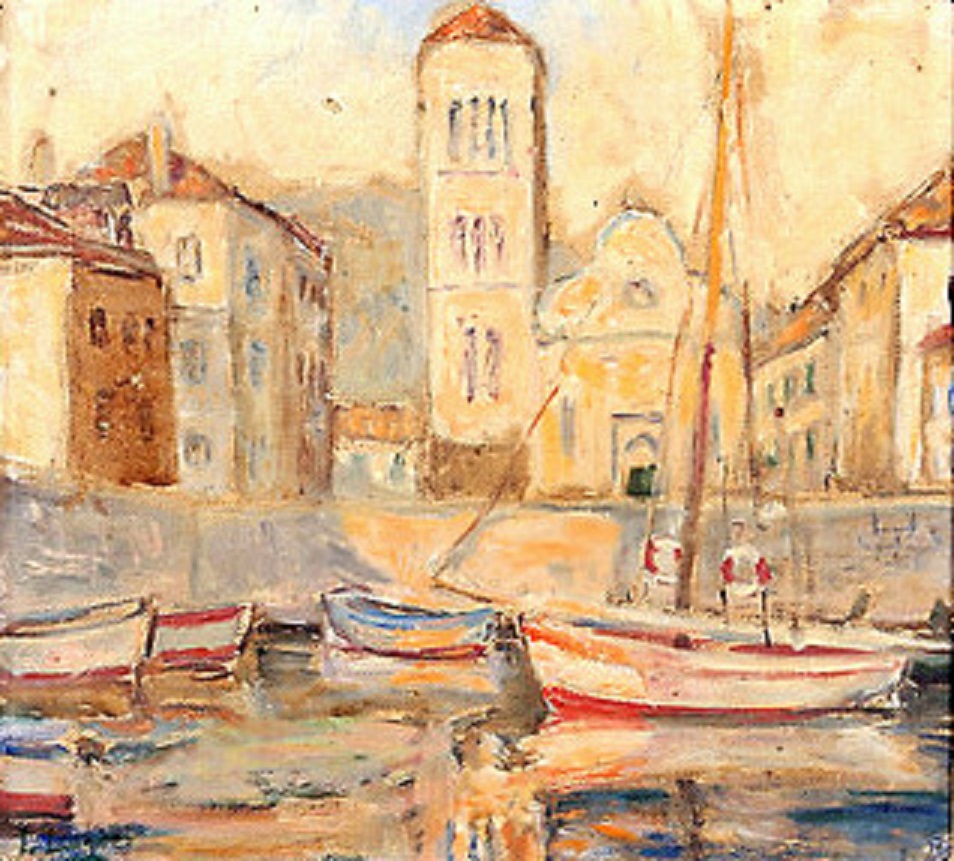
Inez Leander var dotter till filosofiprofessorn P. J. H. Leander i Lund.
The Initiation and Foundation Practices of Free Spiritual Life
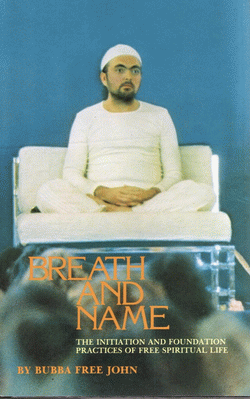
The Dawn Horse Press, 1977
All the ancient traditions agree that the most sublime possibility for any human being is a direct relationship to a living Spiritual Master.
Bubba Free John is such a Master, a Western-born man of God-Realization. His original Teaching, the Way of Divine Ignorance, or Radical Understanding, revives and fulfills the great spiritual expression initiated by Jesus, Gautama, and Krishna in ancient times. The Way itself is uniquely accessible to modern men and women. To all who truly hear his liberating argument and prepare themselves as he recommends, Bubba Free John offers himself in relationship as Divine Master, the transforming function of God.
Breath and Name communicates the Way of Divine Communion, the first stage of practice in the Way of Divine Ignorance. This Way is a path of preparation of body, emotions, and mind for higher or more radical spiritual practice. But as indicated in the introduction and Part I, even this level of practice is priorly enlightened, intelligent, and free of childish and adolescent habits and illusions.
Part II is the heart of the book. Here Bubba presents the dynamic principles of devotion, sacrifice, and dependence on Grace. He shows how the practice of ordinary life-discipline as intentional service to the Spiritual Master and all living beings leads naturally into simple but profound enjoyment of specific spiritual disciplines which he has called the Breath of God and the Name of God. The foundation of the whole Way of spiritual awakening is heart-felt Communion with God as all-pervading Presence, which is Gracefully and spontaneously initiated in the Company of the Spiritual Master.
Even by reading these essays, you may come to enjoy a more intelligent and illumined approach to ordinary life. But the Way itself remains to be realized in practice. Part III of Breath and Name is an instructive commentary on the practical and spiritual disciplines. And the book closes with an invitation to all readers to take up this Way themselves, and make the transition from the usual, deluded, mortal destiny to the purifying fire of life in God.
From their album The Yes Album (1971).
There are two reasons why it is important today to answer this question with a sufficient degree of precision.
The first is that humanism is often conceived today exclusively in terms of secular humanism, as an affirmation of the dignity of man, or humanity, understood in naturalistic terms, and as a negation of theism and sometimes of any real spiritual dimension.
The second is that humanism has long been confused with or in substance identified with what Irving Babbitt called humanitarianism, the sentimental, romantic view of humanity that underlies the modern ideologies, not least underpinning (in the distinctly modern dialectic and synthesis of romanticism and rationalism) the abstractly universalist notion of human rights. Hence it has become a central part of the polemic arsenal deployed against the truths of traditional views of human nature. Increasingly, humanism is attacked and rejected by critics of today’s dominant political correctness as simply part of the latter’s propagandistic terminology.
These partly related developments are most unfortunate. In order to clarify and specify at least much of what I mean by humanism, I will now publish Babbitt’s essay ‘What Is Humanism?’ from his first book, Literature and the American College, published in 1908.
Babbitt was critical of some of the dogmatic positions of orthodox Christianity, although defending other, ethical aspects of it as essential elements of true humanism. But he explicitly and repeatedly affirmed the existence of a higher level of “meditation”, above the humanistic level of ethical “mediation”. Thus not only the less dogmatic tradition of Christian humanism, but Babbitt’s own New Humanism, which was also influenced by his own contribution to the introduction of Eastern thought – primarily Buddhism and Confucianism – in the West, is reconcilable with spirituality and religion as I understand and defend them.
In my texts not least in the category Value-Centered Historicism I have devoted much space to his criticism of humanitarianism, and, more generally, of the modern dynamic of combined rationalism and romanticism. Sometimes, in this criticism, he includes modern philosophical idealism among his targets; Babbitt seems to have kept a significant distance to his philosophical colleagues – Royce and others – at Harvard in the Golden Age of American philosophy.
Partly following Folke Leander and Claes Ryn, but going much further than they, I have tried to show why and how idealism needs to be defended against, or rather, is in fact not invalidated by this criticism; why and how idealism must rather be reformulated in a way which assimilates the New Humanist criticism.
Although dubious and weakened forms of idealism have certainly supported and been part of the distorted humanism that is humanitarianism, the modified and adjusted idealism that would result from the incorporation of the Babbittian analysis is of course likewise harmonizable with the superior spiritual level of “meditation”. I submit, in accordance with my extensive argumentation in my various articles and shorter texts in the Philosophy category (with all its three sub-categories) and other publications, that such idealism is an essential part of true humanism.
Readers familiar with these texts will also, when reading Babbitt’s essay, see more clearly the reasons for my suggested personalistic supplementation and modification of Babbitt’s humanism.
Babbitt’s essay is divided into three parts, following a brief introduction:
–
One of our federal judges said, not long ago, that what the American people need is ten per cent of thought and ninety per cent of action. In that case we ought all to be happy, for that is about what we have already. One is reminded by contrast of an accusation brought by a recent historian of Greek philosophy against Socrates, who, according to this historian, exaggerates the reasonableness of human nature. Only think rightly, Socrates seems to say, and right acting may be counted on to follow. The English and American temper is in this respect almost the reverse of Socratic. Act strenuously, would appear to be our faith, and right thinking will take care of itself. We feel that we can afford to “muddle along” in theory if only we attain to practical efficiency.
This comparative indifference to clearness and consistency of thought is visible even in that chief object of our national concern, education. The firmness of the American’s faith in the blessings of education is equaled only by the vagueness of his ideas as to the kind of education to which these blessings are annexed. One can scarcely consider the tremendous stir we have been making for the past thirty years or more about education, the time and energy and enthusiasm we are ready to lavish on educational undertakings, the libraries and laboratories and endowments, without being reminded of the words of Sir Joshua Reynolds: “A provision of endless apparatus, a bustle of infinite inquiry and research, may be employed to evade and shuffle off real labor – the real labor of thinking.” We live so fast, as the saying is, that we have no time to think. The task of organizing and operating a huge and complex educational machinery has left us scant leisure for calm reflection. Evidently a little less eagerness for action and a little more of the Socratic spirit would do no harm. We are likely, however, to be arrested at the very outset of any attempt to clarify our notions about education, as Socrates was in dealing with the problems of his own time, by the need of accurate definition. The Socratic method is, indeed, in its very essence a process of right defining. It divides and subdivides and distinguishes between the diverse and sometimes contradictory concepts that lurk beneath one word; it is a perpetual protest, in short, against the confusion that arises from the careless use of general terms, especially when they have become popular catchwords. If Socrates were here to-day, we can picture to ourselves how he would go around “cross-examining” those of us (there are some college presidents in the number) who repeat so glibly the current platitudes about liberty and progress, democracy, service, and the like; and he would no doubt get himself set down as a public nuisance for his pains, as he was by his fellow Athenians.
A good example of the confusion rising from general terms is the term that is more important than any other, perhaps, for our present argument. To make a plea for humanism without explaining the word would give rise to endless misunderstanding. It is equally on the lips of the socialistic dreamer and the exponent of the latest philosophical fad. In an age of happy liberty like the present, when any one can employ almost any general term very much as he pleases, it is perhaps inevitable that the term humanism, which still has certain gracious associations lingering about it, should be appropriated by various theorists, in the hope, apparently, that the benefit of the associations may accrue to an entirely different order of ideas. Thus the Oxford philosopher, Mr. F. C. S. Schiller, claims to be a humanist, and in the name of humanism threatens to “do strange deeds upon the clouds“. Renan says that the religion of the future will be a “true humanism”. The utopists who have described their vision of the future as “humanism” or the “new humanism” are too numerous to mention. Gladstone speaks of the humanism of Auguste Comte, Professor Herford of the humanism of Rousseau, and the Germans in general of the humanism of Herder; whereas Comte, Rousseau, and Herder were all three not humanists, but humanitarian enthusiasts. A prominent periodical, on the other hand, laments the decay of the “humanitarian spirit” at Harvard, meaning no doubt humanistic. We evidently need a working definition not only of humanism, but of the words with which it is related or confused – humane, humanistic, humanitarian, humanitarianism. And these words, if successfully defined, will help us to a further necessary definition, – that of the college. For any discussion of the place of literature in the college is conditioned by a previous question: whether there will be any college for literature to have a place in. The college has been brought to this predicament not so much perhaps by its avowed enemies as by those who profess to be its friends. Under these circumstances our prayer, like that of Ajax, should be to fight in the light.
I
The first step in our quest would seem to be to go back to the Latin words (humanus, humanitas) from which all the words of our group are derived. Most of the material we need will be found in a recent and excellent study by M. Gaston Boissier of the ancient meanings of humanitas. From M. Boissier’s paper it would appear that humanitas was from the start a fairly elastic virtue with the Romans, and that the word came to be used rather loosely, so that in a late Latin writer, Aulus Gellius, we find a complaint that it had been turned aside from its true meaning. Humanitas, says Gellius, is incorrectly used to denote a “promiscuous benevolence, what the Greeks call philanthropy”, whereas the word really implies doctrine and discipline, and is applicable not to men in general but only to a select few, – it is, in short, aristocratic and not democratic in its implication. [See Noctes Atticae, xiii, 17.]
The confusion that Gellius complains of is not only interesting in itself, but closely akin to one that we need to be on guard against to-day. If we are to believe Gellius, the Roman decadence was like our own age in that it tended to make love for one’s fellow men, or altruism, as we call it, do duty for most of the other virtues. It confused humanism with philanthropy. Only our philanthropy has been profoundly modified, as we shall see more fully later, by becoming associated with an idea of which only the barest beginnings can be found in antiquity – the idea of progress.
It was some inkling of the difference between a universal philanthropy and the indoctrinating and disciplining of the individual that led Aulus Gellius to make his protest. Two words were probably needed in his time; they are certainly needed today. A person who has sympathy for mankind in the lump, faith in its future progress, and desire to serve the great cause of this progress, should be called not a humanist, but a humanitarian, and his creed may be designated as humanitarianism. From the present tendency to regard humanism as an abbreviated and convenient form for humanitarianism there must arise every manner of confusion. The humanitarian lays stress almost solely upon breadth of knowledge and sympathy. The poet Schiller, for instance, speaks as a humanitarian and not as a humanist when he would “clasp the millions to his bosom”, and bestow “a kiss upon the whole world”. The humanist is more selective in his caresses. Aulus Gellius, who was a man of somewhat crabbed and pedantic temper, would apparently exclude sympathy almost entirely from his conception of humanitas and confine the meaning to what he calls cura et disciplina; and he cites the authority of Cicero. Cicero, however, seems to have avoided any such one-sided view. Like the admirable humanist that he was, he no doubt knew that what is wanted is not sympathy alone, nor again discipline and selection alone, but a disciplined and selective sympathy. Sympathy without selection becomes flabby, and a selection which is unsympathetic tends to grow disdainful.
The humanist, then, as opposed to the humanitarian, is interested in the perfecting of the individual rather than in schemes for the elevation of mankind as a whole; and although he allows largely for sympathy, he insists that it be disciplined and tempered by judgment. One of the most recent attempts to define humanism, that of Brunetière, [Histoire de la littérature française classique, t. 1, p. 28.] who was supposed to be out of touch with his own time, suffers, nevertheless, from our present failure to see in the term anything more than the fullness of knowledge and sympathy. Brunetière thinks he has discovered a complete definition of humanism in the celebrated line of Terence: “Humani nihil a me alienum puto.” This line expresses very well a universal concern for one’s fellow creatures, but fails to define the humanist because of the entire absence of the idea of selection. It is spoken in the play as an excuse for meddling; and might serve appropriately enough as a motto for the humanitarian busybody with whom we are all so familiar nowadays, who goes around with schemes for reforming almost everything – except himself. As applied to literature, the line might be cited as a justification for reading anything, from Plato to the Sunday supplement. Cosmopolitan breadth of knowledge and sympathy do not by themselves suffice; to be humanized these qualities need to be tempered by discipline and selection. From this point of view the Latin literae humaniores is a happier phrase than our English “humane letters,” because of the greater emphasis the Latin comparative puts on the need of selection.
The true humanist maintains a just balance between sympathy and selection. We moderns, even a champion of the past like Brunetière, tend to lay an undue stress on the element of sympathy. On the other hand, the ancients in general, both Greek and Roman, inclined to sacrifice sympathy to selection. Gellius’s protest against confusing humanitas with a promiscuous philanthropy instead of reserving it for doctrine and discipline would by itself be entirely misleading. Ancient humanism is as a whole intensely aristocratic in temper; its sympathies run in what would seem to us narrow channels; it is naturally disdainful of the humble and lowly who have not been indoctrinated and disciplined. Indeed, an unselective and universal sympathy, the sense of the brotherhood of man, as we term it, is usually supposed to have come into the world only with Christianity. We may go farther and say that the exaltation of love and sympathy as supreme and all-sufficing principles that do not need to be supplemented by doctrine and discipline is largely peculiar to our modern and humanitarian era. Historically, Christians have always inclined to reserve their sympathies for those who had the same doctrine and discipline as themselves, and only too often have joined to a sympathy for their own kind a fanatical hatred for everybody else. One whole side of Christianity has put a tremendous emphasis on selection – even to the point of conceiving of God Himself as selective rather than sympathetic (“Many are called, few are chosen”, etc.). We may be sure that stalwart believers like St. Paul or St. Augustine or Pascal would look upon our modern humanitarians with their talk of social problems and their tendency to reduce religion to a phase of the tenement-house question as weaklings and degenerates. Humanitarianism, however, and the place it accords to sympathy is so important for our subject that we shall have to revert to it later. For the present, it is enough to oppose the democratic inclusiveness of our modern sympathies to the aristocratic aloofness of the ancient humanist and his disdain of the profane vulgar (Odi profanum vulgus et arceo). This aloofness and disdain are reflected and in some ways intensified in the humanism of the Renaissance. The man of the Renaissance felt himself doubly set above the “raskall many”, first by his doctrine and discipline and then by the learned medium through which the doctrine and discipline were conveyed. The echo of this haughty humanism is heard in the lines of Milton:
“Nor do I name of men the common rout,
That wandering loose about,
Grow up and perish as the summer fly,
Heads without name, no more remembered.”
Later on this humanistic ideal became more and more conventionalized and associated with a hierarchy of rank and privilege. The sense of intellectual superiority was reinforced by the sense of social superiority. The consequent narrowing of sympathy is what Amiel objects to in the English gentleman: “Between gentlemen, courtesy, equality, social proprieties; below that level, haughtiness, disdain, coldness, indifference…The politeness of a gentleman is not human and general, but quite individual and personal.” It is a pity, no doubt, that the Englishman is thus narrow in his sympathies; but it will be a greater pity, if, in enlarging his sympathies, he allows his traditional disciplines, humanistic and religious, to be relaxed and enervated. The English humanist is not entirely untrue to his ancient prototype even in the faults of which Amiel complains. There is a real relation, as Professor Butcher points out, between the English idea of the gentleman and scholar and the view of the cultivated man that was once held in the intensely aristocratic democracy of Athens.
II
We should of course remember that though we have been talking of ancient humanism and humanists, the word humanist was not used until the Renaissance and the word humanism not until a still later period. In studying the humanism of the Renaissance the significant contrast that we need to note is the one commonly made at this time between humanity and divinity. In its essence the Renaissance is a protest against the time when there was too much divinity and not enough humanity, against the starving and stunting of certain sides of man by mediaeval theology, against a vision of the supernatural that imposed a mortal constraint upon his more purely human and natural faculties. The models of a full and free play of these faculties were sought in the ancient classics, but the cult of the ancients soon became itself a superstition, so that a man was called a humanist from the mere fact of having received an initiation into the ancient languages, even though he had little or nothing of the doctrine and discipline that the term should imply. Very few of the early Italian humanists were really humane. For many of them humanism, so far from being a doctrine and discipline, was a revolt from all discipline, a wild rebound from the mediaeval extreme into an opposite excess. What predominates in the first part of the Renaissance is a movement of emancipation – emancipation of the senses, of the intellect, and in the northern countries of the conscience. It was the first great modern era of expansion, the first forward push of individualism. As in all such periods, the chief stress is on the broadening of knowledge, and, so far as was compatible with the humanistic exclusiveness, of sympathy. The men of that time had what Emerson calls a canine appetite for knowledge. The ardor with which they broke away from the bonds and leading-strings of mediaeval tradition, the exuberance with which they celebrated the healing of the long feud between nature and human nature, obscured for a time the need of decorum and selection. A writer like Rabelais, for instance, is neither decorous nor select; and so in spite of his great genius would probably have seemed to a cultivated ancient barbaric rather than humane. Such a disorderly and undisciplined unfolding of the faculties of the individual, such an overemphasis on the benefits of liberty as compared with the benefits of restraint, brought in its train the evils that are peculiar to periods of expansion. There was an increase in anarchical self-assertion and self-indulgence that seemed a menace to the very existence of society; and so society reacted against the individual and an era of expansion was followed by an era of concentration. This change took place at different times, and under different circumstances, in different countries. In Italy the change coincides roughly with the sack of Rome (1527) and the Council of Trent; in France it follows the frightful anarchy of the wars of religion and finds political expression in Henry IV, and literary expression in Malherbe. Of course in so complex a period as the Renaissance we must allow for innumerable eddies and crosscurrents and for almost any number of individual exceptions. In an age as well as in an individual there are generally elements, often important elements, that run counter to the main tendency. But if one is not a German doctor who has to prove his “originality”, or a lover of paradox for its own sake, it is usually possible to discern the main drift in spite of the eddies and counter-currents.
We may affirm, then, that the main drift of the later Renaissance was away from a humanism that favored a free expansion toward a humanism that was in the highest degree disciplinary and selective. The whole movement was complicated by what is at bottom a different problem, the need that was felt in France and Italy, at least, of protecting society against the individual. One can insist on selection and discipline without at the same time being so distrustful of individualism. Many of the humanists of this period fell into hardness and narrowness (in other words, ceased to be humane) from overemphasis on a discipline that was to be imposed from without and from above, and on a doctrine that was to be codified in a multitude of minute prescriptions. The essence of art, according to that highly astringent genius, Scaliger, who had a European influence on the literary criticism of this age, is electio et fastidium sui – selection and fastidiousness toward one’s self (in practice Scaliger reserved his fastidiousness for other people). This spirit of fastidious selection gained ground until instead of the expansive Rabelais we have the exclusive Malherbe, until a purism grew up that threatened to impoverish men’s ideas and emotions as well as their vocabulary. Castiglione had said in his treatise on the Courtier up of the gentleman an element of aloofness and disdain (sprezzatura), a saying that, properly interpreted, contains a profound truth. Unfortunately, aristocratic aloofness, coupled with fastidious selection and unleavened by broad and sympathetic knowledge, leads straight to the attitude that Voltaire has hit off in his sketch of the noble Venetian lord Pococurante, – to the type of scholar who would be esteemed, not like the man of today by the inclusiveness of his sympathies, but by the number of things he had rejected. Pococurante had cultivated sprezzatura with a vengeance, and rejected almost everything except a few verses of Virgil and Horace. “What a great man is this Pococurante!” says the awe-stricken Candide; “nothing can please him”.
The contrast between the disciplinary and selective humanism of the later Renaissance and the earlier period of expansion should not blind us to the underlying unity of aim. Like the ancient humanists whom they took as their guides, the men of both periods aimed at forming the complete man (totus, teres atque rotundus). But the men of the later period and the neo-classicists in general hoped to attain this completeness not so much by the virtues of expansion as by the virtues of concentration. It seemed to them that the men of the earlier period had left too much opening for the whims and vagaries of the individual; and so they were chiefly concerned with making a selection of subjects and establishing a doctrine and discipline that should be universal and human. To this end the classical doctrine and discipline were to be put into the service of the doctrine and discipline of Christianity. This attempt at a compromise between the pagan and Christian traditions is visible both in Catholic countries in the Jesuit schools, and in Protestant countries in the selection of studies that took shape in the old college curriculum. No doubt the selection of both divinity and humanity that was intended to be representative was inadequate; and no doubt the whole compromise between doctrines and disciplines, that were in many respects divergent and in some respects hostile, laid itself open to the charge of being superficial. The men of the early Renaissance had felt more acutely the antagonism between divinity as then understood and humanity, and had often taken sides uncompromisingly for one or the other. Machiavelli accused Christianity of having made the world effeminate, whereas Luther looked on the study of the pagan classics, except within the narrowest bounds, as pernicious. Calvin execrated Rabelais, and Rabelais denounced Calvin as an impostor. Yet, after all, the effort to make the ancient humanities and arts of expression tributary to Christianity was in many respects admirable, and the motto that summed it up, sapiens atque eloquens pietas, might still, if properly interpreted, be used to define the purpose of the college.
A desideratum of scholarship at present is a study of the way certain subjects came to be selected as representative and united into one discipline with elements that were drawn from religion; we need, in short, a more careful history than has yet been written of the old college curriculum. Closely connected with this and equally needful is a history of the development of the gentleman, going back to the work of Castiglione and other Italian treatises on manners in the sixteenth century, and making clear especially how the conception of the gentleman came to unite with that of the scholar so as to form an ideal of which something still survives in England. A Castiglione in Italy and a Sir Philip Sidney in England already realize the ideal of the gentleman and scholar, and that with the splendid vitality of the Renaissance. But a Scaliger, for all his fastidious selection, remains a colossal pedant. In general, it is only under French influence that scholarship gets itself disengaged from pedantry and acquires urbanity and polish, that the standards of the humanist coalesce with those of the man of the world. But it is likewise under French influence that the ideal of the gentleman and scholar is externalized and conventionalized, until in some of the later neo-classic Pococurantes it has degenerated into a mixture of snobbishness and superficiality, until what had once been a profound insight becomes a mere polite prejudice. We must not, however, be like the leaders of the great romantic revolt who, in their eagerness to get rid of the husk of convention, disregarded also the humane aspiration. Even in his worst artificiality, the neo-classicist is still related to the ancient humanist by his horror of one-sidedness, of all that tends to the atrophy of certain faculties and the hypertrophy of others, by his avoidance of everything that is excessive and over-emphatic; and, inasmuch as it is hard to be an enthusiast and at the same time moderate, by his distrust of enthusiasm. He cultivates detachment and freedom from affectation (sprezzatura) and wonders at nothing (nil admirari); whereas the romanticist, as all the world knows, is prone to wonder at everything – especially at himself and his own genius. In his appearance and behavior, the neo-classicist would be true to the general traits of human nature, and is even careful to avoid technical and professional terms in his writing and conversation. “Perfected good breeding”, says Dr. Johnson, “consists in having no particular mark of any profession, but a general elegance of manners.” (A standard that Dr. Johnson himself did not entirely attain.) At the bottom of the whole point of view is the fear of specialization. “The true gentleman and scholar” (honnête homme), says La Rochefoucauld, “is he who does not pride himself on anything.” We may contrast this with a maxim that is sometimes heard in the American business world: A man who knows two things is damned. In other words, the man of that time would rather have been thought superficial than one-sided, the man of today would rather be thought one-sided than superficial.
III
We may perhaps venture to sum up the results of our search for a definition of humanism. We have seen that the humanist, as we know him historically, moved between an extreme of sympathy and an extreme of discipline and selection, and became humane in proportion as he mediated between these extremes. To state this truth more generally, the true mark of excellence in a man, as Pascal puts it, is his power to harmonize in himself opposite virtues and to occupy all the space between them (tout l’entredeux). By his ability thus to unite in himself opposite qualities man shows his humanity, his superiority of essence over other animals. Thus Saint François de Sales, we are told, united in himself the qualities of the eagle and the dove – he was an eagle of gentleness. The historian of Greek philosophy we have already quoted remarks on the perfect harmony that Socrates had attained between thought and feeling. If we compare Socrates in this respect with Rousseau, who said that “his heart and his head did not seem to belong to the same individual,” we shall perceive the difference between a sage and a sophist. Man is a creature who is foredoomed to one-sidedness, yet who becomes humane only in proportion as he triumphs over this fatality of his nature, only as he arrives at that measure which comes from tempering his virtues, each by its opposite. The aim, as Matthew Arnold has said in the most admirable of his critical phrases, is to see life steadily and see it whole; but this is an aim, alas, that no one has ever attained completely – not even Sophocles, to whom Arnold applies it. After man has made the simpler adjustments, there are other and more difficult adjustments awaiting him beyond, and the goal is, in a sense, infinitely remote.
For most practical purposes, the law of measure is the supreme law of life, because it bounds and includes all other laws. It was doubtless the perception of this fact that led the most eminent personality of the Far East, Gotama Buddha, to proclaim in the opening sentence of his first sermon that extremes are barbarous. But India as a whole failed to learn the lesson. Greece is perhaps the most humane of countries, because it not only formulated clearly the law of measure (“nothing too much”), but also perceived the avenging nemesis that overtakes every form of insolent excess (ὕβρις) or violation of this law.
Of course, even in Greece any effective insight into the law of measure was confined to a minority, though at times a large minority. The majority at any particular instant in Greece or elsewhere is almost sure to be unsound, and unsound because it is one-sided. We may borrow a homely illustration from the theory of commercial crises. A minority of men may be prudent and temper their enterprise with discretion, but the majority is sure to over-trade, and so unless restrained by the prudent few will finally bring on themselves the nemesis of a panic. The excess from which Greek civilization suffered should be of special interest, because it is plain that so humane a people could not have failed to make any of the ordinary adjustments. Without attempting to treat fully so difficult a topic, we may say that Greece, having lost its traditional standards through the growth of intellectual skepticism, fell into a dangerous and excessive mobility of mind because of its failure to develop new standards that would unify its life and impose a discipline upon the individual. It failed, in short, to mediate between unity and diversity, or, as the philosophers express it, between the absolute and the relative. The wisest Greek thinkers, notably Socrates and Plato, saw the problem and sought a solution; but by putting Socrates to death Athens made plain that it was unable to distinguish between its sages and its sophists.
There is the One, says Plato, and there is the Many. “Show me the man who can combine the One with the Many and I will follow in his footsteps, even as in those of a God.” [Phaedrus, 266 B. The Greeks in general did not associate the law of measure with the problem of the One and the Many. Aristotle, who was in this respect a more representative Greek than Plato, can scarcely be said to have connected his theory of the contemplative life or attainment to a sense of the divine unity, with his theory of virtue as a mediating between extremes.] To harmonize the One with the Many, this is indeed a difficult adjustment, perhaps the most difficult of all, and so important, withal, that nations have perished from their failure to achieve it. Ancient India was devoured by a too overpowering sense of the One. The failure of Greece, on the other hand, to attain to this restraining sense of unity led at last to the pernicious pliancy of the “hungry Greekling”, whose picture Juvenal has drawn.
The present time in its loss of traditional standards is not without analogy to the Athens of the Periclean age; and so it is not surprising, perhaps, that we should see a refurbishing of the old sophistries. The so-called humanism of a writer like Mr. F. C. S. Schiller has in it something of the intellectual impressionism of a Protagoras. [Mr. Schiller himself points out this connection (see Humanism, p. xvii). As will appear clearly from a later passage (pp. 136 ff.) I do not quarrel with the pragmatists for their appeal to experience and practical results, but for their failure, because of an insufficient feeling for the One, to arrive at real criteria for testing experience and discriminating between judgments and mere passing impressions.] Like the ancient sophist, the pragmatist would forego the discipline of a central standard, and make of individual man and his thoughts and feelings the measure of all things. “Why may not the advancing front of experience”, says Professor James, “carrying its imminent satisfaction and dissatisfaction, cut against the black inane, as the luminous orb of the moon cuts against the black abyss?” [Humanism and Truth, p. 16.] But the sun and moon and stars have their preordained courses, and do not dare, as the old Pythagoreans said, to transgress their numbers. To make Professor James’s metaphor just, the moon would need to deny its allegiance to the central unity, and wander off by itself on an impressionistic journey of exploration through space. It is doubtless better to be a pragmatist than to devote one’s self to embracing the cloud Junos of Hegelian metaphysics. But that persons who have developed such an extreme sense of the otherwiseness of things as Professor James and his school should be called humanists – this we may seriously doubt. There would seem to be nothing less humane – or humanistic – than pluralism pushed to this excess, unless it be monism pushed to a similar extremity.
The human mind, if it is to keep its sanity, must maintain the nicest balance between unity and plurality. There are moments when it should have the sense of communion with absolute being, and of the obligation to higher standards that this insight brings; other moments when it should see itself as but a passing phase of the everlasting flux and relativity of nature; moments when, with Emerson, it should feel itself “alone with the gods alone”; and moments when, with Sainte-Beuve, it should look upon itself as only the “most fugitive of illusions in the bosom of the infinite illusion”. If man’s nobility lies in his kinship to the One, he is at the same time a phenomenon among other phenomena, and only at his risk and peril neglects his phenomenal self. The humane poise of his faculties suffers equally from an excess of naturalism and an excess of supernaturalism. We have seen how the Renaissance protested against the supernaturalist excess of the Middle Ages, against a one-sidedness that widened unduly the gap between nature and human nature. Since that time the world has been tending to the opposite extreme; not content with establishing a better harmony between nature and human nature, it would close up the gap entirely. Man, according to the celebrated dictum of Spinoza, is not in nature as one empire in another empire, but as a part in a whole. Important faculties that the supernaturalist allowed to decay the naturalist has cultivated, but other faculties, especially those relating to the contemplative life, are becoming atrophied through long disuse. Man has gained immensely in his grasp on facts, but in the meanwhile has become so immersed in their multiplicity as to lose that vision of the One by which his lower self was once overawed and restrained. “There are two laws discrete,” as Emerson says in his memorable lines; and since we cannot reconcile the “Law for man” and the “Law for thing”, he would have us preserve our sense for each separately, and maintain a sort of “double consciousness,” a “public” and a “private” nature; and he adds in a curious image that a man must ride alternately on the horses of these two natures, “as the equestrians in the circus throw themselves nimbly from horse to horse, or plant one foot on the back of one and the other foot on the back of the other”.
There is, perhaps, too much of this spiritual circus-riding in Emerson. Unity and plurality appear too often in his work, not as reconciled opposites, but as clashing antinomies. He is too satisfied with saying about half the time that everything is like everything else, and the rest of the time that everything is different from everything else. And so his genius has elevation and serenity, indeed, but at the same time a disquieting vagueness and lack of grip in dealing with particulars. Yet Emerson remains an important witness to certain truths of the spirit in an age of scientific materialism. His judgment of his own time is likely to be definitive:
“Things are in the saddle
And ride mankind.”
Man himself and the products of his spirit, language, and literature, are treated not as having a law of their own, but as things; as entirely subject to the same methods that have won for science such triumphs over phenomenal nature. The president of a congress of anthropologists recently chose as a motto for his annual address the humanistic maxim: “The proper study of mankind is man”; and no one, probably, was conscious of any incongruity. At this rate, we may soon see set up as a type of the true humanist the Chicago professor who recently spent a year in collecting cats’-cradles on the Congo.
The humanities need to be defended to-day against the encroachments of physical science, as they once needed to be against the encroachment of theology. But first we must keep a promise already made, and in the following essay try to trace from its origins that great naturalistic and humanitarian movement which is not only taking the place of the humanistic point of view, but actually rendering it unintelligible for the men of the present generation.
Man hör nu hela tiden svenskar verkligen ta i för att få fram det specifika amerikanska uttalet av “matter” (“madder”, ungefär som “ladder”). Utan tvekan tror de att det är det enda rätta engelska uttalet. Stoppa amerikaniseringen.

 Olle Bengtsson