February 2003 1-3
Category: History
Christian Vandermotten & Bernard Dézert: L’identité de l’Europe
Histoire et géographie d’une quête d’unité
Armand Colin, 2009 Amazon.fr
Présentation de l’éditeur:
 À l’heure de l’affirmation des grands blocs régionaux dans le monde, l’Europe continue à se chercher en posant la question de son identité.
Expliquer l’identité de l’Europe est bien l’ambition du présent ouvrage. Par la géographie et la profondeur chronologique qu’apporte l’approche historique, il s’appuie sur la complexité pour montrer l’importance des continuités et des ruptures au cours des âges.
II pose la question essentielle pour la construction de l’unité européenne : les particularismes régionaux et le nouvel essor des nationalismes sont-ils un obstacle ? Ou bien sont-ils les symptômes d’une réaction générale à l’impact de l’économie mondialisée en réseau qui s’impose en Europe comme ailleurs dans le monde ? Car la confrontation a lieu entre cette globalisation – et ses effets environnementaux – et les diversités culturelles et économiques intérieures du continent européen.
Les auteurs examinent la variété des paysages et des héritages, en les restituant dans leur cadre physique. Ils considèrent les rapports entre l’Europe et le reste du monde, posant ainsi la question des frontières de l’Union.
Par son approche originale, l’ouvrage s’adresse autant aux historiens et aux géographes qu’aux économistes, politistes et aménagistes.
Biographies des auteurs:
Christian Vandermotten, géographe et urbaniste, est professeur à l’Université libre de Bruxelles, est président de la Société royale belge de géographie et président de l’association des sociétés européennes de géographie (EUGEO).
Bernard Dézert, géographe et urbaniste, est professeur émérite à l’Université de Paris-Sorbonne et secrétaire général-adjoint de la Société de géographie de Paris.
L’un et l’autre ont participé à de nombreux réseaux de recherche sur les problèmes européens.
Thomas Fleming: The Illusion of Victory
America in World War I
Basic Books, 2003
Book Description:
 The political history of the American experience in World War I is a story of conflict and bungled intentions that begins in an era dedicated to progressive social reform and ends in the Red Scare and Prohibition. Thomas Fleming tells this story through the complex figure of Woodrow Wilson, the contradictory president who wept after declaring war, devastated because he knew it would destroy the tolerance of the American people, but who then suppressed freedom of speech and used propaganda to excite America into a Hun-hating mob. This is tragic history: inexperienced American military leaders drove their troops into gruesome slaughters; progressive politics were put on hold in America; an idealistic president’s dreams were crushed because of his own negligence. Wilson’s inability to convince Congress to ratify U.S. membership in the League of Nations was one of the most poignant failures in the history of the American presidency, but even more heartrending were Wilson’s concessions to his bitter allies in the Treaty of Versailles. In exchange for Allied support of the League of Nations, he allowed an unfair peace treaty to be signed, a treaty that played no small role in the rise of National Socialism and the outbreak of World War II. Thomas Fleming has once again created a masterpiece of narrative American history. This incomparable portrait shows how Wilson sacrificed his noble vision to megalomania and single-mindedness, while paying homage to him as a visionary whose honorable spirit continues to influence Western politics.
Book Description (paperback edition, 2004):
In this sweeping historical canvas, Thomas Fleming undertakes nothing less than a drastic revision of our experience in World War I. He reveals how the British and French duped Wilson into thinking the war was as good as won, and there would be no need to send an army overseas. He describes a harried president making speech after speech proclaiming America’s ideals while supporting espionage and sedition acts that sent critics to federal prisons. And he gives a harrowing account of how the Allies did their utmost to turn the American Expeditionary Force into cannon fodder on the Western Front.Thoroughly researched and dramatically told, The Illusion of Victory offers compelling testimony to the power of a president’s visionary ideals-as well as a starkly cautionary tale about the dangers of applying them in a war-maddened world.
Review:
“[Fleming’s] latest book is filled with wonderful quotations, salient facts and deft characterizations …. He tells a gripping story.” New Leader
About the Author:
Thomas Fleming is the author of more than forty books, including The New Dealers’ War, Duel, and Liberty! The American Revolution, as well as best-selling novels about America’s war experience such as Time and Tide and The Officers’ Wives. Fleming is a frequent guest on and contributor to NPR, PBS, A&E, and the History Channel. He lives in New York City and Westbrook, Connecticut.
Origins of the Pantheistic Revolution
The possibility of the utopian distortion of the meaning of the metaxy had been present from the beginning. When the concrete experience of the higher reason’s opening to transcendence and the concomitant experience of the limitation and imperfection of the immanent sphere were lost, the results of differentiation could easily be construed as an abstract rational blueprint for social reorganization, in line with the generalistic trend of Greek throught and its apprehension of nature in contradistinction to convention. Burke turned against the ‘thoroughbred metaphysicians’ of the Enlightenment, and his historicist followers today see no mystery in the development of Strauss’s analysis and endorsement of the classics more or less into the same kind of Jacobin ideology of democratic imperialism. [See Ryn, The New Jacobinism: America as Revolutionary State (2011 (1991)), and America the Virtuous: The Crisis of Democracy and the Quest for Empire (2003).] While the differentiated experience did reveal a transcendent, divine order with a moral dimension, and this revelation guided the development of the Christian concept of natural right, the utopian mindset, without full access to the engendering experience, could transfer the claims of perfection to its own limited schemes, and posit the latter, in stark opposition to history and convention, as guiding principles for comprehensive social revolution.
This potentiality of a kind of “totalitarianism” – or of a limited vision oppressively posited as a false totality – and some of the later monistic developments of Platonism were, however, combined with, added to, and in some cases replaced by the corresponding Israelite and Christian distortion of differentiational experience. The resultant Gnosticism and Hermeticism, or what I shall henceforward call the esoteric tradition, has – while containing some noble, valuable, and interesting variations – in some of its central characteristics been of decisive importance as a subsequently ever-present threat to differentiational and person-centered civilization. The esoteric tradition can today be seen to have shaped Western modernity from the outset, and, directly and indirectly, almost in its entirety.
This tradition, of which from the earliest stages monistic mysticism was a part, the Schwärmerei of the millenarian sects, and the rationalism of the philosophers (in the late medieval period added to by the influence of Averroism), combined to set in motion what I suggest could be called a pantheistic revolution, a revolution which, through ever bolder syntheses, comprised the most important modes of impersonalistic thought and practice of the modern West.
This was not a return to the early pantheism of the cosmological civilizations, which was in its own way ordered and structured, where the elements of differentiation were present in compact form, where they were undiscovered in their true nature yet not denied. It was a search, theoretical as well as violently practical, and driven by the failure to live with the tension of the metaxy, for a new kind of pantheism, for a new kind of closed immanence, a re-divinized immanence without order and structure, and filled with new content. To this day, and with unabated vigour, its impersonalistic momentum undermines in ever new and shifting expressions the moral, humanistic, and religious values of which the person is the most important bearer.
Richard M. Gamble: The War for Righteousness
Progressive Christianity, the Great War, and the Rise of the Messianic Nation
ISI Books, 2003 Amazon.com
Back Cover:
 In The War for Righteousness, Richard Gamble tells the story of how progressive Christian leaders in America transformed themselves from principled pacifists to crusading interventionists at the time of the First World War. Gamble reconstructs the inner world of the social gospel clergy, showing how they came to see their task as evangelists for the new creeds of democracy and internationalism, and ultimately for the redemption of civilization itself through the agency of total war. World War I thus became a transcendent moment of fulfillment. Gamble also engages the broader questions of religion’s role in shaping the modern American mind and the development, at the deepest levels, of the logic of messianic interventionism – the idea that America has been destined by divine Providence to bring a kind of secular salvation to the less enlightened nations of the world. This timely book not only fills a significant gap in our collective memory of the Great War, it also helps demonstrate how and why that war heralded the advent of a different American self-understanding.
“Gamble’s insight could scarcely be keener, nor his timing better. From Bunker Hill to Baghdad, America’s wars have always been ‘holy’ because Americans, from the Puritans of old to the secular liberals, neoconservatives, and evangelicals of today, imagine their country a promised land with a calling to redeem the world…if necessary, by force. The War for Righteousness brilliantly parses the ‘progressive’ theology sustaining that mission.” Walter A. McDougall, University of Pennsylvania, Pulitzer Prize-winning historian
“The War for Righteousness is ‘relevant’ history in the best sense. Nobody can claim to understand truly the role of the United States government in the world today unless he has been over the ground that Gamble has covered. It is impossible to overestimate the contribution of this book to American self-understanding.” Clyde N. Wilson, Professor of History, University of South Carolina
“This is a splendid study of progressive Christianity and its political significance before and during the Great War. Gamble perceptively explains the important connection between a spiritually dubious form of Christianity and a desire for international political crusading. This fine historical work is also highly relevant to assessing present moralistic calls for American empire.” Claes G. Ryn, Professor of Political Science, Catholic University of America
About the Author:
Richard M. Gamble is Assistant Professor of History at Palm Beach Atlantic University in West Palm Beach, Florida, where he has tauht in the history and honors programs since 1994. He is also a Visiting Scholar at St. Edmund’s College, Cambridge University, and regularly returns to the Western Front to lead travel-study programs on the Battle of Verdun. His essays and reviews have appeared in Humanitas, the Journal of Southern History, Chronicles, the Independent Review, and Ideas on Liberty.
JOB’s Comment:
I think Gamble is now at Hillsdale College. I met him at a colloquium in Savannah, GA in 2000. A charming, humble scholar, thoroughly familiar with the work of Irving Babbitt, which is fundamental to his analysis in this book.
Thomas J. Knock: To End All Wars
Woodrow Wilson and the Quest for a New World Order
Princeton University Press, 1995 Amazon.com
Book Description:
 In his widely acclaimed To End All Wars, Thomas Knock provides an intriguing, often provocative narrative of Woodrow Wilson’s epic quest for a new world order. The account follows Wilson’s thought and diplomacy from his policy toward revolutionary Mexico, through his dramatic call for “Peace without Victory” in World War I, to the Senate’s rejection of the League of Nations. Throughout Knock explores the place of internationalism in American politics, sweeping away the old view that isolationism was the cause of Wilson’s failure and revealing the role of competing visions of internationalism – conservative and progressive.
About the Author:
Thomas J. Knock received his A.B. from Miami University, his M.A. from Boston College, and his Ph.D. from Princeton University. His articles have appeared in American Quarterly, Political Science Quarterly, Reviews in American History, and several anthologies. A native of Harrison, Ohio (near Cincinnati), he lives in Dallas, Texas and is Associate Professor of History at Southern Methodist University.
JOB’s Comment:
The full phrase, used by Wilson and others, was of course “the war to end all wars”. As was soon remarked, the war led to a peace to end all peace. Others were responsible for the terms of that peace, but Wilson was, I think, responsible for disastrously prolonging the war, and certainly for implementing and expanding decisively the new policy of American intervention in the name of international democratism. The epic tragedy of the “new world order”, having reached the post-national stage, far beyond the Wilsonian one of alleged national self-determination vs the old empires, continues to win “victories” without peace (let alone true freedom and civilization): “Perpetual war for perpetual peace”, as Charles Beard called it. But although many of them need to be understood in a different light, important facts are presented in this book. We have by now a vast and unambiguous historical experience of the problematic nature and the errors of twentieth-century “internationalism” and its underlying ideology and interests. But along with it, and properly taking it into account, we need a vision of an alternative internationalism. For this purpose, some of the discussion here of the “competing visions” of internationalism at the time of Wilson is worth considering.
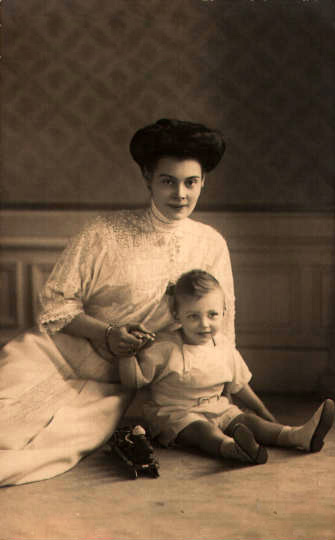
Kronprinzessin Cecilie
& Prinz Wilhelm
Teori i svensk idé- och lärdomshistoria, 7
Teori i svensk idé- och lärdomshistoria, 1
Teori i svensk idé- och lärdomshistoria, 2
Teori i svensk idé- och lärdomshistoria, 3
Teori i svensk idé- och lärdomshistoria, 4
Teori i svensk idé- och lärdomshistoria, 5
Teori i svensk idé- och lärdomshistoria, 6
”Lindroth uttryckte en gång”, skriver Liedman, ”sin syn på forskning med orden att det gällde att ’huvudstupa kasta sig ner i ett hav av fakta’. Aspelin krävde snarare dykarklocka med en ordentlig vetenskaplig apparatur ombord.” Jag delar här Aspelins uppfattning som naturligtvis också är Liedmans, även om dykarklockan bör vara en annan och annorlunda utrustad än främst den senares.
Men det följer också av vad jag här sagt att det är viktigt att inte fastna i den olyckliga dikotomi mellan en rent tidlös och apriorisk, på rationella grunder vunnen vetenskaplig apparatur, inklusive urvalet (m.m.) möjliggörande värderingar, å ena sidan, och den historiska empirins hav av relativa och relativiserande fakta å den andra, som präglade exempelvis nykantianernas försök till lösning av vad som uppfattades som ”historicismens kris”. Vår historievetenskapligt-teoretiska apparatur, såväl som vår insikt i sanningen, objektiviteten, de normerande värdena, kan vi normalt endast vinna genom ett dialektiskt samspel med den historiska empirin själv. Om den senare uppfattades som enbart relativiserande, berodde det förvisso på bristen på avancerad filosofisk penetration och belysning, men om å andra sidan den vetenskapliga objektiviteten ansågs kunna nås i det isolerade nuet genom blott rationalistiskt filosoferande, var detta givetvis i hög grad en illusion.
Den på många sätt frustrerande inkonklusivitet som inte minst i historiska framställningar tycks prägla striderna rörande historicismen och vetenskapligheten alltifrån historicismens begynnande ”kris”, Nietzsche, nykantianerna, Dilthey, Weber, Troeltsch och fram till Heideggers framträdande, har lett till en olycklig uppgivenhet och ett alltför långtgående accepterande av nietzscheanska och heideggerianska ”utvägar”. Med den både intellektuellt krävande och tålamodsprövande urskillning som är nödvändig för att frigöra oss från de teoretiska uttrycken för de delar av den äldre historicismens historiesyn som sedan länge upplevs som ohållbara, kan vi, föreslår jag, idag också se att i arvet från dessa debatter i själva verket även ryms outnyttjade teoretiska potentialer, som idag är tillgängliga för en nyformulering av humanvetenskapernas innebörd och egenart.
Denna tillägnelse kan dock naturligtvis inte ske utan en samtidig filosofisk nybearbetning under mobilisering av ytterligare andra teoretiska resurser. Först härigenom kan vad som hittills framstått som oförenligheter uppvisas som möjliga komplementariteter. Jag har föreslagit att härvid åtminstone en av de nödvändiga nya resurserna, utöver subjektets modifierade rekonstruktion och idealismens allmänna återkomst enligt ovan, är den typ av värdecentrerad historicism som i Folke Leanders efterföljd och i fortsatt tillägnelse av Irving Babbitts humanism och Benedetto Croces idealism börjat utvecklas av Claes G. Ryn, och som, oavsett dess sanningar i övrigt, kan delvis omformuleras och tillämpas i historievetenskapligt-teoretiska termer.
Aspelin var i hög grad formad av de före nypositivismens genomslag dominerade teoretiska och filosofiska debatterna. ”Aspelin blev”, skriver Liedman, ”den siste filosofiprofessor i Sverige som bedrev filosofihistoria i traditionell mening, d.v.s. en filosofihistoria som inte enbart likt den wedbergska dissekerar förflutna tankar för att framställa preparat för nutida bruk utan som har ett genuint intresse av historiska omständigheter kring tankarna.” Tilläggas kan att till den ”traditionella” filosofihistorien måste sägas höra inte blott de från de wedbergska ”rationella rekonstruktionerna” skilda ”historiska rekonstruktionerna” (för att använda den gängse terminologin), utan också den enligt ovan oundvikliga typ av filosofihistoria i vilken också, på annat sätt än i de rena rationella rekonstruktionerna, stundom för vissa bestämda syften och på visst bestämt sätt finns närvarande den filosofiska aspekten och värdeaspekten – såtillvida som själva den egna utgångspunkten och den historiska förståelsen är oskiljaktiga från denna dimension. I den lundensiska traditionen representeras den traditionella filosofihistorien också av såväl Axel Nyblaeus som Hans Larsson – och inte minst den senare visade hur sådan filosofihistoria kunde förenas med en annan typ av betonande av historiska filosofers betydelse för samtiden. Men traditionella filosofihistoriker har i Sverige sedan länge tvingats övergå till idé- och lärdomshistoria, och idag representeras kontinuiteten i Lund av Svante Nordin, som började sin akademiska karriär som filosof.
Detta är också något helt annat än den typ av föregiven Geistesgeschichte som Richard Rorty, på filosofiskt groteskt sätt förenande postmodernismen inte bara med den amerikanska pragmatismen utan också med fysikalismen, förespråkar. Den gamla tyska historievetenskapens förmenta eunucker som Nietzsche vände sig mot lyckades åtminstone i någon mån bevara kvinnorna i det förflutnas harem, även om den tyngande och relativiserande empiri som blev resultatet av deras arbete i åtminstone några fall förvisso kunde tendera att göra dem själva könlösa. Det är emellertid en illusion att tro att Rorty bara vill befria kvinnorna från eunuckernas beskydd och låta dem möta oss som de är. Om historicisternas epistemologiska vetenskaplighet delvis innebar en inadekvat behandling, är Rortys i själva verket en långt allvarligare sådan. För Rorty rymmer det förflutna för nuet farliga idéer. I verkligheten är det för Rorty så att det inte räcker med att oskadliggöra dessa idéer, utan de måste måste aktivt omtolkas och förvrängas för att passa nuets behov – behov av ett helt annat slag än såväl Nietzsches som Heideggers, och i flera avseenden faktiskt i själva verket betydligt närmare Wedbergs.
Det behöver inte förklaras i vilken utsträckning ett sådant projekt var främmande för en Larsson eller en Nyblaeus. Den humanistiska filosofihistorien förenade den historiska rekonstruktionen med nuets anspråkslösa beredvillighet att lyssna och lära av det förflutna. Det förtjänar i detta sammanhang också att erinras om att det betonande av oundvikligheten i våra Vorverständnisse, som Lindberg ironiserar över, också, och just genom medvetandegörandet av dessa, kan syfta till att möjliggöra just den mer elementära historiska förståelse som Lindberg själv efterlyser.
Gnostic Escape from the Metaxy
It was not just the historical legacy of the patterns of cosmological civilization itself – patterns which the Hellenic and Roman empires had displayed and reinforced long after the differentiational shift had first influenced Greek and Roman culture – that continued to threaten the unique potentiality of a person-centered civilization ordered in accordance with the experience of differention and with the new element of selective flexibility with regard to human social arrangements that it both allowed and required. Temptation to yield to the pantheistic pull was produced by the tension of the metaxy itself, inasmuch as it often remained too demanding even with the availability in principle of divine grace.
This was not only the temptation of releasing or escaping from the tension through a relapse into early pantheism, into the historically existing forms of closed cosmic immanence, through spiritual retrogression to the womb of divinized nature or community. As Voegelin shows, there also developed from an early stage another and different temptation: a future-oriented temptation to close by novel means the sometimes seemingly unbearable gap between perfection and impefection and to throw off the burden of responsibility for the free choice of destiny.
This could only be done by denying the true import of the differentiational experience. The denial could take two forms. One could either, seizing on the differentiational awareness of perfection, try, in its light, to efface imperfection, to impose perfection on the immanent order. This implied a denial of the distance between imperfect human nature and transcendent perfection, of the impossibility of man’s full possession qua man or even finite soul of the qualities of transcendence, and of the constitutive limits of the immanent order and thus of its reformability. Or, still seizing on the new awareness of perfection, one could simply deny the imperfection of the immanent sphere, by proclaiming it to be divine according to the new standard.
Both of these strategies were attempted. Through them, the demanding, open undecidedness of differentiation would again be closed, and the individual would be rid of the responsibility that followed from the clear perception of reality – the reality of perfection, of imperfection, of the hiatus between them, and of the inescapability of his own free decision in favour of orientation towards the one or the other. According to Voegelin, it is the difficulty of remaining on the high level of insight that the differentiational shift had made possible, of living up to the standards and the demands implicit in the tension of the metaxy, that gives rise to the recurrent tendencies of the subsequent development of Western civilization to move away from its defining, highest insights and standards, to distort them or to deny them.
A culmination of the insight into the nature of the existential reality of man had been reached, but few could sustain the new level of consciousness. Everything now hinged on the individual person as the nexus of transcendence and immanence. But the individual person was weak, and it was precisely the differentiational disclosure of his existential status that had made his constitutive imperfection fully transparent.
The rejection of the differentiational tension was, according to Voegelin, the deepest import of and motivational drive behind the Gnostic movements of antiquity. The phenomenon of early Gnosticism is a complex one, and the Voegelinian analysis, which stresses the radical transcendence and dualism insisted on by many of its early representatives, has been supplemented by an emphasis on the strand of immanentistic monism in the Hermetic writings, as well as – as I have already pointed out – by a more generally complexifying analysis and understanding, independent of the early polemic accounts of the Church Fathers. In this connection, however, it is important to stress both that radical unification with God was taught also, in their own way, by the dualistic Gnostics, and that their very dualism was for various historical reasons gradually transformed through a process of immanentization, resulting in the conception of the “transcendence” of the Gnostic utopians themselves and their pure vision vis-à-vis the evil order of the present, of the dualism between that order and the heaven on earth to be established by the revolutionary imposition of perfection.
Voegelin captures essential psychological components in the development of what came to take shape, during the long centuries of repression from the orthodoxy of Rome, as the mindset of the millenarian sects of the late Middle Ages and the Reformation period. And there can be little doubt about the correctness of his focus on the centrality of gnosis conceived as power to be used for the transformation and perfection of what is according to the differentiated vision a constitutively imperfect immanent reality.
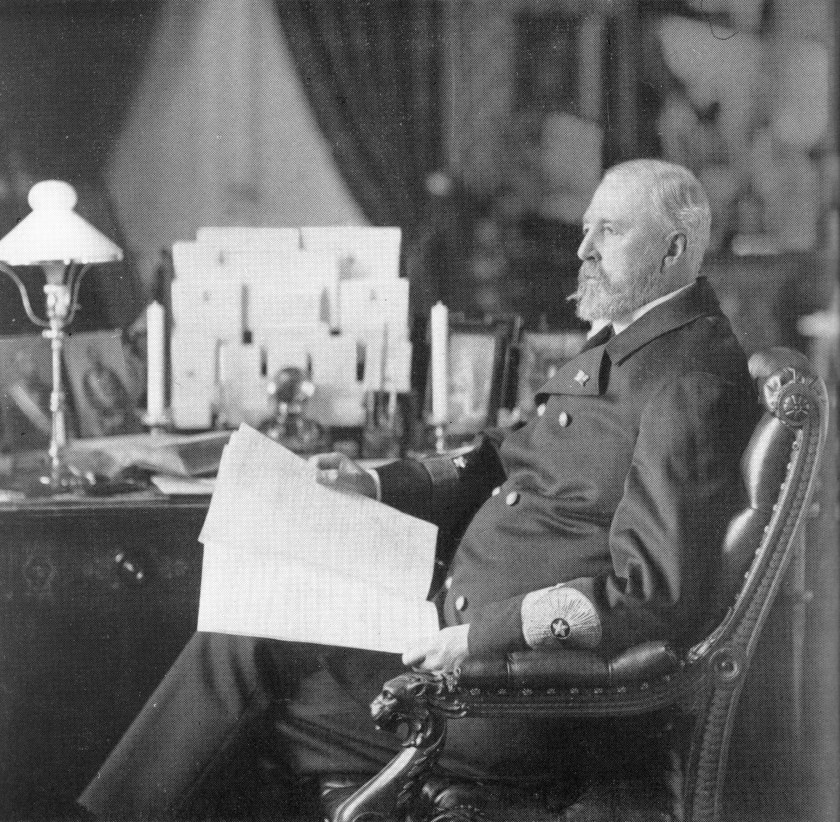
Oscar II vid sitt arbetsbord
 Olle Bengtsson