
From 2007, before the latest “crisis”.
Category: Politics
Ilija Trojanow & Juli Zeh: Angriff auf die Freiheit
Sicherheitswahn, Überwachungsstaat und der Abbau bürgerlicher Rechte

Deutscher Taschenbuch Verlag, 2010
Kurzbeschreibung:
Alle sind scharf auf private Daten. Der Staat möchte die biologischen Merkmale der Bürger kennen. Die Wirtschaft kann gar nicht genug Informationen über die Vorlieben ihrer Kunden sammeln. Arbeitgeber suchen mit illegalen Überwachungsmaßnahmen nach schwarzen Schafen unter ihren Mitarbeitern. Die Warnungen vor Terror und Kriminalität und die Annehmlichkeiten von Plastikkarten und Freundschaften im Internet lenken von einer Gefahr ab, die uns allen droht: dem transparenten Menschen.
“Wollen Sie warten, bis Ihren Kindern bei der Geburt ein Chip ins Halsfleisch gepflanzt wird, der eine sechzehnstellige Personenkennzahl enthält und über Satellit zu orten ist (so wie es bei Ihrem Haustier, falls Sie eins haben, schon der Fall ist)?”
Pressestimmen:
“In ihrer provokanten Streitschrift ‘Angriff auf die Freiheit’ rufen Juli Zeh und Ilija Trojanow dazu auf, dem Ausverkauf der Privatsphäre den Kampf anzusagen.” Thomas Hummitzsch, die tageszeitung 05.09.2009
“Ein politischer Warn- und Weckruf.” Uwe Justus Wenzel, Neue Zürcher Zeitung 29.08.2009
“In diesem Buch wird umfassend erläutert in welchen Bereichen der Staat uns überwacht und wie es im Ausland zugeht. Die dabei genannten Fakten mag man kaum glauben. Umso erschreckender ist die Realität. Ein Buch, das aufklärt und aufrüttelt.” WILD: Das Magazin 25. August 2010
Über die Autoren:
Ilija Trojanow, 1965 in Sofia geboren, floh mit seiner Familie 1971 über Jugoslawien und Italien nach Deutschland, wo sie politisches Asyl erhielt. 1972 siedelte die Familie nach Kenia über. Von 1985 bis 1989 studierte Trojanow Rechtswissenschaften und Ethnologie an der Universität München, später gründete er hier den Kyrill & Method Verlag sowie den Marino Verlag. 1998 zog Trojanow nach Bombay, 2003 nach Kapstadt. Seine Bücher wurden mit zahlreichen Literaturpreisen ausgezeichnet, unter anderem erhielt er 2006 den Preis der Leipziger Buchmesse für den Roman ›Der Weltensammler‹ (dtv 13581) und 2009 den Preis der Literaturhäuser sowie den Würth-Preis für Europäische Literatur. Zurzeit lebt Ilija Trojanow in Wien.
Juli Zeh, 1974 in Bonn geboren, Jurastudium und Studium am Deutschen Literaturinstitut in Leipzig, Gastdozentin an mehreren Universitäten, lebt heute in Leipzig. Zahlreiche Preise, zuletzt Carl-Amery-Literaturpreis und Solothurner Literaturpreis. Zahlreiche Veröffentlichungen.
R. T. Allen: Beyond Liberalism
The Political Thought of F. A. Hayek and Michael Polanyi

Transaction, 1998
In Beyond Nihilism, Michael Polanyi argued that a merely “negative” liberty of doing as one pleases so long as one does not impinge upon the equal liberty of others, must and has led to destructive nihilism and a fierce reaction of collectivism. R. T. Allen takes up this argument in Beyond Liberalism, and shows how Polanyi’s political philosophy evolved into a more “positive” and distinctly conservative concept of liberty, converging upon the archetypal conservatism of Edmund Burke. Allen examines Polanyi’s and F. A. Hayek’s thinking with respect to the nature, value, and foundatios of liberty.
Negative and positive liberties are two sides of one liberty, and Allen believes negative conceptions of liberty are as dangerous as positive ones. He distinguishes among general and abstract definitions of liberty and shows how all, including that of Hayek, ultimately dissolve. According to Allen, only tacit conceptions of liberty, such as those of Burke and Polanyi, prove viable. This is because they rest on concrete tradition. Allen examines how the skeptical, rationalist, and utilitarian philosophies of Ludwig von Mises and Sir Karl Popper fail to support the value of liberty and even proved to be destructive of it. Allen argues that society caonnot rely upon the classically liberal notion of contract but rather upon prescriptive and inherited obligations. In turn, this means that citizens have positive, as well as negative, duties to each other and the body politic of which they are part and upon whose support liberty depends.
A free society is held together by emotional bonds and the traditions and rituals that sustain them. A free society also presupposes that the individual has inherent value in and for himself. For R. T. Allen, only Christianity, and certainly no modern philosophy, has a conception of the unique individual and his irreplaceable value and of a political order that transcends itself into the moral order. Even Polanyi’s liberty is ultimately insufficient, for it gives no inherent value to the person himself but instead to the ideals which he serves. Beyond Liberalism challenges deeply ingrained notions of liberty ad its meaning in modern society. It is a call for traditions of self-restraint and justice for their own sakes. This noteworthy volume is an essential addition to the libraries of political scientists, philosophers, and theologians alike.
About the Author:
R. T. Allen has taught philosophy of education at the University of the West Indies, Trinidad, Sokoto College of Education, Nigeria, and the Loughborough College of Education, United Kingdom. He has been published widely in philosophy (especially on Polanyi) and theology and is the author of Polanyi, The Education of Autonomous Man, and The Structure of Value, and has edited Society, Economics, and Philosophy: Selected Papers by Polanyi for Transaction.
JOB’s Comment:
Richard Allen is also the editor of Appraisal, a well-known, regular presenter at international philosophy conferences, the organizer of his own excellent annual conference on personalistic philosophy at the University of Nottingham, and a distinguished introducer in the anglosphere of Hungarian and Romanian personalist and conservative thinkers, maintaining close contact and attending conferences with scholars in those countries. His most recent book is The Necessity of God: Ontological Claims Revisited (2008).
Datalagringsdirektivet efter bordläggningen
SDs Joakim Larsson skrev i början av mars förra året om EUs s.k. datalagringsdirektiv: “Det är min uppfattning att direktivet är synnerligen integritetskränkande. Nota bene: jag har inget alls emot att spaning bedrivs mot personer eller grupper som bedöms som farliga, men att lagra trafikuppgifter från alla, hela tiden? Nej, det här går för långt. Vi borde istället ha röstat nej till direktivet helt. Nu blir det ju (vad det verkar) ändå en minoritetsbordläggning eftersom regeringen inte ville ta hänsyn till våra synpunkter i utskottet. Frågan kommer i så fall att läggas på is i ett år och på den tiden kan mycket hända.”
Den stora frågan här är naturligtvis vilka personer och grupper som “bedöms som farliga”. Man måste skilja mellan legitim övervakning och den som bedrivs i syfte att kontrollera och tysta kritiker av den framväxande totalitarism som finansglobalisterna i förening med vänstern in absurdum fortsätter arbeta för. SD måste naturligtvis stödja den förra (och borde inkludera inte bara verkliga brottslingar och brottsmisstänkta utan också de nuvarande övervakarna, den nuvarande makten, en verkligt farlig grupp), och motsätta sig den senare. Partiet borde också bli mycket tydligt på denna punkt. Det gäller att inte gå vilse här på grund av strävan efter hårdare tag mot brottslighet.
Jag skrev två inlägg om frågan om datalagringsdirektivet (Problemet med datalagringsdirektivet och Stoppa datalagringsdirektivet!) där jag bland annat citerade Larsson. Denne motsatte sig att SD endast förespråkade ändringar på några punkter och i övrigt godtog direktivet. Enligt honom borde det förkastats i dess helhet.
Larsson hade rätt. Och datalagringsdirektivet ingår naturligtvis som endast en i en lång rad liknande åtgärder för ökad övervakning och kontroll, och dessutom övernationellt centraliserad sådan. Den enda som lett till en mer märkbar debatt i Sverige är FRA-debatten, men den tycks snabbt ha glömts bort, trots att alla kritikernas argument och misstankar bekräftats och andra liknande initiativ fortsatt drivas från EUs och de internationella intresse- och lobbyorganisationernas sida.
Larsson hänvisade till Piratpartiet i denna fråga, och jag återgav in extenso Anna Trobergs argumentation som trots hennes partis uppenbara svagheter i övrigt är föredömlig så långt den sträcker sig. Alla dessa åtgärder av datalagringsdirektivets typ är inte bara tvetydiga och potentiellt problematiska i deras tillämpning, utan det har redan från början varit uppenbart att de är delar av ett större maktpolitiskt sammanhang av ideologisk, politisk styrning och kontroll i distinkta intressens tjänst. Även om de förvisso kan användas för legitim brottsbekämpning, används de också för och är de avsedda att användas för illegitim maktutövning i form av på distinkt innehållsligt-ideologiskt sätt bestämt åsikts- och annat förtryck.
Därför bör, upprepar jag, SD följa Joakim Larssons linje och rösta nej till Datalagringsdirektivet i dess helhet, liksom till alla liknande förslag och åtgärder. Tillsammans med Miljöpartiet och Vänsterpartiet genomdrev SD, trots att man i de egna argumenten bortsåg från många av de verkliga problemen, den s.k. minoritetsbordläggningen, mot vad som i debatten i mars förra året med få undantag såg ut som de i dessa frågor genomkorrupta frihetsfienderna Alliansregeringen och Socialdemokraterna, som ofta tycktes på arrogant sätt – inte minst hos Johan Pehrson (FP), i Thomas Bodströms (S) efterföljd – ignorera dessa frågors verkliga dimensioner. Och Miljöpartiet och Vänsterpartiet är naturligtvis inte pålitliga partners på områden som detta, vare sig ifråga om motivation eller ståndaktighet. Men snart har ett år gått, i mars kommer riksdagen såvitt jag förstår åter kunna ta upp och driva igenom direktivet.
På ett år kan mycket hända, skrev Larsson, och ställde därmed i utsikt en omprövning av partiets otillräckliga ställningstagande. Därför undrar jag nu: Har något hänt? Togs frågan upp på SDs landsdagar? Utanför partiet, såväl i EU-kommissionen, vars utlovade utvärdering kommit, som i riksdagens konstitutionsutskott, har en del hänt under året. Som ytterligare bekräftar att Joakim Larsson hade rätt.
Patrick J. Buchanan: The Great Betrayal
How American Sovereignty and Social Justice Are Being Sacrificed to the Gods of the Global Economy

Little, Brown, 1998
Publisher’s Description:
Pat Buchanan has seen firsthand the devastating effects of America’s slavish devotion to global free trade. As a Republican candidate for president in 1992 and 1996, he met plenty of American workers who had been sacrificed to the Global Economy, and saw towns and entire regions abandoned by the industries that once supported them. While America boasts of having a strong economy – a powerful stock market, booming corporate profits, record CEO salaries – the men and women he met on the campaign trail told a far different story. With free trade now supported by both parties, more and more businesses are closing up shop in the United States and moving elsewhere, taking thousands of jobs with them. The result is a sharp drop in Middle America’s standard of living – a trend that has continued for twenty-five years – and a national divide between the global elites and those who have been left behind.
Now, in The Great Betrayal, Buchanan charges the architects of NAFTA and GATT with selling out the middle class and turning their backs on the nation. As the voice of populist conservatism, he speaks to the desperation of the millions of Americans who have lost their jobs as a result of the free-trade policies of the Global Economy. He shows how by exporting jobs to Asia and Mexico, the corporate elite is destroying the American dream and profiting from the exploitatin of sweatshop labor. Abandoned by their government, American workers are being forced to compete with cheap Third World labor and, inevitably, are losing out.
Basing his arguments on the principles of our Founding Fathers and using real-life stories to illustrate the plight of the working class, Buchanan raises an impassioned call to arms. He offers a “new economic nationalism” and invites a battle for the heart and soul of the Republican Party in 2000 on the issues of national sovereignty and social justice. Republicans, neoconservatives, and Democrats cannot let his charges go unanswered.
Alain Soral
Russia Today
Thanks to Nordbo (Gudomlig Komedi) for finding this interview.
Stephen J. Sniegoski: The Transparent Cabal
The Neoconservative Agenda, War in the Middle East, and the National Interest of Israel
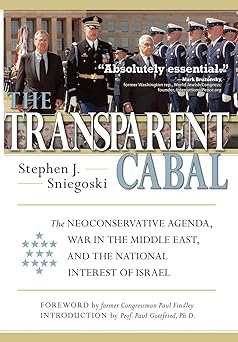
Foreword by Paul Findley Introduction by Paul Gottfried
Enigma Editions, 2008
Publisher’s Description:
Although it is generally understood that American neoconservatives pushed hard for the war in Iraq, this book forcefully argues that the neocons’ goal was not the spread of democracy, but the protection of Israel’s interests in the Middle East. Showing that the neocon movement has always identified closely with the interests of Israel’s Likudnik right wing, the discussion contends that neocon advice on Iraq was the exact opposite of conventional United States foreign policy, which has always sought to maintain stability in the region to promote the flow of oil. Various players in the rush to war are assessed according to their motives, including President Bush, Ariel Sharon, members of the foreign-policy establishment, and the American people, who are seen not as having been dragged into war against their will, but as ready after 9/11 for retaliation.
Reviews:
“Absolutely essential.” Mark Bruzonsky, former Washington rep., World Jewish Congress; founder, InternationalPeace.org
“This is a riveting book.” Paul Craig Roberts, Ph.D., syndicated columnist; former Assistant Secretary of the Treasury; and former associate editor, Wall Street Journal
“The time is right for an unvarnished examination of the origins, history, and agenda of the neoconservative policy bloc in Washington and in Tel Aviv. The Transparent Cabal helps to provide one.” Lt. Col. Karen Kwiatkowski, USAF (ret.), Ph.D.
“The timing of Dr. Sniegoski’s book could not be better. The only aspect of U.S. Middle East policy not in controversy is that no one knows what to do; Sniegoski’s book may help the debate break through this barrier.” Joseph Douglass Jr., Ph.D., author, America the Vulnerable: The Threat of Chemical/Biological Warfare and Red Cocaine: The Drugging of America
“I have known Dr. Sniegoski for many years. He is a thorough researcher with a capacity for independent thought and the courage to advance and defend his analyses.” Wayne S. Cole, Ph.D., professor emeritus, University of Maryland
“Sniegoski leaves no stone unturned in exposing the Israeli-neocon alliance and its catastrophic consequences in the Middle East. Timely and important, his book should provoke a much-needed debate about who truly benefits from current US policies in the region.” Jonathan Cook, author, Israel and the Clash of Civilisations
“That the security of Israel has been central to the foreign-policy worldview of the neo-conservatives is one of the least discussed and most taboo aspects of the movement. Sniegolski has long been among the most dogged researchers who have tried to bring this to light.” Jim Lobe, Washington Bureau Chief, Inter Press Service (IPS).
“Sniegoski breaks new ground and pulls no punches in his analysis of the neocon-driven policies that brought about war with Iraq. He broadens the inquiry into many areas that desperately need sunshine and clarity.” Philip Giraldi, former CIA officer, partner in Cannistraro Associates, national security consultants, and contributing editor, The American Conservative
“Telling the truth in America today is more professionally risky than ever before, but happily Sniegoski couldn’t care less. His rendition of recent American history is utterly absorbing.” Thomas Woods, Ph.D., New York Times bestselling author, The Politically Incorrect Guide to American History
“…a must read for anyone horrified by the disastrous course [neoconservatives] have set for U.S. policy.” Kathy and Bill Christison, former CIA officials
“Sniegoski succeeds admirably in documenting the corrosive influence of the well-financed neoconservative lobby and its selling of a one-sided foreign policy to the Bush-Cheney administration.” Rodrigue Tremblay, Ph.D., emeritus professor of economics and author of The New American Empire
“…required reading for all who wish to learn how American foreign policy has been hijacked, and who wish to reclaim it before it leads to another Middle East catastrophe.” James C. Russell, Ph.D., author of Breach of Faith: American Churches and the Immigration Crisis
“…devoted to saving the United States from an even worse mistake than its attack on Iraq. Patriots informed by this book will not be tricked into support of neocon war plans.” Virginia Deane Abernethy, Ph.D., Professor Emerita of Psychiatry (Anthropology), Vanderbilt University School of Medicine
“[The] book contributes to an eventual [Iraq war] post mortem by laying out present-day politics that should be public knowledge.” James Kalb, New York City lawyer and writer
About the Author:
Stephen J. Sniegoski, Ph.D., earned his doctorate in American history, with a focus on American foreign policy, at the University of Maryland. He has had articles published in The World & I, Modern Age, Current Concerns, Zeit-Fragen, Telos, The Occidental Quarterly, Arab News, The Last Ditch, and elsewhere on subjects such as communism, political philosophy, World War II, and the American war on Iraq. His focus on the neoconservative involvement in American foreign policy antedates September 11, and his first major work on the subject, ‘The War on Iraq: Conceived in Israel’, was published February 10, 2003, more than a month before the American attack.
Paul Findley is a former Congressional Representative from Illinois, elected as a Republican to the eighty-seventh and the ten succeeding Congresses (January 3, 1961 – January 3, 1983). He was appointed to the Board for International Food and Agricultural Development (1983-1994). He is the author of The Federal Farm Fable; They Dare to Speak Out: People and Institutions Confront Israel’s Lobby; A. Lincoln: The Crucible of Congress; and Deliberate Deceptions: Facing the Facts about the U.S.-Israeli Relationship.
Paul Gottfried, Ph.D., is the Horace E. Raffensperger Professor of Humanities at Elizabethtown College and a member of the executive board of the Historical Society. He is also contributing editor for Chronicles and Telos, and is editor-in-chief of This World. In addition to being an Adjunct Scholar at the Ludwig von Mises Institute, Gottfried was a Guggenheim Fellow in 1984 and was recognized by Who’s Who in the World in 2000. He is the author of [etc. – readers of this blog will be familiar with him; if not, see the links on the Links page].
Chris Hedges: Empire of Illusion
The End of Literacy and the Triumph of Spectacle

Nation Books, 2009
2009 Publisher’s Description
We now live in two Americas. One – now the minority – functions in a print-based, literate world that can cope with complexity and can separate illusion from truth. The other – the majority – is retreating from a reality-based world into one of false certainty and magic. To this majority – which crosses social class lines, though the poor are overwhelmingly affected – presidential debate and political rhetoric is pitched at a sixth-grade reading level. In this “other America,” serious film and theater, as well as newspapers and books, are being pushed to the margins of society.
In the tradition of Christopher Lasch’s The Culture of Narcissism and Neil Postman’s Amusing Ourselves to Death, Pulitzer Prize-winner Chris Hedges navigates this culture – attending WWF contests, the Adult Video News Awards in Las Vegas, and Ivy League graduation ceremonies – to expose an age of terrifying decline and heightened self-delusion.
2010:
In this New York Times bestseller, Pulitzer Prizewinning journalist Chris Hedges has written a shattering meditation on American obsession with celebrity and the epidemic of illiteracy that threatens our cultural integrity. Reporting on such phenomena as professional wrestling, the pornographic film industry, and unchecked casino capitalism, Hedges exposes the mechanisms used to divert us from confronting the economic, political, and moral collapse around us. Empire of Illusion shows us how illiteracy and the embrace of fantasy have impoverished our working class, allowed for the continuance of destructive public policy, and ushered in cultural bankruptcy.
Reviews:
“Remarkable, bracing and highly moral, Empire of Illusion is Hedges’ lament for his nation.” Maclean’s
“Each chapter of Empire of Illusion makes a strong case for how different illusions – of literacy, love, wisdom, happiness – taken together are destroying the American mind, culture and the nation itself.” National Post
“Each chapter torches one of our cultural illusions.” The Globe and Mail“Hedges is a fan of big ideas, and in Empire of Illusion, he draws upon the culture of professional wrestling and pornography, the elite university, positive psychology and the financial crisis to fashion a social theory of everything.” Winnipeg Free Press
About the Author:
Chris Hedges, the author of the bestselling War Is a Force That Gives Us Meaning, is currently a senior fellow at The Nation Institute and the Anschutz Distinguished Fellow at Princeton University, and writes for many publications including Foreign Affairs, Harper’s, The New York Review of Books, Granta and Mother Jones. He is also a columnist for Truthdig.
Sheldon S. Wolin: Democracy Incorporated
Managed Democracy and the Specter of Inverted Totalitarianism
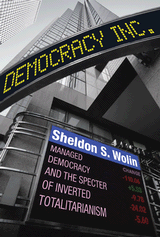
Princeton University Press, 2010
Book Description:
Democracy is struggling in America – by now this statement is almost cliché. But what if the country is no longer a democracy at all? In Democracy Incorporated, Sheldon Wolin considers the unthinkable: has America unwittingly morphed into a new and strange kind of political hybrid, one where economic and state powers are conjoined and virtually unbridled? Can the nation check its descent into what the author terms “inverted totalitarianism”?
Wolin portrays a country where citizens are politically uninterested and submissive – and where elites are eager to keep them that way. At best the nation has become a “managed democracy” where the public is shepherded, not sovereign. At worst it is a place where corporate power no longer answers to state controls. Wolin makes clear that today’s America is in no way morally or politically comparable to totalitarian states like Nazi Germany, yet he warns that unchecked economic power risks verging on total power and has its own unnerving pathologies. Wolin examines the myths and mythmaking that justify today’s politics, the quest for an ever-expanding economy, and the perverse attractions of an endless war on terror. He argues passionately that democracy’s best hope lies in citizens themselves learning anew to exercise power at the local level.
Democracy Incorporated is one of the most worrying diagnoses of America’s political ills to emerge in decades. It is sure to be a lightning rod for political debate for years to come.
In a new preface, Wolin describes how the Obama administration, despite promises of change, has left the underlying dynamics of managed democracy intact.
Reviews:
“[A] comprehensive diagnosis of our failings as a democratic polity by one of our most seasoned and respected political philosophers…Democracy Incorporated is a devastating critique of the contemporary government of the United States – including what has happened to it in recent years and what must be done if it is not to disappear into history along with its classic totalitarian predecessors.” Chalmers Johnson, Truthdig
“[Democracy Incorporated provides] a rare, chilling analysis of intellectual critics of democracy. If democracy means more than occasional elections and protection of those rights that are compatible with economic and political elites’ interests, Wolin’s analysis of our democratic predicament is shocking, solid, and fundamentally correct.” C. P. Waligorski, Choice
“Sheldon Wolin has produced an ambitious and broad-ranging book that examines the current state of democracy in America… Wolin argues that the unquestioned faith in the virtues of free market capitalism has dramatically narrowed the range of policy options that are on the table when debate turns to resolving the US’s ills…[T]his is a trenchant and powerful volume.” Alex Waddan, International Affairs
“Of the many books I’ve read or skimmed in the past seven years that attempted to get inside the social and political debacles of the present, none has had the chilling clarity and historical discernment of Sheldon S. Wolin’s Democracy Incorporated. Building on his fifty years as a political theorist and proponent of radical democracy, Wolin here extends his concern with the extinguishing of the political and its replacement by fraudulent simulations of democratic process.” Jonathan Crary, Artforum
“[W]e need to understand the deep roots of our present troubles ourselves and Wolin’s book is an excellent beginning.” Toby Grace, Out in Jersey
“Democracy Incorporated acts as an antidote to unconstrained corporate power and an elitist obsession and should be widely read by all those who cherish democracy and civil liberty.” Shih-Yu Chou, Political Studies Review
“[Wolin] provides a rich narrative of the struggle of elites and the demos from ancient Greece through the writing of the U.S. Constitution and into the present, and the corporate-managed politics that has emerged will survive no matter which party holds Congress or the presidency.” Coleman Fannin, Journal of Church and State
“Despite being written shortly before both the financial crisis and the Obama victory, the main lineaments of his analysis are still alarmingly cogent.” Tom Angier, Marx & Philosophy Review of Books
“With his fundamental grasp of political theory and restless spirit to get at the essence of what threatens modern democracy, Wolin demonstrates that the threats to our democratic traditions and institutions are not always from outside, but may come from within. It is a book that policymakers and scholars of contemporary society should read and reflect upon.” Rakesh Khurana, Harvard Business School, author of From Higher Aims to Hired Hands
“As we’ve come to expect from Sheldon Wolin, a tightly argued and deeply revealing book about the dangers of unconstrained capitalism for our democracy.” Robert B. Reich, University of California, Berkeley
“For half a century, Sheldon Wolin has been one of the most distinguished and influential political theorists in the United States and a perceptive observer of the American political scene. In his magisterial latest book, Wolin shows himself at the height of his powers as he presents a highly original, sober, and persuasive account of a number of tendencies in contemporary American society that constitute a significant danger for the future of constitutional democracy. If totalitarianism establishes itself in the United States, it will be in the ‘inverted’ form Wolin analyzes in this important book.” Raymond Geuss, University of Cambridge
“Wolin’s writing has a resonance that binds the canon of political philosophy to unfolding events and present circumstances. In Democracy Incorporated, he contends that the institutions and practices that Americans regarded as their defense against totalitarianism – and other forms of authoritarian domination–have failed them. There is nothing like this book. It is a major, potentially revolutionary contribution to political thought.” Anne Norton, author of Leo Strauss and the Politics of American Empire
“Powerful and persuasive. Democracy Incorporated does exactly what great political theory should do: it provides a theoretical framework that allows the reader to see the political world anew. It left this reader with an almost nightmarish vision of American politics today, a nightmare all the more terrifying for being so compelling, so vivid, and so real.” Marc Stears, author of Progressives, Pluralists, and the Problems of the State
About the Author:
Sheldon S. Wolin is professor emeritus of politics at Princeton University. His books include Politics and Vision and Tocqueville Between Two Worlds (both Princeton).
Thomas Molnar: The Decline of the Intellectual

Transaction, 1994 (1961)
With a new introduction by the author
Publisher’s Description:
In perhaps his most famous book, The Decline of the Intellectual, Thomas Molnar launches into a fundamental critique of the intellectual class. He sees it as a group that has lost its way, collapsing a sense of vision into political activism, social engineering, and culture manipulation, and abandoning the writing, philosophizing, and scholarship that had occupied its predecessors. Universities began to produce factory-like, faceless citizens, as the job market became the arbiter of education and culture. Today’s professors are recruited from this group of job seekers, and hence, have a shared indifference toward learning.
Molnar likens present-day intellectuals to the earlier Marxists who elaborated their utopian model in the Communist Party. The campus intellectuals’ objective is to transform the university into a replica and a laboratory of the ideal society. Colleges and universities thus become sources of propaganda of various political, financial, cultural, and ideological trends, not only among students, but professors as well. The thirty years separating editions have done nothing to weaken such a critical appraisal.
In his new introduction, Molnar writes that the decline of intellectuals has extended outside of the campus to the arts, the public discourse, and the robotization caused by technology. On the initial publication of this work, Frank S. Meyer wrote in Modern Age, “Thomas Molnar’s book is not only true; it is intellectually exciting and it will remain a necessary handbook for anyone interested in the decisive problem of the 20th century.” The Decline of the Intellectual is essential reading for sociologists, political scientists, educators, and university officials. It is the basis of present-day critiques of the academic world.
About the Author:
Thomas Molnar [was] professor of philosophy of religion at the University of Budapest. He is the author of numerous articles and books, including The Emerging Atlantic Culture, Sartre: Ideologue of Our Time, and Utopia: The Perennial Heresy.
 Olle Bengtsson