Grundlagsfrågan

Det finns vissa frågor som trots att de tillhör den kategori som angår alla och borde vara ständigt aktuella, inte blir föremål för kontinuerlig politisk debatt och uppmärksamhet från de politiska partier som borde arbeta med dem.

Ett exempel på en sådan är frågan om övervakningssamhället. Sedan de svenska debatterna om FRA och EUs s.k. datalagringsdirektiv har den verklighet det här handlar om antagit groteska proportioner, och ingen borde efter de kontinuerliga avslöjandena om NSA och USAs totalitära strävanden kunna undgå att se dem och förstå deras innebörd; inte heller det faktum att den svenska regeringen fortsätter att stödja denna utveckling och till och med motsätter sig andra europeiska länders försök att protestera och stoppa den tycks förmå väcka den svenska opinionen.

Frågor som denna ägnas tillfällig, upprörd uppmärksamhet under en, eller i några fall flera kortare perioder, men sjunker sedan på skrämmande sätt undan utan att någonting kunnat förändras.

Ett annat exempel är frågan om grundlagen. Vad den handlar om är visserligen inte lika löjligt uppenbart, den involverar, eller tycks för många involvera, svåra författningstekniska överväganden och tillhöra ett område som normalt behärskas endast av specialiserade jurister och statsvetare. Den skiljer sig också från övervakningsfrågan såtillvida som att det inte blev någon mer allmän upprörd debatt, och signifikativt nog tycktes inte ens jurister och statsvetare bry sig om den på det sätt de normalt alltid gjorde förr i liknande fall.

Men i sak är ju också detta en fråga som i högsta grad angår alla svenska medborgare; i ett längre och större perspektivet är ju få frågor viktigare än författningsfrågorna. Och åtminstone SD förde en intensiv debatt om den under några veckor som jag uppmärksammade och i begränsad utsträckning själv försökte bidra till här i bloggen.

Nu, efter tre år, undrar man om riksdagsbeslutet gjorde att det inte längre anses meningsfullt att ägna denna fråga uppmärksamhet. Ytterligare ändringar, som upphäver de senaste, är ju med nödvändighet är en krävande och långdragen process. Begränsade resurser gör det väl rimligt att prioritera annat. Samtidigt riskerar man, om man helt släpper frågan, att ge intrycket att man accepterar beslutet i den meningen att man inte eftersträvar ny revision. Det vore olyckligt.

Därför frågar jag mig om det finns någon SD-politiker som fortfarande åtminstone sporadiskt försöker följa upp och fortsätta driva den linje i denna fråga som var partiets 2010, som framför konkreta förslag för återupptagande, och som kanske rentav strävar att ytterligare utveckla och fördjupa analysen och argumenten. Sådan kontinuitet och långsiktighet är i hög grad önskvärd.

Lindbom, kristendomen och västerlandet

Svar till “Den Väldige”

Nätpseudonymen “Den Väldige” ställer ett antal frågor med anledning av min post i kategorin References om Tage Lindboms korta självbiografi Omprövning; liksom många andra av hans kommentarer är de värda ett separat inlägg, trots att jag denna gång finner frågorna svåra att besvara.

Med anledning av denna bloggpost skulle jag vilja försöka formulera några frågor till JOB, och jag vill då först skissera bakgrunden, eller bakgrunderna:

Jag har fått uppfattningen, riktig eller inte, att Lindbom gick från ateism till gudstro genom kristendom och sedan gick över till en islamsk mystisk tradition: sufismen.

Det första jag undrar är: beskriver och förklarar Lindbom någonstans varför han tydligen upplevde kristendomen, som ju är den lokala och traditionella religionen inom vår kulturkrets, som ofullständig, inte användbar eller liknande?

Det andra jag undrar är, varför gick han till just islam/sufismen? Det vill säga, har han klart uttryckt detta? (För båda frågorna undrar jag också om han i sådana fall gör det i någon av de böcker som anmälts här.)

Lindbom gick, inspirerad av Kurt Almqvist, direkt till den s.k. traditionalistiska skolan, där han blev initierad av Frithjof Schuon. Det innebar inte att han därefter betraktade kristendomen som “ofullständig, inte användbar eller liknande”. I nästan alla hans böcker hänvisar han huvudsakligen till kristendomen, i enlighet med traditionalismens uppfattning om exoterikens delvis s.a.s. geografiska betydelse. Han skrev ju i första hand för en svenskspråkig och i stor utsträckning kristen läsekrets. Först i hans sista i livet utgivna bok, Västerlandets framväxt och kris, bör den med Lindboms tidigare verk förtrogne kunna urskilja vissa historiska tolkningar som antyder en uppfattning om kristendomens otillräcklighet som västerländsk exoterik. Hänvisningar till islam och sufismen förekommer i de flesta av hans böcker efter omprövningen, liksom till vedanta o.s.v.  Anledningen att han i den traditionalistiska skolan mottog esoterisk initiering i sufismen var utan tvekan just mötet, via Almqvist, med Schuon. Den posthuma volymen I Frithjof Schuons fotspår, med utmärkt och mycket utförlig inledning av Ashk Dahlén, behandlar uteslutande Schuon.

Jag har också fått uppfattning av JOB själv är mystiker, men inte kristen utan hinduisk eller närmare bestämt vedisk. Anledningen till detta, uppfattar jag, är att JOB menar att räddningen av Västerlandet, om denna alls är möjlig, på något sätt, vid sidan av direkt politiskt agerande och liknande, måste gå via det vediska då där finns kvar en direkt och levande andlig tradition och praktik som skulle gått förlorad inom kristendomen. Ett slags renovering av det andliga i väst kan då via den vägen på något sätt kanske komma till stånd. (Jag ber att få bli rättad på de punkter jag missförstått hela saken.)

Mot ovan skisserade beskrivning av JOB ur en viss aspekt skulle jag, som själv är kristen, vilja ställa några frågor som liknar de jag ställt om Lindbom:

För det första: Vad är det som gör att du inte finner det möjligt att hitta eller hitta tillbaka till något slags levande kristen tradition och inifrån den verka för att levandegöra det andliga?

Ja, här måste jag rätta dig. Denna fråga kan jag inte besvara, eftersom det inte alls förhåller sig så att jag inte finner detta möjligt. Frågan beskriver min hållning oriktigt. Jag går ofta tillbaka till levande kristna traditioner och försöker, under urskillning, inifrån dem verka för att levandegöra det andliga.

Däremot är det riktigt att jag tror att en ”renovering av det andliga i väst” kräver en komplettering och modifikation i form av en ny ”vedisk” traditionalistisk impuls, i enlighet med vad jag beskrev under Spirituality på About-sidan i dess första version – vilket också i någon mån är vad som sker idag. Och att jag såtillvida, till skillnad från Lindbom i de flesta av hans verk, finner kristendomen, åtminstone i vissa dominerande tolkningar, ”ofullständig”. Jag har diskuterat dessa tolkningar med viss utförlighet i åtskilliga inlägg i katergorin Philosophy.

För det andra: Jag kan ha fel, men mitt intryck är att många andra i den, som jag uppfattar det, ytterst lilla svenska krets av egentliga konservativa, antingen är ateister, eller ansluter sig till andra religioner än kristendomen. T.ex. islam, vanligen då sufism eller liknande. Är detta möjligen riktigt?

Tyvärr tror jag inte att jag kan svara på denna fråga heller, på ett tillräckligt meningsfullt sätt, eftersom jag saknar den överblick som skulle krävas. “Många” är litet vagt. Utan tvekan finns konservativa som tillhör flera olika religiösa och andliga traditioner, såväl som ateister.

Frågan då: Om det är så, ligger det ändå inte en stor fara i detta? Jag accepterar visserligen andliga riktningar av mer mystisk karaktär från alla religioner, och är klar över att dessa ofta ligger närmare varandra än “den vanliga religionen” avsedd mer för massan, och att det på (mycket) lång sikt kanske kan ligga något avgörande konstruktivt i den samverkan som småningom kan uppstå mellan mystiker från olika religioner.

Men ändå, på kortare sikt: Om nästan inga personer av seriositet ägnar sig åt den lokala traditionella religionen, i detta fall kristendomen, kan inte det vara/bli ett tecken i sig på det som brukar beskrivas ungefär som:

Om du lägger ner ditt svärd tar någon annan upp det.

Och är då inte detta mycket farligt?

Exempelvis genom att, vad vi kan kalla vulgärislam, passar på att kraftigt ta mark, då de tydligt kan se att kristendomen har övergivits av nästan alla de lokalt boende människor som är något att räkna med. Och är det inte just det som sker inför våra ögon?

Inte heller dessa frågor kan jag, är jag rädd, besvara tillfresställande, åtminstone inte utan vissa tydliggöranden från din sida. Menar du alltså, trots att du accepterar allt det du beskriver i första stycket här, att man inte bör hänvisa till andra traditioner än den kristna eftersom ”vulgärislam” då tar mark, att man av detta skäl uteslutande måste levandegöra det andliga utifrån en kristen tradition? I så fall håller jag inte med, bl.a. men inte enbart p.g.a. den nämnda ”ofullständigheten”.

Den kristna traditionen rymmer utan tvekan ett värdefullt kulturellt och andligt arv som västerlandet har att förvalta. Detta står på intet sätt i motsättning till den av mig försvarade kompletteringen och modifikationen. Den kristna ortodoxin innehåller åtskillda välkända, i dogmatikens form fastslagna lärosatser, men redan den, och naturligtvis i än högre grad kristendomen i vidare mening, uppvisar historiskt ett stort utrymme för olika tolkningar. Du är alltså kristen, och du menar såvitt jag förstår att jag bör begränsa mig till kristendomen p.g.a. hotet från vulgärislam. Jag måste fråga: vilka specifika kristna läror är det du tror på, och som du menar att jag måste eller åtminstone bör omfatta? Om du läser inläggen i kategorin Philosophy som berör dessa ämnen kan du, tror jag, få en ungefärlig uppfattning av vilken grad av precision det är jag efterlyser i svaret på denna fråga.

Det intryck jag får är att din argumentation mot Lindboms och min inriktning bestäms huvudsakligen av politiska överväganden, och väl i någon mån därmed sammanhängande kulturella (av detta skäl placerar jag detta inlägg i kategorin Politics). Du säger ingenting om kristna religiösa, teologiska eller andliga sanningsanspråk gentemot Lindbom eller mig. Men borde det inte, när du säger att du är kristen, utöver vulgärislams hot och den blotta kristna historiska dominansens fakticitet under de senaste tusen eller drygt femtonhundra åren beroende på var vi befinner oss (”den lokala traditionella religionen”), hur betydelsefull denna fakticitet än är för konservativa historicister, finnas också något distinkt positivt värde som gör att enligt dig andligheten uteslutande bör levandegöras i kristendomens form? Först när jag ser hur du svarar på dessa frågor kan jag försöka vidareutveckla mitt svar.
The First Step in Meditation

“Now the discipline of yoga”, Patanjali says. The atmosphere is pure and peaceful. In recent weeks, you have assimilated the introductory teaching, achieved some basic theoretical understanding of things, as set out not just in yoga but in sankhya and vedanta. You knew it was necessary to approach a real, authentic teacher. You are aware you have been learning about what is truly interesting and important, indeed decisive in life.

You sit still, with eyes closed, relaxed. Your senses are now withdrawn from their outer objects. You remember the clear, well-articulated words of guru, and his presence, through which alone much has been tacitly communicated and transfered to you. You are filled with the impression of the few images of guru and the few, traditional spiritual symbols in the room. Some flowers and fruit lie next to the portrait of guru. There is the aroma – not too strong – of a certain kind of incense, which you will always associate with this moment.

The mantra comes to you. You think it quietly. This practice of transcendence is the central practice of yoga, which, although not in itself difficult, few seem able to practice with the requisite regularity in the contemporary world. You understand that to the seed-mantra some can of course add other strengthening and supporting techniques from traditional yoga. Softly, the mantra begins to penetrate the layers of mental content. You – the conscious self – are immersed, dispersed in that content, the subtle objects of the senses, the images and ideas, the feelings and desires, the mental noise. By a mild, initial impulse of the will and the direction of guru, your attention is focused on the mantra. In this way, you are subtly led in the inner direction. In the stillness, you already sense something of the tremendous potential power of the finer levels of awareness. It is a natural process. Through the mantra, you are silently led out of the many phenomenal identifications of the false ego. Lightly and quietly thinking the mantra, or rather just being aware of it, leads you beyond thinking, beyond the mind.

A path is opened, which you already feel will take you beyond the plurality of manifestation and relativity. You move through the mists of the mind. Thoughts come, images come, plans and memories, you hear a faint sound from the street outside, you note some sensations in your body. But again and again, you return to the pure quality of the soft mental vibration of the mantra. You approach the fuller exploration of consciousness itself, of its true nature. You go deeper and deeper on the subtler levels. You are turning towards home, towards your true self. With the help of the mantra, you are beginning to pass through the cloud. You are quietly pulled towards the field of all possibilities, towards the higher nature of transcendent being, knowledge, and bliss. This is not faith. This is experience.

At some point you stop. You begin to return towards the surface. You come out of the meditation. A small but bright, mild ray of the sun of higher consciousness has been allowed to shine forth in you as you moved through the levels of conditional experience. From the partly uncovered sky beyond, there emanates a force of purity, of freshness, of life, of creative intelligence. You open your eyes. To some extent you already experience the world around you in a different way. You see deeper. You understand there is a truer perspective on everything you have known. That knowledge is structured in consciousness. Your mind is being modified in accordance with the light of right knowledge, which allows you to see everything as it really is.

You feel fully centered, present, crystallized. Finer energy fields are stirring in your vividly felt inner body. You feel in control of enhanced faculties of all kinds. You sense that bad habits and destructive or non-optimal patterns in your life are going to be dissolved of their own accord; that major transformations and developments are available to you, that illusion will fade away. Beyond the modifications of the mind, you will come in contact with the source of happiness beyond outer pleasure, with the highest reality, with the lofty realm of truth. You see how you can become a being that spontaneously works for the ultimate good of society and of all living beings; how you will be able to promote that spiritual good by simply being, by simply being a certain kind of being.

You are already on the way to ultimate fulfillment, higher than and different from any achievement in the transitory sphere of phenomena. You begin to awake. This is the sublime way of realization, beyond the theory of the metaphysical philosophers, beyond the moral and aesthetic discipline of classical humanistic culture, beyond all forms of psychological therapy, beyond any intellectual and professional skill. You are set on the path of perfection, reoriented towards the true goal of life, towards ultimate good, the manifestation of life’s full values on all levels, the actualization of the essence of the beauty and sublime greatness you have had intimations of in art, music, poetry, nature, love. You realize that you can live in, that you can become “oned” (to use Julian of Norwich’s wonderful word) with that very essence. The attainment, in a certain sense, of the fullness of the absolute, of the life of the spirit, of the divine, appears possible. You stand before, and are becoming part of, the Great Tradition. You sense that if you just continue on this path, the insights, the powers, the enlightenment, and the liberation spoken of by the greatest spiritual teachers, seers, mystics, saints, and avatars throughout history is ultimately within your reach.

The path is clear – the path that is no path, the path that is rather the goal rediscovering itself. You remember you have been taught that patient, regular practice is needed, and that you must not make any drastic changes in your life in premature reliance on the increased strength you now feel is yours. Humility is always needed. But it will come naturally. The higher nature of divine being, knowledge and bliss has already begun to penetrate and spread through you. It pulls you, your impulses, your will, and your imagination without resistance towards itself, towards the unbroken continuation of the practice. You begin to desire to become immersed and absorbed in that nature, to make your whole mind and body a translucent medium, entirely shaped by and soaked in it. Your whole existence, inner as well as outer, has already been elevated in a wholly new and beautiful way.

If you do not experience the things here described, it does not mean something is wrong with your practice. The qualities and presence of guru may not have been as effectively communicated as it could have been, the theoretical understanding you acquired may not have been clear enough, and, above all, your mental cloud may be too thick and dark for such experiences to be possible. Still, the practice is the right one and you need only continue it a little longer before these realizations begin to happen.

This first step of practice, added to contact with guru and basic theory, is all that is needed. Even if the force of illusion created by strong attachment to conditional experience should delay you, hinder you, mislead you onto lower paths, it is certain that you will sooner or later find your way back. A different seed has been sown deep inside you. The awakened glimpse of your higher self, of transcendent being, will always attract you anew.

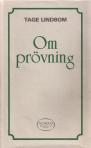
Tage Lindbom: Omprövning

Norma, 1983

Från baksidan:

LindbomSocialismen vinner ständigt nya proselyter. Men det finns människor, som levat under de röda fanorna under avsevärd tid men som efter noggrann självprövning lämnat denna tankevärld och gjort detta ej på grund av uteblivna förväntningar utan på grund av att det grundfalska i socialismen till slut blivit uppenbart.
Tage Lindbom berättar om sitt liv och om sin utveckling från ateistisk socialism till tron på en gudomlig ordning.

Fil. dr Tage Lindbom var till år 1965 chef för Arbetarrörelsens arkiv och hade bakom sig ett närmare fyrtioårigt liv i svensk arbetarrörelse. 1962 publicerade han boken Sancho Panzas väderkvarnar, som blev inledningen till hans uppgörelse med den förhärskande samhällsuppfattningen. Han har i sin fortsatta publicistiska verksamhet framförallt behandlat andliga och samhällskritiska ämnen och framstår som en av landets mest klarsynta filosofer.

JOBs kommentar:

Det var den upplevda kortheten och otillräckligheten i dessa memoarer som var bakgrunden till de regelbundna mötena med Lindbom under andra hälften av 90-talet: det önskades att Lindbom skulle berätta mer om sitt liv. Vid dessa möten gjordes inspelningar av Lindboms betättande, och här finns material för den biografi som förr eller senare måste skrivas och redan vid denna tid diskuterades. Men självklart är också Omprövning av stort värde. I den återfinns bl.a. den skildring av Lindboms andliga uppvaknande i katedralen i Chartres som jag tidigare citerat. De djupa andliga grunderna för avståndstagandet från socialismen (och hela moderniteten) förtydligas genom bokens självbiografiska perspektiv.

Personalism East and West

I just came back from the fifth ISKCON Studies Conference, organized at wonderful Radhadesh/Château de Petite Somme in the Ardennes outside Durbuy in Belgium, by Kenneth Valpey and Ferdinando Sardella (who both spoke at the 12th International Conference on Persons in Lund in August) of the ISKCON Studies Institute, a subdivision of the Oxford Centre for Hindu Studies; the institute publishes the ISKCON Studies Journal. Many old friends attended as well as new faces from different parts of the world. I spoke on ‘Personalism East and West’ (see abstract below).

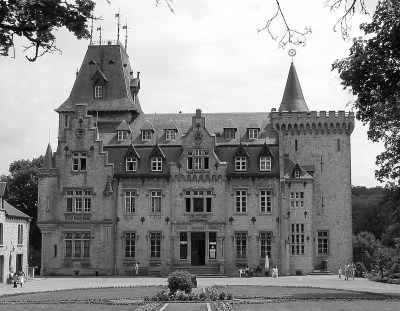
Château de Petite Somme (Photo: Jean-Pol Grandmont)

The Radhadesh website is temporarily offline for technical reasons so I cannot link to it here; awaiting the solution of the technical problems, they refer to this temporary blog. Radhadesh is almost certainly the most important ISKCON temple community in Europe, and the site not only of the temple and of ashramas, but also, and not least, of many important international conferences since the early 1990s. Among them I have attended several ISKCON Communications Seminars and ISKCON Conventions, and one meeting of the Bhaktivedanta Academy of Arts and Sciences, all with many prominent Hinduism and other religion scholars from inside and outside of ISKCON.

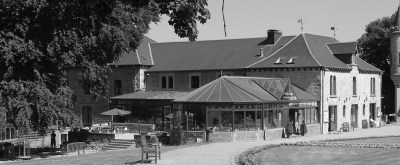
The restaurant (Photo: Jean Housen)

Radhadesh has gradually been developed into a first class conference centre with a new hotel – called a guesthouse – next to the château, and an excellent restaurant in an adjacent building. However, I think this was the first time the ISKCON Studies Conference was held here – a couple of years ago I spoke on ‘Conversion, Preaching, and Western Cultural Identity’ at an earlier ISC on the theme of Transmitting the Truth: Education, Preaching, and Conversion in ISKCON, at the equally beautiful Villa Vrindavana outside Florence; as far as I understand, that paper will soon appear in the next issue of the ISKCON Studies Journal. Radhadesh is also the site of Bhaktivedanta College, where ten years ago I taught the introduction to Western philosophy course. Since I was last there, a new building for accommodation of the students, as well as for the college library, had been built. Finally, on the premises is also found the building housing the Bhaktivedanta Library Services.

During this visit to Belgium I also had the opportunity to take photos of some parts of or with certain angles on Poelaert’s Palais de Justice in Brussels which I have not been able to find on the internet, and some of the Parc de Bruxelles by the Palais Royal and the streets next to it. I plan to publish them here. The many beautiful late nineteenth-century buildings on Avenue du Midi south of Place Rouppe, Boulevard Maurice Lemonnier, Boulevard Anspach, and Boulevard Adolphe Max must also be photographed on some other occasion. Especially the first two of these are in a part of Brussels that seems to be quickly slummed now (most of central Brussels is), so that it is not clear to what extent the buildings will be preserved. Buildings of this kind remain continuously threatened all over the world since the process of discovery of the fact that this was a golden age of architecture (as of much else) is still very slow. In some places, they are still almost systematically destroyed, and because of the lack of interest in them, they are not even properly photographed. Hotel Métropole on Place de Brouckère is now Brussels’ only remaining nineteenth-century hotel, and striving to preserve as much as possible of its original design etc. Imaginative historical reconstruction is needed in order to understand how beautiful and well-ordered this area was a hundred years ago. I also had time for a short visit to Leuven.

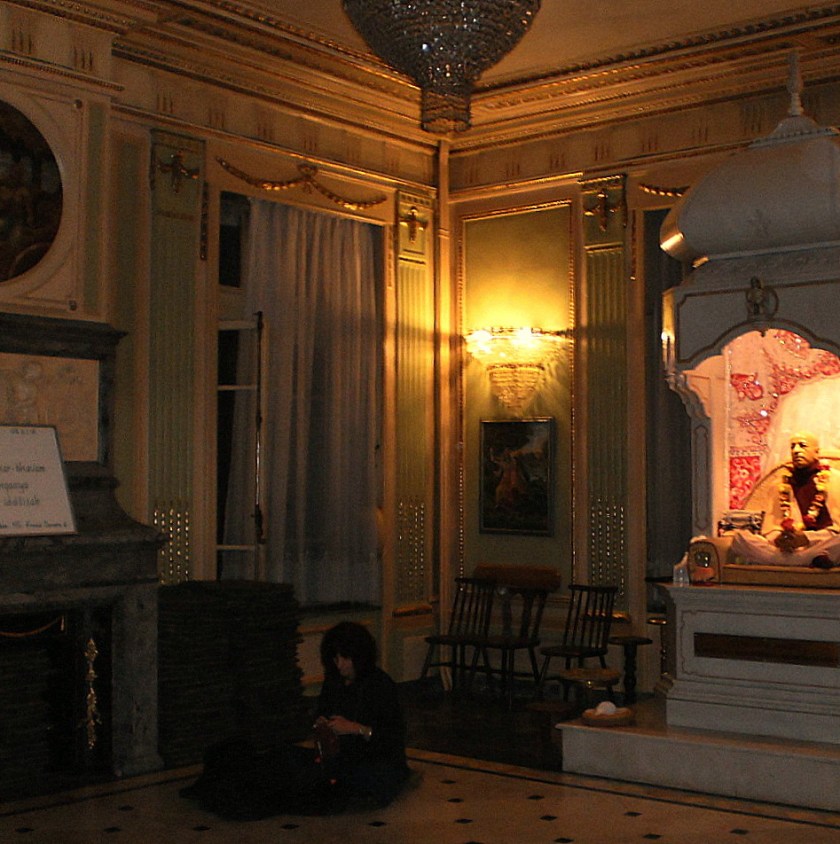
A corner of the main temple room, with the murti of His Divine Grace A.C. Bhaktivedanta Swami Prabhupada

But I digress. Here is the abstract of my presentation, ‘Personalism East and West’:

This presentation will be an introduction to the comparative study of Eastern and Western personalism, with special reference to the personalism of the theistic form of Vedanta represented by ISKCON. A certain kind of propedeutic to this study is necessary, since without it, the real nature and implications of the differences between the respective forms of personalism are normally overlooked and the similarities to some extent misconstrued and misunderstood. The relevant historical, cultural and intellectual contexts will therefore be outlined, and only with these basic perspectives firmly in place will the presentation move on to a brief overview of the conceptual and terminological histories of “person” and related notions in the West and of comparable ideas in the East. This overview will, for the purposes of the introduction to the subject, be given exclusively in light of and with constant reference to the mentioned fundamental perspectives on the general, constitutive characteristics of and differences between Eastern and Western thought as historically developed. In this way, the presesentation will seek to prepare the ground for a subsequent step in the comparative work, through which, along with more particularized study of individual personalist thinkers, schools, and positions, meaningful East-West relations can be established and possibilities of mutual influence and adjustment and new syntheses fruitfully explored.

Photo by Jean-Pol Grandmont

Photo by Jean Housen