In the French Revolution, J. L. Talmon observed, rationalism itself had been transformed into a passionate faith. [The Origins of Totalitarian Democracy (1970 (1952), 6.] Already Lamartine noticed that Mirabeau managed to make reason passionate. The social and political consequences of the idea that the voice of the People was really the voice of God now had to be drawn. The Roman-inspired constitutional aspiration were swept aside by the Jacobins with the help of the new, militantly impersonalistic political concept of la volonté générale, as the revived generalistic paradigm of Greek political philosophy combined with the new centralism and nationalism to produce the first Gnostic dictatorship of modernity. The rights of the secular individual – in Robespierre’s rhetoric sometimes under the nominal designation of personality – were proclaimed alongside the rights of the abstract universal Humanity which was somehow embodied in the new republic.
Described as an explosion of divine wisdom, the Revolution was immediately seized upon and further theorized by the politically powerless German romantics and idealists. [The reactionary side of romanticism is not seldom a superficial, aesthetic phenomenon, under the surface of which hide the same radical ideas. When it is real, what we find is often the use of some of the new intellectual resources in the defence of pre-revolutionary social and political formations which were already characterized by the relapse from differentiation. A more balanced, selective, non-revolutionary use of romantic ideas is found in Burke and similar thinkers.] Kant wrote a treatise on eternal peace which was followed by the outbreak of the most extensive wars in history. If the people were only released, some Germans proclaimed, a magnificent, spontaneous, peaceful harmony of individually different nations would arise, like a wonderful symphony. This vision, however, already swerved significantly from the French form of universalism. Crushed by Napoleon, yet incapable of rejecting the Revolution, the Germans devised their own popular, pantheistic nationalism as an ideology of resistance.
Pantheism thus provided the metaphysics of the revolution. The People was the real divinity which advanced irrepressibly while the empty abstractions of the Supreme Being or Reason were formally worshipped. In the absence of the differentiational framework – the transcendent sphere of values, the ontic logos, and the objective moral order – the asserted freedom was of the distinctly modern kind: the freedom of mere self-assertion, either as guided by self-protection and rational calculation of the maximization of pleasure, or in the form of the new emotional expressionism of the romantics. It was no more qualified than the simultaneously asserted equality: both were normless, tending towards abstract absoluteness and limitlessness and thus the illusory. They corresponded to a universe in which All is God. And if All is God, God cannot be the Father, and if there is no father, the assertion of general human brotherhood is meaningless. German idealism, at one early stage, conceptualized it all in the form of a Transcendental Jacobinism.
Romanticism was the cultural expression of the state of affairs after the divine explosion, where differentiation and structured order were theoretically and practically rejected on all levels. Drawing on the accumulated legacy of the esoteric tradition, the romantics further transformed nature/God into an evolving, holistic, and vitalistic process in which the individual was to be merged through intuition and feeling. Everything was included in the becoming in which nature/God strove to realize all its potentials, in nature, history, and art, and in which it became conscious in Man. Nature was visible spirit and spirit invisible nature. Illustrating the continuity of rationalism and romanticism, Carlyle proclaimed that the Enlightenment philosophers were right in asserting that the supernatural was not distinct from the natural; but this, he held, meant that the natural must be elevated to the supernatural and not, as they had thought, the reverse. [See Franklin L. Baumer, Modern European Thought: Continuity and Change in Ideas, 1600-1950 (1977), 274-6.] But if they were not distinct, the meaning of this position was hardly clear. If All is God, there is no difference between high and low, up and down. The position that All is God, that God alone exists, turned out to be difficult to distinguish from the position that Nothing is God, that Man alone exists.
The new totality was without any structure, any hierarchy. It was without rules, auto-evolved, no longer created and ordered according to an ontic logos. The endeavour to preserve the traditional distinctions of morality, society, art and religion were powerless against the underlying blurring momentum of the pantheistic revolution.
Mendelssohn sought to show that pantheism, rightly conceived, was congruent with religion and morality. Throughout the ages, similar strategies could seem to have been devised by monists. Christian mystics had claimed to uphold the Trinitarian theism of orthodoxy, Sufi mystics had defended Allah and his law, and advaita vedantists retained on one level the ishvara, the personal deity. But that was before the pantheistic revolution of modernity. In the context of the latter, the elevation of a wholly ineffable, impersonal oneness to the highest, ultimate or only true reality assumed new meanings and had different consequences. Its often neglected metaphysical diffculties were reproduced on all levels of the respective philosophical systems. The efforts to preserve, under this condition of the relegation of the distinct focus of the personal aspect of the transcendent Godhead to a lower level in the hierarchy of being, the structured order of the still lower, phenomenal levels of reality all seemed somehow sooner or later to fail. As the transcendence of the unity was lost in the ever-growing metaphysical confusion, phenomenal reality dissolved into chaotic formlessness, increasingly exposed to the manipulations of arbitrary human will.
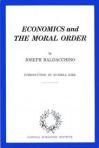 “Any society’s moral order develops from its religion, its philosophy, its humane literature. The discipline of political economy, little understood until the latter half of the eighteenth century, is no independent creation: what economic views one holds must depend upon one’s apprehension of human nature. An economic system indifferent to morality will not long endure. For proof of these theses, read with attention Baldacchino’s succinct study, the work of a sound scholar endowed with a philosophical habit of mind.” Russell Kirk, from the Introduction

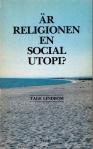 Fil. dr Tage Lindbom har, sedan han lämnat sin tjänst som chef för Arbetarrörelsens arkiv, i sina skrifter framförallt behandlat andliga och samhällskritiska ämnen. Han framstår som en av landets största och mest klarsynta filosofer. Han påvisar hur den kristna kyrkan löper faran av ett inre sönderfall genom teologins frivilliga underkastelse under existentialism och marxism och hur den sekulariserade mänskligheten utropar sig själv till ett herrefolk som liter till sina egna krafter i stället för den kraft som är av Gud.
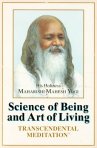 The Vedic knowledge of India has been the source of insight, inspiration, and enlightenment for mankind for countless generations. Maharishi Mahesh Yogi’s Science of Being and Art of Living is the modern expression of this ancient wisdom, presented with exceptional clarity, precision, and depth.
 Olle Bengtsson