
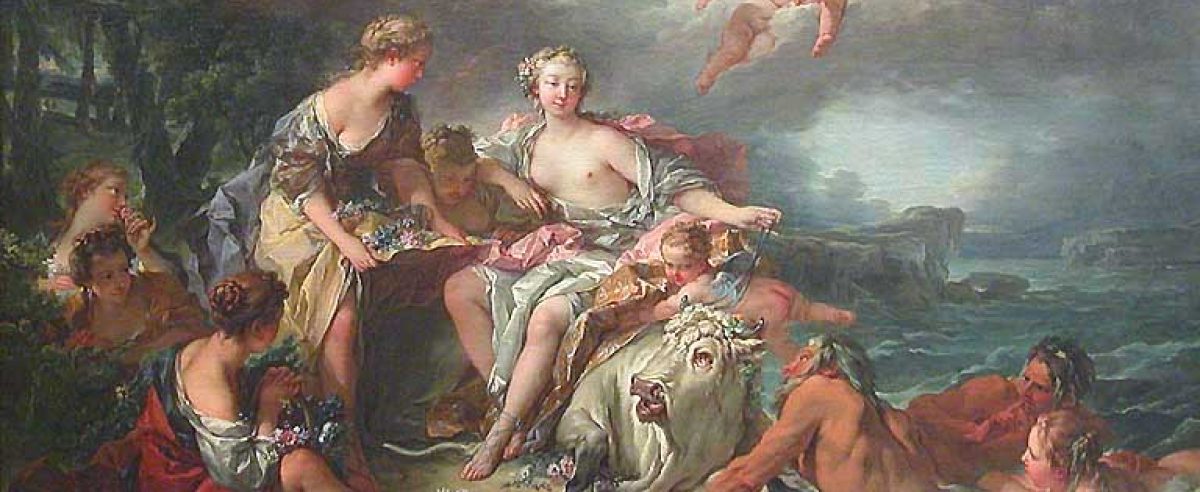
Sebastiano Mazzolino: Allegoria della primavera
Rider, 1970 (1939)
Back Cover:
From the Preface
 I do not desire to convince others, but simply to radiate whatsoever of truth I have found; then others can pick it up or not as they wish. They must approach me of their own free will and not because I wish to act as a missionary to them. I do not seek to convert, much less compel, but to show others what they, too, can find within themselves.
Frankly, I have not become conscious of possessing any mission to this world, but the only one I would care to undertake, if the gods were to grant me the ability, would be to make men aware of the value of their own soul. Moreover, this personal freedom is not without some peculiar value of its own. Because I am independent of all allegiances and because I obey no other authority than that of my own inward monitor, I can freely afford to set down truths which have either been selfishly hidden or foolishly distorted in the past.
Chapters:
Prefatory
What is God?
A Sane Religion
The Mystery of the Kingdom of Heaven
The Seven Beatitudes
Practical Help in Yoga
Psycho-spiritual Self-analysis
The Question of Asceticism
The Scripture of the Yogis: I. Renunciation
The Scripture of the Yogis: II. Revelation
The Scripture of the Yogis: III. Realization
Errors of the Spiritual Seeker
The Gospel According to St. John
The Mystery of Jesus
JOB’s Comment:
I have to repeat myself: It is difficult to recommend modern books on spirituality. None expresses my own views only. But most of course contain some of them. Brunton’s were among the first I read, in the 1970s. See also my earlier Brunton posts, in the Spirituality and References categories.
Routledge, 2011 Amazon.co.uk
Pre-Prelims:
 Julius Evola’s writing covered a vast range of subjects, from a distinctive and categorical ideological outlook and has been extremely influential on a significant number of extreme right thinkers, activists and organisations. This book is the first full length study in English to present his political thought to a wider audience, beyond that of his followers and sympathisers, and to bring into the open the study of a neglected strand of contemporary Western thought, that of traditionalism.
Evola deserves more attention because he is an influential writer. His following comes from an important if largely ignored political movement: activists and commentators whose political positions are, like his, avowedly traditionalist, authoritarian, anti-modern, anti-democratic and anti-liberal. With honourable exceptions, contemporary academic study tends to treat these groups as a minority within a minority, a sub-species of Fascism, from whom they are held to derive their ideas and their support. This work seeks to bring out more clearly the complexity of Evola’s post-war strategy, so as to explain how he can be adopted both by the neo-fascist groups committed to violence, and by groups such as the European New Right whose approach is more aimed at influence from within liberal democracies. Furlong also recognises the relevance of Evola’s ideas to anti-globalisation arguments, including a re-examination of his arguments for detachment and spontaneism (apolitia).
This work will be of great interest to students and scholars of political theory, international relations and fascism.
Paul Furlong is Professor of European Studies at Cardiff University. He has written on Italian politics, European politics and methods in political science.

Photo: Bjaglin Click to enlarge
Not much needs to be said here about the impersonalistic import of classical physics and the conception of science to which it gave rise and which in important respects dominated the West for centuries. In the course of the Enlightenment, classical materialism and atomism, the minor traditions of Greek philosophy which had been rejected by the speculative philosophers of the differentiational shift and which could not enter into the grand synthesis that was Christian theology, were again taken up and deployed in theoretical support of the emerging scientific administration of modernity. With the differentiational tension abolished, the West’s dynamism and creativity was increasingly refocused on the material sphere.
The story of how the West came seriously to adopt as a worldview the mechanistic model of matter in motion, how it built a predominantly materialistic civilization focused on the control and exploitation of nature, and how it proceeded to spread it to the rest of the world, is at least in the perspective of comparative cultural history not only a history of beneficial material and even, indirectly, some cultural and political advancement, but also one of a cultural, moral, and spiritual abnormity. From the model’s beginnings in the early modern period, when Hobbes and others immediately began to apply it to human beings, it has also produced problematic and sometimes tragic results of a scale and a number which alone foreclose any interpretation of Western modernity as simple progress of the values of the person.
Renaissance individualism, even among the learned humanists, had been marred from the beginning by the relativism, egocentrism, vanity, Prometheanism, and sheer vulgarity of the new secularism. When modern individualism was philosophically formulated by Hobbes, it was the grossest doctrine of a living lump of matter, without any distinctly human nature in common with others, causally impelled by the drive for self-preservation and the satisfaction of desires. This is the doctrine which still dominates liberal political philosophy, political economy, and utilitarianism, and which, behind the added facade of Locke’s philosophically largely unsupported moral rhetoric, is the basis of the modern theory of natural rights. The problem of setting only abstractive reason and nature against convention became much more evident in the eighteenth century than among the Greeks. [Again, while they point to the potential dangers in Strauss’s return to the classics, the historicist conservatives also criticize the failure of his American followers properly to distinguish between the classics and the radicals of the Enlightenment. But, as could be gleaned from the previous section, both parties fail to recognize the difference made by Voegelinian experiential transcendence, especially as supplemented by the personalistic dimension.]
Both the concept of reason and the concept of nature were susceptible of continuous reinterpretation. Modern rationalism was in the process of cutting off the upper layers of classical reason which accounted for the differentiational intuition of transcendence, and of reinterpreting nature in accordance with the new science. And in the course of the transition from transcendence to immanence, from theism via deism and pantheism to romanticism, Rousseau only added further new dimensions of the definition of the concept of nature to those of the rationalists. The individual conceived in the terms of any of the versions of modern “nature” was far from the person.
Meanwhile, the secularization of the Renaissance, the Reformation, hosts of new ideologues, and the new technological resources together made possible the consolidation of the position of the territorial monarchs, who set about neutralizing the independent aristocracy, centralizing power, and re-divinizing both the state and themselves, to some extent after the pattern of the early pantheism of the cosmological civilizations, the pull of which was still strongly felt. Because of the still historically influential concrete social and cultural results of differentiation in the intervening classical and Christian civilization, they could never completely succeed, but in addition to the intellectual developments of the new pantheism, the new political form of absolutism ensured that the process of modernization often continued to proceed in a manner intrinsically inimical to the values of the person.
Although Rousseau remains the paradigmatic thinker of romanticism, adding the sentimental variation of modernity to its uncompromising rationalization, [After almost ninety years, Babbitt’s Rousseau and Romanticism is still the unsurpassed analysis of this phase of Western intellectual history, the objections even of critics like A. O. Lovejoy and I. Berlin tending to fall by the wayside. The latest edition (1991) contains a lengthy introduction by Ryn.] others before him had contributed powerfully to the development of this unavoidable complement. In the worldview of monistic mysticism and metaphysics, nature devolved from the absolute and perfect impersonal oneness, and it increasingly came to be thought that for this reason it could not contain evil in any sense except that of privation. On this view, no expansive desires and rational and emotional exploits could really be evil. The providential plan according to which man moved towards the secular kingdom of perfection was apprehended not only by the sinless certainty of unaided reason, but by the sinless certainty of the innocent heart.
Like the universe of immanentistic Hermeticism, man is good, and the Man Machine of Enlightenment materialism could not satisfy romantic man’s emotional side. Committed to his secularism, romantic man could not return to the differentiated reality of true personal identity. Despite his rejection of the rationalist materialism, atomism, and utilitarianism as well as the formalist conventions of the culture of the Enlightenment, he had to move forward, inevitably carrying with him most of the deeper legacy of the modern impersonalistic development. Instead of reversing its trend, he added to it supplementary dimensions.
In Rousseau we stand not only before the paradigmatic addition of the general romantic complement, but also before the equally paradigmatic prefiguration of its more specific dialectic of narcissistic individualism and egotism, on the one hand, and its longing for absorption in a larger whole, on the other. And the larger whole is both the womb of the good nature which is one with the cloudy haziness that is now the divine, as confessed by the Savoyard vicar in Émile, and the whole of the nation, of la volonté générale: rejecting the disruptiveness of Christianity, Rousseau praises the cohesive power of pagan civil religion as perceived through his distinctly new sensibility.
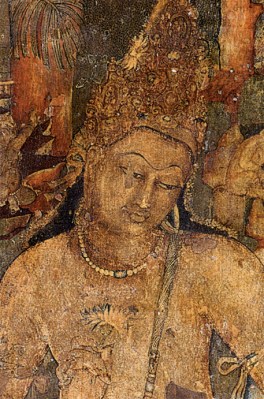
5th century, Ajanta caves
ISI Books, 1999 Amazon.com
Front and Back Flaps:
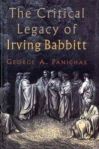 This penetrating new study of one of the twentieth century’s leading literary and social critics is the product of a lifetime of reflection. It is a discerning examination of the ideas of Irving Babbitt, founder of the intellectual movement known as the New Humanism. An early mentor of T.S. Eliot and a Harvard professor, Babbitt was also a diagnostician of the modern social order, which he believed to be in rapid retreat from a faith in first principles and first causes. He saw that Western intellectual life was drifting toward what he termed “a new dualism based on the myth of man’s natural goodness”.
Babbitt’s writings were uncompromising and controversial. His ideas revolved around the ultimate problems of life, literature, and thought and were rooted in and impelled by moral concerns and imperatives. George A. Panichas writes with rare sympathy and vision, drawing the reader to a frame of reference that elucidates Babbitt’s affinities with his contemporaries, including the religious philosopher Simone Weil, with whom Babbitt shared a grounding in French literary thought, a reverence for the classical tradition, and a fascination with Asian religion and philosophy.
“Babbitt never ceased to state the case for criticism”, Panichas asserts. “Nor did he ever relent in affirming the active interdependence of, if not the parity between, the creative and the critical states of mind.” A major American critic, Babbitt stood four-square against the most insidious forces assailing modern man. Throughout The Critical Legacy of Irving Babbitt, Panichas wrestles with what such a figure represents in terms of human possibility and moral illumination. Beyond all else, this profound study and appreciation is an effort to re-introduce and re-integrate a deeply needed restorative influence and paradigm into contemporary existence.
From the Back Cover:
“Panichas places Babbitt where he belongs: at the core tradition in literary analysis-and does so without resorting to bile, guile, or clever ripostes at the expense of a giant.” Irving Louis Horowitz, author, Foundations of Political Sociology
“A penetrating study of the most influential humanist of the twentieth century.” W. Jackson Bate, Kingsley Porter University Professor, Harvard
“Irving Babbitt was a formidable scholar and moralist who stood unflinchingly against the corrosive intellectual tides of his day. In this illuminating volume, Professor George Panichas convincingly establishes why, nearly seven decades after Babbitt’s death, he remains a conservative sage, worthy of careful study and respect-the kind of respect and meditation Panichas himself here displays.” George H. Nash, author, The Conservative Intellectual Movement in America Since 1945
“This is the most authoritative and comprehensive exposition of Babbitt’s thought and character to date. Panichas writes in a style consonant with Babbitt’s own: direct, firm, rational, informed by devotion to standards and evaluation.” Stephen L. Tanner, Professor of English, Brigham Young University
“Dr. Panichas is a historian of ideas, a cultural critic and a splendid writer. It is time to turn our attention once again to Irving Babbitt and Dr. Panichas is an expert guide.” Jeffrey Hart, author, Political Writers of the Eighteenth Century
About the Author:
George A. Panichas is a moralist critic whose main concerns and many books center on the relations between literature, culture, and society. He is the author of the much applauded critical trilogy – The Reverent Discipline (1974), The Courage of Judgement (1982), and The Critic as Conservator (1992). His publications on Irving Babbitt have appeared regularly during the past twenty years, of which Irving Babbitt: Representative Writings (1981) continues to find new readers. He recently edited In Continuity: The Last Essays of Austin Warren (1996). Since 1984 he has been serving as the editor of Modern Age: A Quarterly Review. John W. Aldridge, the eminent American critic and essayist, writes of Panichas’s critical achievement as follows: “Professor Panichas is civilized, fair-minded, compassionate, disciplined, and meticulous in judgment…He sees his function to be that of a detached and impartial assessor of the moral meanings of literature, and he performs that function with admirable grace.”
JOB’s Comment:
See also my review in Humanitas, Vol. XII, No. 2, 1999.
His worldview in twenty minutes.
Meet Ward at the 12th International Conference on Persons, Lund, Sweden, August 6-10, 2013, where he will be the keynote speaker.
The Essential Keith Ward
Darton, Longman and Todd, 2012 Amazon.co.uk
Book Description:
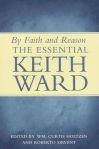 Philosopher and theologian Keith Ward is one of the most prolific scholars alive. For over forty years Ward has been a respected voice in many ongoing theological and philosophical discussions. Ward has the rare ability to seamlessly articulate careful thinking and creative insights on issues such as the nature of God, faith and science, and the value of religion in contemporary society. The mixture of intellect, imagination, passion and wit make Wards writings a must read for all those interested in philosophy or theology, whether a professional or a layman. This reader offers a distillation of Ward s most incisive pieces collected together for the first time. It will be an invaluable resource for students of philosophy of religion, apologetics, contemporary theology, religion and science and philosophy of science, for any general reader interested in comparative theology and the interplay between science and faith. Sections include: The Concept of God, Faith and Science, The Bible and its Interpretation, In Defence of Religion, and Inter-Faith Dialogue and Disagreement.
 Olle Bengtsson