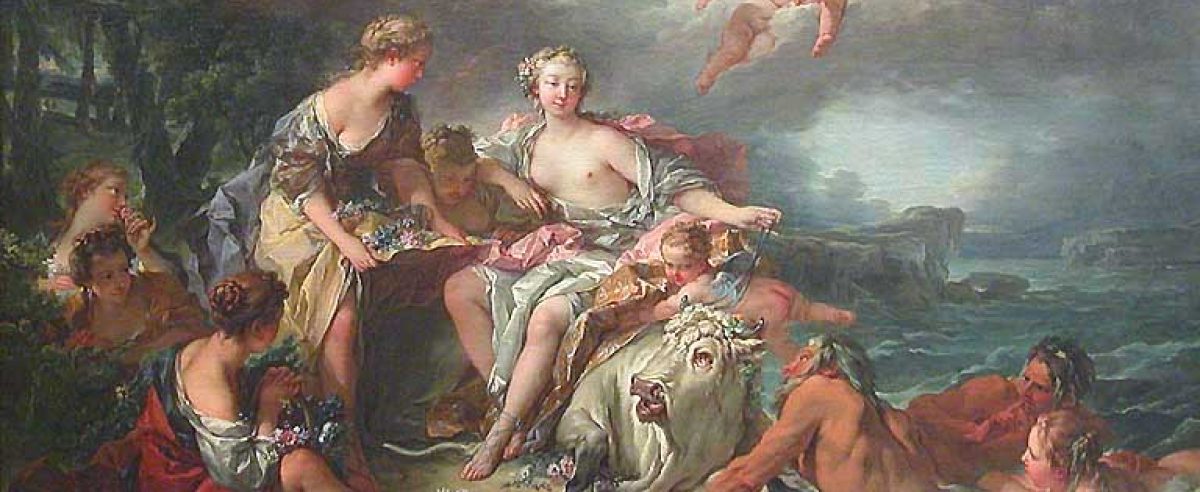
1916
12th International Conference on Persons: Call for Papers
LUND, SWEDEN, AUGUST 6-10, 2013

Papers in any area or discipline are welcome, so long as their themes are relevant to the ideas and concepts of persons, personhood, and personality as a philosophical, theological, psychological, social, political, historical, creative, or linguistic concern.
Papers must not exceed a length of 3000 words and should be prepared for blind review.
In the e-mail sent with the submission, we require the following eight items:
1. word count – 3000 words maximum
2. author’s name
3. academic status (professor, unaffiliated, graduate student)
4. institutional affiliation (if any)
5. mailing address
6. e-mail address
7. the paper’s title
8. an abstract – 200 words maximum
Submission deadline for abstracts is MAY 1, 2013. Full papers will be reviewed on a rolling basis, since travel plans for some need to be made well in advance. Submissions of complete papers will be refereed as soon as they are submitted. Those who submit abstracts will receive preliminary approval of the abstract, but full acceptance depends upon the complete text, due by JUNE 1, 2013.
No more than one submission by the same author will be considered.
Email as an attachment a copy of your paper and/or abstract in rich text format to:
COMMENTATORS
Each paper will have a commentator. Persons whose papers are accepted will be expected to serve as commentators, if asked. Others interested in commenting should send a note to the conference e-mail address above by June 15 detailing availability and areas of interest. Copies of papers will be available by July 1 or earlier. E-mails of authors will also be available for purposes of sending your commentary in advance of the conference.
WEBSITE
The conference website provides information about travel, accommodation, registration, confirmed speakers etc. as it becomes available:
Bibliothèque de la Sorbonne

Thanks to WordPress Bloggers

I want to say Thank You to all WordPress bloggers whose Likes are not displayed here but who Like my posts as they appear on the WordPress pages. I also wish to thank my WordPress Followers for their kind interest. Today the sixtieth was added.
Luc Ferry et Alain Renaut sur la pensée 68
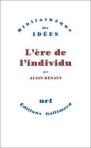
Alain Renaut: L’ère de l’individu
Contribution à une histoire de la subjectivité
Gallimard, 1989 Amazon.fr
Quatrième de couverture:
 La culture moderne n’en a jamais fini de dissiper le mystère qu’elle constitue pour elle-même. Deux schémas principaux in spirent aujourd’hui cette autoréflexion de la modernité. Dans la mouvance de Heidegger, les Temps modernes assurent le règne sans partage du sujet au sein d’un univers réduit à être objet de maîtrise et de possession. Selon une inspiration tocquevillienne comme celle, en particulier, de Louis Dumont, c’est l’individualisme qui, rompant avec la domination traditionelle du collectif, sert de fil conducteur omni-interprétatif. Ces lectures ont pour point commun de rendre la modernité homogène, assimilée au “tout-sujet” our au “tout-individu”. Et surtout, elles occultent la césure qui brise l’histoire du sujet moderne en infléchissant l’humanisme vers l’une de ses figures possibles, problématique et évanouissante: l’individualisme.
L’archéologie de cet énigmatique déplacement conduit Alain Renaut jusqu’à Leibniz. Là s’est décidée une profonde mutation: l’affirmation de l’individualité devient soudain compatible, au prix d’un dispositif intellectuel inédit, avec celle d’une rationalité du réel. Une culture de l’indépendance où chaque être, ne se souciant que d’accomplir sa nature, contribue à manifester l’ordre du monde, se greffe sur la valorisation de la raison. Invention géniale qui, répétée à sa manière par l’empirisme de Berkeley ou de Hume, parachevée par Hegel, a marqué la fin du rationalisme ascétique: l’individualité n’était plus contrainte de se sacrifier sur l’autel de la rationalité et pouvait se déployer librement; au point, chez Nietzsche, d’anéantir tout principe de limitation.
Ainsi débarrassée des fausses linéarités, la logique de la modernité apparaît sous un jour neuf: loin d’avoir sans cesse consolidé le pouvoir de la subjectivité, elle a été aussi le lieu de son éclipse. Dynamique de la modernité qui, à l’âge de l’individualisme absolu, nous lèque la tâche de fair resurgir l’exigence d’autonomie qu’exprime, si elle se peut encore assumer, l’idée du sujet.
–
Biographie de l’auteur:
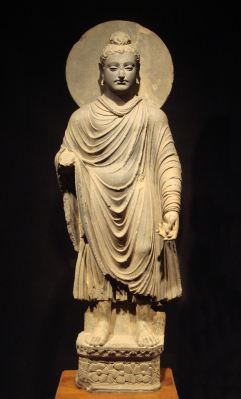
Gandhara Buddha
R. T. Wallis: Neoplatonism
Foreword and Bibliography by Lloyd P. Gerson
Hackett, 1995 (1972) Amazon.com
Book Description:
 Neoplatonism, a development of Plato’s metaphysical and religious teaching, whose best-known representatives were Plotinus, Porphyry, Iamblichus and Proclus, was the dominant philosophical school of the later Roman Empire and has been a major influence of European and Near Eastern thought and culture ever since. Yet the school’s philosophy is only now coming to be studied in detail by historians of philosophy, largely because of the difficulty of the Neoplatonists’ writings and the lack of a good summary exposition. This defect Dr. Wallis sought to remedy in this, the first full-length study of the school by a single author to appear for over half a century. Lloyd Gerson’s new Foreword sets that contribution in context; he also provides an up-dated Bibliography.
Table of Contents:
1 The Aims of Neoplatonism
2 The Sources of Neoplatonism
3 Plotinus
– Life and Writings
– The Three Hypostases
– Emanation, Logos, Sympathy
– The Individual Soul
– Return to the One
– Plotinus and Later Neoplatonism
4 Porphyry and Iamblichus
– Neoplatonism from Plotinus to the Death of Julian
– Anti-Christian Polemic and the Problem of Theurgy
– The Three Hypostases in Porphyry and the Parmenides Commentator
– Iamblichus’ Counter-Attack; The Soul and Her Salvation
– The Structure of Late Neoplatonic Metaphysics
– Textual Exegesis According to Porphyry and Iamblichus
5 The Athenian School
– Neoplatonism at Athens and Alexandria
– Some Basic Doctrines of the Athenian School
– Damascius and the End of the Academy
6 The Influence of Neoplatonism
About the Author:
R. T. Wallis was Associate Professor of Classics at the University of Oklahoma. (Lloyd P. Gerson is Professor of Philosophy at the University of Toronto.)
Yes: Heart of the Sunrise
Live version from the album Yessongs (1973).
Estetik och idealism
Något förtjänar även i samband med persontematiken att sägas också om Kants estetik, eller de estetisk-filosofiskt relevanta partierna av kritiken av omdömeskraften, men detta måste jag återkomma till senare, i mån av tid. Den har i vår tid varit av stor betydelse inte minst för Roger Scruton. Själv vill jag dock se dess sanningar – såväl som exempelvis Schillers estetisk-filosofiska sanningar – insatta i ett större idealistisk-filosofiskt sammanhang av viss typ, och allt detta måste också idag, liksom allt annat i den moderna idealismen (detta är ett grundläggande perspektiv som måste finnas närvarande för den rätta förståelsen av allt jag försöker säga om idealistisk filosofi), på nytt sätt kopplas tillbaka till den klassiska idealismen – inte minst nyplatonismen – och den större andliga traditionalismens förståelse av skönheten.
 Olle Bengtsson