Pantheism, Postmodernism, Pop, 3
Pantheism, Postmodernism, Pop, 1
Pantheism, Postmodernism, Pop, 2
Making a case for the vulgarity that has already triumphed (and possibly simply because it has already triumphed, considering it inevitable), Pattison endeavours to see its strenghts: “Vulgar pantheism is abysmally indiscriminate – or said another way, it is infinitely tolerant. The vulgar pantheist finds room in his universe for the atheist and the witchdoctor as well as the Pope and the rabbi. Professing no one religion, he accepts and rejects them all.” [The Triumph of Vulgarity, 27.]
This unqualified pluralism and tolerance is part of what Babbitt analysed as the “sham spirituality” of romanticism and modernity, and what orthodox Christians criticized as the sentimental watering down of the truths of their religion by liberal theology. [There is no implication here that I accept a literalist position of orthodox Christianity.] It is a phenomenon which through the subtle reinterpretations of countless leading thinkers, novelists and political ideologists gradually guided Western culture away from the objective dualisms of classicism and Christianity. It was supported by progressivist adaptations of ancient wisdom in the form of theosophy and of monistic vedanta in the streamlined form of the pop-gurus of the sixties, issuing today in the combined individualism and metaphysical impersonalism of New Age spirituality, to which I will return shortly. It can hardly be doubted that its love and its oneness were often as vague and as thin as – empty space.
To use Lasserre’s words about pantheism, postmodernism displayed an “insouciance supérieure de s’accorder avec soi-même, de s’astreindre à la conséquence, incapacité d’opter entre deux contradictoires, bien plus, complaisance satisfaite à prêter également à l’un et à l’autre son sentiment et son jugement, délices de penser dans une région si indéterminée et si fluide qu’il ne s’y saurait, à vrai dire, rencontrer de contradictions.” There was in postmodernism no longer any cooperative quest for the infinite, yet once again, shelter from the destruction threatened by the self-aggrandizement of desire was sought in a regressive state of alternating narcissism and self-extinction. And the experience of the irreducible irrationality and difference, of the resistance of the opaque, intractable elements of reality, and the resulting acceptance of ultimate irrationality, now had as a consequence that philosophy itself was given up. Like romanticism, postmodernism was “le plus profond dissolvant intellectuel. [Il donnait] une mystérieuse valeur métaphysique à toutes les libertés, à tous les relâchements, au bout desquels la pensée trouve sa propre décomposition.” [See the note about Lasserre’s book and page numbers above.] Its subjectless subjectivity no longer aspired to or claimed to be objective. The common world dissolved, there were many conflicting realities with no shared, underlying deep structure. In this multiverse, all relations were reduced to power.
Postmodernism’s subjectivism without a subject emerged in the wake of avant-garde modernist literature and art, which, ever since Proust and Joyce, under the influence of changing perceptions of space and time, dissolved the “bourgeois” subject and its character development, but nonetheless retained the subject in new distorted forms. In postmodernism, as for Heraclitus, men are really “flames” and things are really “processes”, there are “no transcendent values”, “all ideas are equally valid”; “the truth is infinite and comprehensive, not narrow and exclusive. The best religion is eclecticism taken to its limit.” Pattison’s description of pantheism holds in almost every detail for postmodernism. Postmodernism was indeed
“a garbage-pail philosophy, indiscriminately mixing scraps of everything. Fine distinctions between right and wrong, high and low, true and false, the worthy and unworthy, disappear in [postmodernism’s] tolerant and eclectic one that refuses to scorn any particular of the many. The [postmodernist] may be fascinated or bemused by the castes, religions, and ethics of a various world, but he denies to each in turn transcendent validity. There is no transcendent validity. There is only the swarming many…[Postmodernism] is necessarily vulgar because it rejects the transcendence from which refinement springs, because it delights in the noisy confusion of life, and because it sacrifices discrimination to eclecticism…it professes to include all philosophies, religions, and ideologies…[Postmodernism] naturally encompasses all the disparate energies loosed by the Romantic revolution. It embraces the mass…makes room for all paradoxical contraries, and reveres the energy of process.” [Op.cit., 23-5.]
Postmodernism, in short, was a further secularized pantheism which no longer endeavoured to elevate or refine itself to monism, and it was evidence of the extent of the failure of such attempts under the circumstances of the modern world.
That postmodernism has produced extreme subjectivism without a subject is only seemingly paradoxical. In the contemporary fragmented mass-culture, the avant-garde of modernist literature and art which systematically sought to dissolve everything “bourgeois” was gradually reduced to nonsense as postmodernism programmatically removed the final barrier against the trivial and the popular. Yet many intellectuals tried hard to find ways to defend it all as the adequate contemporary form of cultural criticism.
Many rock musicians have drawn inspiration directly from Blake, the romantic arch-equivocator, and some have made recordings of his poems. The British trajectory from the culture of classicism and Christianity in its nineteenth-century version to the anti-essentialist, romantic kitsch satanism of today, from, say, Matthew Arnold, who upheld some objective values of classicism and Christianity in a Victorianized form based on a general liberal understanding of religion, over his pupil Walter Pater and Pater’s pupil Oscar Wilde, to Wilde’s pupil David Bowie, is clear and unambiguous. David Buckley’s Strange Fascination. David Bowie: The Definitive Story (1999) was in many respects a representative, 600-page mise au point on the state Western culture as shaped by postmodernism and radical modernism. Pattison, and, for instance, the British philosopher Anthony O’Hear, express the increasingly common insight that popular culture is today the dominant culture – in America, it has even been considered the only culture. More interestingly, Pattison and O’Hear both claim that it is today also the most significant and original culture. [See O’Hear, After Progress: Finding the Old Way Forward (1999).] By the analysis of the pantheistic revolution, it is possible to see also much of the dominant rational bourgeois culture as not only dialectically related to the romantic counterculture, but as itself largely defined by romanticism, not least in the optimistic shallowness of the understanding of man and his motives that has shaped classical liberal economic theory from Adam Smith to this day.
Almost all leading intellectuals, novelists, and artists are now themselves shaped by what was once the isolated subculture, and share a single imaginative and emotional universe. The trend in the postmodern and post-postmodern academia of yesterday and today (which has reached its fullest development in the United States, although it has there also produced a sometimes rather consistent reaction) to extol what is held to be some original and primitive pantheism and compare it unfavourably to the dualistic, patriarcal, exploiting, hierarchical, white, repressive, unequal, logocentric worldview of the Greeks, the Bible, and modern rationalism, can be analysed as a typical product of that exclusively modern phenomenon that is romantic pantheism. Deconstruction seems to have been at least partly driven by the yearning for the primitive sensual unity of romanticism, and this and other specifically philosophical formulations of poststructuralism and postmodernism in France, a mere continuation of the French romanticism as analysed by Lasserre, have been systematically and precisely traced to German sources by Luc Ferry and Alain Renaut, although they of course do not share Lasserre’s deeper analysis from a more strictly “classicist” perspective but are part of much of the underlying modern dynamic that he criticizes. [La pensée ’68. Essai sur l’anti-humanisme contemporain (1986).]
When seen as developed from its logical and historical roots in romantic pantheism, it is clear that all this is a worldview, precisely in its fragmented, kaleidoscopically changing, and inconsistent quality. For these characteristics are all ultimately “meaningful”, no matter how unconsciously they are manifested, as the actualization of what from the positions of classical reason can be seen to be the timeless potentiality of dissolution in chaos and of sophistry’s termination of thought. This potentiality could only be actualized in a dominant movement under the unique conditions provided by modern romantic pantheism.
Even if we can seemingly change worldviews every day – as the Protean personalities of postmodern culture changes identities, clothes, sex, and lifestyles – this very state of affairs can be shown logically and historically to be an expression or a consequence of the worldview of romanticized pantheism taken to the extreme of sophistic self-dissolution. This is not only a worldview; as Pattison insists, it is increasingly the worldview of contemporary liberal democracy. This worldview stands opposed in principle not only to original classicism, Christianity, and, mutatis mutandis, the other major cultural traditions of humanity properly understood, but also to an alternative understanding of modernity itself that affirms the partial truths of rationalism and romanticism as congruent with a discerning, creative form of traditionalism.
Camille Corot: Le quai des Pâquis, Genève

Leszek Kołakowski: Modernity on Endless Trial
University of Chicago Press, 1997 (1990) Amazon.com
Back Cover:
 Leszek Kolakowski delves into some of the most intellectually vigorous questions of our time in this remarkable collection of essays garnished with his characteristic wit. His writings cover nature and the limits of modernity, Christianity in the modern world, politics and ideology, and the question of the claim to knowledge of the human science. Taken together, these essays represent an overview of the problems and dilemmas facing modern reason and modern man.
“Exemplary…It should be celebrated.” Arthur C. Danto, New York Times Book Review
“This book…express[es] Kolakowski’s thought on God, man, reason, history, moral truth and original sin, prompted by observation of the dramatic struggle among Christianity, the Enlightenment and modern totalitarianism. It is a wonderful collection of topics.” Thomas Nagel, Times Literary Supplement
“No better antidote to bumper-sticker thinking exists than this collection of 24 ‘appeals for moderation in consistency,’ and never has such an antidote been needed more than it is now.” Joseph Coates, Chicago Tribune
“Whether learned or humorous, these essays offer gems in prose of diamond hardness, precision, and brilliance.” Thomas D’Evelyn, The Christian Science Monitor
A “Notable Books of the Year 1991” selection, New York Times Book Review; a “Noted with Pleasure” selection, New York Times Book Review; a “Summer Reading 1991” selection, New York Times Book Review; a “Books of the Year” selection, The Times.
About the Author:
JOB’s Comment:
Some strange formulations on the back cover, of a kind that one doesn’t expect from Chicago. The human science? And doesn’t “vigorous questions” refer rather to the manner in which questions are asked – in this case, the way Kołakowski delves into them – than the questions themselves? But be that as it may. Kołakowski was a vastly influential Polish philosopher, not least in the late 1970s and the 1980s due to his magisterial Main Currents of Marxism in three volumes. But having moved beyond Marxism with that criticism, his later work is even more interesting and important.
Tchaikovsky National Academy of Music, Kiev

Julius Evola: Révolte contre le monde moderne
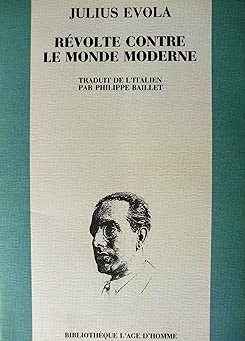
Bibliothèque L’Age d’Homme, 1991
Résumé de l’éditeur:
Initialement paru en 1934, traduit en allemand un an après, Révolte contre le monde moderne est considéré comme l’ouvrage le plus important de Julius Evola (1898-1974). Ce livre prouve que déjá à cette époque, les bases d’une révolte globale entre la civilisation contemporaine avaient été posées, révolte en comparaison de laquelle la “contestation” qui s’est exprimée à la fin des années soixante apparaît chaotique et invertébrée. Au-delà des derniers aspects du monde moderne – hypertrophie de la technique, société de consommation, conditionnement de masse, etc. -, ce livre remonte aux causes, analyse les processus qui, depuis des siècles, ont exercé une action destructrice sur toute valeur authentique et toute forme supérieure d’organisation de l’existence, ont soustrait le monde des hommes aux influences spirituelles pour le livrer à l’individualisme, au materialisme, à l’irréalisme et à sa rhétorique spectrale.
La première partie du livre, “Le monde de la Tradition”, définit, à travers une étude comparée embrassant les civilisations les plus variées, une doctrine des catégories fondamentales du monde raditionnel: la royauté sacrée, la paix et la justice, l’Etat et l’Empire, le rite, la contemplation et l’action, l’initiation et le sacre, la guerre, les “jeux”, le statut de l’homme et de la femme, etc. Ainsi sont indiquées les voies qui conduisaient parfois au-delà de la condition humaine, ou bienqui lui assuraient une stabilité inébranlable. A l’inverse, l’homme moderne apparaît comme un cas aberrant d’être non plus relié aux forces d’en haut et emporté par la “démonie” du collectif vers de nouvelles formes de barbarie.
La deuxième partie du livre, “Genèse et visage du monde moderne”, développe une “métaphysique de l’histoire”, à travers l’exposition de la doctrine traditionelle des cycles, des considérations sur le symbolisme du pôle, l’habitat hyperboréen originel, la “Lumière du Nord” et la “Lumière du Sud”, le matriarcat, etc. Elle se poursuit par l’analy se des cycles de la décadence, depuis les grandes cultures préchrétiennes jusqu’à la Russie et l’Amérique contemporaines, en passant par le monde gréco-romain et le Moyen Age.
En 1935, le poète Gottfried Benn salua ce livre comme “une oeuvre dont l’importance exceptionelle apparaîtra clairement dans les prochanes années” et écrivit qu’en la lisant “on regardera l’Europe d’une autre manière”.
Cette nouvelle traduction française intégrale et précédée d’une introduction du traducteur consacrée aux sources d’Evola (notamment le mythologue J. J. Bachofen) et suivie d’une bibliographie française de Julius Evola, établie par Alain de Benoist.
Nieuwe Gracht, Haarlem
Stig Strömholm: Motskäl
Essäer
Norstedts, 1979
Baksida:
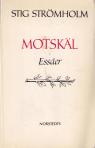 I oktober 1972 utgav Stig Strömholm den mycket uppmärksammade och diskuterade boken “Sverige 1972. Försök till en lidelsefri betraktelse”, en grundlig, skarpsinnig och rikt nyanserad analys av den samhälleliga utvecklingen i Sverige. Sedan dess har snart sju år gått och Stig Strömholm har funnit tiden inne att i en ny debattbok, Motskäl, granska vad som hänt i det svenska samhället efter 1972. Han prövar noggrant frågorna kring rättssamhällets stabilitet, kring domaren och jämlikheten, kring löntagarfonderna och lagarna, kring folkrörelserna, organisationerna och makten, kring jämlikheten, friheten och demokratin. Och lågmält och eftersinnande analyserar han vad “samhället” är och vad “historielös” betyder. Slutligen drar han i några framtidsbilder förkrossande stillsamt konsekvenserna av vissa av samtidens tecken.
Innehåll:
Förord
“Vår historielösa tid…”
Förfallets stormklockor
Demokratins begravning
Lag och ordning
Vänstern och kulturinnehållet
Efesus, Konstanz och Nürnberg – också en kulturtradition
Det tillkommande prästadömet
Är rättssamhället på glid?
Vad har vi paragrafer till?
Domaren och jämlikheten
Normpyramiden och Portugal
Grande misère ouverte royale
Sverige 1973: varmt eller kallt?
Svensk 70-talspolitik: tendenser och möjligheter
Organisationerna i samhället
Folkrörelserna och makten
När ingen väg finns att välja
Kanske en diktare?
Vad är “samhället”?
Multinationalens miljoner
Timrå i deras hjärtan
Preferenser och konsekvenser
Meidner och lagarna
Fonddebatten: låsningar och luckor
Vad hände sen? Kommentar till en roman
De fordringsfulla gästerna
Sju små hem
Kvalitet -95
JOB:s kommentar:
Den första av Strömholms böcker jag läste, på ett tidigt stadium av utvecklingen av min politiska förståelse. Som så ofta väcktes nyfikenheten av negativa recensioner. Man förstod omedelbart av dem dels att detta som de vände sig så skarpt mot var just sådant som berörde en själv och i mycket överensstämde med ens egen gradvis frammognande orientering, dels att det sätt på vilket de utmålade det inte kunde vara med sanningen helt överensstämmande. Från och med Motskäl blev Strömholm en följeslagare under många år. Som många av hans böcker är detta en klippbok med tidigare publicerade artiklar. Den förtjänar fortfarande att läsas av samma skäl som Sverige 1972. Strömholm representerade redan vid denna tid en ovanlig, kulturmedveten borgerlighet, med avsevärd insikt när det gäller även liberalismens svagheter, även om han saknar djupare förståelse för kapitalismen och dess problem.
Edward Frederick Brewtnall: Where Next?
Individualism contra subjektivitet
Fastän alla monader icke är ”andar” i inskränkt mening, instämmer Renaut med Hegel och Strawson i att för Leibniz “le réel a la structure de l’esprit [i inskränkt mening]”, emedan dessa andar “parmi toutes les catégories que nous employons…constituent le modèle de la monade le plus approché et le plus commode”. [L’ère de l’individu, 135.] Det kan icke betvivlas att Leibniz genom att etablera att verklighetens och andens struktur är densamma “contribue à éliminer l’idée d’une extériorité en soi du réel par rapport à la rationalité et, en ce sens, s’inscrit dans le mouvement qui culminera chez Hegel à travers l’avènement du concept comme loi même du réel”. [Ibid.]
Men Renaut bestrider, contra Heidegger, att denna begreppets triumf också är subjektets, att detta tänkande av substansen som subjekt i termer av begreppslighet innebär en subjektivitetens triumf över verkligheten. Begreppets filosofi är helt enkelt inte detsamma som en subjektets filosofi. Tvärtom gör Renaut gällande att monaderna överhuvud knappast kan sägas vara subjekt hos Leibniz, ja rentav att “la monadologie leibnizienne s’aquitte d’une destruction de l’idée de sujet“. [Ibid.]
Den gör det för det första genom att den transparenta “auto-réflexion” som alltifrån Descartes’ cogito-princip definierade subjektiviteten ifrågasätts genom den opacitet som introduceras genom föreställningen om “petites perceptions” – enligt Renaut en “véritable émergence philosophique de l’idée d’inconscient”. [Ibid.] För det andra, och allvarligare, gör den det genom att förneka subjektiviteten som “auto-fondation”, som autonomi och självbestämning. Ty den ordning, som etablerar och reglerar monadernas inbördes förhållande
“ne peut en aucun cas être conçu comme auto-institué par de quelconques sujets entendus comme les fondements de ce qu’ils s’imposent les uns aux autres: les monades n’ayant point de fenêtres, l’idée même d’une causalité horizontale entre elles se trouve en effet exclue. L’indépendence ontologique entre les monades finies annule toute possibilité de concevoir que le moindre ordre soit introduit au sein du réel par imposition humaine de certaines règles limitant la spontanéité des individus”. [Ibid. 137.]
Denna ordning är istället uteslutande Guds prestabilerade harmoni, som är inskriven i de formler som programmerar monaderna själva och deras utveckling:
“En ce sens, la liberté leibnizienne – dont on sait déjà avec quelle ironie en parlait Kant – n’est donc nullement auto-nomie, soumission à une loi que l’on s’est soi-même donnée, elle est seulement accomplissement par chaque monade de la loi constitutive de son être, auto-déploiment de sa déterminité propre et non pas auto-determination: la loi qui organise le réel précède toute décision, et loin que ce soit la volonté qui pose cette loi, c’est la loi immanente au réel qui s’actualise à travers le surgissement de telle ou telle monade et de ses ‘volontés’.” [Ibid. 138.]
Av dessa skäl har subjektiviteten hos Leibniz förlorat all sin väsentliga betydelse, och friheten kan inte längre förstås som den allmänna subjektivitetens autonomi utan endast som individens oberoende. Därigenom uppvisar Leibniz’ filosofi på ontologins plan exakt detsamma som det Tocqueville på politikens plan benämner och analyserar som den självtillräckliga, oberoende, intersubjektivitets-, kollektivitets-, kommunikations-, konsensus- och kontraktsupplösande individualism där all ordning och överensstämmelse är att hänföra till “la logique interne du système”. [Ibid. 139 f.]
Med Leibniz har alltså enligt Renaut samtidigt subjektiviteten och intersubjektiviteten upplösts. Genom den ontologiska grundläggningen av individualismen har också dess etiska legitimitet etablerats. Vi finner en metafysisk tillspetsning och därmed i väsentliga avseenden en förändring av vad Weintraub analyserade som individualismen, såväl som av den lockeska och senare liberala läran om egen- och allmänintressets förening:
“[C]‘est à travers le repli sur soi et le fait de ne se soucier que de soi-même, par la culture de son indépendance et la soumission à la loi de sa nature (= à la formule qui le caractérise), que chaque individu contribue à manifester l’ordre de l’univers, l’harmonie et la rationalité du Tout. Pour la premiere fois, il n’y a plus de contradiction insurmontable entre le souci de soi…et l’affirmation de la rationalité du Tout…Telle est l’invention propre, géniale, de Leibniz: celle d’une structure intellectuelle nouvelle qui fait émerger les valeurs de l’individualisme (indépendance) en les rendant compatibles avec l’idée d’une rationalité du réel.” [Ibid. 140 f.]
 Olle Bengtsson