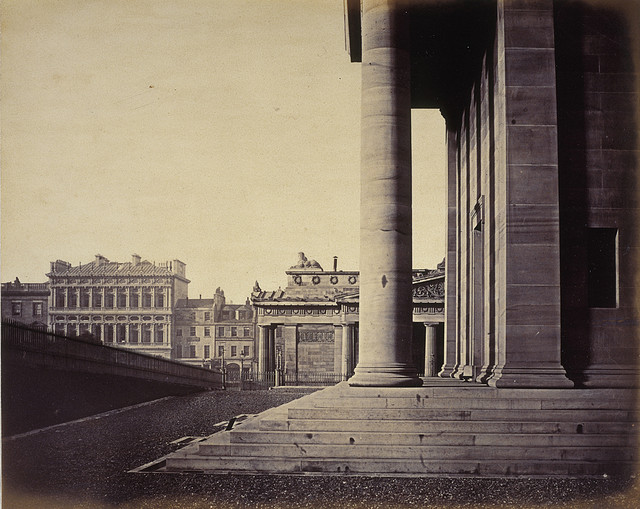
Scottish National Gallery and Royal Scottish Academy, Edinburgh
Separationen av de två idealistiska flödena kan, tror jag, visas vara central för förståelsen av några av huvuddragen i 1800-talets hela kultur, dess filosofi, moral, politik, estetik, religion, personliga biografier. Det är i egenskap av panteister av visst slag som flera mer eller mindre romantiska filosofer blev den idealistiska personalismens främsta eller s.a.s. omedelbara motståndare, och som panteist hamnade även Hegel i motståndarlägret. Förbiseende vidden av frågan om innebörden av den historiska dynamik som den moderna panteismen var ett uttryck, brukar detta oftast förklaras med eller beskrivas i termer av att man helt enkelt, liksom teologer alltid gjort, uppfattade panteismen som etiskt förkastlig åtminstone i sina konsekvenser.
I sin negativt-kritiska aspekt är den svenska utvecklingen generellt sett en parallell till Jacobis kritik av panteismen och vad Jacobi kallade nihilismen i framför allt de nya rationalistiskt-idealistiska formerna, men den innebär också en kritik av de distinkt romantiska. En avsevärd skillnad gentemot Jacobi består i att Biberg, Grubbe, Geijer och Boström menar sig kunna genomföra detta övervinnande med bibehållande av väsentliga inslag i äldre och nyare idealism. Det var hos dem icke som hos Jacobi på samma sätt fråga om en återgång till en mer ortodox kristen ståndpukt, eller till en “realistisk” sådan. Här överensstämmer man istället i mycket med den sene Schelling och de s.k. senidealisterna och spekulativa teisterna i Tyskland. Mot romantiska såväl som rationalistiska panteister gäller det att försvara personlighetens självständighet. Även den ledande svenske, starkt Schellinginfluerande romantikern, Atterbom, har på 1830-talet entydigt övergått till det teistiska lägret och i eminent mening blivit en “svensk personlighetsfilosof”, som det senare kom att kallas.
En linje har etablerats, som tydligt undviker såväl vad Leander kallar den “lägre” romantiken som de varianter av idealism som åtminstone med tiden förenas med denna i stundom alltmer nihilistisk och demoniserad form, och även alltmer övergående i naturalismen. Med hänvisning till skönlitteraturen och ett närmast psykologiskt plan gör Leander med Babbitt gällande att det är ett misstag att sätta romantik och naturalism i motsättning till varandra:
“[I] verkligheten äro de komplementära företeelser. Hallströms naturalistiska pessimism är den desillusionerade, besvikne romantikerns, som väntat för mycket av livet. Naturalisterna se klart, att romantikens drömvärld är overklig och illusorisk; och eftersom denna drömvärld för dem är liktydig med idealism överhuvud, förklara de bittert, att all idealism är omöjlig och att våra bästa och vackraste drömmar äro för goda för denna världen. Därför att en osund form av idealism gjort bankrutt, förkasta de all idealism. Romantik och naturalism kunna mötas hos samma individ och i samma diktverk; den romantiska ironien visar det…i den mäktiga romantisk-naturalistiska strömningen äro livsdyrkan och livsleda förbundna i den stora längtans tecken.” [Romantik och moral, 46 f.]
Men till skillnad från Babbitt anser Leander i högre grad att detta blott gäller en typ av romantik, nämligen vad han kallar den lägre.
Morse Peckhams analys av romantiken – utsträckt över hela 1800-talet – som ett sökande efter identitet efter den gamla samhällsbestämda identitetens upplösning [Se Beyond the Tragic Vision: The Quest for Identity in the Nineteenth Century (1962) och i de uppsatser som samlats i The Triumph of Romanticism (1970).] ansluter sig delvis väl till Barzuns tolkning av romantiken – likaledes utsträckt över hela 1800-talet – som sökande efter en ny ordning efter den brytning som den franska revolutionen utgjorde. Ordningssökandet ägde förvisso rum i alla möjliga olika riktningar, vilket starkt bidrar till romantikbegreppets vaghet och mångtydighet. Men den nya identiteten upplevdes ofta som möjlig blott i det egna självet, som nu framstod som den enda källan till värde, och som nu ensamt förlänade världen och naturen en ny mening. Detta var den karaktäristiska blandningen av subjektivistisk individualism och panteism till ett helt nytt tillstånd av moralisk tvetydighet och hotande nihilism, men som Peckham, som själv skriver utifrån en radikalmodernistisk, romantisk-ironistisk position, framlyfter som tidens stora framsteg.
Peckham tar sin utgångspunkt i en egen men samtidigt typiskt amerikansk psykologisk-pragmatisk modell för mänskligt beteende. Produkterna av ett biologiskt betingat behov av “orientation”, den kristna teologins, platonismens och upplysningsklassicismens overkliga, i sin dualism och sina hierarkier falskt entydiga, i själva verket ohjälpligt paralogistiskt motsägelsefulla strukturer och ordningskonstruktioner, upplöses i Goethes, (den sene) Beethovens, (den tidige) Wordsworths, C. D. Friedrichs konst, samtidigt som dessas nya identiteter, som i sig upptar och bejakar tillvarons konstitutiva motsägelsefullhet, inte heller kan undgå att själva delvis konstitueras av samma orienteringsdrift, om än på annat sätt: driften förenas hos dem för första gången med ett bejakande av vad Peckham menar vara “verkligheten”. Schopenhauer inser att konsten förmår genomskåda orienteringsdriften, och den nihilistiska viljan avslöjas som verkligheten. Först med Nietzsche har paradoxerna slutligt bejakats, men det nya har länge att kämpa en ojämn kamp med de kvardröjande illusionerna i 1800-talets samhälle och kultur. Med Kants kritik av det praktiska förnuftet och den med Hegel kulminerande postkantianska idealismen gör sig också orienteringsdriften i dess totalitära blindhet åter, på nytt sätt, gällande:
“[T]he Kantian-Hegelian…[line] of thinking inevitably led to a restoration of value to nature and society, as they exist. And that affirmation of an absolute morality stripped the individual of moral responsibility, leaving him only conformity to a morality maintained by power, as in the past. Though such thinking started by deriving value from the self, it ended by stripping value from the self.” [Beyond the Tragic Vision (1962 (1981)), 172 f.]
Fastän den framlyfter bristerna i ett visst slags äldre rationalism, och fastän den i mycket på riktigt sätt beskriver den moraliska ambivalensen i romantiken, förefaller mig Peckhams ironistiska modell, orienteringsdriften contra ”verkligheten”, sakna förståelse för väsentliga aspekter av såväl den platonska som den postkantianska idealismen. Den även av viss modern idealism bejakade intellektiva medvetenheten eller högre förnuftsuppfattningen ligger bortom alla försök till heltäckande logiska system, och denna idealisms rationella strukturer är blott tentativa, relativa approximationer till ett innehåll som i princip är outtömligt och för det ändliga subjektet aldrig möjligt att definitivt behärska. Ordningen är enligt denna idealism verklig, icke illusion, men den kan blott ofullkomligt avspeglas eller uttryckas på det relativa planet. Det absoluta är verkligt, men kan aldrig fullständigt uppfattas eller kvarhållas av oss som ändliga varelser, begränsade till detta plan. I vår bristfälliga, begränsade och relativa verklighet är emellertid enligt denna idealism vad vi dock verkligen kan uppfatta av ordningens och det absolutas normativa objektivitet likafullt oundgängligt – religiöst, etiskt, estetiskt, och även samhälleligt och politiskt.
Peckhams delvis i sak postmodernistiska tolkning skiljer sig dock fördelaktigt från den som var vanlig i de nyfideistiska och nypositivistiska lägren och som fortfarande är vanlig, såtillvida som han uppfattar skillnaderna t.o.m. mellan den transcendentalistiska (i Carlyles och Emersons mening) hjälteidealismen och de senare dionysiska urspårningarna. Det heter rentav att “[i]f the Nazis had understood Wagner they would have banned him; if they had been capable of believing him, they would never have been Nazis”. [Ibid. 241.] Men hans ironistiska modell förbiser i vilken utsträckning de totalitära systemen själva bygger på och möjliggörs av den “lägre” romantikens relativism och nihilism. Även om den första vågen av historisk kritik av nazismen ofta präglades av missvisande överdrifter, enligt vilka inte bara Wagner och Hegel, utan Goethe, Luther, allt tyskt var orsak till nazismen, kvarstår likafullt hos de tidiga kritiker som i likhet med den sene Meinecke eller exempelvis Peter Viereck vill bygga på en mer genuin värdeobjektivism flera här väsentliga perspektiv på idealismens uppblandning med naturalistiska idéer. [Vierecks Metapolitics: From the Romantics to Hitler, som utkom redan 1941 och redan året därpå översattes till svenska av Alf Ahlberg, bygger specifikt ifråga om nazismen delvis på tvivelaktiga källor och tolkningar (vilket inte är märkligt vid denna tidpunkt), men hans allmänna förståelse av de här aktuella aspekterna av moderniteten, senare utvecklad i andra verk med politisk tillämpning och delvis inspirerad av Babbitt, är viktig. Ryn har skrivit en längre uppsats om Viereck, ‘Peter Viereck: Unadjusted Man of Ideas’, i Political Science Reviewer, vol. 7 (1977); se också min artikel om Viereck i Svensk Tidskrift, 4-5, 1989.]
Hegels idealism med dess nya “orientering” var inte den enda varianten av idealism under 1800-talet. Den förenade förvisso nytt och gammalt, men trots att Hegel själv inte menade sig vara romantiker och att han i sin orienteringssträvan förvisso i mycket fortsatte upplysningens projekt, var det nya avgjort av sådant slag som på visst sätt integrerade moment av den nya panteistiska moraliska relativismen. Liksom Mefistofeles s.a.s. förblir enrollerad vid Fausts sida, om än “besegrad”, legitimeras ytterst även allt av lägre art i världsandens dialektiska rörelse. Enligt Peckhams pressade tolkning är det snarare Mefistofeles som med sin magi representerar Gud, eller åtminstone religionen, som det strävande, självständiga subjektet alltfort delvis förlitar sig på – en tolkning som ju inte minskar dramats moraliska tvetydighet. [På säkrare mark rör sig Gillespie; se hänvisning i not i del 2.] Leanders analys framstår som sannare: ”Dionysos var…hela 1800-talets gud, som vid århundradets slut uppenbarade sig i all sin härlighet genom profeten Nietzsche. Men rusets gud dyrkades lika mycket av de första romantikerna.” [Op.cit., 53.]
Men den typ av personalistisk idealism vi inte minst i det svenska 1800-talet har att göra med, och dess motsvarande nyskapande traditionalistiska kulturyttringar i 1800-talets samhälle, är, förefaller det, att beskriva dels som en reaktion mot den revolutionära upplysningsrationalismen och den lägre romantiken, dels som ett partiellt bejakande av den nya subjekts- och individualitetsförståelsen och ett teologiskt, metafysiskt, moraliskt, estetiskt och politiskt inordnande av densamma i vederbörligen modifierade former av alltfort kristet-klassiskt inspirerade ordnings- eller orienteringsstrukturer. Såväl Peckhams som Barzuns beskrivning, förklaring och förståelse av denna sida av 1800-talet framstår därför som otillräckliga. [Se också exempelvis Peckham, Beyond the Tragic Vision, 234 f.] Såväl romantikens identitetsfråga som dess ordningsfråga finner i den personalistiska idealismen en typ av åtminstone partiell lösning som Peckham och Barzun förbiser.
Förvisso var det inte en fullständig lösning. Det skulle 1900-talet komma att visa. Men det var en partiell lösning som jag tror att vi bör förstå för att vinna en riktig uppfattning av moderniteten i dess helhet, även när vi mobiliserar andra och vid den här behandlade tiden ännu inte fullt tillgängliga perspektiv.

Svar till “Den Väldige”
Den flitige och sympatiske om än tyvärr anonyme nätdebattören “Den Väldige”, känd inte minst för läsare av den nu nedlagda Axess-bloggen, skrev följande kommentar till min bok-post Roger Scruton: The Need for Nations, och den förtjänar ett svar i form av ett separat inlägg (”Den Väldige” skrev på engelska eftersom inlägget var på engelska, men jag väljer att här svara på svenska):
“I think I am more of a nationalist than Jan Olof Bengtsson, more like Scruton himself. For example, I find Scruton’s ‘England: An elegy’ a treasure, and for a long time I have longed to read something similar about Sweden, but there is nothing similar.
For me, Scruton’s little book ‘The need for nations’ is of the utmost importance, and I find it very much encouraging that a ‘Europist’ like Jan Olof Bengtsson feels that the book is important and often essential.
That shows, I think, that there is a real potential for cooperation between more nationalistic and more ‘Europeanistic’ points of view. I think it is most important to develop that cooperation as soon as possible on a bigger scale.
How, I cannot say yet…”
Tack för viktig kommentar.
Ja, boken är viktig och essentiell inte minst därför att vi idag står inför en helt annan typ av europeisk union än den jag menar är önskvärd. Detta problem, i förening med min uppfattning att de nationalistiska partierna i Europa idag ensamma står inte bara för det enda effektiva motståndet mot denna union utan överhuvudtaget för mycket av de väsentliga konservativa och traditionalistiska insikter och positioner som andra partier övergivit, ligger bakom att jag kommit att försvara en ”post-paleokonservativ” ståndpunkt och förespråka ett kvalificerat stöd för dessa partier, d.v.s. just det samarbete du ser som viktigt. Men detta program innefattar för mig också en strävan att omvandla just dessa partier i riktning bort från den i det sanna Europaperspektivet ohållbara och problematiska typen av nationalism, och mot en tydlig alternativ pro-europeisk position.
Vad det handlar om här är distinkta, gemensamma europeiska kulturella traditioner och värden, utan vilka inte ens de nationella identiteterna och egenarterna kan rätt förstås. Som jag hela tiden betonat finns det ju oacceptabla, lägre former av nationalism som är direkt motsatta den av mig försvarade europeiska ståndpunkten. Hållbarheten i mitt post-paleokonservativa förslag förutsätter naturligtvis att dessa övervinns och entydigt ersätts av den typ högre försvar för nationell egenart o.s.v. som är en konstitutiv beståndsdel i den kvalificerade Europaförståelsen och den ”högre kosmopolitismen”. Min avsikt har varit att försöka lämna något litet bidrag till att påverka de europeiska nationalistiska partierna i denna riktning.
Det kvarstående problem jag har med nationalisterna är att jag är osäker på i vilken utsträckning de är med på noterna här. Såtillvida innebär mitt ställningstagande också ett risktagande.
Låt mig tydliggöra. Några av de många som välkomnat mitt ställningstagande och uttryckt sig ytterst uppskattande här i bloggen är förvisso utan tvekan nationalister. Jag är tacksam för och uppskattar detta mycket, och jag önskar omedelbart samarbete med dem. Men de flesta av dessa som ställt sig positiva till den nya linje jag försvarat är, tror jag, konservativa i det gamla, krympande lägret, försvarare av nationell egenart o.s.v. men framför allt av en gemensam västerländsk kulturtradition, och inte nationalister. Den viktiga poängen här är att den enda kritik som framförts mot mitt ställningstagande kommit just från nationalister. Alla nationalister är inte som de som välkomnat det steg jag tagit. Alla nationalister är överhuvudtaget inte lika trevliga som du.
Den kritik jag mött från detta håll är inte vilken kritik som helst. Det är en kritik som visar att det fortfarande i det nationalistiska lägret även i Sverige finns representanter för just den lägre nationalism som jag skarpt tar avstånd från. Nationalister som uppenbart har problem med eller direkt avvisar just de gemensamma europeiska kulturella värden och traditioner som är grunden för min pro-europeiska ståndpunkt. När de försvarar Sverige, svensk identitet, svensk egenart, tycks det vara något annat än den svenska variationen och särpräglade tillägnelsen av detta, något annat, som står i motsats till det.
Jag märkte det första gången i reaktionerna från Nordiska Förbundets bloggportal Motpol på mitt inlägg om Jonas De Geer och Samtidsmagasinet Salt och mina efterföljande bemötanden och övriga kommentarer i Motpols kommentarfält. Positiva reaktioner har också kommit från Motpol-bloggare, men responsen från andra – och framför allt från några kommentatorer – gav verkligen en del att tänka på. I samband med detta dök liknande reaktioner också upp i kommentarer här. Denna kritik var inte att leka med. Det framstod alltså, som jag visade i mina svar, som ett våldsamt angrepp just mot de paneuropeiska kulturella värden som tillhör det centrala i det budskap jag försökt förmedla i denna blogg såväl som i sådant jag skrivit på annat håll.
Detsamma blev uppenbart när jag något senare upptäckte tråden om mig, konservatismen och Sverigedemokraterna på Flashback. Genom den upptäckte jag överhuvudtaget Flashback för första gången, och det var till en början ett på flera sätt intressant och lovande möte. Även i andra trådar kommenterade man mina inlägg, och jag gav mig in i utförlig diskussion med Flashback-skribenterna genom att här publicera svar i form av längre inlägg på det de skrivit i forumet. Det kunde, hoppades jag, utvecklas till en meningsfull och givande diskussion. Men inom kort visade sig några deltagare vara nationalister av det problematiska slaget, milt uttryckt, och man kan nu både på Flashback och i mina många inlägg mot dessa här i bloggen se hur det gick.
Det skulle inte finnas någon anledning att ta upp detta igen om det inte vore så att just denna typ av attacker fortsätter. Helt nyligen skrev en nationalist – givetvis anonym som vanligt – följande kommentar här, en kommentar av ett slag som jag inte längre publicerar: “Du tror verkligen att du är ngt?! Bara en osäker liten tönt utan självsäkerhet som alltid funderat för mkt och länge kring sånt folk inte bryr sig [om]. Mao en förlorare…”
Denne kommentator ångrade sig efter bara några timmar och bad om ursäkt. Det har även några andra kommentatorer av samma typ gjort. Dessvärre förblir kommentaren ändå signifikativ, och jag börjar tröttna på det här nu. Kommentaren är ett uttryck för vad jag tvingats konstatera är ett mer allmänt, bestående ogillande från vissa nationalisters sida.
Huruvida jag tror att jag är något, i vilken utsträckning jag är en liten tönt utan självsäkerhet och en förlorare, låter jag andra bedöma. Vad jag kompromisslöst vänder mig mot är däremot denne säkre vinnares uppfattning, och fördömande av, att jag ”alltid funderat för mkt och länge kring sånt folk inte bryr sig [om]”.
Dessa frontalangrepp, ja detta hat (jag hoppas det finns något annat ord med tanke på hur detta missbrukas idag?) mot det som är mitt centrala budskap, det som är huvudinnehållet bl.a. i den här bloggen – detta var vad jag mötte också på Motpol och Flashback och i de tidigare kommentarerna här. Det är just detta innehåll, det jag funderat mycket och länge kring och som jag huvudsakligen skriver om, som, alldeles oavsett i vilken utsträckning folk bryr sig om det, inte bara i sig är det viktigaste av det jag har att säga, utan som också är själva grunden för, ja en stor del av substansen i mina politiska ställningstaganden.
Angreppen påminner om vad många skrivit om de avarter av nationalism, eller former av lägre nationalism, som sägs ha florerat som subkulturer på åttio- eller nittiotalet. Jag vet inte mycket om dem, men att lägre former av nationalism fortfarande finns visar dessa kommentarer tyvärr tydligt. Jag tar därför tillfället att gå vidare med ytterligare ett motangrepp mot den nationalism jag tar avstånd från.
Inte sällan får man känslan att ett huvudsakligt innehåll i nationalismen är – inte bara elgitarr (Scruton: “om en maskin kunde sjunga, skulle det låta som en elgitarr”), utan ”metal”. Och detta inte hos de ledande politikerna – som möjligen i några fall lyssnade på detta i tonåren men lämnat det bakom sig – men hos sådana som försöker tillhandahålla intellektuell och kulturell fördjupning, och tar det på största allvar. Det hela går ofta långt över gränsen till det parodiska. Ifrågasättanden bemöts ibland med oförsonligt kategoriska krav på acceptans. De som inte gillar ”metal” i olika varianter och vidareutvecklingar är inte välkomna – men hur skulle någon som inte gör det kunna uthärda en sådan miljö?
Även jag lägger ut och skriver om rockmusik här i bloggen. Men jag är kritisk även mot de genrer jag lyfter fram, försöker föra en kontinuerlig analytisk-kritisk diskussion. Om någon kan övertyga mig om att något exempel på ”metal” i vid mening är värdefullt enligt mina eller eventuellt några andra som giltiga uppvisbara kritierier, ska jag gärna erkänna det (och jag vill uttrycka min uppskattning till de få som verkligen ansträngt sig och försökt påvisa och argumentativt försvara sådana exempel).
Men av vissa nationella intellektuella tycks ”metal” hyllas och spelas helt okritiskt, och i oproportionerlig omfattning. Det verkar ibland vara det främsta, kanske det enda kvarstående, sättet på vilket man kan uttrycka vad man uppfattar som manlighet. Och “metal” framstår också som det som är det svenska, det nordiska o.s.v. Det är “metal” det handlar om. “Metal” blir det verkliga innehållet, själen i den nationella politiken. “Metal” ska vara en del av en ny kulturell sensibilitet och identitet, som underbygger en ny politik. Det är mycket märkligt. Denna nationalism osar av sjuk, juvenil subkultur. “Metals” råa, iskalla, aggressivt våldsmättade atmosfär ligger som ett tungt, mörkt och frånstötande giftmoln över det hela. Dess tomma, hårda anda sprider sig dödande över allt man säger, skriver och gör, brutaliserar även det som är sant och rätt.
Ursäkta digressionen, men jag måste någon gång få säga det. Detta är ju så långt från Scruton man kan komma. Och en nationalism som tror att en annan typ av kulturellt innehåll och kulturella värderingar, den typ som återfinns exempelvis i denna blogg, är uttryck för att man ”tror sig vara något”, för något slags löjlig snobbism – vad ska man säga om en sådan? Tror man detta har man ju verkligen inte förstått någonting. Ens politik är destruktiv och farlig, och inget samarbete kan komma ifråga.
Om nationalister har denna inställning till vad jag skriver, ja till själva de ämnen jag skriver om, hur kan jag då försvara nationalismen? Det är, tvingas jag säga som svar på din kommentar, nationalisternas sak att svara på dessa frågor. Din sak, som ”mer nationalist”. Hur hanterar du som scrutonian grobiannationalismen? Scruton markerar ju för övrigt just i The Need for Nations tydligt skillnaden mellan nationalism å ena sidan och nationalitet och nationell lojalitet å den andra (såtillvida var det förenklat och missvisande av mig att säga att han var mer nationalist än jag). Och hur menar du att nationalisterna ska samarbeta med Europaförsvararna? Du måste nog själv kunna förklara det. Jag har förklarat vad jag som Europaförsvarare menar och avser med mitt försvar för nationalitet och nationalistiska partier.
Att den citerade typen av kommentarer fortsätter komma säger också, befarar jag, något om innebörden av den tystnad jag inte sällan mött när jag, i linje med mitt nya ”post-paleokonservativa” ställningstagande, försökt kontakta svenska nationalister. Liksom några reagerade positivt här i bloggen, har också några gjort det på annat håll. Men i andra fall har det tyvärr inte gått lika bra. Som led i mitt utforskande av nationalismen försökte jag nå nationalister på olika håll i landet, på alla nivåer, både kända och okända, för att få något slags bild av helheten. Men en mycket stor del av dem svarade helt enkelt inte när jag, i några fall vid upprepade tillfällen, skrev till dem. Jag blev förvånad och besviken, eftersom det ju måste betyda att de markerar ett mycket skarpt avståndstagande.
Inte minst anmärkningsvärt och oroväckande var att det här i några fall var fråga om personer som jag uppfattat som tillhörande sådana riktningar som verkligen försökte ta avstånd från grobiannationalismen. Här tycks finnas något jag förbisett eller missbedömt; en oklarhet har uppstått.
Sverigedemokraternas ersättande av nationalismen med socialkonservatismen som huvudsaklig ideologisk beteckning ser jag i ljuset av de problem jag här antytt som ett nödvändigt steg i rätt riktning. Det tyder på att stora delar av partiet befinner sig långt från den lägre nationalismen. Men det räcker inte. Man måste, menar jag, fortsätta och gå längre. Inte för att bli mer politiskt korrekt, anpassa sig till övriga partier o.s.v. Utan därför att så många svenska nationalister fortfarande tycks ha en helt oacceptabel förståelse av svensk nationell egenart, självständighet och identitet, och tyngdpunkten måste förskjutas i riktning mot den gemensamma europeiska kulturtradition förutan vilken inte heller dessa saker kan ses i rätt sammanhang och förstås på rätt sätt.
Rechtsdemokraten und Patrioten über Zustand und Zukunft des Kontinents
Kurzbeschreibung:
 “Unser Bild von Europa” zeichnen Andreas Mölzer, Otto Scrinzi und Ewald Stadler. In der Dokumentation über die Euro-Rechte finden sie Sloweniens Sozialdemokraten und die deutschen Republikaner, Sinn Féin – der politische Arm der IRA und die Lega Nord, Schottlands Nationalisten und Serbiens Ultranationalisten, die Dänische Volkspartei und die Union für Südtirol, der Eidgenosse Christoph Blocher und Bruno Gollnisch – der Vordenker des Front National, der Vlaams Blok und die Gruppe der Alessandra Mussolini und noch viel mehr.
Idealism and the Renewal of Humanistic Philosophy, 1
Idealism and the Renewal of Humanistic Philosophy, 2
Idealism and the Renewal of Humanistic Philosophy, 3
Idealism and the Renewal of Humanistic Philosophy, 4
Idealism and the Renewal of Humanistic Philosophy, 5
Idealism and the Renewal of Humanistic Philosophy, 6
The experiential whole and the reason that is adequate to it is the whole and the reason of individual finite beings, even as we, as such beings, understand that in explicating, as it were, the whole of experience we also explicate the larger whole of which we are “parts”. The necessary reference of the absolute as distinct from our relative perspectives and eternally complete, is of course easily conceivable for non-“modal” philosophical purposes, and even when still merely a regulative idea, as more objective than any realist conception that we may work out of correspondence with an independent, external physical structure could ever be.
Yet even Croce’s understanding of intrinsic rationality is connected with a version of the calamitous older idealist ambiguity concerning the relation between the finite subject and the absolute, or, put more simply, the lack of a clear understanding of the necessity of distinction between them – the weakness which British absolute idealism inherited from the pantheistic Germans. It is not necessary to exemplify further this position according to which the individual lacks independent reality from the perspective of the absolute and even, ideally, in some respects from his own, and his separateness and integrity is reduced to a relative, temporary fragment of the comprehensive historical self-actualization of the absolute, to a passing contribution to the absolute experience, or to a presupposition of the mode of practice, to be cultivated for what it is worth as a feature of everyday experience.
It is not just from the perspective of an anti-pantheistic traditionalism that a humanist philosophy taken to this point of anti-essentialism must be rejected – even as in some ways expressed by such a traditionalist as Burke, for all the insight he possessed into the difference between the classico-Christian understanding of human nature and the moral order and the modern rationalist one. It is also because of the nature of the historical genesis of this conception of the absolute in the first post-Kantian idealists and Green, as critically analysed by Pringle-Pattison. Yet as Pringle-Pattison immediately makes clear, this does not mean that the concept of the absolute itself, even as in other respects understood in absolute idealism, should be rejected. There are certainly ways leading from consciousness to the absolute, or from the finite to the infinite consciousness. But these ways are other than the standard absolute idealist one. My consciousness and experience are not the absolute’s consciousness and experience, although I may indeed fragmentarily share them through their piecemeal communication and reproduction; philosophical progress takes place only in some finite individuals. Philosophy is only ideally and potentially a system in development, and even where this ideal is realized, there is, again, for philosophy, in contradistinction to modern gnosticism, no general historical progress toward a final, immanent redemptive consummation.
A deeper view of the finite centres as distinct persons is necessary for many reasons, not least for the understanding of perspectival relativity and of how precisely the modes of experience are not in every respect independent either of each other or of philosophy. Experience has its modes, we ourselves, as subjects of experience, are not modes. In one sense, we are of course part of the absolute experience, but as Bradley had to admit, the absolute must comprise both unity and diversity, it must, no matter how paradoxical it might seem from the standpoint of a reifying logic, be relational.
The closed immanentism of idealism as part of the pantheistic revolution, with a number of typical concomitant philosophical positions, must be rejected. I cannot see that there is any problem with saying that there is a transcendent dimension to the absolute, even if we hold merely that the absolute is absolute experience and that this experience, distinct from ours, has a subject conceived in the terms of personal idealism. If the personal idealists are right that our experience never exhaustively coincides with that of the absolute, there would still be no need to insist on the strict Kantian meaning of transcendence. Oakeshott’s putting religion on a par with scientism, Marxism, and Freudianism as a rationalism claiming to yield knowledge of how reality is apart from how we experience it, as well as his own later doubts about idealism itself as rationalism, can, I think, be shown to be superficial even from the position of idealism’s own emphasis on experience, as including religious experience.
But of course the absolute is both immanent and transcendent, and since there is both unity and diversity in the whole, even our ordinary experience can partly coincide with or participate in it to various degrees, depending not only on philosophical insight but also on the moral preconditions of such insight. To that extent it would be more correct to say that in relation to our experience the absolute is “implicit”, in Oakeshott’s sense, than “unconscious” or beyond anyone’s possible experience and conception.
To a degree that I think it is today possible to see is problematic, the understanding of the nature and the order or sequence of the modes in both early and later idealists was determined by the in some respects, as it were, substitute culturalism of the nineteenth-century secular humanist world of Wissenschaft and its modified perpetuation in the early twentieth century. But the more general idealist positions I have pointed to represent lasting contributions and insights of nineteenth- and early twentieth-century humanistic Bildung, apart from what could perhaps be called the management of knowledge and its sometimes too context-specific divisions. Idealism in its highest forms represents this culture at its best, restoring badly needed elements of philosophy as the love of, and the quest for, wisdom. The potential for retrieving elements of the pre-pantheist synthesis, for rethinking the modes and their relations to each other and to philosophy, and for further thought on the complex issues associated with some of the positions I have defended, is considerable within the general framework of idealism.
Apart from its contribution to all of the branches of philosophy which it uniquely and organically connects, idealism could contribute to the renewal of humanistic philosophy especially by demonstrating anew the partial, modal nature of “non-humanistic” thought, and indeed by explaining the deeper significance and value of the humanistic modes: by explaining, when they are invaded and distorted by rationalism and scientism, why and how they must again be conceived as humanistic. It could thus contribute to the restoration of the larger context and framework of human culture and practice which sustains philosophy even as philosophy dialectically transcends it, and which both analytic and continental philosophy have undermined in the twentieth century through different yet not unrelated forms of nihilism.
As a description of the current state of philosophy, the distinction between Anglo-American analytic philosophy and continental philosophy is, increasingly, at least geographically obsolete. This marks a step forward. Although it has long been clear to me that “non-humanistic” philosophy in any of the forms produced by the two wings of the pantheistic revolution is going nowhere and has indeed been disastrous, there are of course still many partial truths floating about in contemporary philosophy that are humanistic and relevant to humanistic philosophy in the deeper, integral sense that idealism at its best represents.
It seems to me, for instance, that even the insights into the nature of intersubjectivity and alterity of dialogical philosophy are not, as is the common understanding, incompatible with idealism – namely, if idealism is conceived in the terms of personal idealism. For as I have tried to show elsewhere, these insights first arose long before twentieth-century continental philosophy in the thinkers and currents of thought that are the origin precisely of personal idealism. In order not to be lost, such truths need to be taken up in idealism thus conceived. And it seems that for this purpose, and for the purpose of their necessary supplementation, the forgotten resources of idealism must be made available and comprehensible through a revised restatement of the kind I have tried to suggest in outline.
Keith Ward on Materialism, 15 1 2 3 4 5 6 7 8 9 10 11 12 13 14
Ward thus begins to refute the argument directly produced by what he rightly finds to be the main drive behind materialism, the rage at the injustice, suffering and evil we find in the universe. This really requires a whole theodicy, and this is also what he proceeds to set forth in outline in the next few paragraphs. It contains several classical themes.
“In a universe generated in such a way, chance and necessity, the conditions of open creativity and intelligible structure respectively, may be bound together in a complex way. Perhaps the general structure of the universe has to be the way it is, because the forms of its being are necessarily laid down in the basic mathematical array of possible worlds.”
As I have already tried to argue, the basic array of possible worlds, in which the forms of the universe’s being, of its being the way it is, cannot possibly be conceived as exclusively mathematical. It is not clear how closely the conception of the necessity of the general structure of the universe is for Ward tied to the mathematical nature of the array of possible worlds. If it depends on it, the argument would, it seems, be untenable. It then has to be rethought so as to make possible the conception of the necessity in terms of non-formal forms, as it were, in the basic array determining the general structure of the universe.
“And the selection of actual universes”, he continues, “may be determined by goals that are worthwhile but hard to achieve and unavoidably susceptible to failure.” This introduces the question of the nature of the goals. And this is a vast issue, involving problems of the philosophy of history and of eschatology. Depending on how the goals are conceived – in terms of a secular futurology of wholly immanent, desirable states of affairs in human society, or in terms of a spiritual culture open to the transcendent dimension – the argument may be acceptable or not.
“Plato and Aristotle struggled with this problem at the beginning of the European philosophical tradition. Their proposal (or one of them) was that the cosmic mind does not create matter, but shapes it to imitate and participate in the divine perfection as far as such a thing is possible. The material realm is one in which chance and necessity combine to form a structure with definite limits but also with possibilities for a certain amount of free creativity. The divine mind shapes the material in accordance with the intrinsic values of beauty and perfection that are inherent in its own being. But even the divine mind cannot annul the elements of chance and necessity that are inseparable from any material universe.”
Plato’s and Aristotle’s teachings on matter are complex. What is translated as matter is not the same as the matter of classical materialism. But it is possible to isolate and identify to an extent that is sufficient for this argument that which is comparable with it. If “elements of chance and necessity” are to be ascribed to this matter as such, however, we must again raise questions about its nature and indeed about whether such a thing exists at all. And, in general, rather than speaking in philosophical analyses of a material realm or universe, with the tacit assumptions or implications of such a concept, what we should perhaps say, and what we can safely say, is that there is a phenomenon, something that we as finite beings experience as matter, and to which elements of chance and necessity may be ascribed. But of course, Ward here speaks of a Platonic and Aristotelian conception.
“What seems to be cosmic injustice or indifference to suffering may be in fact”, Ward suggests, “an unavoidable consequence of the interplay of chance and necessity, inseparable from any material world, influenced but not wholly determined by the attraction of a divine mind that seeks to draw all things towards itself.” Via Plato and Aristotle, we have moved here from the basic (mathematical) array of possible worlds to an actual world of “matter”. But it is the former that determined the latter, inasmuch as the forms of its being are necessarily laid down in it. Yet is is not wholly determined by the divine mind. The latter must thus be more than the basic array, although the array must be conceived as part of it. While the basic array of possibility determines the interplay of chance and necessity in actual “material” universes, the part of the divine mind that is not identical with the array seeks to draw the actual universe (“all things”) to itself, an influence which cannot be a complete determination because of the nature of the array. Again, it is clear that the divine mind must be more than the basic array if the latter is conceived purely in terms of mathematics. But even if it is not, even if it is conceived in terms of “non-formal forms”, the divine mind must be something more than it.
And again, there arises the question of what the drawing of all things to the divine mind means more precisely, with regard to the worthwhile goals and intrinsic values, the state of the realized goals and values. Is “matter” going to be somehow perfected in itself by the imitation of and participation in the divine perfection, by the closeness to the divine mind in a future scenario, or will that which lives in matter, that which experiences matter, the finite beings, transcend matter altogether through this drawing? There are important differences of worldview implied in the different answers to these questions. Either the “material” realm becomes translucent with the intrinsic values, and the worthwhile goal is a state of matter itself as thus perfected. Or the intrinsic values are merely guiding and ever imperfectly realized ones in a “material” universe – any “material” universe – which knows no such definite goal but remains finite and ever to some extent imperfect, so that the orientation of the finite beings that is indicated by the intrinsic values is primarily and ultimately the purely transcendent one towards the divine mind itself and as such (the divine mind that has more dimensions than that of the basic array of possibilities of universes), quite regardless of any accidental relation to phenomenal universes.
“In general, this philosophical approach does provide a robust theoretical response to the reproach that good and bad fortune are wholly accidental, or that no alleged cosmic consciousness could seriously intend to create a universe containing so much suffering. A universe in which free creativity and genuine personal relationships are important has to be a world in which chance (undirectedness by some determining force) has to play a part – though chance always works within the limits of a more general determinate structure.”
Again, chance and necessity are “bound together in a complex way”, since it seems chance cannot be explained by reference to “matter” itself but must somehow be part of the basic array of possibilities which determines any actual universe. Good and bad fortune are not wholly accidental but they are partly accidental, and the cosmic consciousness intended to create the actual universe as it is, as partly determined and partly accidental, since the basic array of possible universes in its own mind is the way it is. Free creativity and genuine personal relationships are part of the goals and intrinsic values, and they require chance in the sense of “undirectedness by some determining force” (a discussion of freedom could be added here). But given the premises with regard to the original source and nature of chance and necessity, the meaning of the creation in terms of an actuality of “matter” would seem somewhat unclear if the source and nature are not exclusively conceived in mathematical terms. There arises the question of the distinctive properties of the experienced materiality as a defining part of actual universes. There are of course many kinds of actual universes or phenomenal worlds that can arise within the divine mind or the cosmic consciousness from its basic array of possibilities.
“And the primordial creative mind does not intend to create suffering. Suffering is a possibility that cannot be eliminated from the necessary set of possibilities in the divine mind. Some suffering is unavoidably necessary in any universe that generates personally created values by beings that are an integral part of a developing, creative, dynamic and interconnected physical system. And much suffering is intensified in kind and degree by the self-centered choices of finite, free intelligences.”
While Ward seeks to refute materialism, I have asked some further questions about the nature of matter or the “physical system” mentioned here. I have also asked some questions about the nature of the goal, and thus the purpose, of creation as Ward loosely conceives it in the Biblical tradition, questions which I have discussed at greater length elsewhere in direct connection with Biblical theology and eschatology. It seems to me these questions are important for the precise understanding of the “personally created values”, the beings that are the persons creating them, and the nature of the “system” of which they are parts. The residues of Biblical theology in terms of “material” creation produce some philosophical difficulties. But on a general level which can be identified apart from the worldview differentiation introduced by these questions, I think I agree with this formulation of Ward’s.
But Ward says “some suffering” is “unavoidably necessary” in “any universe” with the specified intrinsic qualities. It would seem this suffering must then be part not only of the process leading to what Ward considers the “goal” of “creation”, but of that goal itself, of the universe as already drawn to the divine mind etc., if the goal is indeed the goal of the universe itself. It is then a matter of the definition of this suffering. But if the goal is that of the finite beings only and not wholly of the universe itself, the transcendent goal of the finite beings as distinguishable from the universe, the transcendent goal that is not reducible to the universe’s determinating structure, there would be no unavoidable necessity in it of the kind of suffering Ward has in mind.
Ward says that philosophy “cannot take us much further than this”. With regard to the specific questions I have raised, I would be so bold as to suggest that philosophy, as distinct from Biblical theology, can take us a little further. But these are not the questions that are central to Ward’s position, and his answers can be reformulated as applicable within the framework of a philosophy that takes us a little further with regard to my questions.
“But it may suggest that if there is a cosmic mind that is inherently perfect, yet has knowledge of every actual event, knowledge of suffering will be transmuted in the divine mind by its conscious inclusion within a wider and deeper experience. Since the divine mind has infinite time at its disposal, and intends the existence of distinctive values, there is some reason to hope that evil can eventually be overcome and eliminated, and might even be used to generate distinctive sorts of values – so that, while evil can never be justified by its consequences, all evil may nevertheless be turned to some otherwise non-existent good.
Here it seems to me that “evil”, if there is reason to hope it can be overcome and eliminated, must be distinguished from “some suffering” in the preceding paragraph. The main question that arises here is, again, the one about where and when precisely, in terms of Ward’s ontological categories, or rather, metaphysical levels, the eventual overcoming and elimination takes place, especially if we continue to speak of a matter that still, after the refutation of materialism’s view of matter, is still somehow distinctive enough to define a particular kind of “created” universe.
Ward further explains his position: “Finally, it seems possible that the divine mind could enable finite intelligences to share in this divine experience of ‘redeemed’ evil. If that could be, materialist objections to the pointlessness and injustice of life would be overcome by giving all sentient beings a share in a supremely valuable reality, to the precise nature of which they had made an important contribution.” It certainly seems possible that the divine mind could enable finite intelligences to share this experience. But does it imply that, as a result of a temporal processes, the whole of the actual “material” universe, i.e. the universe of or with finite intelligences, will at one point be without as yet unredeemed evil (but only with some suffering), that such evil will then be forever a thing of the universe’s and the finite intelligences’ past alone? That there will be in the totality of reality, i.e. in the divine mind conceived as all-inclusive cosmic consciousness, a state where there is no longer any as yet unredeemeed evil in the (or any) actual universe? And is the acceptance of such a state necessary for the tenability of Ward’s theodicy? Elements of a Biblical eschatology and the historical mode of thinking that it leads to seem to produce here a position that is not really needed for the validity of the general argument.
It also seems there are other positions, having to do with the freedom – and the meaning of the freedom – of the finite intelligences (Ward only briefly mentions one aspect of this above), that could be adduced here in order to account for the existence, without any such cosmic history, in the totality of reality of such parts of it in which at least periodically the injustice, suffering and evil which produce the primarily psychological reaction that produces materialism are indeed experienced. But sufficient stress should certainly be placed, with regard to the finite intelligences that primarily experience this, on what Ward here says about the general possibility of their being enabled to share in the divine experience of it as “redeemed”, and their contribution, through their experience and their way of dealing with it, to a supremely valuable reality.

 Olle Bengtsson