Idealism and Orthodoxy at Oxford, 1901-1945
Mercer University Press, 1985 Barnes & Noble
Book Description:
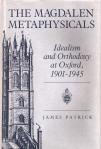 In the decades “between the wars” four notably articulate philosopher-theologians at Oxford defied the revival of realism and positivism ad denied the eclipse of philosophical idealism. They never consciously constituted a school; yet – under the influence of their common mentor John Alexander Smith – Clement C. J. Webb, R. G. Collingwood, and C. S. Lewis came to embrace certain convictions rooted in classical metaphysics and transmited to them by great teachers of the nineteenth century, especially Thomas Hill Green and Richard Nettleship. As James Patrick describes them, “These men also shared a time, the years between the wars; a place, Oxford, ‘towery city and branchy between towers’ in Hopkins’s words; and a college, Magdalen, its deer park circled by the Cherwell, its face dusty rom the traffic of the London road.” The intellectual influence for traditional metaphysics and Christian theology exerted by these scholars of Oxford lived on after 1945 in the eloquent apologetics of C. S. Lewis and in the mature work of others like Austin Farrer, T. S. Eliot, and Willmoore Kendall.
The philosophical interests of the “Magdalen metaphysicals” directed them, individually and collectively, to a careful reconsideration of the essential relation between philosophy and religion. Their philosophy, as they expressed it in maturity, stemmed from four convictions: an interest in classical sources, especially Plato and Aristotle; participation in historical studies and in the revival of history as a discipline; belief in the essentially literary character of philosophical inquiry; and confidence that religion, while it might begin with experience, was finally a matter of truth. “Characteristically”, Dr Patrick writes, “the Magdalen metaphysicals believed that philosophical questions provoked theological answers.”
They were “metaphysicals”, Dr Patrick suggests, “because their philosophy tends deliberately toward poetry, complementing the achievement of the seventeenth-century metaphysical poets…Webb, Lewis, Smith and Collingwood, each in a distinctive way, wrote as though philosophy were a literary genre, and Lewis developed a form for which no name exists, writing story after story in which ideas dominate narrative and diction. All four shared the conviction that language, and hence poetry, is a kind of truth.” The Magdalen metaphysicals also shared a profound interest in history and a traditional metaphysics that made mind the matrix, not merely the subject, of experience. Taken together, they represent a previously undefined and, therefore, overlooked school of traditional Christian wisdom. It is their work as much as that of any other group that will make twentieth-cetury English thought memorable
About the Author:
James Patrick serves as director of the Saint Thomas More Institute in Forth Worth, Texas. He studied architecture at Auburn University, theology ad University of the South, philosophy at the University of Wisconsin in Milwaukee, and earned his Th.D. in historical theology at Trinity College of the University of Toronto. Dr Patrick is a practicing architect and has taught and written extensively about architecture, philosophy and theology. This is his first book for Mercer University Press.
JOB’s Comment:
Dr Patrick is a charming southern gentleman, whom I have met on at least two occasions. Among his other books is the beautiful Architecture in Tennessee, 1768-1897 (University of Tennessee Press, 1981), which he kindly gave me.

 Jan Olof Bengtsson
My personal favorites among the Magdalen metaphysicals are
from the older generation, CCJ Webb (especially for his studies of personality as divine and human)
and, in the second generation, Austin Farrer (several of whose books I am currently looking into, ‘Finite and Infinite,’ ‘The Glass of Vision’, ‘The Freedom of the Will’).
I devoted considerable space to Webb in The Worldview of Personalism, as I think you may have seen. And yes, Farrer is certainly important too. In connection with a lunch in the Keble SCR to which he kindly invited me, the Revd Dr Peter Groves, who was also at Pusey House, showed me his portrait in a nearby room.