
Author: Jan Olof Bengtsson
Spirituality - Arts & Humanities - Europe
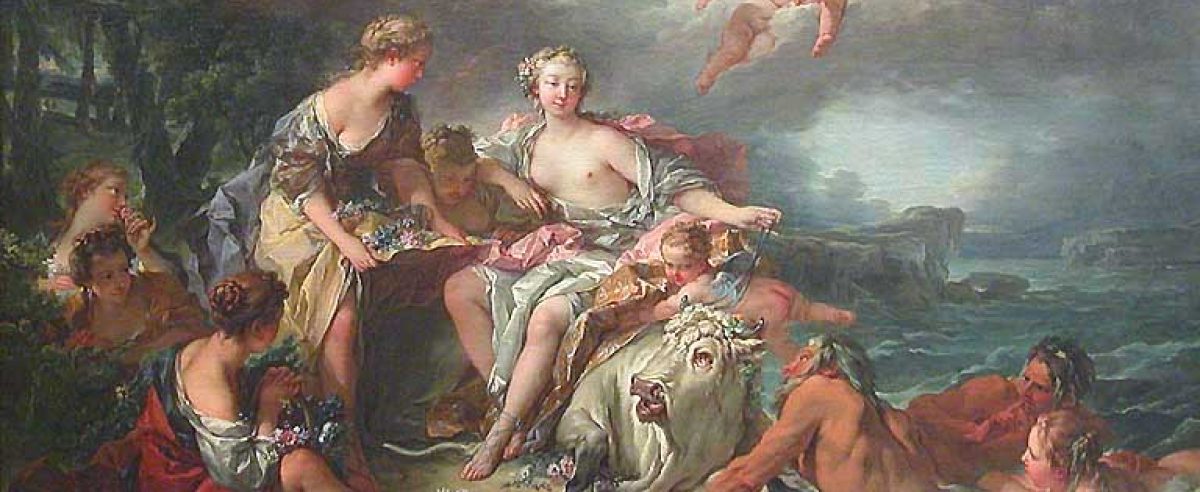
Barbara Rosenkranz: MenschInnen
Gender Mainstreaming – Auf dem Weg zum geschlechtslosen Menschen
Stocker, 2008 Amazon.de
 Mit dem Begriff Gender Mainstreaming (dt.: „durchgängige Gleichstellungsorientierung“) ist der Versuch verbunden, die Gleichstellung der Geschlechter auf allen gesellschaftlichen Ebenen durchzusetzen. Der Amsterdamer Vertrag von 1997 hat dieses Konzept auch zum offiziellen Ziel der EU-Politik erhoben. Dagegen wurde von Anfang an scharfe Kritik erhoben, die im Gender Mainstreaming-Konzept einen totalitären Kern ortet. Zu den Kritikern der GM-Politik gehört auch Barbara Rosenkranz. Die Autorin zeichnet in ihrem Buch zum einen die Entwicklung des GM nach und versucht dieses Phänomen einzuordnen. Leitend für die Untersuchung sind unter anderem folgende Fragen: Was unterscheidet Gender Mainstreaming von klassischer Frauen- und Gleichstellungspolitik? Inwieweit geht GM daran vorbei oder darüber hinaus? Wer sind die hauptsächlichen Propagandisten des GM? Wie konnte es zu der Rechtsstellung des GM kommen? Gibt es einen Zusammenhang zwischen Feminismus und Neoliberalismus? Welche konkreten Auswirkungen hat das GM auf das tägliche Leben, insbesondere in der Verwaltungspraxis und im Erziehungsbereich? Wie stark GM bereits im öffentlichen Leben verankert ist, zeigt unter anderem die Verweiblichung von Piktogrammen und Verkehrsschildern. Auch hier spürt die Autorin den Gründen für diese schleichende Veränderung im Alltagsleben nach. Die Argumente und Beobachtungen, die Rosenkranz zusammenträgt, sind alarmierend, gelingt es ihr doch, das GM-Konzept als neomarxistische Ideologie zu enttarnen, die darauf abzielt, einen neuen, geschlechtslosen Menschen zu schaffen. Grundlage ist ein behavioristisches Menschenbild, das jeglichen biologischen Unterschied zwischen den Menschen zu leugnen bestrebt ist.
Über die Autorin:
Barbara Rosenkranz, Jahrgang 1958, war u. a. Abgeordnete zum Niederösterreichischen Landtag 1993-2002, seit 2006 ist die Autorin Obmann-Stellvertreterin des Freiheitlichen Parlamentsklubs.
Il Canaletto: Capriccio

Person ej blott moralisk
Ayers förkastar helt den vanliga tolkning som innebär att Lockes personbegrepp skulle vara rent moraliskt. Denna tolkning åberopar i synnerhet en känd passage i vilken Locke hävdar att “person”
“is a Forensick Term appropriating Actions and their Merit…This personality extends it self beyond present Existence to what is past, only by consciousness, whereby it becomes concerned and accountable, owns and imputes to it self past Actions, just upon the same ground, and for the same reason, that it does the present…And therefore whatever past Actions it cannot reconcile or appropriate to that present self by consciousness, it can be no more concerned in, than if they had never been done.” [Cit. i Locke, II, 266.]
Ayers kritiserar D. P. Behans och andras uppfattning att dessa formuleringar innebär att personlig kontinuitet för Locke överhuvud icke är vad Ayers kallar “a natural relation”, utan istället att
“what links past to present is not cognitive consciousness of the past in the sense of memory, but an act of moral concern or acknowledgement which sets up a kind of non-natural, proprietary relationship. On this view Locke’s notion of a person is so thoroughly ‘forensic’ (and so like the notion of legal property itself) that the identification of persons and questions of their continuity fall right outside the scope of ontology, being somehow concepts of pure ethics.” [Ibid. 266; Historisches Wörterbuch der Philosophie bygger sin framställning av Lockes personbegrepp bl. a. på Behans artikel ‘Locke on Persons and Personal Identity’, i Canadian Journal of Philosophy, vol. 9, 1.]
Men denna tolkning, “even in so far as it is at all clear”, kan enligt Ayers icke upprätthållas i ljuset av allt det övriga som Locke gör gällande rörande personbegreppets förhållande till varvaron, medvetandet: rörande medvetandets natur, dess förhållande till det förflutna i minnets form, och analogin mellan medvetandet och livet. Fastän förbindelsen mellan de engelska termerna “consciousness” och “conscience” förvisso var starkare på Lockes tid än idag, och fastän detta även är av betydelse hos Locke, [Ibid. + not 87.] gäller dock för denne att
“Consciousness is distinct from conscience, and prior to it. The point in associating them was to find reason for identifying the individual ‘thinking thing’ (i.e. that which is distinguished and united, at the experiential level, by consciousness) with the ‘legal’ individual, the moral agent subject to law, responsible for a past and concerned for a future. If Locke saw the class of persons as important to ethics rather than for biology, that does not mean that self-conscious rationality, which defines that class and unifies each of its members, is anything but a natural attribute…It is true that external property is united to us by merely legal or moral relation, and in the most primitive cases by an act of appropriation. Our actions themselves, on the other hand, not to speak of our experiences and the parts of our bodies, are ‘appropriated’ to us by an entirely natural and given principle of unity, namely consciousness, rather than by some acquisitive act of acknowledgement or ‘owning’ on our part.” [Ibid. 267 f.]
Vi konstaterar alltså åter att personskapet för Locke konstitueras av (det icke-substantiella) medvetandet i sig, och av minnet som är beroende av det.
Georges-Antoine Rochegrosse: Amandiers à Alger

Manfred Kleine-Hartlage: “Neue Weltordnung” – Zukunftsplan oder Verschwörungstheorie?
 Wer die Globalisierung für ein unentrinnbares Schicksal hält, gilt als Realist, wer sie als Ergebnis zielgerichteter Politik zur Errichtung einer Neuen Weltordnung (NWO) auffaßt, als “Verschwörungstheoretiker“ – und dies ist heutzutage kein Kompliment, sondern eein Ausschlußkriterium.
Wären die globalen Eliten aus Politik, Wirtschaft, Medien und Wissenschaft Teil einer Verschwörung: es wäre die geschwätzigste Verschwörung der Weltgeschichte. Denn jeder kann nachlesen, welche Pläne sie verfolgt und welcher Utopie sie anhängt. Das Publikum jedoch ist dazu erzogen worden, in denselben Begriffsschablonen zu denken wie die herrschenden Eliten selbst, und so erscheint als gegeben, was in Wahrheit politisch herbeigeführt, als alternativlos, was nur eine Möglichkeit unter mehreren ist: Man sieht Schicksalsmächte walten, wo durchaus benennbare menschliche Akteure am Werk sind.
Die in Errichtung befindliche Neue Weltordnung so zu nennen heißt: durch eine ideologiekritische Brille sehen. Genau dies tut der bisher vor allem als Islamkritiker bekannte Berliner Sozialwissenschaftler Manfred Kleine-Hartlage im vorliegenden Essay: Er seziert die Begrifflichkeit der globalistischen Ideologie und Propaganda, in der nahezu jedes Wort das Gegenteil von dem bedeutet, was es zu bedeuten scheint; er deckt auf, welche Interessen damit bemäntelt werden; und er zeigt, daß und warum die Neue Weltordnung eine totalitäre Herrschaft neuen Typs ist.
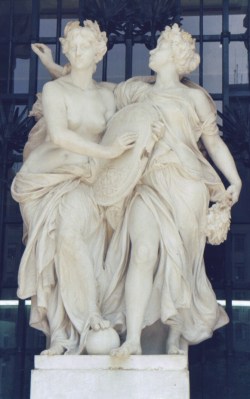
Géza Maróti: Melpomene and Polyhymnia
Teatro Nacional (Palacio de Bellas Artes), Mexico City
Origins of the Pantheistic Revolution
The possibility of the utopian distortion of the meaning of the metaxy had been present from the beginning. When the concrete experience of the higher reason’s opening to transcendence and the concomitant experience of the limitation and imperfection of the immanent sphere were lost, the results of differentiation could easily be construed as an abstract rational blueprint for social reorganization, in line with the generalistic trend of Greek throught and its apprehension of nature in contradistinction to convention. Burke turned against the ‘thoroughbred metaphysicians’ of the Enlightenment, and his historicist followers today see no mystery in the development of Strauss’s analysis and endorsement of the classics more or less into the same kind of Jacobin ideology of democratic imperialism. [See Ryn, The New Jacobinism: America as Revolutionary State (2011 (1991)), and America the Virtuous: The Crisis of Democracy and the Quest for Empire (2003).] While the differentiated experience did reveal a transcendent, divine order with a moral dimension, and this revelation guided the development of the Christian concept of natural right, the utopian mindset, without full access to the engendering experience, could transfer the claims of perfection to its own limited schemes, and posit the latter, in stark opposition to history and convention, as guiding principles for comprehensive social revolution.
This potentiality of a kind of “totalitarianism” – or of a limited vision oppressively posited as a false totality – and some of the later monistic developments of Platonism were, however, combined with, added to, and in some cases replaced by the corresponding Israelite and Christian distortion of differentiational experience. The resultant Gnosticism and Hermeticism, or what I shall henceforward call the esoteric tradition, has – while containing some noble, valuable, and interesting variations – in some of its central characteristics been of decisive importance as a subsequently ever-present threat to differentiational and person-centered civilization. The esoteric tradition can today be seen to have shaped Western modernity from the outset, and, directly and indirectly, almost in its entirety.
This tradition, of which from the earliest stages monistic mysticism was a part, the Schwärmerei of the millenarian sects, and the rationalism of the philosophers (in the late medieval period added to by the influence of Averroism), combined to set in motion what I suggest could be called a pantheistic revolution, a revolution which, through ever bolder syntheses, comprised the most important modes of impersonalistic thought and practice of the modern West.
This was not a return to the early pantheism of the cosmological civilizations, which was in its own way ordered and structured, where the elements of differentiation were present in compact form, where they were undiscovered in their true nature yet not denied. It was a search, theoretical as well as violently practical, and driven by the failure to live with the tension of the metaxy, for a new kind of pantheism, for a new kind of closed immanence, a re-divinized immanence without order and structure, and filled with new content. To this day, and with unabated vigour, its impersonalistic momentum undermines in ever new and shifting expressions the moral, humanistic, and religious values of which the person is the most important bearer.
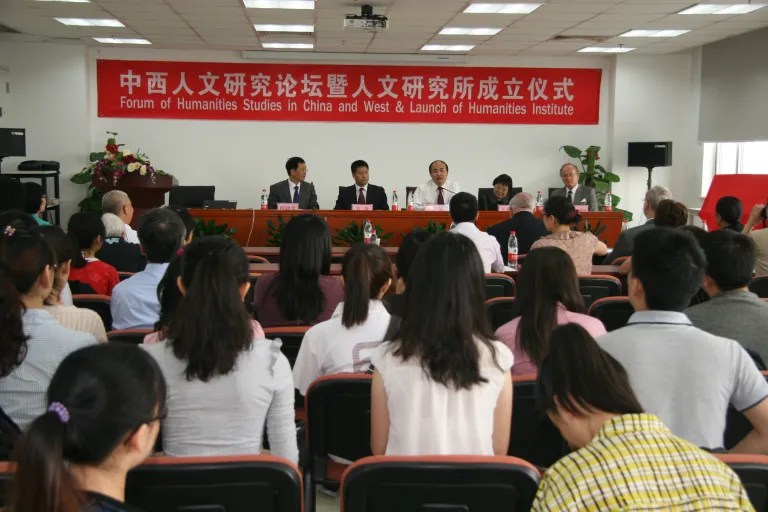
Humanities Institute at Beijing Normal University
Claes Ryn and the Vice-Chancellor of Beijing Normal University, Dong Qi, unveil a plaque at the inauguration in May of the new Humanities Institute, Renwen Yanjiusuo, whose work, like that of Ryn’s National Humanities Institute in Washington, D.C., will be inspired by Babbittian humanism and its further philosophical elaboration:
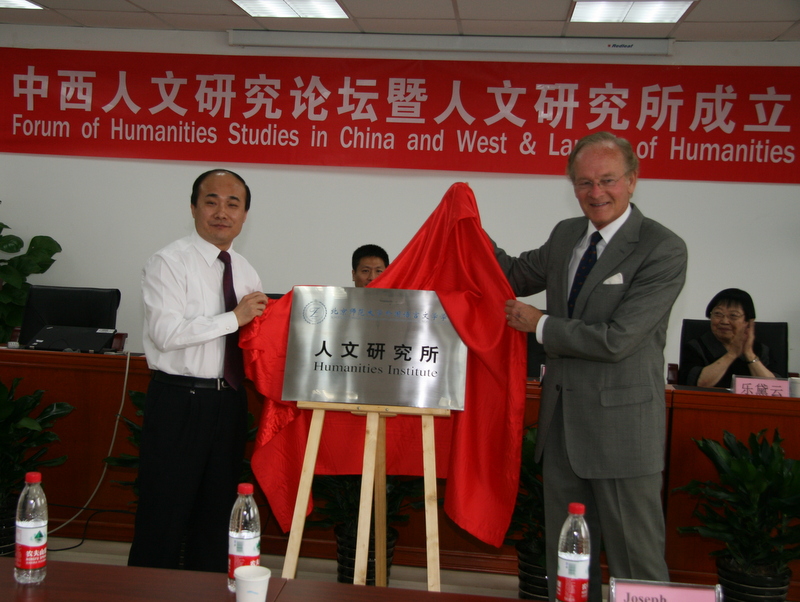
Babbitt, whose wife, Dora, grew up in China, and who often made reference to Confucianism and also analysed the different strands of Taoism, had Chinese followers in the 1930s, and there has long been a renewed interest in him in this country as world events have increasingly borne out his analyses and revealed the relevance of his work. In 2010, Zhang Yuan, one of Ryn’s visiting scholars in Washington, the executive director of the new institute and associate professor in the School of Foreign Languages and Literature at BNU, won the top Chinese academic prize in philosophy and the social sciences for her book on Babbitt’s influence in China.
In this picture can be seen the dignitaries who spoke at the ceremony, in which Ryn was also made Honorary Professor; the woman next to Ryn is the highly influential Yue Daiyun, a famous Chinese scholar who, perhaps more than anyone else, has promoted Ryn’s work in China – three of his books have been published in Chinese translation – since the late 1990s:
Claes G. Ryn: The New Jacobinism
America as Revolutionary State
National Humanities Institute, 2011 (1991) Amazon.com
With a Major New Afterword by the Author
Back Cover:
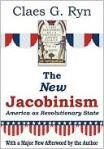 This strongly and lucidly argued book gave early warning of a political-intellectual movement that was spreading in the universities, media, think-tanks, and foreign-policy and national security establishment of the United States. That movement claims that America represents universal principles and should establish armed global hegemony. Claes G. Ryn demonstrates that, although this ideology is often called “conservative” or “neoconservative”, it has more in common with the radical Jacobin ideology of the French Revolution of 1789. The French Jacobins selected France as savior of the world. The new Jacobins have anointed the United States. The author explains that the new Jacobinism manifests a precipitous decline of American civilization and that it poses a serious threat to traditional American constitutionalism and liberty. The book’s analyses and predictions have proved almost eerily prophetic. President George W. Bush made neo-Jacobin ideology the basis of U.S. foreign policy, and it continues to exercise great influence in both parties. This new edition of a modern classic contains a thought-provoking afterword by the author that brings the book up to date.
 The first edition of The New Jacobinism received extraordinary praise:
“Well done, The New Jacobinism!…Lucid and succinct and right.” Russell Kirk
“A much-needed antidote to some of the fatuous assessments of The New World Order emanating from many of the foreign policy experts who live in the Washington Beltway – the modern version of Plato’s Cave.” President Richard M. Nixon
“A splendid, eloquent, hard-hitting effort…[Ryn] has identified for us, as well as it can possibly be done, our malady and the course of treatment we must follow to survive.” Clyde Wilson
“The New Jacobinism…is splendid. [It fills] an important need with eloquence and convincing argument.” Herbert London
“Right on target on an important subject that has long needed to be addressed.” Peter J. Stanlis
“[This] book is truly excellent.” Patrick J. Buchanan
Claes G. Ryn is professor of politics and former chairman of his department at the Catholic University of America. He is chairman of the National Humanities Institute, editor of Humanitas, and president of the Academy of Philosophy and Letters. He is widely published on both sides of the Atlantic and in China. In 2000 he gave the Distinguished Foreign Scholar Lectures at Beijing University. His many books include America the Virtuous, A Common Human Ground, Will, Imagination and Reason, and Democracy and the Ethical Life.

