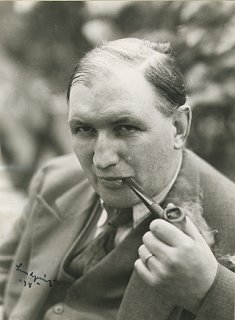
In his doctoral thesis from 1937, Humanism and Naturalism: A Comparative Study of Ernest Seillière, Irving Babbitt and Paul Elmer More, written under the direction of Ernst Cassirer at Gothenburg University, Claes Ryn’s teacher Folke Leander gives an account of Seillière’s view of what I call classical idealism as a mysticisme d’alliance, and also of John Dewey’s similar description of it.
This view is part of Seillière’s analysis of human ”imperialism”, which, in turn, is related to his own partial utilitatianism. Despite the similarities in their analyses of romanticism, this utilitarianism, as Leander clearly shows, distinguished him from Irving Babbitt and Paul Elmer More. These positions need not concern us here.
What is interesting is rather the account of classical idealism as such. For even as understood in terms of a mysticisme d’alliance, a striving for protective and strengthening connection with higher powers against the dangers and uncertainties of life, both Seillière and Dewey manage to give a correct description of it, with reference to which Leander defends at least some of the positions of this idealism.
Babbitt chose to dwell mainly on the humanistic level of ethical ”mediation”, not on the metaphysical and mystical level of ”meditation”. He also rejected, in the spirit of Burke, what he perceived as a ”static absolute”, and focused on the inner check, the higher will, and the moral imagination as the path towards reality. And Leander follows him in this.
Yet at the same time, Babbitt did not deny the existence of the higher level of meditation and mysticism. And Leander too clearly affirms some aspects of classical idealism as described in the accounts he cites. He rejects the alliance part that has to do with Seillière’s ”imperialism” and utilitarianism, but affirms what he summarizes as the ”realism of universals”, although he goes on to agree with Babbit on how precisely the universals are in reality apprehended. This makes it possible to get a clear view of how the value-centered historicism, as developed by Leander and Ryn, regards the relation between the levels of mediation and meditation and also how, more precisely, it understands the latter. It also, in fact, affords us an opportunity to affirm, with reference to Leander’s own formulations and those he cites, the validity of those positions of idealism that go beyond their own.
Seillière shares the common, broadly progressivist view of the development of human thought which in the nineteenth and early twentieth centuries was far from being embraced only by positivists. Classical idealism, or the realism of universals, is therefore accounted for in its characteristic, genealogical terms. For Seillière, this idealism or realism is a development of certain elements of the worldview of primitive man, his experience of the power and mana in nature and in the spirit-world that was compactly non-differentiated from nature, although in a different sense and to a greater extent than in the ”cosmological” civilizations which Voegelin analyses in terms of compactness and differentiation. Leander summarizes:
”Man tries to ally himself to the God-Universals, or God-Being, and expects some kind of happiness in return. The realm of Change and Not-Being is the source of misery and pain, and therefore, it is held, one should seek the realm of Being, the source of peace and happiness. The universals are the divine element in the world, the mana, and what partakes of them has mana. The philosopher who communes with God-Being in a mystical contemplation, stands above his fellow-men in dignity, just as the saint does in Christianity and Buddhism, and the inspired genius in aesthetic mysticism. They are all looked upon as having mana. They are the prophets of their divinities, and their favoured children.”
In primitive societies, the social hierarchy is, in general, ”reflected in the distribution of mana or, if one prefers, the participation in the divine”. Leander speaks of a ”homoiosis theou of primitive man”. But here it is important first of all to say something about the worldview of the primitive peoples. For instance, it must be observed that according to the traditionalist school started by René Guénon, the peoples perceived as primitive by modern Western scholars are in reality to be understood as degenerate: their worldview is a reflection or residue on a low or non-civilizational level of conceptions properly belonging to the metaphysical tradition that is also expressed in the early high civilizations.
Whether or not this is so is something I cannot discuss here. A structural similarity, with underlying, recognizably identical broader features variously expressed on different levels of civilization, reflection, conceptualization, and corresponding cultural expressions and practices, does not, however, seem to be an overly speculative understanding. Such phenomenological unity is clearly often discernible. Quite regardless of the question of chronology, history and development, it can of course be accounted for simply by reference to a common, underlying unity of experience and to a shared objective reality. To the truth, quite simply, with its various degrees of apprehension.
Leander quotes Seillière on the development from the primitive worldview to the metaphysical and idealistic: ”’Totemism…gives birth to metaphysical notions which have expanded later into the notion of ”Ideas” in the Platonic sense, and of the archetype, and into the so-called ”realistic” (in reality essentially mystical) conceptions of the philosophy of the Middle Ages.’” This developmental analysis is of course shared by Dewey, who takes what Leander points out is a purely anthropological view of Greek philosophy. The philosophies of Plato and Aristotle were, in Dewey’s own words, ”systematizations in rational form of the content of Greek religious and artistic beliefs.” And again, for Dewey too, religion and idealism are a mysticisme d’alliance: this is ”the Leitmotiv of Dewey’s critiqe of religion, primitive and refined, as well as of the various philosophies clustering around it or absorbing and supplanting it”.
But Leander objects that it is ”by no means clear” that the anthropologist’s point of view, which ”coincides with the realism of ’facts’, or positivism”, is ”the only one”, and goes on to cite Maritain with approval. He thus makes clear that he does not share Dewey’s understanding when he proceeds to cite his characterization of classical idealism.
But some things he has already said about this idealism by way of his summary of Seillière’s view. Even as rendering Seillière’s interpretation of the classical idealist phase in the light of the primitive understood as its origin and a preceding stage in its development, the summary accurately described some elements of classical idealism in a broad sense. And if we regard the relation between the primitive and the classical as at least also one of between different modalities, levels or degrees of apprehension of the same reality, we can bracket the issue of the progressivist and positivist claim with regard to their connection in terms of causality and sequence.
The first thing that was said about classical idealism is that ”Man tries to ally himself to the God-Universals, or God-Being, and expects some kind of happiness in return.” Here we are immediately introduced to a central ambiguity: ”the God-Universals, or God-Being”. This is a legitimate formulation in this connection, but it is also vague. The question of what, more precisely, universals are, of course immediately takes us far into Plato’s various exposition of the theory of forms, into conceptual realism as worked out in the Aristotelian tradition, and, in this connection, into value-centered historicism. I discuss all of this in other posts, but it is of course to some extent unavoidable in connection with this direct discussion on the part of Leander of classical idealism.
Here I want to focus primarily on ”God-Being”, however. One aspect of the vagueness of the formulation is that although in classical idealism the ”God-Universals” are certainly Being, and indeed, as God-Universals, even God-Being, ”the divine element in the world”, it is not obvious that God-Universals and God-Being are synonymous terms, as the ”or” indicates. It would seem that the God-Universals may not exhaust God-Being, that God-Being, in addition to being the God-Universals, is also something more.
This too would take us into areas which cannot be adequately covered in this post, including as they do the vast subject of the Greek concept of Being. Apart from Heidegger’s thinking on this subject, many readers of the passage will certainly remember how Plato considers the form or idea of the Good ultimately to rise in its dignity above Being itself, perhaps in a particular Greek sense. This fact is especially important in connection with the traditionalist school which often stresses this, not least in the work of Tage Lindbom, in separating Being, as an immanent sphere, from transcendence.
I have doubts regarding the terminological consequence of this distinction however, and have no problem with the tem God-Being if, when necessary, it is distinguished from Being that is not God-Being and a proper conception of transcendence (which does not imply radical dualism) is maintained. Leander does not do precisely this in his summary, but instead distinguishes God-Being from ”Not-Being”, ”the realm of change and Not-Being”. This too I find uncontroversial, inasmuch as God-Being must be accepted as true Being and the Being that is not God-Being as less Being, as it were, than God-Being. This is all classical Platonism of course – the whole tradition of Platonism.
What is important is that these very first sentences in this characterization of classical idealism express, quite apart from Seillière’s own intentions, such a basic and central truth. ”The realm of Change and Not-Being is the source of misery and pain, and therefore, it is held, one should seek the realm of Being, the source of peace and happiness.”
Given only a few further definitions of each of the terms, this, I contend, is an absolute truth. In itself, it explains the whole need to ever return to classical idealism, the Western philosophy that gave expression to this truth, or rather, expressed it in terms of the new Western phenomenon of philosophy. I would even suggest that those who do not accept this truth are not true philosophers in a proper, strict sense, inasmuch as they are neither wise nor lovers of wisdom. For we must keep in mind here that philosophy in antiquity, while forming a unity in its speculative aspect with emergent science, also had a different aspect of spiritual practice of the kind stressed by Pierre Hadot, often in conjunction with the elements of traditional (in Guénon’s sense) metaphysical substance beyond the reach of the new speculative enterprise, as well as with those elements as rationally reconstituted and adjusted to philosophy in the way we find them to be in the Platonic tradition. This central and constitutive aspect of philosophy as practical spiritual exercise, which, in its universality converged in its intrinsic universality – beyond the separative results of the larger process of differentiation described by Voegelin – with metaphysical or spiritual traditionalism, was largely lost with the realliance with science during the Renaissance or the early modern period. Although some forms of modern idealism began to shown the way, philosophy has yet to reconnect to and revive this aspect, something which is indeed tantamount to reconstituting itself as philosophy proper or philosophy in the full sense as understood in antiquity.
While Western modernity especially needs to return to the truths of classical idealism, having so long drifted into onesided Becoming and thus Not-Being or Non-Being, this is not incompatible with a simultaneous affirmation of the more or less relative values of the phenomenal sphere of Change and the partial truths of the kind of alternative modernity I have tried to defend. And the general truths on the humanistic level described by Babbitt in his centrally important synthesis of the classical tradition of philosophy in the original, broad sense on the one hand and some of those partial truths of modernity of the other, his version of ethical mediation in terms of the higher will and creative imagination, truths on the humanistic level, of course provide a supporting structure of moral and aesthetic values, of character-formation and general humanistic wisdom that is also always needed. Despite his doubts about idealism and the absolute, as he saw them defended by some philosophers, these truths and values were not incompatible with what he called the level of meditation. Babbitt in his own way – and to a still higher degree, More – affirmed the fundamental truth we are talking about here.
In itself, once fully grasped and experienced, this truth about God-Being is however unambiguously superior to the truths on the other levels, and indeed overwhelming, definitive, uncontradictable. To a very considerable extent, discussion ends here. Sat sapienti. From this point, a non-superficial soul engages in the pursuit of God-Being. Other issues – the rest of the history of philosophy, for instance – can attract his attention only as related to and congruent with this pursuit.
All philosophies that propose to reject it are, in the very nature of things, refuted in advance, as it were. The realm of Change and Not-Being is the phenomenal realm of shifting experiences of what is perceived as outer, ”material”, sensual reality, in which all endeavours are not only always inseparable from ”misery and pain”, but are also ultimately futile if disconnected from ”the peace and happiness of the realm of Being”. Nothing in the the relative, phenomenal sphere can ever change and remedy this.
A spiritually advanced Westerner who contemplates this truth in terms of Greek idealism will today naturally continue along the same line directly to the deepened insight that is found in the Upanishads and the Bhagavad-Gita – now that these truths have long been authentically represented and communicated also in the West. This, with or without classical idealism, is where one has to go if one really wants to ”seek the realm of Being”, or rather, if one really wants to find it in the sense of attaining it. Classical idealism speaks of God-Universals, including Truth, Goodness and Beauty of course, and of God-Being. Vedanta speaks – and in the kataphatic schools this is only a preliminary utterance – of sat (being, eternity), cit (consciousness, knowledge), and ananda (bliss) as the nature of atman-brahman.
The world is awash in ignorance and illusion, in maya. It is lost in the transience of Non-Being and thus in suffering, or rather, in passing pleasure and enjoyment inevitably mixed with suffering. The classical idealist philosopher is the result of a particular, in a certain sense non-traditional development in the West and of the particular nature of the Western process of differentiation. Yet against the sophists’ challenge, he restores and renews traditional wisdom within the new framework of philosophy, and gives it a new theoretical and conceptual expression. He too, at least to some extent, indeed ”communes with God-Being in a mystical contemplation”, and to the extent that he does so, he, like the vedantist, the yogi, the guru, calls the world back to the higher life, to brahman, to God-Being, in which ultimate perfection and fulfillment is alone achieved, and through the enlightenment in and through which even the realm of Change and Not-Being, or phenomenal experience, is in a certain way partly transformed.
Here is indeed a direct continuity between India and Greece, and of course another plain similarity, or rather, on this general level, an identity, accountable for by the apprehension of a single reality even without the consideration of direct or indirect historical contact and influence. It points to the limitations which I have briefly indicated in Voegelin’s analysis of differentiation.
The truth we are talking about that was once naturally stated in terms of philosophy has, because of the latter’s development, tended to be removed to the sphere of mysticism and esotericism. There is nothing wrong with the traditions of mysticism and often not of esotericism either, especially inasmuch as they often seek to add the dimension of philosophical and spiritual practice which modern philosophy had lost, to compensate partly for what was, before the new East-West bridgebuilding of the last few centuries, the absence in the modern West of a widely accepted and in its own way institutionalized spiritual practice corresponding to what without it remained only a theoretical truth. A counterpart and equivalent of Yoga, which always complemented the theoretical disciplines of Samkhya and Vedanta (although they too are forms of spiritual practice). A practice of meditation, beyond the New Humanist practice of ethical mediation, and resuming and sometimes deepening the exercises spirituels of classical philosophy so well described by Pierre Hadot. Indeed, in the Abrahamitic traditions, it is only their mystic and esoteric strands which at all communicate the whole of the truth of God-Being, and that only in some cases.
But it is unfortunate and wholly unnecessary that this truth is no longer or so very rarely expressed conceptually in philosophy as such to the extent that it acutally could be, and thus as central to philosophy. Even modern idealism has tended to occlude it for various reasons which it is of the greatest importance to understand and to the understanding of which not just the traditionalist school but also the New Humanists made considerable contributions.
Although I certainly add some distinctive elements of modern idealism, what I mean when I speak about and defend idealism – as I do when I speak in terms of Western philosophy, trying to remedy the lametable situation – is also an idealism of this original, metaphysical, spiritual and, as it were, uncompromising variety. An idealism that is defined by the affirmation of this absolute truth about God-Being stated by Leander in his account of Seillìère, and, it seems, even believed in by him at least to a greater extent than by Seillière.