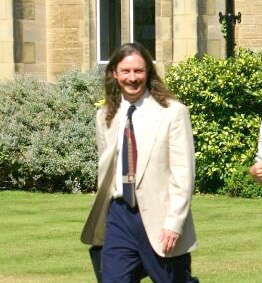
 Jan Olof Bengtsson teaches the history of ideas at Lund University in Sweden. He is best known for his book The Worldview of Personalism: Origins and Early Development, to which a special issue of the journal The Pluralist was devoted in 2008. He has published articles and book chapters on personalism, idealism, and so-called value-centered historicism, the most recent being a chapter on the origins and meaning of the German concept of “late idealism” (Spätidealismus). He is the author of the entries on personalism in The Stanford Encyclopedia of Philosophy (with Thomas D. Williams) and Springer’s Encyclopedia of Sciences and Religions. He has also published a Swedish introduction to and translation of Eric Voegelin’s Wissenschaft, Politik und Gnosis. He regularly attends conferences on personalism and idealism in Europe and America, and, in 2013, organized the 12th International Conference on Persons at Lund.
Category: Personalism
British Personalist Forum Conference
Last week I spoke at the British Personalist Forum’s excellent conference on British Contributions to Personalist Philosophy: Duns Scotus to the Present Day in Oriel College, Oxford. Several prominent personalists and historians of British philosophy were in attendance, and Raymond Tallis was a special guest speaker (see the programme). I read a revised version of a paper from a conference on British idealism in 2013, ‘In Defence of the Personal Idealist Conception of the Finite Self’, with an added extensive, informal introduction.
I want to congratulate Richard Allen, Alan Ford, Simon Smith and my other friends in the BPA for this major success and step forward in the development of their group and its important scholarly events. This is how they described the aims of their conference:
“Although John Grote (Knightsbridge Professor of Philosophy at Cambridge) in 1865 named his own philosophy ‘personalism’, hardly any other British philosophers have been designated, by themselves or others, as ‘personalists’, save perhaps for the ‘Personal Idealists’ of c. 1885-1920.
Nevertheless some have focused upon personal existence and the freedom, responsibility and dignity of the individual person who is also a person in relation to other persons, and other philosophers have at least dealt with one or more aspects of distinctively personal existence, and have done so in terms, concepts and categories truly appropriate to persons as distinct from ones applicable only to sub-personal or impersonal entities or those of merely formal logic.
The aim of this conference is to bring to wider notice those British philosophers who have made such contributions to personalist philosophy, not only to amend the historical record which has often neglected them, but also to suggest why they are worth reading today.”
JOB in Warsaw, 2005
8th International Conference on Persons. I suggest to Lech Wałęsa that there is reason for Poland to be more critical of the EU, and, with its recent experience of totalitarian oppression, to set an example for Western Europe in this regard. Politics were of course inevitable in Wałęsa’s long and important opening address and in the discussion following it, but the role of personalism in recent history was strongly emphasized.
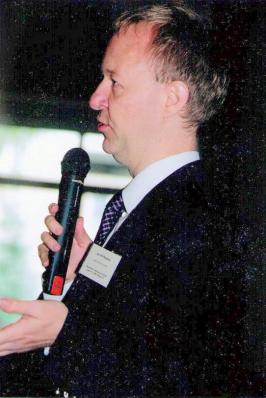
Photo: Marek Gacka
Personalism East and West
I just came back from the fifth ISKCON Studies Conference, organized at wonderful Radhadesh/Château de Petite Somme in the Ardennes outside Durbuy in Belgium, by Kenneth Valpey and Ferdinando Sardella (who both spoke at the 12th International Conference on Persons in Lund in August) of the ISKCON Studies Institute, a subdivision of the Oxford Centre for Hindu Studies; the institute publishes the ISKCON Studies Journal. Many old friends attended as well as new faces from different parts of the world. I spoke on ‘Personalism East and West’ (see abstract below).
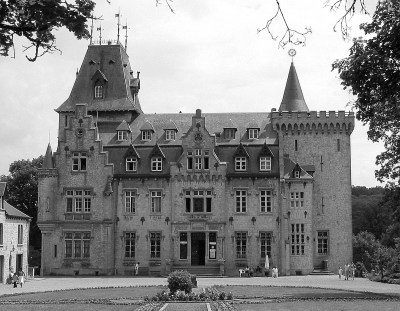
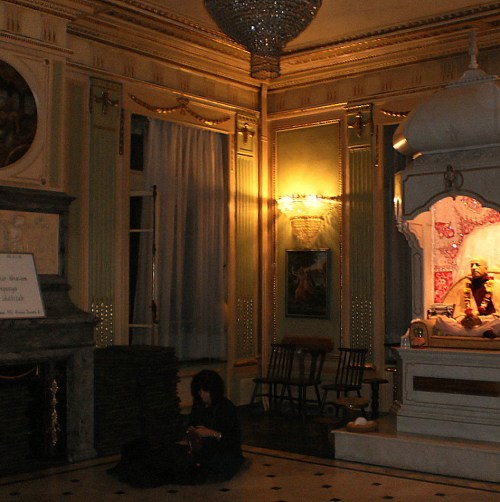
The Radhadesh website is temporarily offline for technical reasons so I cannot link to it here; awaiting the solution of the technical problems, they refer to this temporary blog. Radhadesh is almost certainly the most important ISKCON temple community in Europe, and the site not only of the temple and of ashramas, but also, and not least, of many important international conferences since the early 1990s. Among them I have attended several ISKCON Communications Seminars and ISKCON Conventions, and one meeting of the Bhaktivedanta Academy of Arts and Sciences, all with many prominent Hinduism and other religion scholars from inside and outside of ISKCON.
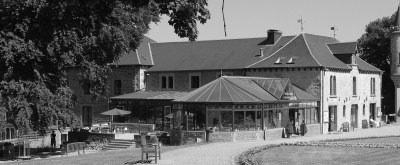
Radhadesh has gradually been developed into a first class conference centre with a new hotel – called a guesthouse – next to the château, and an excellent restaurant in an adjacent building. However, I think this was the first time the ISKCON Studies Conference was held here – a couple of years ago I spoke on ‘Conversion, Preaching, and Western Cultural Identity’ at an earlier ISC on the theme of Transmitting the Truth: Education, Preaching, and Conversion in ISKCON, at the equally beautiful Villa Vrindavana outside Florence; as far as I understand, that paper will soon appear in the next issue of the ISKCON Studies Journal. Radhadesh is also the site of Bhaktivedanta College, where ten years ago I taught the introduction to Western philosophy course. Since I was last there, a new building for accommodation of the students, as well as for the college library, had been built. Finally, on the premises is also found the building housing the Bhaktivedanta Library Services.
During this visit to Belgium I also had the opportunity to take photos of some parts of or with certain angles on Poelaert’s Palais de Justice in Brussels which I have not been able to find on the internet, and some of the Parc de Bruxelles by the Palais Royal and the streets next to it. I plan to publish them here. The many beautiful late nineteenth-century buildings on Avenue du Midi south of Place Rouppe, Boulevard Maurice Lemonnier, Boulevard Anspach, and Boulevard Adolphe Max must also be photographed on some other occasion. Especially the first two of these are in a part of Brussels that seems to be quickly slummed now (most of central Brussels is), so that it is not clear to what extent the buildings will be preserved. Buildings of this kind remain continuously threatened all over the world since the process of discovery of the fact that this was a golden age of architecture (as of much else) is still very slow. In some places, they are still almost systematically destroyed, and because of the lack of interest in them, they are not even properly photographed. Hotel Métropole on Place de Brouckère is now Brussels’ only remaining nineteenth-century hotel, and striving to preserve as much as possible of its original design etc. Imaginative historical reconstruction is needed in order to understand how beautiful and well-ordered this area was a hundred years ago. I also had time for a short visit to Leuven.
But I digress. Here is the abstract of my presentation, ‘Personalism East and West’:
This presentation will be an introduction to the comparative study of Eastern and Western personalism, with special reference to the personalism of the theistic form of Vedanta represented by ISKCON. A certain kind of propedeutic to this study is necessary, since without it, the real nature and implications of the differences between the respective forms of personalism are normally overlooked and the similarities to some extent misconstrued and misunderstood. The relevant historical, cultural and intellectual contexts will therefore be outlined, and only with these basic perspectives firmly in place will the presentation move on to a brief overview of the conceptual and terminological histories of “person” and related notions in the West and of comparable ideas in the East. This overview will, for the purposes of the introduction to the subject, be given exclusively in light of and with constant reference to the mentioned fundamental perspectives on the general, constitutive characteristics of and differences between Eastern and Western thought as historically developed. In this way, the presesentation will seek to prepare the ground for a subsequent step in the comparative work, through which, along with more particularized study of individual personalist thinkers, schools, and positions, meaningful East-West relations can be established and possibilities of mutual influence and adjustment and new syntheses fruitfully explored.
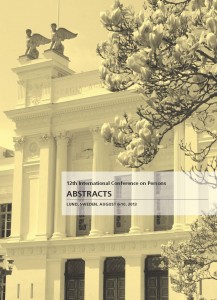
12th ICP: Abstracts PDF
Click for PDF with the abstracts (no abstracts of the papers of the plenary speakers Keith Ward, Juan Manuel Burgos, Fredrik Ullén, and Claes G. Ryn were included):
12th ICP: Program PDF
![12-icp-program-bild[1]](https://janolofbengtsson.com/wp-content/uploads/2013/09/12-icp-program-bild1.jpg)
12th ICP: Thank You
I want to extend my warmest thanks to all sixty-one participants, presenting as well as non-presenting, for your contributions to this year’s International Conference on Persons. It was a pleasure to receive you at Lund. Together, you made the event a success.
Most of all, my co-organizer, Randall E. Auxier of Southern Illinois University Carbondale, the current editor of the Library of Living Philosophers, deserves credit for making this a memorable conference.
Special mention must also be made of our wonderful conference assistant Rebecka Klette, a promising student in our department of the History of Ideas, who took care of the welcome reception, the coffee breaks, and much else; without her, the meeting would not have been possible.
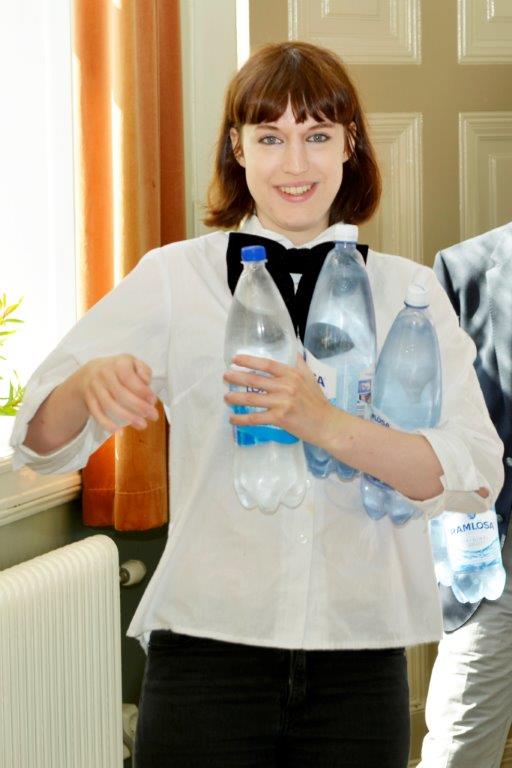
My friend and colleague Jonas Hansson also set aside much time and energy to see to that everything ran smoothly.
A number of partners or accompanying persons who attended the conference dinner and in some cases a few of the sessions also contributed to the event.
My thanks go, finally, to Kungliga Humanistiska Vetenskapssamfundet i Lund; to Prof. Marianne Thormählen; to Prof. Thomas Kaiserfeld, Christel Anderberg, Kristiina Savin, Karin Salomonsson, and Susann Roos in the department of Arts and Cultural Sciences; to MediaTryck; and to the staff of Hotel Concordia and of the Grand Hotel.
I, Randy, Tom Buford and other past organizers of the ICP whom you met hope we will get an opportunity to see you all again at future ICPs.
At least two prominent publishers have expressed an interest in publishing the proceedings in book form; we will come back to you with information about this as soon as possible.
–
Read more about the 12th International Conference on Persons under Uncategorized or on the conference website.
New Encyclopedia Article
 After the one in the Stanford Encyclopedia of Philosophy written together with Thomas D. Williams, another encyclopedia article on personalism, this time by me alone, is now published in Springer’s new Encyclopedia of Sciences and Religions.
Presentation of Burgos’s Introducción al personalismo
April 2012
Juan Manuel Burgos: Introducción al personalismo
 La filosofía personalista surgió en la Europa de mediados del siglo XX proponiendo un concepto de persona digna y solidaria frente al colectivismo y al liberalismo. Este proyecto tomó cuerpo gracias al intenso trabajo de E. Mounier y se consolidó a través de las aportaciones de filósofos como Maritain, Buber, Wojtyla, von Hildebrand, Marcel, Guardini, Julián Marías y otros. Su influencia ha sido grande.
Juan Manuel Burgos, reconstruye lúcidamente en este libro la génesis de esta filosofía a través de la vida y pensamiento de sus principales representantes. Además, propone también una síntesis personal con la que pretende consolidar las bases del personalismo del siglo XXI. El reconocido prestigio del autor en este terreno y su capacidad de síntesis convierten a esta obra en un texto imprescindible para quien quiera introducirse en el pensamiento personalista.
Juan Manuel Burgos es Fundador y Presidente de la Asociación Española de Personalismo y de la Asociación Iberoamericana de Personalismo. Es profesor titular de la Universidad CEU-San Pablo y ha publicado numerosos libros sobre antropología y personalismo entre los que destacan: Antropología: una guía para la existencia (4ª ed., 2009), Repensar la naturaleza humana (2007) y Reconstruir la persona. Ensayos personalistas (2009).

