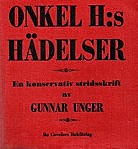
Gunnar Unger: Onkel H:s hädelser

En konservativ stridsskrift

Bo Cavefors Bokförlag, 1964

Baksida:

UngerGunnar Unger är en av sin generations mest uppmärksammade publicister. Han grundade 1944 tillsammans med Arvid Fredborg tidskriften OBS! och tillhörde under tio års tid den redaktionella ledningen för denna pigga, stridbara och omstridda tidskrift. I OBS! gjorde sig Gunnar Unger ett namn bl.a. som porträttör och politisk kåsör. Med sina dialoger om katten Felix och hans kumpaner skapade han en ny typ av politiskt kåseri, som väckte berättigat uppseende inte minst genom sitt lika kvicka som skoningslösa persiflage av den socialdemokratiska regimen. Sedan 1955 är Gunnar Unger medarbetare i Svenska Dagbladet och ingår där i den politiska redaktionen. För en större allmänhet har han blivit känd främst genom sina porträtt, sina intervjuer och sina marginalartiklar om onkel Heliogabalus, “den gräslige geronten”. Onkel H. är företrädare för en kämpande kulturkonservatism och han kommenterar dagens frågor med polemisk skärpa och drastisk humor, en humor, som inte sällan har ett inslag av självironi.

I den här boken, “Onkel H:s hädelser”, har Gunnar Unger samlat och bearbetat ett urval av dessa kåserier till en konservativ stridsskrift, som han hoppas skall vara lika förargelseväckande för somliga som uppbygglig för andra.

JOB:s kommentar:

Onkel H:s/Ungers vanliga borgerliga ekonomiska politik är problematisk, men kulturkritiken är ofta viktig.

Big Business, Big Banks, Big Bureaucrats

15 January:

In this speech on Wednesday, soon after the unfortunate interview I recently commented on, Mr Farage, while making special reference to the “trilogue on MiFID” (the Markets in Financial Instruments Directive) in which the Greek prime minister was involved, is also crystal clear on the general fact of the decisive constellation of Big Bs and their problematic rule of Europe. Indeed, he is much clearer on this point than his fellow populists in the Danish People’s Party and – out of the EU – the Norwegian Progress Party. Despite differences in their economic policies, he sounds much closer to Marine Le Pen.

Again, one wonders why it was necessary to reject her Front National as a partner in the European Parliament in such uncompromising, unfair, and definitive terms as did Mr Farage. It is probably understandable that it is impossible for him and his party to join the Front now. In reality, it is the British media that say the things about the Front that he himself repeated, clearly calculating it would be suicidal to challenge their view before the next elections in Britain. Nonetheless, the terms of his rejection seemed much too strong, given the Front’s position in France and France’s position in Europe, and also in view of the real conditions for actually achieving his own goals after further success in those elections.

Mr Farage always speaks of trade and cooperation between the European nations as the alternative to the EU. Although he may want little more than Britain’s leaving the Union, his rhetoric has always been one of a general dismantling of it, the liberation of all the European nations from it – something which is more clearly the goal not least of the Front National, especially after Mme Le Pen’s appel aux peuples d’Europe last year, and which sets him clearly apart from the Churchillian defence of a EU without Britain.

But this of course requires patient, long-term political collaboration with such parties, within and without the European Parliament. British trade with Europe will certainly continue without them, but in political terms, for the purposes of the effective opposition to the EU and the replacement of it with truly pro-European political cooperation, the only Europe that matters is, at least for the foreseeable future, the Europe that is represented by the Front National and its partners.

That is why Mr Farage’s categorical rejection looks like something very much more than and something very different from opposition to the EU: it looks like anti-Europeanism. It seems clear he would not accept a truly European, pro-European union either, a looser union in the interest of the peoples of Europe, a union that builds on the preservation of the nations, a union that might perhaps even take over some of the structures of the EU and use them for its own purposes. Given the need for such cooperation on many levels in today’s world, this is a problem, involving deep issues of the historical identity of the UK in relation to Europe, which will have to be addressed in the future and which call for the mobilization of forces in Britain quite different from those of the lower kind of populism.

For now, Mr Farage’s and UKIP’s fight for independence is clearly a part of our common work of saving Europe from the in central respects anti-European union of the Big Bs. But a permanent rift between the EFD group (and, I would add, in some respects even that distinctly national conservative party in the EPP group, Hungary’s Fidesz) and the currently non-inscrit but biggest and most successful anti-EU party in Europe is simply not tenable if the former is serious about its political goals. Geert Wilders’s Party for Freedom and the Austrian Freedom Party have already accepted the Front National as a partner. But to a considerable extent because of UKIP’s and the Danish People’s Party’s populist rejection, it seems the requisite number of parties from other European countries may not do so, so that a new parliamentary group cannot be formed after the election in May.

In this situation we must hope that those other parties, which may thus find it impossible to join the Front, Wilders, and the FPÖ this year, will at least not turn against Mme Le Pen and close the door on any future collaboration with her in the undiplomatic and counterproductive manner of Farage. Their countries’ freedom, as well as the new, alternative, and truly European unity based on such freedom that should replace the current union, would only be unnecessarily delayed, and much avoidable harm would be done.

We must hope that the exaggerated terms of Mr Farage’s dismissal were a temporary mistake, and that he will himself reconsider them. Again, there are differences between the economic policies of UKIP and the Front National. Yet in Wednesday’s speech, our hero in Brussels and Strasbourg seemed almost indistinguishable from Mme Le Pen.

Farage’s Mistake

British “splendid isolation” in some populist version may be what Nigel Farage envisages for his country. Historically, such isolation had nothing in common with what in reality he will give it if he has his way.

Mr Farage has long been known and loved in all Europe as an excellent critic of the EU. But after his recent, more definitive rejection even of Marine Le Pen’s Front National and any future collaboration with it, he also appears genuinely anti-European, which is of course something completely different, and certainly not generally characteristic of Victorian Britain.

The terms of his dismissal are surprisingly strong, even given the current public perception of the French party in Britain. He sounds even more categorical than his fellow populists in the Danish People’s Party and the Norwegian Progress Party.

Not only was the real splendid isolation wholly dependent on the British empire; it also ended long before it. Moreover, it was an isolation from specific European alliances in terms of countries and continental empires. That is not what the rejection of the Front National is about.

What Mr Farage now more firmly than ever sets his face against – while at the same time pointing out that his own family is of French origin – is the leading force in the general, common European opposition, in all countries, against the EU, and in the movement for a Europe of nations. Is this really part of what the UK should be independent of? If so, why?

Because of the “completely different political traditions” from which, according to Mr Farage, the Front National comes. In a Europe of nations, different traditions, and national variations of the same traditions, must of course be accepted. But from what tradition does UKIP come? After Farage’s new, uncompromising denouncement, it unfortunately seems to be little but the simplest and cheapest populism. Compared to that, the tradition of the Front is to be strongly preferred.

And, Mr Farage tells us, because of the Front’s “antisemitism”. What is this antisemitism? I don’t understand it, I don’t see it. The allegation is ludicrous in view of the fact that the fanatically pro-Jewish and pro-Israel Geert Wilders – far more so than anything we have ever seen from Farage – supports the Front.

What will Mr Farage do when Britain has become independent – in the sense he obviously has in mind – not only of the EU but of the real Europe, the Europe which Britain has always, in its special, unique way, been a part of? Will he continue to rely on the unsplendid nonisolation from the United States that led to the fall of the empire and made impossible the real splendid isolation? The alliance which through its fatal blunders throughout the twentieth century made inevitable and indeed promoted the rise of totalitarianism? The alliance which almost destroyed the real Europe? The alliance with the forces that are now fast destroying the real US too?

He should think again. The US, or that now dominant US, cares nothing for a UK independent of the EU. The EU is to a very considerable extent its own and its globalist ideologues’ project. It wants Britain in it in order to promote its own interests and its own agenda, which are not those of either the true Europe or the UK. Farage will be powerless to stop the UKs further cultural decline as dictated by the forces of political correctness which he joins.

The same holds, needless to say, for the globalist financial system, should Mr Farage prefer to conceive of “independence” in terms of London’s alliance with it. There will be no isolation, and very definitely no splendour.

The broadly “liberal”, radical ideological agenda is a calamity for the world, for humanity, and must simply be abandoned, just as the financial system must be reformed. Unfortunately, the populist tradition of the UKIP seems not to provide the historical and philosophical insights needed to grasp these facts.

By turning his back on his European friends and supporters in this spectacular manner, Mr Farage undermines his own work as a brilliant leader of the opposition against the EU, and shrinks to a truly petty nationalist, or pseudo-nationalist. If he does not reconsider this fanatical and confrontational stance, it could amount to a tragic sabotage of the European opposition to the EU. The prolonged division, with a separate parliamentary group of populists which will have nothing whatsoever to do even with France’s biggest and in every respect leading political party, will not ruin but will much delay the progress of the sound political forces in Europe – including Britain.

These British populists could, like the Danish and, out of the EU, the Norwegian ones, do much good, as representing a higher form of populism, if they join the more sophisticated and rigorous national-conservative parties. As it is, they may have short-term electoral success and form government alliances with the centre-right and centre-left liberals. But in the long term, and in itself, that will help neither Europe in general nor their own countries.

What would it take for Mr Farage to become convinced that he could safely collaborate with the Front in the European Parliament? Must they send a special delegation of Jews in their party to pedagogically explain what they stand for? Do they need to lecture him on the basic European and twentieth-century historical experience and the meaning of the differences and similiarities in European political and cultural traditions?

It seems it would not be enough. After Mr Farage’s last interview, it appears nothing can be done. But it is difficult to believe he can really be quite so superficial and shortsighted. The terms of his current dismissal seem much too strong, even if the political climate in Britain is still such as to simply make it impossible for UKIP to associate itself with the Front. Things change, and they will do so even more in the future.

I hope it is only a momentary error of judgment, and that our hero in Brussels and Strasbourg will at least keep a distant possibility of joining us open.
Sverigedemokraterna – Europapartiet

Kasselstrand Le Pen

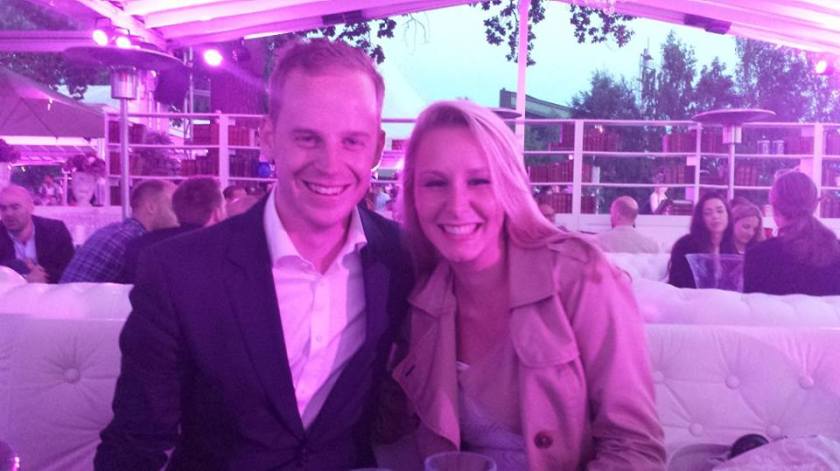
Gustav Kasselstrand och SDU är pionjärer för omvandlingen av SD till vad jag vill kalla det sanna svenska Europapartiet. Här ses Kasselstrand med Jean-Marie Le Pens dotterdotter och Marine Le Pens systerdotter Marion Maréchal-Le Pen i Stockholm i somras, strax före evenemangen i Almedalen med ordföranden Julien Rochedy och Paul-Alexandre Martin från Front National de la Jeunesse, Udo Landbauer, ordförande för Ring Freiheitlicher Jugend (FPÖ), och Tom van Grieken från Vlaams Belang Jongeren.

Varför är det viktigt att lyfta fram detta? Det är viktigt därför att det, för att balansera och modifiera den i sig som politisk filosofi helt otillräckliga nationalismen, krävs mycket mer sådant här när de mer eller mindre nationalistiska partierna i Europa växer: disciplinerat Europafokuserat samarbete, i den organisatoriska form som FN, FPÖ och VB nu förbereder och fler förhoppningsvis snart ansluter sig till. Och inte minst är det viktigt därför att just SD som helhet redan från början bör bli en del av detta samarbete och göra ett helhjärtat engagemang där till en central punkt i sin politik: det sanna Europapartiet contra alla de falska och i verkligheten antieuropeiska.

Sverigedemokraterna och Front National

Med sin franska och även nederländska orientering tar Tobias Svensson och hans medieblogg ställning för ett samarbete mellan Sverigedemokraterna och Front National, och Geert Wilders Frihetsparti, i Europaparlamentet efter vårens val. Detta är en särskilt viktigt ställningstagande från hans sida. Jag håller med om att det är det rätta vägvalet för vårt svenska parti.

Jean-Marie Le Pen påpekade i ett inslag i det av Tobbe översatta intervjuprogrammet med hans dotter i december med humor och självinsikt hur partiet med henne fått ett mer tilltalande (avenant) ansikte. Detta gäller även i vidaste mening.

Alla europeiska nationalistiska partier har, tycker jag, ganska långt kvar att gå i riktning mot alternativ europeisk enhet-i-mångfald och bort från urskillningslös nationalism, eller bristande vaksamhet och kritik mot den lägre nationalismens ständigt närvarande hot, dess förmåga att släppa lös människans lägre sidor, pöbelväldets ibland obehagligt påtagliga potential. Men med Marine Le Pen har betydande steg tagits i denna riktning, bland annat genom hennes Appel aux peuples d’Europe förra året.

Redan tidigare fanns djupt kultiverade och sympatiska personer i ledningen, inte minst den tidigare vice partiordföranden Bruno Gollnisch, och partiet utmärker sig också för den mängd betydande intellektuella och tyngre tidskrifter som är mer eller mindre knutna till det eller åtminstone närstående. Här finns i största allmänhet kulturella och intellektuella resurser som gör en fortsatt gynnsam utveckling både möjlig och sannolik.

Nationalismen finns ju också i en högre form, och vad man än tycker om nationalism i allmänhet har den historiskt naturligtvis ägt resurser av detta slag i helt annan utsträckning än vanlig populism, sådan den tyvärr i alltför hög grad representeras exempelvis av Fremskrittspartiet och även våra vänner i Dansk Folkeparti. De senare partierna har förvisso utvecklats, men de har svårt att frigöra sig från sina enkla populistiska ursprung.

Det räcker att läsa inledningen till Front Nationals gamla partiprogram (‘La France: L’universalité, la mémoire et le sacré’) och dess kulturpolitiska avsnitt, med deras historiska djup, litterära referenser och allmänna kulturella och andliga insikter, för att inse vilken nivåskillnad det här är fråga om. Den amerikansk-neokonservativa populism som de norska och danska partierna fortfarande uppvisar starka drag av är inte bara otillräcklig utan på flera punkter en politiskt alltmer uppenbart ohållbar väg. Förhoppningsvis kan den helhetliga europeiska oppositionens sammantagna utveckling dra dem med sig i riktning bort från den.

Det är viktigt att betona hur Sverigedemokraterna här fördelaktigt skiljer sig från dem. Sverigedemokraterna är inte Ny Demokrati. Nedtoningen av nationalismen och framlyftandet av socialkonservatismen var ett riktigt steg (som naturligtvis inte i sig behöver innebära något som helt uppgivande av den självklara värderingen av nationell egenart eller med denna sammanhängande, specifika politiska ställningstaganden), ett steg som togs med det nya principprogram som antogs 2011. Men det gamla program som det ersatte tydliggjorde, trots sina brister, åtminstone ett viktigt förhållande rörande partiet. Man kunde se att det var en under lång tid framvuxen produkt av seriöst tänkande personers arbete, som grep tillbaka på traditioner bortom populismen.

Åtminstone detta är ett värdefullt arv att förvalta och föra vidare, när partiet nu, som jag hoppas, rör sig vidare i riktning mot en humanistiskt-filosofiskt fördjupad och nyskapande social-, kultur- och värdekonservatism. Och inte minst: vidare mot Europa.

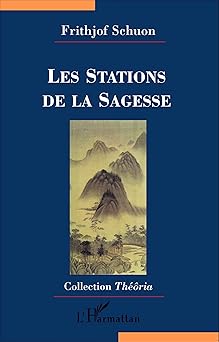
Frithjof Schuon: Les Stations de la sagesse

L’Harmattan, 2011 (1958)

Fnac

Pris dans le tourbillon d’une vie survoltée, l’homme semble avoir perdu le sens du repos et de la contemplation; se nourissant volontier d’ecorces, c’est-à-dire de superficialité, il n’a plus conscience de la qualité du fruit. C’est pourquoi il croit volontier à la faillite des valeurs traditionelles et des religions, s’engage dans des voies sans issue et, désorienté, devient la proie d’un désespoir nihiliste.

Saisir les racines de l’impasse dans laquelle s’est engagé l’esprit moderne, tel est le propos de cette réédition des Stations de la Sagesse, un classique paru pour la première fois en 1953. Les essais réunis dans ce recueil visent à dégager le sens profond des doctrines religieuses et des sagesses traditionnelles pour satisfaire au besoin de causalité et d’intelligibilité propre à l’esprit humain, trop souvent méconnu et négligé par les enseignements religieux fondés sur la seule croyance.

La nature transcendante et primordiale de la Révélation, de l’intellect, de la foi et de la prière se trouve alors replacée dans un cadre qui permet de résoudre l’apparente incompatibilité entre la métaphysique – communément confondue avec la pensée rationelle – et l’amour de Dieu, si souvent envisagé du seul point de vue de la sentimentalité. Ainsi le lecteur prend-il consience que les religions parlent à son intelligence et a son sens de la beauté pour lui faire découvrir la “splendeur du vrai”, et le guider dans sa quête de la sagesse.

Tobbes Medieblogg

Tidigare brukade jag då och då publicera YouTube-klipp med tal och intervjuer med franska Front Nationals företrädare. Partiet, och den franska politiken i allmänhet, följdes, som jag minns det, i mycket begränsad utsträckning, om överhuvudtaget, av den verkliga politiska oppositionen i Sverige och dess media.

Idag känns behovet av sådana inlägg inte lika stort. Förra året dök nämligen Tobbes Medieblogg upp i den svenska politiska debatten. Den etablerade sig från början som en av Sveriges allra bästa politiska bloggar, och glädjande nog inte bara rapporterar den även om Front National och Frankrike, utan den kan sägas ha denna bevakning som en särskild specialitet.

Bloggaren, Tobias Svensson, presenterar sig som en oppositionell samhällsdebattör som även skriver i Dispatch International och Fria Tider och har visst samarbete med Avpixlat. Redan denna presentation signalerar vad som rikligt bekräftas vid läsningen, nämligen att han med självständigt, balanserat omdöme rör sig över det åsiktsspektrum inom oppositionen som markeras av dessa nätpublikationer och som av vissa uppfattas som innehållande oförenliga positioner. Så är det utan tvekan också i några fall; själv ser jag tydliga svagheter inte minst hos Dispatch International. Men mycket finns också som förenar, och det är framför allt detta Svensson visar.

Med stor bredd, imponerande kvantitet, utmärkt språkbehandling och väl avvägd stil täcker Svensson in och kommenterar med oftast osviklig träffsäkerhet en stor del av det politiska skeendet och den politiska debatten i Sverige idag. Men det är bevakningen av Frankrike, och även Nederländerna, som är hans helt unika bidrag. Svensson behärskar av allt att döma i grunden det franska språket, och är väl förtrogen med landets kultur och politiska förhållanden.

Det visar sig i de svenska översättningar han tillhandahåller när han publicerar den typ av franska YouTube-klipp som även jag tidigare uppmärksammade, liksom i hans pedagogiskt förklarande kommentarer. Denna föredömliga omsorg och initierade hjälp gör det naturligtvis mycket bättre och lättare för svenska läsare att ta del av detta material på Svenssons blogg. Hans översatta klipp finns även samlade på hans egen YouTube-kanal.