One-Sided Differentiation and Spurious Re-Divinization

The process of differentiation established the anthropological, political, philosophical, and theological insights upon which structured order was founded in Western civilization: with the distinction – or the new kind of distinction – between immanence and transcendence, there followed not only a clearer awareness of the higher and lower potentialities of man, but, as we have seen, a number of other distinctions, dualities, opposites, and polar tensions which accounted for much of the spiritual, moral, and intellectual creativity of the West.

The various forms of modern pantheism, the mystical, the rationalistic, the romantic, the idealistic, and the materialistic, besides intermixing and engendering each other, have in common not only the loss of the metaxical status of the individual person but also a more general blurring of distinctions, a loss of hierarchy, structure, discernment, vertical dynamism. While the transcendence and the ontic logos of differentiated culture lay hidden in compact form in what, in the absence of full access to and comprehension of the great Eastern systems of thought could be perceived from what came to be the Western point of view as early pantheism, they were denied and rejected in the new pantheism of modernity. With them was denied the objective moral and axiological order which compact civilization too, in its own way, had affirmed, and which ultimately, in its differentiated apprehension, alone safeguards the moral space of the person.

The medieval tension of faith and reason was destroyed through the impact of the radical nominalism and the radical voluntarism which went far beyond the emphasis on individuality and will required by the insights regarding the person as the focus of differentiated existence. For the latter also required a synthesis with universality and rationality. Per definition, personhood united individuality with an element of universality. Radically separating the irrational transcendence of the deus absconditus from the immanent sphere and confining man to the latter, these late medieval currents, while correctly objecting to the onesidedly rationalist tendencies of scholasticism, led indirectly, in their extremism, rather to a new exclusive turning of man’s intellectual curiosity to the empirical manifold of sensual existence, and to the metaphysical scepticism that shaped the Renaissance. [The several different scholarly accounts of the nature and meaning of the transition from the ‘late medieval’ to the ‘early modern’ period that are discussed today are not always mutually contradictory.]

Modern rationalism was born as a response to or way out of this scepticism, and in stark opposition to late medieval and Reformation fideism. From the outset, it had the character of a voluntaristic reaction on the part of man to the new situation of radical uncertainty: human logical rationality was asserted as the standard and the organizing principle of a system of knowledge through which man was to control nature and his own worldly destiny. In Descartes’ system, God tended to be reduced to the role of guarantor of the validity of this system. And the rational, epistemological human subject that came to dominate modern philosophy was not as such or in itself the person; although some aspects of its focus on self-consciousness could be taken up by modern personalism, it normally represented, in exaggerated and distorted fashion, only one side of the rationality of personhood.

It is quite clear that nature de-divinized both by onesided or problematically elaborated differentiation and by the mentioned specific developments of early modernity was perceived to be open to the exploitation of modern science, and that this is one of the causes of the rise of the latter. But this analysis easily obscures the re-divinization that also entered as a decisive factor into the development of early modernity. Renaissance Hermeticism and Neo-Platonism was in many respects an important rediscovery or introduction in the West of traditional spirituality of the kind that ultimately has its roots in the Eastern tradition that remains imperfectly understood in the Voegelinian analysis of differentiation. Yet there was also often the tendency towards an affirmation of a too simple, and in some cases also a new kind of identification of God with nature and towards the unification of nature and man with the impersonal Godhead in these currents, as they sprang from traditions of onesided, more or less radical monistic mysticism. With regard to this, reinterpretation both of orthodox Christianity along the ancient Gnostic lines and of ancient Gnosticism itself was going on not only in the millenarian mass movements but also among the learned humanists.

By the time of the Reformation and the Counter-Reformation, the divergence from orthodoxy was clearly perceived by both sides in what became a sharp conflict. But then, the pantheistic revolution was unstoppable. The differentiational structure was increasingly difficult to preserve for the learned idealists, as men like Agrippa, Bruno, Campanella, and Bacon endorsed the scientific revolution as an essential part of the realization of their interpretations of Hermetic teachings of the deification of man and of their ideas of utopian immanent perfectibility and nature’s paradisical instauration.


Tony Banks: Siren

from Six Pieces for Orchestra

The City of Prague Philharmonic Orchestra, Paul Englishby

Banks now – beginning with the suite for orchestra called Seven (2004) – does what I have suggested progressive rock should do: he transcends progressive rock. But he does it by simply beginning to write in a different genre altogether, another existing genre. What I suggested, more precisely, was, as it were, rather that progressive rock itself progress beyond progressive rock, i.e., beyond its remaining rock elements, into a new genre that is a further development of progressive rock. But Banks’s orchestral work is interesting in its own right, and although it is not this new genre, it could certainly contribute indirectly to its development.

In Classic FM’s introduction here there is, again, the irritating use of the term “classical”, which seems to be interchangeable with “classic” in this context and is equally misleading. Banks is rightly uncomfortable with it in this interview.

12th ICP: Alternative Accommodation

Among cheaper hotels (i.e., cheaper than Concordia, which offers the special conference rate mentioned in the Call for Papers) are Ahlström and Sparta.
More expensive ones are Lundia and the Grand.
All of these are right in the centre, with the exception of Sparta, which, however, is still within walking distance of the conference venue.
There are quite a few other hotels both in central Lund (like Lilla Hotellet, Oskar and Duxiana) and in the high-tech sprawl surrounding the centre.
Find more hotels, and compare prices, at Hotels.com or Booking.com.
Bed & Breakfast and private rooms are also available, at lower prices than the hotels.
See also:

12th ICP: Accommodation

Hotel Concordia
Hotel Concordia

A limited number of rooms are available at the reduced conference rate of 1150 SEK (single) and 1350 SEK (double) at Hotel Concordia in central Lund.

Please mention that you are attending this conference and the name of the local organizer, Jan Olof Bengtsson, in order to obtain this rate.

The hotel is within walking distance of the conference venue, the Department of Arts and Cultural Sciences of Lund University.

See also:

12th International Conference on Persons: Call for Papers

History of the International Conference on Persons

12th ICP Keynote Speaker: Keith Ward

12th ICP: Lund and Lund University

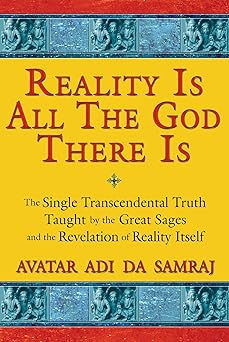
Adi Da Samraj: Reality Is All The God There Is

The Single Transcendental Truth Taught by the Great Sages and the Revelation of Reality Itself

Inner Traditions, 2008

Amazon.com

Publisher’s Description:

Contemporary renderings of the dharma of the great sages of Advaita Vedanta and Buddhism from the Realized Spiritual Master Avatar Adi Da Samraj

– Includes transmissions of wisdom teachings of the great sages Gotama Sakyamuni, Nagarjuna, Shankara, and Ribhu

– Presents classic texts of spiritual realization from the perspective of a Realized Teacher

– Provides insight into the ultimate realization possible when dualistic consciousness has been transcended

In this book Avatar Adi Da Samraj offers his unique renderings of the dharma of the great sages of Advaita Vedanta and Buddhism, including Gotama Sakyamuni, Nagarjuna, Shankara, and Ribhu. Rather than simply translate their teachings from available source texts, Avatar Adi Da, himself a Realized Master, respeaks them as one who has personally realized their truth, revealing that the Buddhist “Nirvana” and the Advaitic “Brahman” point to the same transcendental condition. Avatar Adi Da’s transmissions restore to these texts the profound communication intended by the spiritual masters who created them.

The ego nurtures the illusion of separation, an illusion that cannot be removed by the ego’s own efforts. It is only the spiritual master who makes possible the realization of egoless consciousness. The great sages proclaimed a state of spiritual realization that exceeded both worldly dualism and mystical seeking. They had awakened to a reality that spoke of abiding in a state of consciousness only. Avatar Adi Da brings these remarkable declarations back to life and then concludes with his own unique description of a realization that transcends even these extraordinary utterances – the realization of Reality As It Is, free of all forms of the ego’s search.

Reviews:

“Adi Da uses his deeply insightful reading of a number of traditional texts, drawn from both the Hindu and Buddhist traditions, as a means to clarify and specify the practice that leads to the ultimate stages of attainment. A revelation of profound originality and force, this book brings forward a new perspective on reality and consciousness.”

Paul E. Muller-Ortega, author of The Triadic Heart of Shiva

“The writings of Adi Da Samraj – including the important essays and talks in this book – are the most doctrinally thorough, the most philosophically sophisticated, the most culturally challenging, and the most creatively original literature on nonduality currently available in the English language.” 

Jeffrey Kripal, director and chair of Religious Studies at Rice University and author of Esalen: America and the Religion of No Religion

About the Author:

Avatar Adi Da Samraj (1939-2008) was born on Long Island, New York. In 1970, after a period of intense spiritual endeavor, he spontaneously became reestablished in the continuous state of illumination that was his unique condition at birth. After his reawakening, Adi Da began to teach. His philosophical, practical, and literary writings consist of more than 70 published books and his students have established Adidam centers around the world. Avatar Adi Da Samraj departed the body on November 26, 2008, in his hermitage sanctuary in Fiji.