Där Yidisher Arbeter Bund grundades 1897.

Blick över tidigare judiska kvarteren, med stora och lilla gettot. Uppe till vänster Koralgoggans blå kupol.
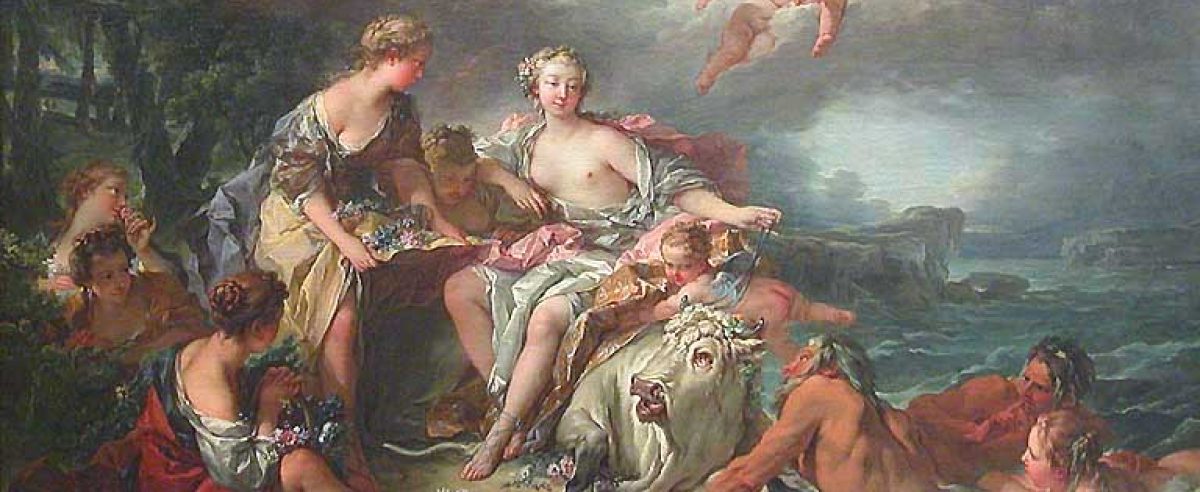
Där Yidisher Arbeter Bund grundades 1897.
Blick över tidigare judiska kvarteren, med stora och lilla gettot. Uppe till vänster Koralgoggans blå kupol.
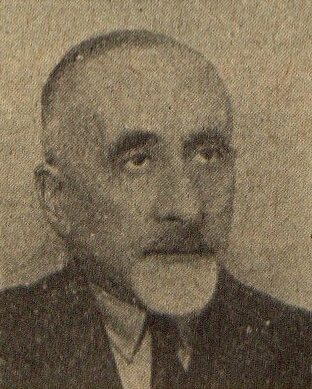
Några för Bund karaktäristiska citat från viktige ledaren (1882-1942), ur en artikel mot sionismen i tidningen Di Tsukunft 1938, återpublicerad i översättning här:
“So what are the main arguments that we have used against Zionism, throughout the decades of the Bund’s existence? We have said that Zionism is not and cannot be the solution to the Jewish question; that by sowing the illusion that Zionism is the answer among the Jewish masses, Zionism diverts their attention and energy away from the goals of their own struggle; and that due to its disdaining attitude towards galuth [JOB:s not: diasporan] and contempt towards the Yiddish language, it is a stumbling stone that stands in the way of the development of Jewish culture.
Over the years, Zionism has transmogrified [JOB:s not: ett litet märkligt ord att använda för översättningen här; man undrar hur jiddisch-originalet uttryckte det] itself into being in an open alliance with our blood-enemy – anti-Semitism. Zionism has practically always derived its inspiration from the persecutions endured by Jewish people, from political reactionism above all. Throughout the 40 years of Zionism’s existence, the following rule has practically always held: the darker the world, the brighter it gets in the Zionist tent; the worse for Jews, the better for Zionists.
What can a Jewish Palestine be in the best case scenario?
A small kingdom of a tiny Hebraist tribe within the Jewish people. When Zionists speak to the non-Jewish world, they are outstanding democrats, and they present the conditions in today’s and future Palestine as exemplary of liberty and progress. But if a Jewish state is to be founded in Palestine, its spiritual climate will be: an eternal fear of the external enemy (Arabs), unending fighting for every little piece of land, for every scrap of work, against the internal enemy [Editor’s note: Palestinians], and a tireless struggle for the eradication of the language and culture of the non-Hebraized Jews of Palestine. Is this the kind of climate, in which freedom, democracy, and progress can flourish? Is this not the climate, in which reactionism and chauvinism typically germinate? Today, even truly Zionist publicists, upon visiting the Holy Land, admit that clericalism has excessive influence there, despite Zionist manual workers playing such a distinguished role in the Zionist organization.”
“Zionism has all along been a Siamese twin of anti-Semitism and every kind of nationalist chauvinism. Zionism has always regarded the law of force, of nationalist reactionism, as the normal law of history, and on this law it has built its interpretations of Jewish life.”
Mycket mer av intresse finns i artikeln, om hur sionisterna behandlade diasporajudarna, om deras förhållande till olika fascistledare, hur de exploaterade antisemitismen, och vilka följderna skulle bli av deras projekt – det mesta slående i ljuset av vad vi nu vet om hur det faktiskt gick.
Här ytterligare några stycken som Molly Crabapple lagt ut på Facebook, i översättning från en tidigare artikel på samma tema, från 1933, med rubriken ‘We Are Not the Chosen People’:
“One of our greatest sins in the eyes of the Jewish bourgeoisie has been that in the course of the thirty-five years of our existence as a party we have not ceased to defend the simple principle that we, Jews, are not a chosen people, neither in the positive nor in the negative sense of the word, but a people just like any other nation, and that even though our history and the social-economic circumstances of our lives are unique, the same rules apply to us that regulate the lives of all other nations in the world. Our Jewish bourgeois opponents are especially enraged by our claim that there is a certain kind of Jewish nationalism that is just as ugly, just as disgusting as the nationalism of the other nations; and if Jewish nationalism, as a general rule, is not bloodthirsty, this is only out of necessity, not virtue; if an appropriate opportunity arose, Jewish nationalism would show its sharp teeth and nails no less than the nationalisms of other nations…
To be sure, Jabotinsky is nothing more than a small-scale Hitler, a fascist clown. But this clown has devoured a significant portion, if not the majority of our very own [heymish] Zionism. The fascist hooliganism that Jabotinsky preaches suits the mood that enveloped a significant portion of the Jewish bourgeoisie and especially bourgeois Jewish youth. Of course, Jabotinsky’s brown-shirt soldiers are nothing more than a tragicomic caricature of Hitler’s SA people. But the only thing missing in order for them to become the same beasts is some muscle strength, some territory, and a political opportunity. In Berlin they have actually ‘bravely’ joined the lines of the real brown-shirt bandits. And in Palestine, too, they have demonstrated that they are not weaklings.
No, we are not a chosen people. Our nationalism is just as ugly, just as harmful, and has the same inclination to fascist debauchery as the nationalisms of all the other nations.”
Allt detta – och mycket mer – finns förstås i Mollys bok. Det här citerade är relevant för den serie inlägg om Israel som jag för närvarande försöker skriva. Men så är också bundisternas socialism, som var en definierande del av deras förståelse av sin “härhet” (doikayt) och identitet i sina respektive länder.
Av viktiga aktivisten Simone Zimmerman, grundaren av organisationen IfNotNow, i hennes program Beyond Israelism på Mehdi Hasans kanal Zeteo:
Litet lustig fråga på bilden (den verkliga rubriken, som dock också syns, är ‘Meet the Jewish “Troublemakers” Who Zionists Hated’): som om fenomenet judiska antisionister är något förvånande, något som man måste fråga sig om det verkligen existerar. I själva verket har ju antalet antisionistiska judar av olika slag i världen alltid varit avsevärt; det tycks nu uppskattas till omkring 10% och växer snabbt bland yngre. Någon majoritet av världens judar har ju aldrig flyttat till Israel, och man bör inte glömma den mycket stora kategori som bara är icke-sionistiska.
När det gäller Bund gav historikern Håkan Blomqvist 2020 ut en viktig bok om dess svenska förgrening: Socialism på jiddisch: Judiska Arbeter Bund i Sverige.
The Story of the Jewish Bund
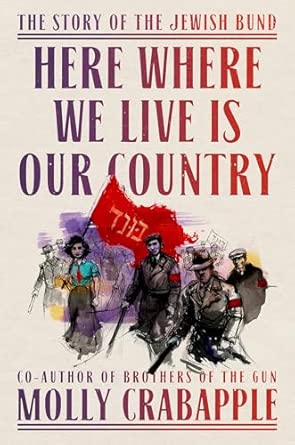
One World (Penguin Random House), 2026
Editor’s Description:
NEW YORK TIMES BESTSELLER
The dramatic story of the Jewish Bund – a revolutionary movement from a vanished world – and its radical vision of solidarity in an age of division.
“Molly Crabapple beckons readers through a portal to an irresistible, lost world, one bound together by passion, solidarity, and a burning hunger for justice.” – Naomi Klein, New York Times bestselling author of No Logo and Doppelganger
In the aftermath of the Holocaust, Sam Rothbort created “memory paintings” with the hope of resurrecting the vanished world of his shtetl childhood. Decades later, his great-granddaughter, the award-winning artist Molly Crabapple, discovered these paintings and one stood out: a girl, her dress the color of sky, hurling a rock through a cottage window. Itka the Bundist, Breaking Windows.
Itka is how Crabapple met the Jewish Labor Bund. Once the most influential Jewish political force in eastern Europe, the Bund was secular, socialist, and uncompromisingly anti-Zionist. The Bundists fought for dignity and equality, not in an imagined homeland in Palestine but “here where we live.”
In the first popular history of the Bund, Crabapple re-creates their extraordinary world through dramatic portraits of insurgent poets and antireligious rebels, clandestine revolutionaries and lovers on the barricades. The Bundists live deeply within this violent, volatile, and somehow hopeful period, as their stories interweave with the Russian Revolution and the Holocaust. The Bund’s rise and fall raises the vital question: What can we learn from a movement that, for all its toughness, imagination, and moral clarity, was largely destroyed?
Here Where We Live Is Our Country reanimates a band of idealists who broadened our global political imagination. As we once again contend with nationalism, repression, and the struggle for belonging, the Bund’s remarkable story and message – that liberation, dignity, and solidarity must begin where we stand – reaches across time as a guide to our own urgent moment.
Reviews:
“Molly Crabapple’s terrific Here Where We Live is Our Country unearths the story of a Jewish political movement that opposed ethnic nationalism of all stripes…thrillingly energetic…delightful…vivid.”
The New York Times Book Review
“In 380 lush, high-tempo, strikingly poignant pages…Crabapple documents the Bund’s extraordinary rise and fall. The relevance of her material for our present moment is impossible to ignore.”
The Guardian
“Here Where We Live Is Our Country is that rarest of books: a gripping, human story of love, idealism, and betrayal – and an immense, rigorous contribution to the historical record. Reading it feels revolutionary.”
Naomi Klein, New York Times bestselling author of No Logo and Doppelleganger
“Molly Crabapple not only recounts, with a novelist’s mastery of detail, one of the most extraordinary rebellions of the human spirit in modern history. In the long battles ahead for truth and dignity, her book will be an indispensable resource.”
Pankaj Mishra, author of the New York Times Notable Book Age of Anger and The World After Gaza
“Vast in scope, elegiac in prose, Here Where We Live Is Our Country brings to life the profound humanity of those who stood up to the blood-soaked ethnonationalisms that led to so many of the twentieth century’s storied horrors. Molly Crabapple, with this great work, adds to her growing legacy as a unique American genius.”
Jason Stanley, New York Times bestselling author of How Fascism Works
“Molly Crabapple’s words are as glorious as her colors, her writing as vivid as her painting. Reading her Here Where We Live Is Our Country today, with Gaza in ruins and the rest of the world seemingly on the road to ruin, is revelatory, a reminder that in even in the most dehumanizing of times a loving humanity might endure, even if only fleetingly.”
Greg Grandin, author of Pulitzer Prize-winning The End of the Myth
“Molly Crabapple takes us through decades of forgotten memories to rediscover an essential part of Jewish history and a revolutionary movement whose organization and ideals are more relevant than ever, and which may yet point the way towards a better future.”
Mike Duncan, author of New York Times bestselling Hero of Two Worlds: The Marquis de Lafayette in the Age of Revolution
“Remarkable for its historical sweep as well as its timeliness, Here Where We Live Is Our Country is a true tour de force.”
Jon Lee Anderson, staff writer for The New Yorker and author of Che Guevara: A Revolutionary Life
“A superb blend of personal and social history, alive with radical spirit…brilliant evocation of the anti-Zionist Jewish Bund, a beacon of hope for a renewed left.”
Kirkus Reviews, starred review
“Writing with lyricism and great depth of feeling, Crabapple movingly presents the principled Bund, decimated by the Holocaust and sidelined postwar by Soviet socialism on one side and Zionism on the other…Readers will be rapt.”
Publishers Weekly, starred review
About the Author:
Molly Crabapple is an artist and writer based in New York. She is the author of two books, Drawing Blood and Brothers of the Gun (with Marwan Hisham), which was longlisted for a National Book Award. She was a 2020 New America Fellow and her reportage is the winner of the Bernhard Labor Journalism Award, and has been published in The New York Times, New York Review of Books, The Paris Review, Vanity Fair, The Guardian, Rolling Stone, The New Yorker, and elsewhere. Her animations have won two Emmys and an Edward R. Murrow Award. Her art is in the permanent collections of the Museum of Modern Art.
A Global History
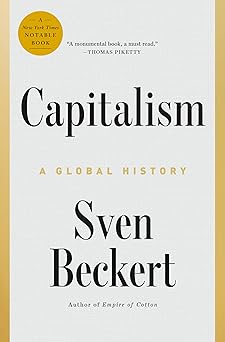
Penguin Press, 2025
Publisher’s Description:
A New York Times Notable Book
A Financial Times Best Book of the Year
A landmark event years in the making, a brilliant global narrative that unravels the defining story of the past thousand years of human history
No other phenomenon has shaped human history as decisively as capitalism. It structures how we live and work, how we think about ourselves and others, how we organize our politics. Sven Beckert, author of the Bancroft Prize–winning Empire of Cotton, places the story of capitalism within the largest conceivable geographical and historical framework, tracing its history during the past millennium and across the world. An epic achievement, his book takes us into merchant businesses in Aden and car factories in Turin, onto the terrifyingly violent sugar plantations in Barbados, and within the world of women workers in textile factories in today’s Cambodia.
Capitalism, argues Beckert, was born global. Emerging from trading communities across Asia, Africa, and Europe, capitalism’s radical recasting of economic life rooted itself only gradually. But then it burst onto the world scene, as a powerful alliance between European states and merchants propelled them, and their economic logic, across the oceans. This, Beckert shows, was modern capitalism’s big bang, and one of its epicenters was the slave labor camps of the Caribbean. This system, with its hierarchies that haunt us still, provided the liftoff for the radical transformations of the Industrial Revolution. Fueled by vast productivity increases along with coal and oil, capitalism pulled down old ways of life to crown itself the defining force of the modern world. This epic drama, shaped by state-backed institutions and imperial expansion, corresponded at no point to an idealized dream of free markets.
Drawing on archives on six continents, Capitalism locates important modes of agency, resistance, innovation, and ruthless coercion everywhere in the world, opening the aperture from heads of state to rural cultivators. Beckert shows that despite the dependence on expansion, there always have been, and are still, areas of human life that the capitalist revolution has yet to reach.
By chronicling capitalism’s global history, Beckert exposes the reality of the system that now seems simply “natural.” It is said that people can more easily imagine the end of the world than the end of capitalism. If there is one ultimate lesson in this extraordinary book, it’s how to leave that behind. Though cloaked in a false timelessness and universality, capitalism is, in reality, a recent human invention. Sven Beckert doesn’t merely tote up capitalism’s debits and credits. He shows us how to look through and beyond it to imagine a different and larger world.
From Reviews:
“A seminal work that explains how capitalism started, evolved, and expanded over the last several hundred years. It’s quotable because the details are so rich and interesting, especially how capitalism started with merchants in a little known area called Aden.”
Forbes
“Capitalism is a learned, formidable and vivid story. Its grand synthesis will engage not only general readers, but thousands of specialists… Readers around the world will study and ponder this monumental work of history, agreeing and arguing with it, all the while affirming its generational importance, for decades to come.”
Marcus Rediker, The New York Times
“Beckert’s bravura new intellectual history sets the record straight… Panoramic… While scholars have illuminated bits and pieces of this immense narrative, Beckert’s massive volume brings it together with impeccable authority and perspicacity… Each chapter offers an abundance of characters and arguments, interpreting the economic and social realities we share, commonalities of revolution and change… An achievement that will endure alongside Tony Judt’s Postwar and Thomas Piketty’s Capital in the 21st Century, whose influence undergirds Beckert’s book.”
The Boston Globe
“Vast in scale, cogent in delivery, accessible enough to accommodate a non-economist like me, [Capitalism] is that rare kind of project that can be described – unironically, no less – as magisterial.”
NPR.org
“Supremely ambitious, an insightful and well-illustrated history by the Harvard historian who has been a pioneer in the creation of new narratives exploring how an ever-changing capitalism has been a socially and culturally rooted phenomenon. At well over a thousand pages, Beckert’s volume offers a synthesis and occasional recasting of almost everything we have learned about the history of capitalism, and not just in the closely studied societies bordering the North Atlantic… Beckert… [writes] eloquently of the panics, booms, and busts that became a characteristic of world capitalism from the early nineteenth century through our own time. But the expansion of trade and production remains at the heart of his book… But whatever its fate, Beckert’s capacious volume provides a new generation of capitalists and anti-capitalists with plenty of precedents for whatever world they come to imagine.”
Jacobin
“An early contender for a Pulitzer, Sven Beckert’s readable, never dull doorstop of how more people came to believe in the end of the world than the end of capitalism.”
Chicago Tribune, Fall Books Preview
“Epic . . . An unparalleled work of scholarship that is also a joy to read, this is a monumental achievement.”
Publishers Weekly (starred review)
“A clarity that Karl Marx could only long for… Beckert’s agile account marches through the emergence of mercantilism and the invention of double-entry bookkeeping and proceeds through plantation and wage slavery, colonialism and postcolonialism, and a managerial/bureaucratic golden age… A comprehensive and up-to-date history, essential.”
Kirkus (starred review)
“Magisterial in scope and ambition, Sven Beckert’s Capitalism is a dazzling global history of the forces that have shaped – and continue to shape – our world. A true tour de force.”
Peter Frankopan, Professor of Global History at Oxford University and author of The Silk Roads: A New History of the World
“Sven Beckert is one of the world’s preeminent scholars on the history of capitalism, and in this monumentally important single-volume global history, simply titled Capitalism, he upends the deeply embedded notion that capitalism was born as a purely Western phenomenon. Instead, he powerfully demonstrates how its ascendancy over the last six centuries depended both on the genius and vibrancy of interconnected communities and on brutally exploitative systems, including slavery. Drawing on astonishing research across multiple continents, Beckert’s new book is a landmark achievement that reorients our understanding of capitalism as an evolving, ever-contested human creation. It is certain to become a canonical work of history.”
Henry Louis Gates, Jr., Alphonse Fletcher University Professor, Harvard University
“It’s hard to think of any other contemporary historian who could have written a new history of capitalism of such global scope and impressive scale. Capitalism promises to be an instant classic that will last.”
Isabella Weber, author of How China Escaped Shock Therapy
“Sven Beckert has written what will surely become a key reference on the global history of modern capitalism. A monumental book, a must-read.”
Thomas Piketty, author of Capital in the Twenty-First Century
“In this magnificent history of capitalism, Sven Beckert presents an exceptionally illuminating account of the thousand years of what he calls (correctly, I think) ‘the most impactful revolution the world has ever seen.’ Beginning with the rapid expansion of trade and capital around the port of Aden in the twelfth century, the gripping history comes all the way to our time, telling us about commerce, technology and innovations, but also about people’s lives, worries and questions. One of the striking features of this splendid book is the avoidance of Eurocentrism in telling the story of capitalism. The global history, in this case, is truly global.”
Amartya Sen, Winner of the Nobel Prize in Economics
“Epic… Read this book and you will learn innumerable things you did not previously know culled from places you have never been… [Readers], including me, will be genuinely grateful for exposure to this breadth of scholarship and be glad to have a valuable tool of reference on their shelves.”
John Kay, Financial Times
About the Author:
Sven Beckert is the Laird Bell Professor of History at Harvard University. Holding a PhD from Columbia University, he has written widely on the economic, social, and political history of capitalism. His book Empire of Cotton won the Bancroft Prize, was a finalist for the Pulitzer Prize, and was named one of the ten best books of the year by The New York Times. An elected member of the American Academy of Arts and Sciences, he lives in Cambridge, Massachusetts.

Från kanalen toldinstone.
Att förstå kulturernas sammanflöde, dess historia, och dess andliga innbörd och potential.
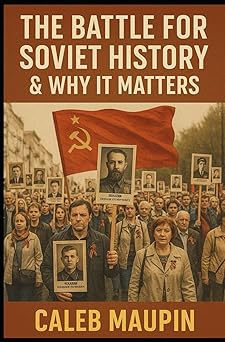
Independently published, 2025
Released in conjunction with the 2025 May 9th Victory Day celebrations, The Battle for Soviet History & Why It Matters is a forceful challenge to decades of distortion surrounding World War II and the Soviet Union’s global legacy. Caleb T. Maupin confronts the myths that dominate Western narratives – myths that minimize the USSR’s central role in defeating fascism while portraying it as a force equal to or worse than the enemy it destroyed.
With piercing analysis and historical clarity, Maupin reveals how powerful interests in the West have manipulated public memory to justify modern imperialism. He traces how U.S. elites once supported fascist regimes, how media outlets sanitize the record of Nazi collaborators, and how economic development under socialism has been systematically erased from mainstream history.
This book explores the deep connections between past and present: the vilification of Russia, the glorification of free-market ideology, and the suppression of anti-colonial resistance. In doing so, Maupin restores a narrative of sacrifice, dignity, and international solidarity – centered on the millions who gave their lives in the Red Army’s march to Berlin.
A vital read for historians, anti-imperialist thinkers, and all who seek to reclaim the truth from a sea of lies.
JOB’s Comment:

Tyske mandarinen, vorden professor vid Harvard, i angelsk översättning. Hur ett kompletterande och modifierande perspektiv på hela detta västerlandet definierande bildningsideal nu är nödvändigt. Hur västerlandet åtminstone i viss mening och viss utsträckning är moget för det. “Egna” outnyttjade resurser finns.
Mer om Michael J. Carleys “revisionism”. Förutom Jackson Hinkles, Glenn Diesens, och Pascal Lottaz’ kortare intervjuer med honom under hösten stod den australiensiske historikern Jeff Rich för en större introduktion av honom för en vidare internationell publik som han själv hänvisar till, i form av en lång, i många delar uppdelad intervju på sin kanal The Burning Archive (han har också en substack med samma namn och även en annan nätplats). Rich har tidigare flera gånger intervjuats av Lottaz om dagens geopolitiska situation och utveckling. Så här beskriver han sin Carley-serie:
“Deep dive interviews with Professor Michael Jabara Carley on the failed 1930s diplomacy that led to World War Two. Why did leaders in Europe and the Soviet Union fail to prevent the war they feared? We dive into his three books based on deep archival research in Russia, Britain and France – Stalin’s Gamble, Stalin’s Failed Alliance and Stalin’s Great Game.”
Här är serien i sin helhet, med Richs korta beskrivande texter om varje avsnitt. Men se också min tidigare kommentar om Carley och intresset för honom.
Is Stalin to Blame for WW2? The True Story from the Soviet Archives
The true story of how the West and the USSR failed to stop the threat of fascism in the 1930s is NOT what you think. Prof. Michael J. Carley gives a masterclass in the history of the failed diplomacy (“appeasement”) that led to the outbreak of World War Two and the disaster of the German invasion of the Soviet Union. From Munich 1938 to Churchill’s Operation Unthinkable – be prepared to change how you see the origins of World War Two and the history of the Cold War in the twentieth century.
How Stalin’s Gamble to Form an Anti-German Alliance Failed
In this deep dive history interview, Prof. Michael J. Carley gives a masterclass in how the Western powers – Poland, Romania, Italy, USA, France and, of course, Britain – rebuffed Stalin’s offer of a defensive alliance against Germany. The divided societies of the West were tempted by fascism. The USSR fell into the 1930s Terror. By 1936, war broke out in Spain, Germany marched into the Rhineland, and the Purges and other disasters devastated the Soviet Union. Was World War Two “precisely the war Stalin wanted” (Sean McMeekin, Stalin’s War)? Not according to leading historian Prof. Michael J. Carley. The story from the archives of how the world fell into this crisis of war is not what you have been told.
Poland and the Failed Alliance Before World War Two
What was Poland’s role in the start of World War II and the failed diplomacy of 1930s Europe? Victim of an aggressive Germany and USSR? Or did Poland bear some responsibility for the failure to form an alliance against Germany? According to leading historian Prof. Michael J. Carley, the story from the archives is not what you have been told. This segment comes from the extended interview with University of Montreal professor, Michael J. Carley on his book, Stalin’s Gamble: The Search for Allies against Hitler, 1930-1936.
France’s Political Chaos Failed Europe and Fuelled War in the 1930s
In this section of a deep dive history interview, Prof. Michael J. Carley explains how France failed to make peace and form a defensive alliance against fascist Germany in the 1930s.
Did Stalin Want World War 2 and the Red Famine, Really?
Was Stalin’s Russia or Soviet Union one of the initiators of the Second World War? Or did Stalin try everything to form a defensive alliance against 1930s Germany? In this deep dive interview, historian of international relations, Prof. Michael J. Carley tells the true history from the archives of Stalin’s failed gambles of the 1930s to make peace with the West and to purge his enemies within.
The Soviet Peace Britain Rejected Before WW2
European diplomacy failed in the 1930s, leading to Munich 1938. In this deep dive interview, historian Prof. Michael J. Carley gives a masterclass on the tragedy of collective security in Europe that caused World War Two. Who is most to blame for the failure to confront Nazi Germany? Soviet Union? France? Or Britain? Some of the most counterintuitive findings from archival research shared by historian Michael Jabara Carley in this video are:
– The Soviet alliance offer that Britain rejected in April 1939
– The real reasons behind the Molotov-Ribbentrop Pact
– Key Soviet diplomat Litvinov’s dismissal for giving up on Western cooperation
– Munich 1938’s true dynamics beyond Chamberlain’s appeasement
– Poland’s rejection of Soviet assistance
– The importance to the USSR of the war in China in 1937
– France’s crucial role in the Czechoslovak Crisis
Stalin’s Unwanted Plan B: Molotov Ribbentrop Pact
The Molotov-Ribbentrop Pact (Soviet-German Non-Aggression Pact 1939) is controversial. Were Stalin and Hitler secret allies? Or was the Pact an unwanted Plan B for the Soviet Union after years of seeking an alliance with the West against Nazi Germany? In these clips from a deep dive interview, historian Prof. Michael J. Carley explains the real reasons behind this notorious agreement on the eve of World War Two.
EU’s Kallas vs China & the Historians on WW2 in Asia
EU Foreign policy chief Kaja Kallas says it is “something new” that China and Russia fought together to defeat Nazis in WW2. History teaches a different lesson. In this clip from a deep dive interview, historian Prof. Michael J. Carley explains how China and Russia (USSR) were fighting fascists together in 1937 before the West (USA and Europe) joined World War Two.
Munich 1938 and Europe’s WW2 Betrayal of Czechoslovakia
What really happened at Munich 1938? You have heard of appeasement, Chamberlain and how it ended in World War Two. But who was to blame? In this clip from a deep dive interview, historian Prof. Michael J. Carley explains what really happened during the Czechoslovak Crisis of 1938 and its disastrous “Peace for our Time” end in the Munich 1938 conference. Based on research in Soviet/Russian, British and French archives, this video gives you the authoritative answer to the question: What really happened at Munich 1938?
Stalin’s Great Game. Part 1. Winter War to Phoney War
In this deep dive interview, historian Prof. Michael J. Carley explains how Stalin stumbled at the start of World War Two. USSR and Finland fought the Winter War. Britain and France played at Phoney War. And Germany planned Operation Barbarossa.
Why Didn’t Stalin Believe Germany would Attack?
Historian Prof. Michael J. Carley tells the story of World War Two from the Soviet archives – from the fall of France to Stalin’s failure to heed warnings of an imminent German invasion.
After Operation Barbarossa Nearly Destroyed USSR Churchill Planned Operation Unthinkable
Historian Prof. Michael J. Carley tells the story of World War Two from the Soviet archives – how Operation Barbarossa nearly destroyed the Soviet Union, how the people of the Soviet Union resisted the onslaught, and how before the war was over British PM Winston Churchill planned Operation Unthinkable to do it all again.

